
TL;DR:
- Alarm verification methods confirm whether an alarm signals a real threat before emergency response is dispatched, reducing false alarms and resource waste. Effective verification combines techniques such as video, audio, cross-trip, and mobile app confirmation, all aligned with AVS-01 standards requiring evidence documentation and retention. Proper integration, regular testing, and AI support ensure verification accuracy, helping facilities avoid costly fines and response penalties.
Alarm verification methods are the systematic processes used to confirm whether an alarm signal represents a genuine security event before dispatching emergency responders. Without them, security teams and facility managers waste resources chasing false alarms that account for the vast majority of all alarm activations. This alarm verification methods guide covers the leading techniques, the TMA’s AVS-01 standard, integration protocols like SIA DC-09 and Contact-ID, and the operational and financial stakes of getting verification right in 2026. Whether you manage a single commercial facility or oversee a network of monitored sites, the methods here directly determine how fast and accurately your team responds.
What are the main alarm verification techniques used in security systems?
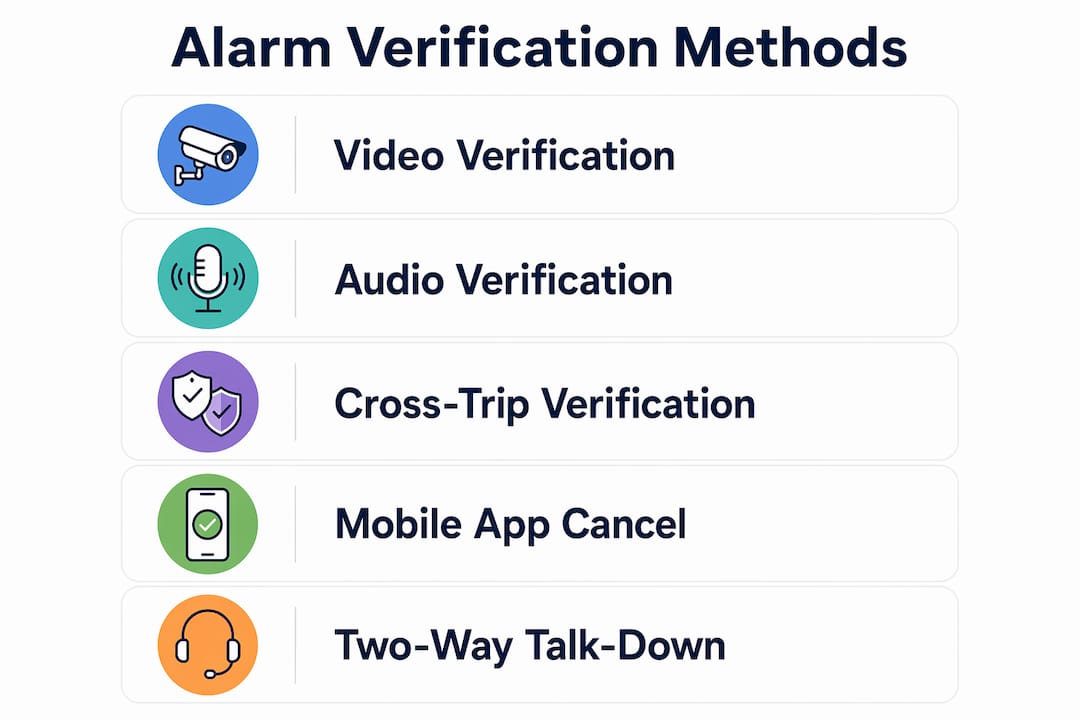
The four core alarm verification techniques are video verification, audio verification, cross-trip verification, and mobile app Cancel/Verify confirmation. Each method targets a different failure point in the alarm chain, and the best deployments combine more than one.
Video verification
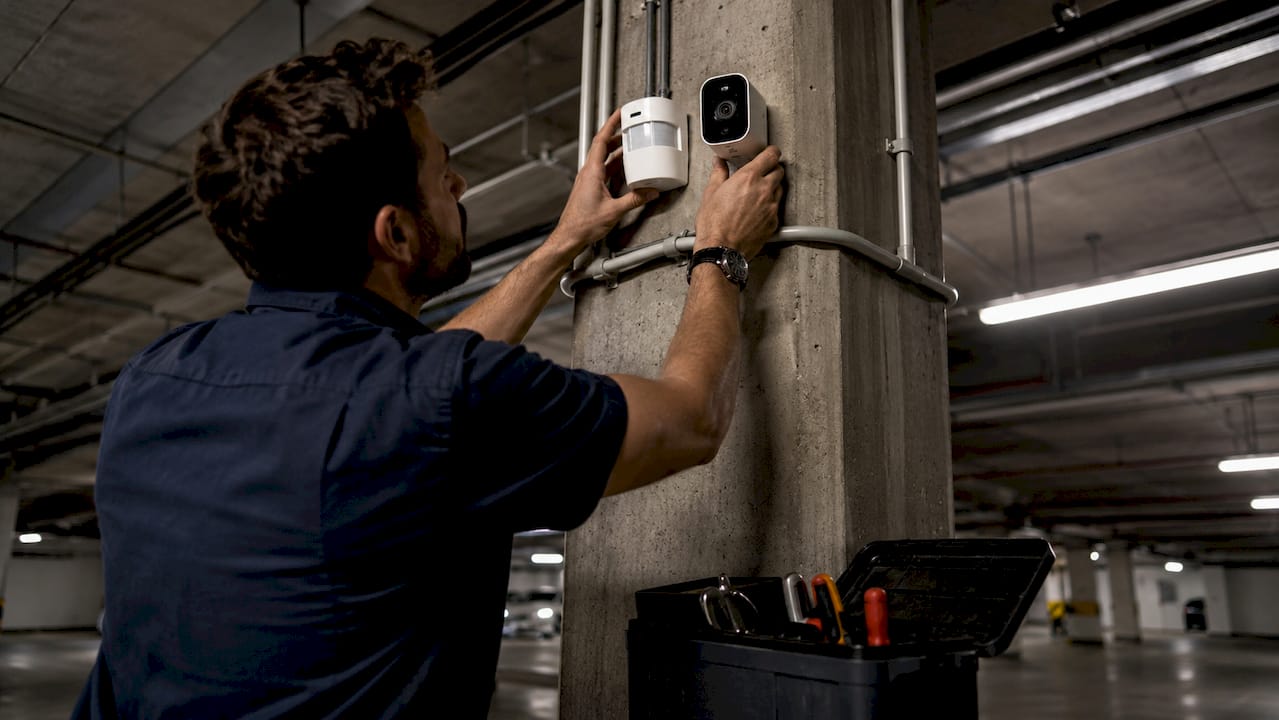
Video verification requires a human operator to assess live or recorded footage within 60–90 seconds of an alert. This is fundamentally different from passive CCTV recording, which only documents events after the fact. A trained operator watching a live feed can confirm an intruder, identify a false trigger from a passing animal, and relay that intelligence directly to law enforcement. That human-in-the-loop step is what makes video verification a genuine confirmation method rather than a documentation tool.
Camera placement and maintenance determine whether video verification actually works. Environmental factors like fog, glare, and poor lighting create blind spots that cameras alone cannot compensate for. Integrators must adjust video management system (VMS) analytic rules regularly to account for these conditions, or false triggers will continue reaching operators.
Audio verification and two-way talk-down
Two-way audio combined with cameras produces a bigger reduction in false alarms and unauthorized activity than either technology deployed on its own. In commercial settings, a monitoring operator can speak directly through an on-site speaker to challenge an intruder or confirm a legitimate employee. That interaction either deters the threat immediately or generates the verbal confirmation needed to escalate dispatch.
Cross-trip verification
Cross-trip verification uses logic rules to require two or more independent sensors to activate before an alarm is treated as confirmed. A motion detector triggering alone might mean a cleaning crew or a wandering pet. The same motion detector triggering alongside a door contact sensor in a secured zone is a much stronger signal of a real event. This method is especially effective in server rooms, pharmacies, and other high-value areas where false dispatches carry serious cost.
Mobile app Cancel/Verify
Mobile app Cancel/Verify gives end users a 2-minute window after an alarm signal reaches the monitoring station to either cancel the alert or confirm it as a real event. That two-minute window is short enough to maintain response speed but long enough to catch the most common false alarm scenario: a user who forgot their code or triggered the system by accident. Platforms like Alarm.com have built this feature into their standard app, making it accessible to both residential and commercial subscribers.
Pro Tip: For commercial sites, pair cross-trip verification with two-way audio as your primary confirmation layer. Reserve mobile app Cancel/Verify as a secondary check for after-hours scenarios where a known user may have triggered the system accidentally.
How does the AVS-01 alarm validation standard influence verification practices?
AVS-01 is the TMA’s (The Monitoring Association’s) alarm validation standard, and it represents the most significant structural change to U.S. monitoring center operations in recent years. The standard classifies every alarm into one of five levels based on the quality and quantity of evidence available, from an unverified sensor trigger at Level 1 to a fully confirmed threat with video, audio, and user data at Level 4 or 5.
The AVS-01 standard mandates four specific operator tasks:
- Classify every alarm into the appropriate evidence level before any dispatch decision.
- Document the evidence used to reach that classification, including video clips, audio recordings, and sensor data.
- Self-audit the monitoring center’s verification performance on a 90-day cycle.
- Retain evidence for a minimum of 12 months to support post-incident review and compliance verification.
These requirements force monitoring centers to treat alarm handling as an evidence-based workflow rather than a reactive call-and-dispatch process. The 12-month retention rule alone requires significant storage infrastructure, particularly for facilities running continuous video feeds.
AVS-01 also standardizes the call scripts operators use when contacting Emergency Communications Centers (ECCs) and Public Safety Answering Points (PSAPs). A verified alarm at Level 3 or above receives a different call priority than an unverified Level 1 signal. Law enforcement agencies in cities that have adopted verified response policies will not dispatch officers to a Level 1 alarm at all. That policy shift makes AVS-01 compliance a direct operational necessity, not just a best-practice recommendation.
AI now supports AVS-01 compliance by processing video, audio, sensor data, and user confirmations simultaneously to generate an alarm validation score. This scoring assists human operators in making faster, more consistent classification decisions. Scaling human-only verification across hundreds of simultaneous alarms is not realistic. AI fills that gap without removing the operator from the final dispatch decision.
What technologies and integration practices optimize alarm verification effectiveness?
Effective alarm verification depends on how well your sensors, cameras, and monitoring software communicate with each other. The foundation is a standardized messaging protocol. Contact-ID and SIA DC-09 are the two dominant standards for transmitting alarm data from a panel to a monitoring center. Proper alarm-to-video linkage using these protocols enables automatic camera pop-up the moment a specific sensor activates, so the operator sees the relevant view without manually searching through a camera grid.
| Integration element | Purpose | Best practice |
|---|---|---|
| Contact-ID / SIA DC-09 | Standardized alarm signal transmission | Use for all panel-to-monitoring center communication |
| Zone-to-camera mapping | Links each sensor zone to a specific camera | One-to-one mapping per zone, verified at installation |
| VMS analytic rules | Filters environmental false triggers | Review and adjust quarterly |
| Cross-trip logic | Requires multiple sensor activations | Apply to high-value or restricted zones |
| Walk test protocol | End-to-end signal chain verification | Conduct every 90 days minimum |
One-to-one zone mapping is the detail most integrators get right in theory and wrong in practice. A motion sensor in Zone 4 should pull up the camera covering exactly that zone, not the nearest camera that happens to be in the same general area. Mismatched mapping forces operators to spend precious seconds reorienting, which erodes the 60–90 second verification window that makes real-time video confirmation viable.
Quarterly end-to-end walk tests are the single most underused maintenance practice in alarm verification. A walk test traces the full signal chain from sensor activation through panel transmission to operator notification. Firmware updates, network changes, and hardware wear can all create silent failures that only show up when you actually walk the system. A sensor that stopped reporting three months ago is not protecting anyone.
Access control data adds a powerful layer to verification workflows. Failed badge attempts at a secured door are highly predictive of genuine intrusion attempts. Monitoring access control anomalies alongside motion and contact sensor data reduces the time operators spend confirming whether an alarm is real.
Pro Tip: Design your verification workflow so that any alarm in a restricted zone requires at least two independent data points before dispatch. This single rule eliminates the majority of costly false alarm fines without slowing legitimate response times.
What are the operational and financial implications of effective alarm verification?
The financial case for alarm verification is direct and measurable. False alarm fines have risen to $75 for third-time offenders in some jurisdictions as of 2026, up from $25 in prior years. That escalation reflects growing municipal pressure on property owners and monitoring centers to stop consuming emergency service capacity with unverified calls.
The costs extend beyond fines:
- Law enforcement non-response: Cities with verified response policies will not dispatch officers to unverified alarms. A facility without a working verification method loses police response entirely for Level 1 signals.
- Insurance implications: Repeated false alarm records can affect commercial property insurance premiums and coverage terms.
- Staff time: Every false alarm that reaches a monitoring operator consumes time that could be spent on a genuine threat. At scale, this degrades overall monitoring quality.
- Reputation with first responders: Fire departments and police departments track repeat false alarm addresses. A facility with a poor record receives slower, lower-priority responses even when a real event occurs.
Verified alarms receive priority dispatch. Unverified alarms in verified-response jurisdictions receive no dispatch at all. That gap is the operational argument for investing in verification technology.
Mobile app verification directly reduces the most common false alarm source: user error. When a subscriber can cancel an accidental trigger within two minutes, the alarm never reaches dispatch. That single feature, deployed consistently across a monitored portfolio, produces measurable reductions in false alarm rates without requiring any hardware changes. Pairing it with advanced fire detectors that filter environmental triggers at the sensor level gives facility managers two independent lines of defense before an alarm ever reaches a monitoring center.
Key takeaways
Effective alarm verification requires layering multiple confirmation methods, meeting AVS-01 evidence standards, and maintaining integration infrastructure through regular testing.
| Point | Details |
|---|---|
| Layer verification methods | Combine video, audio, cross-trip, and mobile app confirmation for the strongest signal accuracy. |
| AVS-01 compliance is operational | The TMA standard mandates five alarm levels, 90-day audits, and 12-month evidence retention. |
| Protocol integration matters | Use Contact-ID or SIA DC-09 with one-to-one zone-to-camera mapping to enable automatic operator pop-up. |
| Walk tests prevent silent failures | Quarterly end-to-end tests catch firmware and network issues before they create coverage gaps. |
| False alarm costs are rising | Third-time false alarm fines reached $75 in some jurisdictions in 2026, making verification a financial priority. |
What I’ve learned from watching verification technology evolve
The biggest mistake I see security professionals make is treating alarm verification as a technology purchase rather than a workflow design problem. You can install the best cameras, the most capable VMS, and a full two-way audio system, and still have a verification failure rate that embarrasses you in front of law enforcement. The reason is almost always the same: the integration between those components was never properly mapped, tested, or maintained.
The AVS-01 standard is forcing a long-overdue correction. Monitoring centers that operated on instinct and call volume are now required to document, audit, and retain evidence. That discipline is uncomfortable for organizations that built their operations around speed rather than accuracy. But the data is clear. Verified alarms get dispatched. Unverified alarms get ignored in a growing number of jurisdictions.
I am also watching AI-assisted validation scoring move from pilot programs to standard practice faster than most facility managers realize. The operators who will thrive are the ones who understand that AI generates a score and a human makes the call. That division of labor is not a threat to operator jobs. It is the only realistic path to scaling AVS-01 compliance across a high-volume monitoring operation.
My practical advice for facility managers: schedule your next quarterly walk test before you finish reading this article. Not next month. This week. Silent failures are the verification gap that no amount of technology investment can fix if you are not actively looking for them.
— Results
How Reliable-fire-protection supports your alarm verification strategy
Reliable fire protection brings Houston-area security professionals and facility managers the fire alarm system expertise needed to build verification-ready infrastructure from the ground up. Understanding how your fire alarm system generates, transmits, and confirms signals is the foundation of any effective verification workflow. The team at Reliable-fire-protection designs and installs systems built for alarm monitoring integration, ensuring your panels communicate correctly with monitoring centers using standardized protocols. If you want to know exactly how your system works before building a verification layer on top of it, start with how fire alarm systems work and then contact Reliable-fire-protection for a tailored assessment of your facility’s verification readiness.
FAQ
What is the difference between alarm verification and alarm monitoring?
Alarm monitoring is the continuous surveillance of alarm signals by a central station. Alarm verification is the process of confirming whether a specific alarm signal represents a genuine threat before dispatching emergency services.
How many alarm verification levels does AVS-01 define?
AVS-01 defines five alarm levels based on the quality and quantity of evidence available, ranging from an unverified sensor trigger at Level 1 to a fully confirmed threat with multiple data sources at Level 4 or 5.
How long does mobile app alarm verification take?
The Cancel/Verify feature in platforms like Alarm.com gives users a 2-minute window after the alarm signal reaches the monitoring station to cancel or confirm the event before dispatch proceeds.
Why do quarterly walk tests matter for alarm verification?
Walk tests trace the full signal chain from sensor activation to operator notification, catching silent failures caused by firmware updates, network changes, or hardware wear that would otherwise go undetected until a real event occurs.
What are the financial penalties for repeated false alarms in 2026?
False alarm fines have reached $75 for third-time offenders in some jurisdictions as of 2026, up from $25 in prior years, making verified alarm practices a direct cost-control measure for facility managers.