

TL;DR:
- Zoned fire protection divides buildings into specific alarm zones to enable rapid and precise fire location identification. This system improves emergency response, supports phased evacuation, and complies with standards like BS 5839-1, especially in large or multi-story buildings. Proper zone design, following physical boundaries and search time limits, significantly enhances overall fire safety.
Zoned fire protection is defined as the systematic division of a building into separate fire alarm zones, each monitored by its own group of detectors and call points, so that a fire’s exact location can be identified at the control panel within seconds. This approach transforms a vague building-wide alarm into precise, location-specific information that emergency teams can act on immediately. Standards like BS 5839-1 in the UK and defensible space regulations from California’s Board of Forestry and Fire Protection both reflect the same core principle: containing fire risk to a defined area saves lives and limits damage. For property owners, managers, and safety professionals, understanding what is zoned fire protection is the first step toward building a system that actually works when it counts.
What is zoned fire protection and how do fire alarm zones work?
A fire alarm zone is a defined group of detectors, call points, and sounders that report to the control panel as a single unit. When any device in that zone activates, the panel identifies the zone, not just the building. That distinction matters enormously in an emergency.

Without zoning, multiple detectors across a large floor activate as one undifferentiated alarm. Emergency responders arrive with no clear starting point. Zoning solves that problem by making every alarm actionable, pointing responders directly to the affected section of the building.
Conventional vs. addressable systems handle zoning differently. In a conventional system, all devices on a circuit share one zone signal. In an addressable system, each device has a unique address, so the panel can pinpoint the exact detector that triggered, not just the zone. Addressable systems from manufacturers like Fire-Lite offer advanced zoning precision that conventional wiring cannot match.
Zoning also enables phased evacuation. Instead of clearing an entire building at once, you can alert and evacuate the affected zone first, then adjacent zones, then the rest of the building in sequence. This reduces congestion at exits and gives emergency services a clearer picture of where to focus.
Key functions a properly designed zone performs:
- Identifies the fire location at the control panel within seconds
- Triggers targeted alerts only in affected areas
- Supports phased evacuation to reduce exit congestion
- Guides fire service personnel directly to the source
- Integrates with suppression systems to activate the correct response
Pro Tip: Label every zone on the control panel with a plain-language description, such as “Third Floor East Wing” rather than “Zone 7.” Responders under stress read plain language faster than codes.
What standards govern fire alarm zone design?
BS 5839-1 is the primary standard governing fire alarm zone design in the UK, and its principles are widely referenced by fire safety professionals across the industry. The standard sets clear limits on zone size, layout, and search time that directly affect how effective your system will be.
Zone size must not exceed 2,000 m², and each zone should be confined to a single floor wherever possible. Stairwells are a recognized exception because they span multiple floors, but they require their own dedicated zone to prevent confusion about which level is affected.
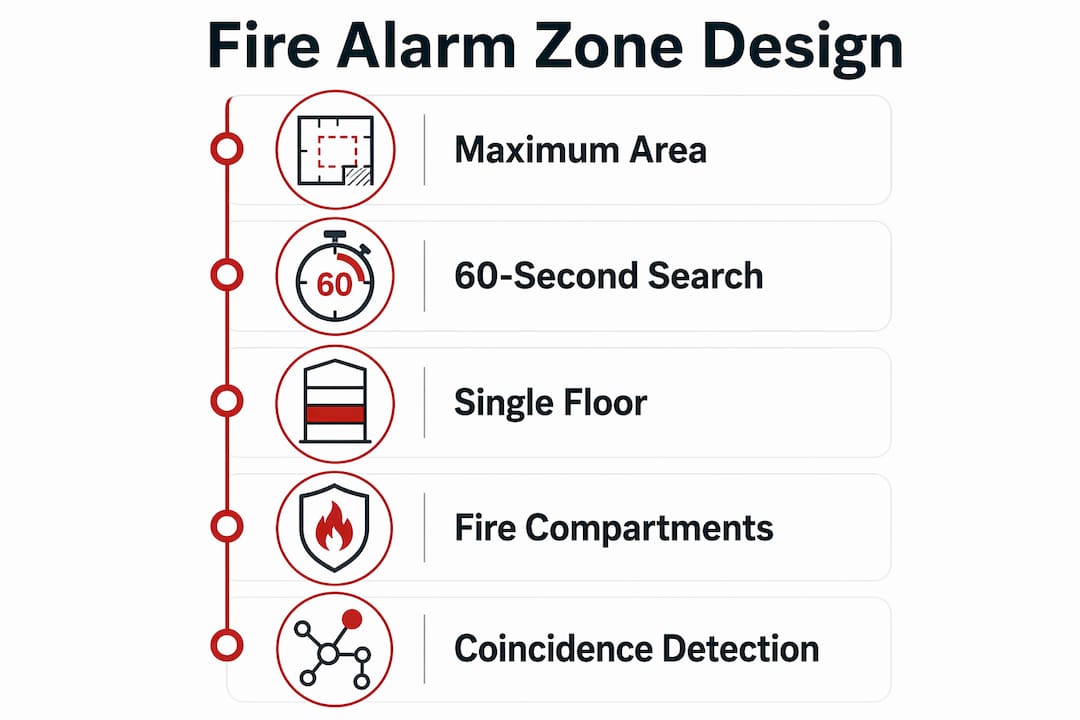
The 60-second search rule is the practical constraint that governs zone size more than any area measurement. A zone must be physically searchable by a single person within one minute. If your floor plan is large but has a complex layout with corridors and rooms, the 60-second limit will shrink your maximum zone size well below 2,000 m².
Zones must align with physical fire compartments, meaning the boundaries of a zone should follow fire-rated walls, doors, and barriers. When zones cross compartment boundaries, responders face confusion about which physical area to search, and that delay costs critical minutes.
| Design Parameter | BS 5839-1 Requirement |
|---|---|
| Maximum zone area | 2,000 m² |
| Maximum search time | 60 seconds |
| Floors per zone | Single floor (stairwells excepted) |
| Zone boundary alignment | Must follow fire compartments |
| Coincidence detection | Permitted, but must not delay real alarms |
Coincidence detection requires two devices in the same zone to activate before triggering a full alarm. This reduces false alarms but carries a real risk: if configured incorrectly, it can delay a genuine alarm by the time it takes for a second device to trigger. Use coincidence detection only with careful configuration and regular testing.
Pro Tip: When redesigning a building or adding partitions, update your zone map immediately. A zone that made sense for an open floor plan may cross new compartment walls after renovation, creating a compliance gap.
How does zoning improve life safety in large buildings?
Zoning is required for premises over 300 m² or any multi-story building, and the reason is straightforward: large buildings create large search problems. A single undivided alarm in a 10-story office tower tells responders almost nothing useful.
Phased evacuation enabled by zoning reduces congestion at stairwells and exits by moving occupants out in controlled waves rather than all at once. Emergency services can move against the flow of evacuees toward the fire zone without fighting through a panicked crowd from every floor.
In multi-tenant commercial buildings, zoning also limits disruption. A kitchen fire on the second floor of a mixed-use complex does not need to trigger alarms in the ground-floor retail space or the fourth-floor offices. Zoning in multi-tenant buildings allows targeted alerts that protect affected occupants without creating unnecessary panic elsewhere.
Benefits for property owners and managers include:
- Faster fire location by both staff and emergency services
- Reduced liability from unnecessary full-building evacuations
- Better coordination with fire departments through precise zone data
- Lower risk of occupant injury from uncontrolled mass evacuation
- Clearer documentation for insurance and compliance audits
The coordination benefit with fire services is often underestimated. When a fire crew arrives and the panel shows “Zone 4: Second Floor South,” they enter with a plan. Without that information, they search blind, and every minute of searching is a minute the fire grows.
What are defensible space zones and how do they connect to fire safety?
Defensible space zoning applies to the exterior of a structure, particularly in wildfire-prone areas, and it follows the same core logic as indoor fire alarm zoning: define a protected perimeter and manage risk within it.
California’s Board of Forestry and Fire Protection mandates three defensible space zones around structures:
- Zone 0 (0–5 feet): The ember-resistant zone directly surrounding the structure. Zone 0 regulations require removal of all combustible materials, including wood mulch, dead plants, and debris. This zone is the most critical because embers landing here cause most structural ignitions.
- Zone 1 (5–30 feet): The lean, clean, and green zone. Vegetation must be well-spaced, trimmed, and maintained to prevent fire from climbing from ground level to the structure.
- Zone 2 (30–100 feet): The reduced fuel zone. California’s Board of Forestry requires reducing the density and continuity of vegetation so that a wildfire loses momentum before reaching Zone 1.
The connection to indoor fire alarm zoning is conceptual but practical. Both systems divide a risk environment into defined areas with specific protective requirements. A property that maintains strong defensible space zones around its perimeter and a properly designed indoor fire alarm zone system has layered protection from both wildfire spread and internal ignition.
For property managers in Houston and surrounding areas, wildfire defensible space is less of a daily concern than it is in California. However, the principle of zoned exterior risk management applies to any property with landscaping, fuel storage, or adjacent structures that could accelerate fire spread.
How to implement effective zoned fire protection in your property
The first decision is whether your property requires zoning at all. Any building over 300 m² or with more than one story needs a zoned fire system. Below that threshold, a single-zone system may suffice, but a professional assessment is always the right starting point.
Practical steps for property owners and managers:
- Assess your building layout. Map fire compartments, floor areas, and occupancy types before designing zones. Zones must follow compartment boundaries, not just square footage.
- Engage a certified fire safety professional. Zone design errors, such as zones crossing compartment walls, are a common design flaw that causes delayed response. A qualified designer catches these before installation.
- Integrate zoning with panel mapping. Zoning and mapping work together: zones group detection devices by location, while mapping links those zones to floor plan visuals on the control panel. Both are needed for responders to navigate effectively.
- Connect detector placement to actual hazards. Zone layouts must link detector placement to the specific fire hazards in each area. A kitchen zone needs different detector types and suppression triggers than a server room zone.
- Schedule regular testing and inspections. Zone boundaries and device placements become outdated as buildings change. Test every zone at least annually and update zone maps after any renovation.
Pro Tip: After any building modification, walk each zone with your zone map in hand and verify that every detector and call point still falls within the correct physical compartment. This takes less than an hour and prevents costly compliance failures.
You can review fire safety zoning requirements specific to Houston properties to understand local compliance expectations before engaging a designer.
Key takeaways
Zoned fire protection works because it converts a building-wide alarm into precise, location-specific data that emergency teams and occupants can act on immediately.
| Point | Details |
|---|---|
| Zone size limits apply | BS 5839-1 caps zones at 2,000 m² and requires a 60-second search time. |
| Zoning is mandatory above 300 m² | Any building over 300 m² or multiple stories requires a zoned fire system. |
| Zones must follow compartments | Zone boundaries must align with fire-rated walls and doors to avoid response confusion. |
| Defensible space adds exterior protection | California’s Zone 0 through Zone 2 framework reduces wildfire ignition risk around structures. |
| Mapping completes the system | Linking zones to floor plan visuals on the control panel is required for effective emergency navigation. |
Why zoning is the most underrated decision in fire safety
Most property owners focus on detector counts and alarm volume. The question they rarely ask is: “When this alarm goes off, will anyone know where to go?” That gap is exactly what zoning closes, and it is the reason I consider zone design the most consequential decision in any fire alarm project.
I have seen buildings with expensive addressable systems and high-quality detectors that were zoned so poorly that the control panel was useless in a drill. Zones crossed three compartments. The panel labels said “Zone A” through “Zone F” with no floor or area reference. Responders stood at the panel and guessed. That is not a detector problem. That is a design problem.
The wildfire defensible space framework from California’s Board of Forestry reinforces something I think applies to all fire safety: layered, defined zones beat single perimeter defenses every time. Whether you are managing a commercial office building in Houston Heights or a multi-tenant complex in Montrose, the principle is the same. Define your zones, align them with real physical boundaries, and make sure every person who might respond to an alarm knows exactly what each zone means.
The 60-second search rule is the detail most designers mention but few clients internalize. It is not a bureaucratic limit. It is a physical reality. If a responder cannot search your zone in 60 seconds, your zone is too large, and a real fire will expose that weakness at the worst possible moment.
— Reliable-fire-protection
How Reliable-fire-protection supports your fire protection needs
Reliable-fire-protection designs, installs, and maintains fire alarm systems for residential and commercial properties across Houston, with zone design built into every project from the start.
Whether you manage a single commercial building or a portfolio of multi-tenant properties, Reliable-fire-protection’s certified technicians design zone layouts that meet BS 5839-1 principles, align with local Houston compliance requirements, and integrate panel mapping for clear emergency navigation. The team handles everything from initial zone assessment through annual inspections and system updates after renovations. To understand how a properly zoned fire alarm system works and what it takes to install one correctly, start with Reliable-fire-protection’s detailed resource. You can also explore Houston Heights fire alarm services for local installation and compliance support.
FAQ
What is zoned fire protection in simple terms?
Zoned fire protection divides a building into separate alarm zones so that a fire’s exact location shows up on the control panel immediately. This allows emergency responders and occupants to act on precise information rather than a building-wide alert.
How large can a single fire alarm zone be?
BS 5839-1 limits zones to 2,000 m², but the practical limit is the 60-second search rule. A zone must be physically searchable by one person within one minute, which often means zones are smaller than the area maximum.
When is fire system zoning required?
Zoning is required for any building over 300 m² or any multi-story property. These thresholds reflect the point at which a single undivided alarm becomes too vague to support effective emergency response.
What is the difference between zoning and mapping?
Zoning groups detection devices by physical location into defined alarm areas. Mapping links those zones to floor plan visuals displayed on the control panel, giving responders a visual guide to navigate directly to the fire source.
Do defensible space zones apply to commercial properties?
Yes. California’s Board of Forestry requires Zone 0 through Zone 2 defensible space for structures in wildfire-prone areas, including commercial buildings. Property managers in high-risk regions must maintain ember-resistant clearance within 5 feet of the structure and reduced fuel zones out to 100 feet.