

TL;DR:
- Flame detectors are highly sensitive sensors that detect fires quickly by analyzing UV and IR radiation signatures emitted by flames. They provide the earliest warning in high-risk environments, enabling rapid response or suppression activation before smoke or heat detection occurs. Proper installation, regular maintenance, and system integration are essential to maximize their effectiveness and ensure safety.
A flame detector is a specialized sensor designed to identify the presence of a fire by analyzing the unique radiation signatures that flames emit, including ultraviolet (UV) and infrared (IR) wavelengths. Unlike smoke or heat detectors, flame detection systems respond to the fire itself rather than its byproducts. That distinction makes them the fastest and most direct fire warning technology available for high-risk facilities. Brands like Protectowire and Honeywell have built entire product lines around this core capability, and understanding the purpose of flame detectors helps safety officers make smarter decisions about where and how to deploy them.
What is the purpose of flame detectors in fire safety?
The purpose of flame detectors is to provide the earliest possible warning of a fire by sensing flame radiation before smoke or heat builds to detectable levels. In environments where fires ignite and spread within seconds, that speed is the difference between a contained incident and a catastrophic loss.
Flame detectors serve three core functions in a fire safety system:
- Early warning: They trigger alarms the moment a flame appears, giving occupants and responders more time to act.
- Automated suppression activation: They send signals directly to suppression control panels, cutting response time to near zero.
- Targeted protection: They cover large open areas, outdoor zones, and spaces where smoke detectors are ineffective, such as high-bay warehouses or open-air fuel storage.
The flame sensor purpose goes beyond simple alarm triggering. These devices are the front line of protection in any facility where a flaming fire can develop faster than people can react.
How do flame detectors work?
Flame detectors work by monitoring specific bands of electromagnetic radiation that flames produce. Every fire emits a characteristic mix of UV and IR energy. Sensors tuned to those wavelengths detect that energy and trigger an alarm when it crosses a defined threshold.
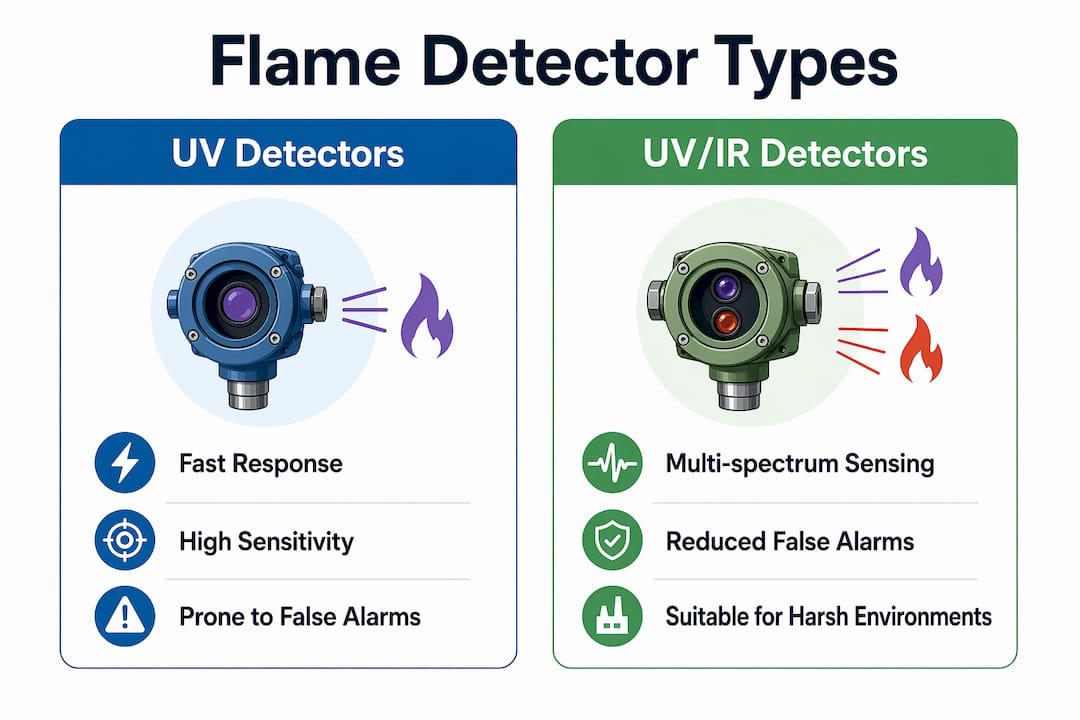
UV detectors respond to the short-wave ultraviolet radiation that nearly all flames emit. They are fast and sensitive, but they can be triggered by arc welding, lightning, or X-ray equipment. IR detectors monitor infrared radiation, which is more specific to combustion but can be confused by hot surfaces or sunlight. Multi-spectrum detectors, such as the Protectowire Quad-Sense series, combine UV and IR sensors across multiple spectral bands. UV/IR combination drastically improves false alarm resistance by requiring confirmation across multiple spectral channels before alarming. That confirmation logic is what separates a reliable industrial detector from a nuisance alarm generator.
Signal processing inside the detector analyzes the frequency and intensity of incoming radiation. Flames flicker at a characteristic rate, typically between 5 and 30 Hz. The detector’s processor looks for that flicker pattern, which further filters out static heat sources. Built-In-Test (BIT) features continuously validate detector circuitry and optics in real time, so you know the unit is functional without waiting for a fire event to prove it.
Pro Tip: Always verify that your flame detectors have an unobstructed line of sight to the highest-risk ignition zones. Even a partial obstruction from a pipe, beam, or equipment rack can create a blind spot that renders the detector useless during an actual fire.
Why are flame detectors critical in high-risk industrial environments?
The importance of flame detection becomes most obvious in environments where fire can go from ignition to explosion in under a minute. Chemical plants, oil and gas refineries, fuel storage terminals, and aircraft hangars all share one characteristic: the fuel load is so high that conventional smoke or heat detection simply cannot respond fast enough.
Ultra-fast flame detectors can respond to flame signatures in under 20 milliseconds. Standard units detect fires in under 5 seconds. Compare that to smoke detectors, which require smoke particles to travel to the sensor, a process that can take minutes in a large open space. Those extra seconds are not a minor operational advantage. They are the window in which a suppression system can activate before a fire reaches structural elements or pressurized equipment.
Industrial flame detectors are also built for the environments where they are needed most. Reliable units operate across temperature ranges from -76°F to +185°F and are rated for exposure to corrosive atmospheres, high humidity, and vibration. SIL3-compatible detectors with a Mean Time Between Failure (MTBF) around 150,000 hours are the standard for safety-critical applications. That MTBF figure means you can expect decades of continuous operation before a statistically likely failure.
The strategic value extends beyond life safety. Facility managers who treat flame detectors as part of a business continuity strategy recognize that preventing equipment loss through early detection avoids production shutdowns, regulatory penalties, and insurance claims that can dwarf the cost of the detection system itself.
One often-overlooked capability: flame detectors identify invisible flames such as hydrogen fires, which produce no visible light and would go completely undetected by cameras or human observers. In facilities handling hydrogen or certain metal compounds, this capability is not optional.
How do flame detectors compare with other fire detection technologies?
Flame detectors, smoke detectors, and heat detectors each solve a different part of the fire detection problem. Understanding where each excels helps you build a system that covers every scenario.
| Detection method | What it senses | Typical response time | Best use case |
|---|---|---|---|
| Flame detector | UV/IR radiation from flames | Under 5 seconds (as low as 20 ms) | Open areas, high-risk industrial, outdoor zones |
| Smoke detector | Airborne smoke particles | 30 seconds to several minutes | Enclosed spaces, offices, residential |
| Heat detector | Ambient temperature rise | 1–5 minutes | Kitchens, dusty environments, areas with smoke interference |
| Multi-sensor system | Combination of above | Varies by configuration | Complex facilities requiring broad coverage |
Flame detectors complement rather than replace smoke or heat detectors. A large warehouse may have flame detectors covering the open floor and smoke detectors protecting the office annex. Neither device alone covers every fire scenario. You can review a detailed breakdown of the tradeoffs between smoke and heat detectors to understand how each fits into a layered protection strategy.
False alarm management is a real operational concern. A single-spectrum UV detector in a facility with arc welding will generate constant nuisance alarms, eroding staff confidence in the system. Multi-spectrum detectors with pattern recognition logic solve this problem by requiring multiple simultaneous confirmations. The function of flame detectors in a well-designed system is to provide reliable early warning without crying wolf, and technology selection drives that outcome more than any other factor.
How to deploy and maintain flame detectors effectively
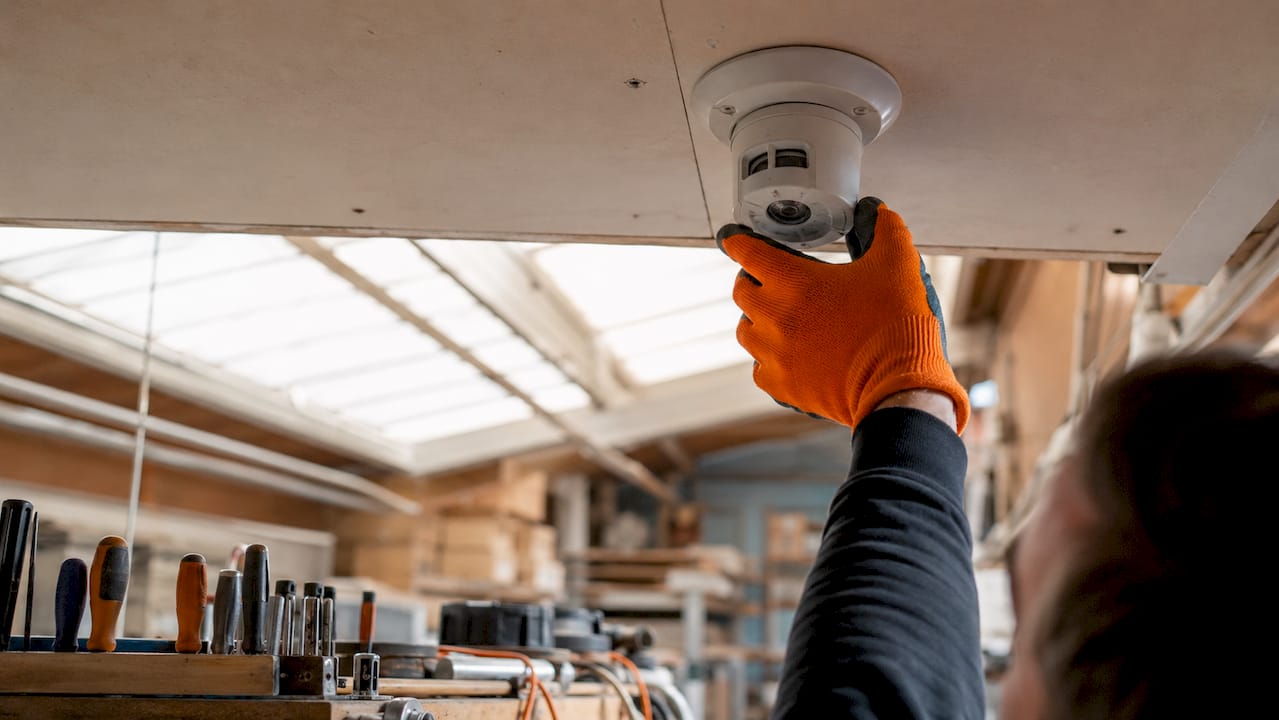
Effective deployment starts with a proper site survey. Flame detectors are line-of-sight devices. Every unit must have a clear, unobstructed view of the area it is protecting. Physical obstructions from equipment, structural steel, or stored materials can create critical blind spots that no amount of sensitivity adjustment will fix.
Follow this deployment and maintenance process:
- Conduct a coverage map. Plot detector positions on a facility floor plan and calculate the cone of detection for each unit based on the manufacturer’s field-of-view specifications. Overlap coverage zones by at least 20% to eliminate gaps.
- Adjust sensitivity thresholds for the environment. A detector near a welding station needs a higher confirmation threshold than one in a clean fuel storage area. Sensitivity adjustment tailored to specific hazard environments prevents nuisance alarms from welding sparks while maintaining response to real fires.
- Schedule regular functional tests. Most manufacturers recommend testing every six months at minimum. Use a calibrated UV or IR test lamp to verify that each detector responds correctly within its rated response time.
- Leverage Built-In-Test features. BIT-equipped detectors report their own health status continuously to the fire alarm panel. Review those status logs monthly rather than waiting for a scheduled test to catch a degraded unit.
- Keep optics clean. Dust, oil film, and condensation on the detector lens reduce sensitivity. In dusty or oily environments, inspect and clean lenses quarterly. Some advanced units include internal event log recorders that track past fault events, which is invaluable for diagnosing recurring contamination issues.
For ongoing maintenance discipline, the fire alarm maintenance tips from Reliable-fire-protection provide a practical framework that applies directly to flame detector upkeep.
Pro Tip: Integrate your flame detectors directly with your fire alarm panel and suppression control system. Automated suppression activation triggered by a flame detector signal cuts the time between detection and suppression to under one second, protecting high-value assets before a human operator can even read the alarm.
What I’ve learned from watching flame detectors save facilities
Most safety officers I speak with treat flame detectors as a checkbox item, something to install in the obvious high-risk spots and then forget. That approach misses most of the value these devices offer.
The facilities that get the most out of flame detection are the ones that design their systems around specific fire scenarios rather than generic coverage requirements. A chemical plant that models its worst-case ignition events and places detectors to catch those scenarios in the first two seconds of ignition is operating at a fundamentally different level of protection than one that simply meets the minimum code requirement.
Training matters more than most managers expect. A detector that triggers an automated suppression response is only as effective as the staff who understand what that response means and how to follow up. I have seen facilities where suppression activated correctly, but confusion about the alarm state delayed evacuation and caused injuries that the detection system itself had no power to prevent.
The technology is also evolving faster than most maintenance schedules account for. Units installed a decade ago may lack the multi-spectrum processing and BIT capabilities that current detectors offer. Reviewing your detector specifications against current performance standards every five years is a reasonable practice. The fire detection response time standards have tightened considerably, and older equipment may no longer meet the risk profile of a facility that has expanded or changed its operations.
The bottom line: flame detectors are not passive safety hardware. They are active, intelligent components of a fire safety strategy, and they perform in direct proportion to how thoughtfully they are selected, placed, and maintained.
— Reliable-fire-protection
Protect your facility with professional flame detection support
Reliable-fire-protection brings Houston-area safety officers and facility managers the expertise to design, install, and maintain flame detection systems that match your specific risk profile and regulatory requirements.

Whether you are protecting a chemical processing facility, a commercial warehouse, or a high-occupancy building, the right flame detection setup starts with understanding how fire alarm systems work as a complete, integrated system. Reliable-fire-protection’s certified technicians assess your facility, specify the right detector technologies, and ensure your system meets current NFPA and local Houston code requirements. Contact Reliable-fire-protection today for a free assessment and take the guesswork out of flame detection coverage.
Key takeaways
Flame detectors are the fastest fire detection technology available, and their value depends entirely on correct specification, placement, and maintenance.
| Point | Details |
|---|---|
| Speed advantage | Flame detectors respond in under 5 seconds, far faster than smoke or heat sensors. |
| Multi-spectrum accuracy | UV/IR combination detectors reduce false alarms by requiring multiple spectral confirmations. |
| Industrial necessity | High-risk environments like chemical plants and fuel storage require flame detectors for adequate protection. |
| Line-of-sight deployment | Every detector must have a clear, unobstructed view of its target zone to function correctly. |
| System integration | Connecting flame detectors to suppression panels enables automated responses that protect assets before human intervention. |
FAQ
What is the primary purpose of flame detectors?
The purpose of flame detectors is to identify the presence of a fire by sensing UV and IR radiation emitted by flames, triggering alarms and suppression systems faster than smoke or heat detectors can respond.
How do flame detectors differ from smoke detectors?
Flame detectors sense radiation directly from a fire and respond in under 5 seconds, while smoke detectors require airborne particles to reach the sensor, which can take minutes in large or open spaces.
Where are flame detectors most commonly used?
Flame detectors are most commonly used in chemical plants, oil and gas facilities, aircraft hangars, fuel storage terminals, and large open industrial spaces where rapid fire spread is a primary risk.
Can flame detectors detect fires that produce no visible flame?
Yes. Multi-spectrum flame detectors can identify invisible fires such as hydrogen flames by sensing their unique radiation emissions, which are undetectable by cameras or human observers.
How often should flame detectors be tested and maintained?
Most manufacturers recommend functional testing every six months using a calibrated test lamp, with monthly review of Built-In-Test status logs and quarterly lens cleaning in dusty or oily environments.