TL;DR:
- Fireproof cabling ensures critical safety systems remain operational during fires by maintaining circuit integrity for up to 180 minutes. Proper specification and installation, including matching ratings and correct support, are essential for system performance and compliance. Integrating fire safety design early prevents costly setbacks and guarantees reliable life safety systems during emergencies.
Fireproof cabling is specialized electrical wiring engineered to maintain circuit integrity and keep critical safety systems functioning during fire emergencies. Construction managers, safety officers, and project planners who specify the wrong cable type risk evacuation failures, code rejections, and insurance denials. The role of fireproof cabling goes far beyond material selection. It is a life safety decision that determines whether fire alarms, emergency lighting, and smoke extraction systems stay online when occupants need them most. Understanding how these cables work, where they apply, and how to install them correctly is non-negotiable for any building project.
How does fireproof cabling work to maintain circuit integrity?
Fire-resistant cables do not simply resist burning. They are engineered to keep electrical circuits alive under direct flame exposure. The key mechanism is mica tape, a mineral-based wrapping applied around the copper conductor. When exposed to fire, mica tape sinters to form a rigid ceramic shell that physically prevents the conductor from short-circuiting or sagging. The outer sheath burns away as expected. The circuit survives.
This distinction matters enormously on a job site. Most people assume “fireproof” means the cable itself will not burn. The correct understanding is that the cable’s outer jacket is sacrificial. The mica layer underneath is the actual protection. That ceramic barrier is what allows the circuit to keep powering a fire alarm panel or emergency lighting fixture while the surrounding structure is actively burning.
Performance is rated by time and temperature. Fire-resistant cables maintain circuit integrity for 30 to 180 minutes at temperatures between 800°C and 1000°C under UL 2196 testing. That range is not arbitrary. It maps directly to the time occupants need to evacuate and firefighters need to operate. A 60-minute rated cable keeps a hospital’s emergency lighting running through a full evacuation cycle. A 120-minute rated cable supports extended firefighting operations in a high-rise.
Low smoke zero halogen (LSZH) jacketing is the second major material component. LSZH compounds replace the PVC found in standard cables. When PVC burns, it releases hydrogen chloride gas and dense black smoke. LSZH materials do not. Fire-resistant cables using LSZH reduce light obscuration in fires to below 60%, compared to over 85% in conventional cables. That difference directly affects how quickly emergency responders can navigate a smoke-filled corridor.
Fire-resistant cables are designed for specified durations such as 30, 60, or 120 minutes, not for indefinite fireproofing. Specifying a cable rated for 30 minutes in a building that requires 90-minute evacuation support is a planning failure, not a product failure.
Pro Tip: Always match the cable’s time rating to your building’s evacuation and firefighting strategy, not just the minimum code requirement. A 120-minute rating costs more upfront but eliminates the risk of a system going dark mid-evacuation.
Fire-resistant vs. flame-retardant cables: what is the difference?
These two cable types are not interchangeable. Confusing them is one of the most common and costly errors in fire safety design. Mixing up flame-retardant and fire-resistant cables is a documented cause of installation failures and insurance claim denials.
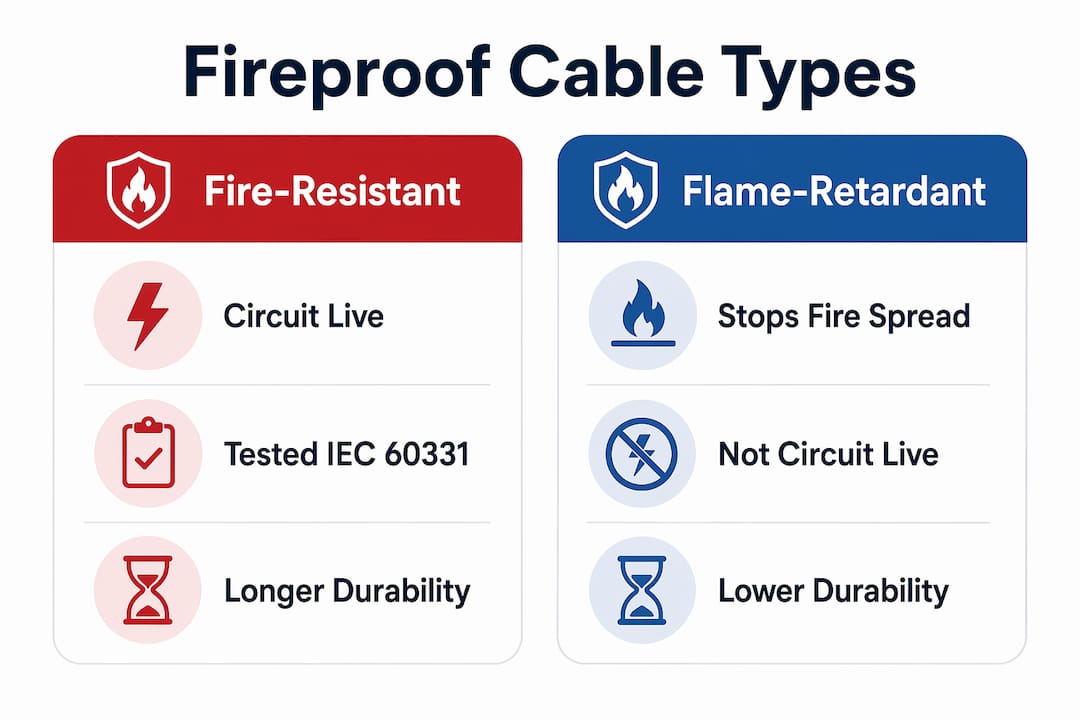
Fire-resistant cables maintain circuit integrity while exposed to fire. The circuit keeps working. Flame-retardant cables do something different and more limited. They slow the spread of flame along the cable run. They do not guarantee the circuit stays live. A flame-retardant cable in a fire alarm circuit will eventually fail under sustained heat. A fire-resistant cable will not, within its rated duration.
The testing standards reflect this difference. IEC 60331 governs fire-resistant cables and tests whether the circuit continues to function under direct flame. IEC 60332 governs flame-retardant cables and tests only whether the flame self-extinguishes after the ignition source is removed. Passing IEC 60332 says nothing about circuit survival. Passing IEC 60331 does.
BS 6387, used widely in commercial projects, goes further. BS 6387 testing combines fire endurance, mechanical shock, and water spray to certify comprehensive fire resistance. A cable that passes BS 6387 Category CWZ has survived flame, impact, and water simultaneously. That is the standard many fire alarm and emergency lighting circuits require.
| Feature | Fire-Resistant Cable | Flame-Retardant Cable |
|---|---|---|
| Circuit stays live in fire | Yes, for rated duration | No |
| Limits flame spread | Yes | Yes |
| Key test standard | IEC 60331, BS 6387 | IEC 60332 |
| Typical application | Fire alarms, emergency lighting | General wiring, data cables |
| Insurance compliance | Required for life safety circuits | Not sufficient for life safety |
Pro Tip: When reviewing project specifications, check whether the spec calls for “fire-resistant” or “fire-rated” rather than “fire-retardant.” Those words are not synonyms. Catching that distinction in the design phase prevents costly rework and failed inspections.
What are the key applications and benefits of fireproof cabling?
Fireproof electrical installations are required wherever a building system must stay operational during a fire. The list of critical circuits is longer than most project planners expect.
Core applications include:
- Fire alarm systems: Panel-to-detector and panel-to-sounder circuits must remain live to trigger evacuation. Understanding fire alarm circuit design helps planners specify the right cable for each circuit type.
- Emergency lighting: Exit signs and escape route lighting must function for the full evacuation period. Most codes require a minimum 90-minute rating for these circuits.
- Smoke extraction and pressurization systems: Stairwell pressurization fans and smoke exhaust dampers depend on powered circuits. If those circuits fail, smoke fills escape routes.
- Sprinkler system controls: Electrically actuated deluge and pre-action systems require powered circuits to open valves and trigger flow.
- Elevator recall systems: Firefighter service elevators must operate on fire-resistant circuits to allow controlled descent and emergency access.
The benefits of fireproof wiring extend beyond keeping systems running. LSZH materials reduce toxic gas release, which directly affects survivability for occupants who cannot evacuate immediately. Reduced smoke density also helps firefighters locate victims and navigate the building faster.
Longevity is another practical benefit. Fire-resistant cables with LSZH jackets resist UV degradation, chemical exposure, and moisture better than standard PVC cables. In plant rooms, parking structures, and rooftop installations, that durability reduces maintenance costs over the building’s life.
Cost is the honest counterpoint. Fire-resistant cables cost 40–60% more than standard cables, and installation labor increases by 15–25% due to stricter support requirements. For a large commercial project, that premium is significant. The correct framing is not whether fire-resistant cable is expensive. The correct framing is what the cost of a failed evacuation system looks like in liability, insurance, and human terms. Products like FP200 Gold, a flexible enhanced softskin cable preferred in many commercial applications, offer a practical balance between performance and cost compared to mineral-insulated cables.
What are the best practices for installing fire-resistant wiring?
Specifying the right cable is only half the job. Installation determines whether that cable actually performs to its rating when a fire occurs. Proper installation per manufacturer instructions is critical. Deviating from those instructions can void the fire rating entirely, leading to code enforcement rejections.
Follow these installation requirements on every project:
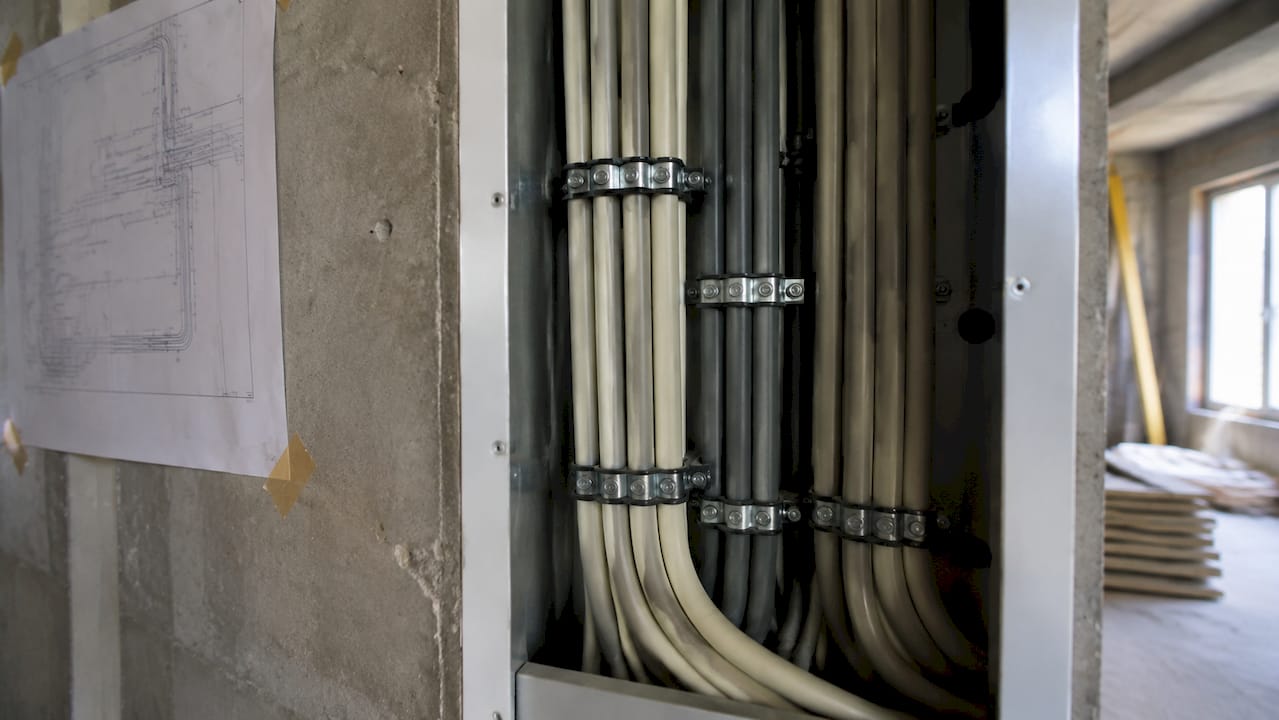
- Use rated support hardware. Fire-resistant cable installation requires specific mounting hardware and prescribed support spacing. Standard cable clips and ties are not always acceptable. Check the manufacturer’s data sheet for approved fixings and maximum spacing intervals.
- Keep fire-resistant cables in dedicated containment. Mixing fire-resistant cables with non-fire-rated cables in the same tray or conduit risks negating the fire-resistance rating. Maintain separate containment for life safety circuits throughout the entire run.
- Protect cables from mechanical damage. Fire-resistant cables are often more rigid than standard cables and more vulnerable to damage at bends and terminations. Use appropriate bend radius guides and protect exposed sections from impact.
- Route cables away from high-risk fire zones where possible. Even a 120-minute rated cable has limits. Routing life safety circuits through the lowest-risk paths reduces the demand placed on the cable’s rating.
- Document every installation detail. Record cable routes, support spacing, containment types, and termination methods. Inspectors and insurers will ask for this documentation. Missing records create compliance problems even when the physical installation is correct.
Early planning is the single biggest factor in getting fireproof cable installations right. Choosing fire safety cables after the structural and mechanical design is complete forces compromises in routing and containment. Involving a fire safety engineer in the design phase, before conduit routes are fixed, produces better outcomes and lower costs.
Key takeaways
Fire-resistant cabling is the physical backbone of every life safety system in a building, and its performance depends equally on correct specification and correct installation.
| Point | Details |
|---|---|
| Circuit integrity is the goal | Fire-resistant cables keep circuits live for 30–180 minutes; the outer jacket burning is expected and acceptable. |
| Cable type confusion causes failures | Flame-retardant cables do not maintain circuit integrity; specifying them for life safety circuits causes code rejections and insurance denials. |
| LSZH materials improve survivability | LSZH jackets reduce smoke obscuration below 60%, directly improving visibility for occupants and responders. |
| Installation is as critical as specification | Incorrect support hardware, mixed containment, or poor routing can void a cable’s fire rating regardless of its listed performance. |
| Plan early to control costs | Integrating fire-resistant wiring decisions in the design phase avoids costly rerouting and reduces the 15–25% labor premium from last-minute changes. |
Why getting fireproof cabling right is a design decision, not a procurement one
I have seen projects where the cable spec was correct and the installation failed inspection anyway. I have also seen projects where the wrong cable was installed because a procurement team substituted a flame-retardant product to save money, assuming the two were equivalent. Both outcomes are preventable. Both are expensive.
The core mistake is treating fireproof cabling as a commodity line item rather than a system component. A fire alarm panel is only as reliable as the circuit connecting it to every detector and sounder in the building. If that circuit fails at minute 45 of a fire, the panel’s listed rating is irrelevant. The system is down.
What I recommend to construction managers and safety officers is this: bring your fire safety engineer into the specification conversation before the electrical contractor is engaged. The engineer should define the required time ratings, the containment strategy, and the approved cable types for each circuit. The electrical contractor then prices and installs to that spec. Reversing that sequence, where the contractor selects the cable and the engineer reviews it afterward, creates friction, rework, and risk.
The emerging trend worth watching is the growth of enhanced softskin cables like FP200 Gold in commercial applications. These products offer the flexibility of standard cables with genuine fire-resistant performance, making installation faster and reducing the labor premium. They are not appropriate for every application, but for fire alarm circuits in typical commercial buildings, they represent a practical and cost-effective choice. Verify the rating against your project’s evacuation time requirements before specifying. Selecting the right fire alarm system from the start, with cabling integrated into that decision, is the approach that holds up under inspection and in real emergencies.
— Reliable-fire-protection
Fire safety cabling solutions from Reliable-fire-protection
Reliable fire protection works with construction managers, safety officers, and project planners across Houston to design and install fire alarm systems with properly specified fire-resistant cabling from the ground up. Every installation follows manufacturer requirements and local code, so your life safety circuits perform to their rated duration when it counts.
If you are planning a new build or evaluating an existing system, start with a clear understanding of how fire alarm systems work and where fire-resistant cabling fits into the overall design. Reliable-fire-protection’s team is available for consultations, system design reviews, and free quotes across Houston and surrounding neighborhoods. Contact us to discuss your project’s specific requirements before the design phase closes.
FAQ
What is the role of fireproof cabling in fire safety systems?
Fireproof cabling maintains electrical circuit integrity during a fire, keeping life safety systems such as fire alarms, emergency lighting, and smoke extraction operational for 30 to 180 minutes depending on the cable’s rating.
How is fire-resistant cable different from flame-retardant cable?
Fire-resistant cable keeps the circuit live under direct flame exposure, tested under IEC 60331. Flame-retardant cable only limits flame spread along the cable run and does not guarantee circuit survival.
What happens if fire-resistant and standard cables share the same conduit?
Mixing fire-resistant cables with non-fire-rated cables in the same containment can void the fire-resistance rating of the entire run, creating a compliance failure and a life safety risk.
What does LSZH mean and why does it matter?
LSZH stands for low smoke zero halogen. LSZH-jacketed cables reduce smoke obscuration in fires to below 60%, compared to over 85% for conventional PVC cables, improving visibility for occupants and emergency responders.
When should fireproof cable selection happen in a project?
Cable selection should happen during the fire strategy design phase, before conduit routes are fixed. Late specification forces routing compromises and increases installation labor costs by 15–25%.