

TL;DR:
- Fire panel zoning groups fire alarm devices into designated building areas to enable quick location identification during emergencies. Properly designed zones, aligned with building features and standards, enhance response times and support targeted evacuations, especially in complex or multi-story buildings. Regular review and accurate labeling are essential to maintain effective fire safety and compliance.
Fire panel zoning is defined as the practice of grouping fire alarm detection devices into designated building areas called zones, so responders can identify exactly where an alarm originated. Understanding fire panel zoning explained in full means knowing how zone design, device placement, and panel annunciation work together to cut emergency response time. Whether you manage a single commercial building in Houston or oversee a multi-story facility, the way your system is zoned directly affects how fast a fire gets located and contained. This guide covers the mechanics, design standards, system types, and real-world challenges you need to know.
How does fire panel zoning work?
Fire panel zoning works by dividing a building into logical sections, each wired or programmed as a separate circuit on the fire alarm control panel (FACP). When a detector or manual call point activates, the panel displays which zone triggered the alarm. Responders then go directly to that zone rather than searching the entire building.
The key distinction in understanding fire panel zones is how much location detail the panel provides:
- Conventional systems show only the zone number or label. Responders must physically search within that zone to find the activated device. This approach is typical for small to medium commercial buildings where zones are kept small enough to search quickly.
- Addressable systems identify the exact device that triggered the alarm, down to a specific detector in a specific room. This precision eliminates guesswork entirely.
- Zone annunciation on the panel uses labels like “Zone 3: Second Floor East Wing” to guide first responders. Clear, accurate labels are the difference between a 30-second search and a 3-minute one.
Zones are defined by physical boundaries such as walls, floors, corridors, and fire-rated doors. A zone should reflect how people move through the building. Aligning zones with corridors and escape routes reduces search time and supports safe evacuation simultaneously.
Pro Tip: Label every zone on your panel to match the floor plan posted at the building entrance. First responders use both references simultaneously, and any mismatch costs critical seconds.

What design standards govern fire alarm zoning?
Two primary standards shape fire alarm zoning design: NFPA 72 in the United States and BS 5839-1 in the United Kingdom. Both set rules for zone size, floor coverage, and documentation requirements.
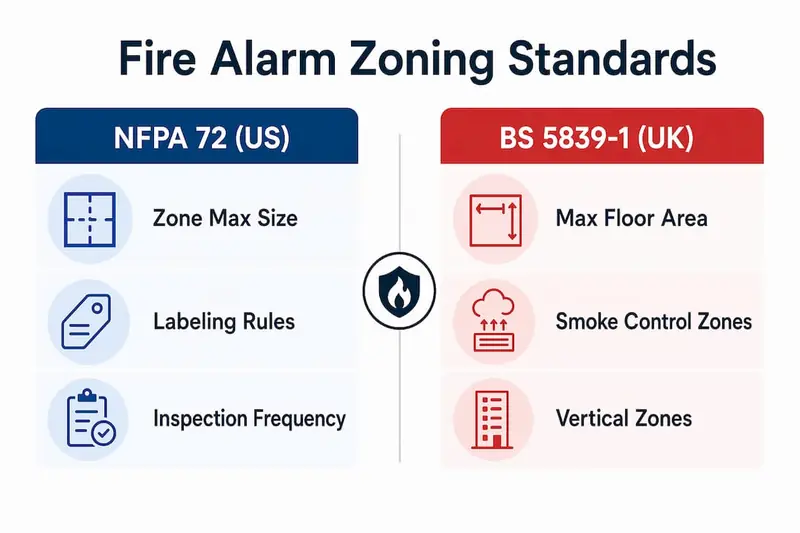
Zone size and floor restrictions
| Design Rule | Requirement | Purpose |
|---|---|---|
| Maximum zone floor area | 2,000 m² per zone | Keeps search area manageable |
| Single-floor coverage | One zone per floor preferred | Eliminates floor ambiguity |
| Investigator search time | Fire located within 60 seconds | Sets practical zone sizing limit |
| Documentation | Detailed zone plans required | Supports installation and compliance |
BS 5839-1 zoning principles restrict zones to a maximum floor area of 2,000 m² and generally confine each zone to a single floor. The 60-second rule is the practical test: if a responder cannot locate the fire source within 60 seconds of entering the zone, the zone is too large.
Special zones for vertical spaces
Stairwells, elevator lobbies, atria, and mechanical shafts require separate treatment. Vertical spaces such as stairwells and lift shafts are treated as single zones across all floors. This prevents a stairwell alarm from being attributed to a specific floor when the fire may have spread vertically.
Zone boundaries should follow fire-rated construction elements such as rated walls and fire doors. Zones aligned with fire-rated barriers maintain accurate location alarms because the physical boundary matches the fire containment boundary.
Designers must produce detailed zone plans showing zone boundaries, detector locations, and manual call points as required by BS 5839-1. This documentation is not optional. It supports installation accuracy, ongoing maintenance, and code compliance audits.
Pro Tip: Request a zone schedule from your fire alarm contractor at project completion. This document lists every zone, its label, its physical boundaries, and the devices it contains. Store it with your as-built drawings.
Conventional vs. addressable systems: which zoning approach fits your building?
The choice between conventional and addressable systems is one of the most consequential decisions in fire zone panel configurations. Both use zones, but they deliver very different levels of location detail.
| Feature | Conventional System | Addressable System |
|---|---|---|
| Location detail | Zone only | Exact device and location |
| Response speed | Slower (physical search required) | Faster (device ID on panel) |
| Typical building size | Small to medium | Medium to large commercial |
| Maintenance capability | Basic fault detection | Individual device diagnostics |
| Upfront cost | Lower | Higher |
Conventional zoned systems indicate alarms by zone but not by the exact initiating device. A responder arriving at the panel knows the fire is somewhere in Zone 4, but must walk the zone to find the source. For a small retail space or single-floor office, this is manageable.
Addressable systems provide individual device identification, enabling faster and more accurate fire source location. They also support better maintenance reporting, since each device can be queried for its status, sensitivity drift, or fault condition. New commercial construction in Houston and across the U.S. increasingly defaults to addressable systems for this reason.
The practical trade-off in fire safety zoning methods is between location clarity and system complexity. A conventional system with well-designed small zones can perform nearly as well as an addressable system in a simple building. In a 20-story office tower, only an addressable system gives you the precision you need.
Zoning does not replace device identification in addressable systems. The zone still tells responders which section of the building to go to. The device address then tells them exactly which detector activated. Both layers of information matter.
Zoning challenges in multi-story and complex buildings
Multi-story buildings introduce zoning problems that single-floor facilities never face. The core challenge is this: fire spreads vertically through shafts, stairwells, and atria, but responders need floor-specific location information to act effectively.
Vertical shared spaces require special zoning rules so alerts do not obscure the floor-specific location information that is critical during emergencies. The standard solution is to assign each stairwell or elevator shaft its own dedicated zone spanning all floors. When that zone activates, responders know the vertical space is involved, not a specific floor.
Best practices for complex building zoning include:
- Keep zones to one floor. Multi-floor zones create ambiguity. A zone labeled “Floors 3 and 4” tells responders almost nothing useful.
- Treat atriums as single zones. An atrium connects multiple floors visually and structurally. One zone covering the entire atrium space prevents conflicting signals.
- Align zone boundaries with physical barriers. A zone that crosses a fire-rated wall defeats the purpose of both the wall and the zone.
- Avoid overlapping zones. A device that belongs to two zones simultaneously creates confusion at the panel and in the field.
Proper zoning supports staged and targeted responses, helping avoid evacuating unaffected areas and reducing occupant confusion during emergencies. A well-zoned 10-story building can evacuate only the affected floor and the floor above while the rest of the building continues operating. Poor zoning forces a full building evacuation every time any detector activates.
Zoning layout depends on building layout, occupancy, fire risk, and code compliance. A hospital zones differently than a warehouse. A school zones differently than a hotel. The occupancy type determines how people move, how fast they can evacuate, and how much location precision responders need.
Key takeaways
Effective fire panel zoning requires matching zone boundaries to physical building features, occupancy patterns, and the level of location detail your system type can deliver.
| Point | Details |
|---|---|
| Zone size limits matter | Keep zones under 2,000 m² and confined to one floor so responders locate fire within 60 seconds. |
| Vertical spaces need dedicated zones | Stairwells, elevator shafts, and atria should each be a single zone across all floors. |
| System type determines detail | Conventional systems show zones only; addressable systems identify the exact device. |
| Labels must match as-built plans | Synchronized zone labels between panel, drawings, and wiring prevent dangerous confusion during alarms. |
| Zone design affects evacuation | Well-designed zones enable targeted floor evacuation instead of full building shutdowns. |
What i’ve learned about zoning that most guides skip
Most fire safety articles treat zoning as a purely technical exercise. In practice, the biggest failures I see are not technical. They are organizational.
The most common problem is label drift. A building gets renovated, zones get rewired, but the panel labels and the posted floor plans never get updated. Zone labels on drawings and fire alarm control panels must be synchronized with as-built wiring. When they are not, a responder following the panel to “Zone 7: Server Room” may end up in a storage closet. That gap costs time when time is the only resource that matters.
The second issue is treating zoning as a one-time decision. Buildings change. Walls move, occupancies shift, and new equipment gets added. Every significant renovation should trigger a zone review. I have seen buildings where the original zone design was excellent but five years of incremental changes made it nearly useless.
Early planning pays off more than any other investment in fire safety design. The panel’s zone annunciation guides first responders’ search workflows, which means zones must be designed according to physical movement patterns within the building. Getting that right at the design stage costs almost nothing. Fixing it after installation is expensive and disruptive.
My honest advice: walk your building with your fire alarm contractor before the design is finalized. Look at how people actually move through the space, where the fire-rated barriers are, and where the vertical shafts run. That walk will produce better zones than any software tool alone.
— Reliable-fire-protection
Get expert fire alarm zoning support in houston
Getting your zones right from the start protects your property, your occupants, and your compliance standing. Reliable fire protection designs and installs both conventional and addressable fire alarm systems for Houston properties, with every system built to NFPA 72 standards and tailored to your building’s specific layout and occupancy.

From initial zone planning through installation and annual inspection, Reliable-fire-protection handles the full process. The team serves Houston Heights, Midtown, Montrose, University Place, and surrounding neighborhoods. If you want a system where every zone label matches every floor plan and every responder knows exactly where to go, learn how fire alarm systems work or contact Reliable-fire-protection today for a free quote.
FAQ
What is fire panel zoning?
Fire panel zoning is the method of dividing a building’s fire alarm system into defined areas called zones, each monitored as a separate circuit on the control panel. When an alarm activates, the panel displays the zone, directing responders to the correct area immediately.
How many devices can be in one fire alarm zone?
Zone size is governed by floor area rather than device count. BS 5839-1 limits zones to 2,000 m² and requires that a responder can locate the fire source within 60 seconds of entering the zone.
What is the difference between conventional and addressable zoning?
Conventional systems indicate only the zone where an alarm occurred, requiring a physical search within that area. Addressable systems identify the exact device that activated, providing precise location without any searching.
Why do stairwells need their own fire alarm zone?
Stairwells and elevator shafts are treated as single zones across all floors because fire and smoke travel vertically through these spaces. Assigning them a dedicated zone prevents responders from being misled about which floor a fire originated on.
How often should fire alarm zones be reviewed?
Zone designs should be reviewed after any significant building renovation, change in occupancy, or addition of new equipment. Outdated zone labels and boundaries are a leading cause of delayed emergency response in otherwise code-compliant systems.