
For most industrial facilities, the right suppression approach starts with one question: are people present when a fire could start? If yes, a clean agent system (FM-200, Novec 1230, or an inert gas blend) protects occupied control rooms, data rooms, and sensitive process areas without creating a lethal atmosphere. If the space is unoccupied or can be reliably evacuated, CO2 or dry chemical becomes cost-effective. Flammable liquid storage and process areas handling fuels almost always call for foam or water-based systems. The immediate next step is a targeted hazard survey conducted by a NICET-certified designer or licensed fire protection contractor — that survey drives every decision that follows.
Life safety comes first. Asset protection and downtime reduction come second. Any specification that reverses that order is a liability.
Key Takeaways
The most critical decision in specifying suppression systems for industrial facilities is matching the agent family to occupancy pattern and acceptable downtime — not simply choosing the cheapest option per protected volume.
| Point | Details |
|---|---|
| Life safety drives agent selection | Occupied spaces require clean agents or water mist; CO2 and dry chemical are restricted to unoccupied or reliably evacuated areas. |
| Room integrity is non-negotiable for total flooding | A door fan test before acceptance confirms the room holds agent concentration long enough to extinguish deep-seated fires. |
| NFPA and OSHA compliance is mandatory | Designs must reference NFPA 2001, 12, 17, or 72 as applicable, and meet OSHA 29 CFR 1910.160/1910.162 pre-discharge and signage requirements. |
| Lifecycle costs exceed installation costs | Budget for annual inspection, agent recharge, cylinder testing, and electronics replacement from day one. |
| Reliable-fire-protection | Provides survey, design, installation, testing, and 24/7 emergency response for industrial suppression systems in the Houston area. |
Table of Contents
- What suppression systems are used in industrial facilities?
- How industrial hazards map to the right suppression approach
- Total flooding vs. local application: what the design difference means for your facility
- Key components every suppression system specification must include
- Codes and standards that govern industrial suppression systems
- Agent selection: the real tradeoffs between FM-200, CO2, foam, and dry chemical
- Design, installation, and lifecycle costs: what to budget
- How to evaluate vendors and the design specification
- Installer-vetted specification checklist for facility managers
- What installers see that the spec documents miss
- Reliable-fire-protection covers the full suppression project, from survey to sign-off
- Sources
What suppression systems are used in industrial facilities?
Industrial fire suppression covers several distinct system families, each built around a different extinguishing mechanism. Matching the right family to the right hazard is the core of industrial fire safety planning.
Water-based sprinklers and pre-action systems are the workhorses of industrial fire protection. Wet-pipe sprinklers activate individually at the fire source, limiting water damage to the affected zone. Pre-action systems add a detection interlock before water enters the piping, making them a better fit for areas where accidental discharge would damage equipment or inventory.
Water mist suppression uses fine droplets at high pressure to cool flames and displace oxygen simultaneously. The smaller droplet size means less water volume and less collateral damage than conventional sprinklers, which is why water mist suppression appears frequently in turbine enclosures, marine engine rooms, and heritage buildings where water damage is a serious secondary concern.
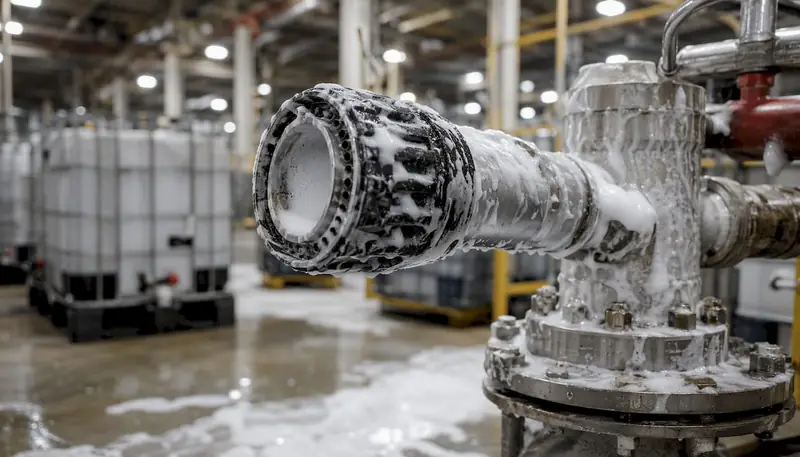
Foam fire suppression blankets the fuel surface to cut off oxygen and prevent re-ignition. It is the standard choice for aircraft hangars, tank farms, loading docks, and any area storing significant quantities of flammable or combustible liquids. Foam systems range from low-expansion (for spill fires) to high-expansion (for deep storage areas).
Clean agents (FM-200 / HFC-227ea, Novec 1230, inert gas blends) discharge as a gas, leave no residue, and are safe for occupied spaces at design concentrations. They are the dominant choice for data centers, electrical switchgear rooms, control rooms, and any space where water or powder would cause irreparable equipment damage. NFPA 2001 governs their design, concentration verification, and maintenance requirements.
CO2 systems extinguish fire by displacing oxygen. Highly effective on deep-seated fires and flammable liquid hazards, CO2 creates a lethal atmosphere at extinguishing concentrations, so it is restricted to unoccupied spaces or areas with reliable evacuation and interlock controls. Generator rooms, printing press enclosures, and industrial drying ovens are common applications.
Dry chemical systems use powder agents (ABC, BC, or Purple-K) to interrupt the chemical chain reaction of combustion. Fast-acting and effective on flammable liquid and gas fires, they leave a corrosive residue that damages electronics and machinery, so cleanup and restart time can be significant. Spray booths, vehicle maintenance bays, and outdoor process equipment are typical applications.
Wet chemical systems are purpose-built for cooking equipment and commercial kitchen hoods. The agent reacts with hot grease to form a soapy layer (saponification) that prevents re-ignition. Outside of food processing and industrial kitchens, wet chemical has limited application.
Twin-agent and pre-engineered local systems combine two agents (typically dry chemical plus foam or CO2) for fast knockdown followed by vapor suppression. Pre-engineered systems, including those using detection tubing that actuates directly at the hazard, are common for CNC machine enclosures, engine compartments, and individual pieces of process equipment where a full engineered system is impractical.
How industrial hazards map to the right suppression approach
The Fire Suppression Systems Association defines special hazards by asset criticality, replacement cost, and downtime implications — and those three factors are exactly what should drive your shortlist.
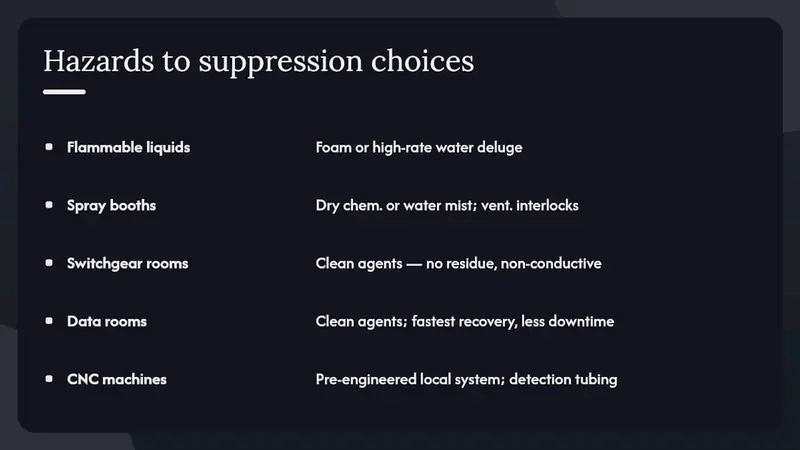
Flammable liquid storage and process areas (tanks, drum storage, loading racks) almost always call for foam fire suppression or a high-rate water deluge system. The surface-blanketing action of foam is the only reliable way to prevent re-ignition on a large fuel spill. For smaller contained spills, a dry chemical local application system can serve as a first-strike option.
Spray booths and paint finishing lines present a combined flammable vapor and liquid hazard. Dry chemical is the traditional choice for fast knockdown, but water mist is gaining ground in newer installations because it suppresses vapor without the residue penalty. Either way, ventilation interlocks and explosion-proof detection are non-negotiable.
Electrical switchgear rooms and control rooms need an agent that leaves no residue and does not conduct electricity. Clean agents (FM-200 or Novec 1230) are the standard answer. CO2 can work if the space is reliably unoccupied, but most facilities choose clean agents to preserve the option of occupied operation.
Data rooms and server areas follow the same logic as control rooms, with one added consideration: downtime. A clean agent discharge means the room is back online within minutes. A water event means days or weeks of recovery. That cost differential justifies the higher agent price for most facility managers.
Industrial ovens, dryers, and furnaces often use CO2 or dry chemical local application systems directed at the combustion zone. The key design requirement is detection speed — a UV/IR flame detector or rate-of-rise heat detector positioned inside the enclosure, not just at room level.
CNC machining centers and metalworking equipment accumulate cutting fluids and fine metal chips that can ignite. Pre-engineered local application systems with detection tubing routed through the enclosure are a practical fit because they activate at the exact ignition point without requiring a full room system.
Compressor rooms and gas handling areas require careful agent selection because the hazard is often a pressurized gas jet fire. Water mist or CO2 can be effective, but the system must be designed around the specific fuel and pressure conditions — a generic sprinkler layout will not reliably extinguish a pressurized gas fire.
When a single space contains both sensitive electronics and a flammable liquid hazard (a combined control and process room, for example), a combined approach is best practice: a clean agent total-flooding system for the electronics zone, with a foam or dry chemical local application system covering the process equipment. The two systems require coordinated detection and sequenced discharge to avoid agent conflicts.
Total flooding vs. local application: what the design difference means for your facility
These two topologies look similar on paper but carry very different design and operational consequences.
Total flooding fills an entire protected volume with agent at a concentration sufficient to extinguish fire throughout the space. The room must be sealed well enough to hold the agent for a minimum hold time (typically 10 minutes for clean agents under NFPA 2001). That means door sweeps, dampers on HVAC penetrations, and a room integrity test (door fan test) before the system is commissioned. Any unsealed penetration — a cable tray, a pipe sleeve — can bleed agent fast enough to prevent extinguishment.
Local application directs agent at a specific hazard or piece of equipment rather than flooding the entire room. No room sealing is required, which makes local application practical for open process areas, outdoor equipment, and spaces where total flooding is physically impossible. The tradeoff is that local application only protects the targeted hazard; a fire that spreads beyond the nozzle coverage zone will not be suppressed.
Design implications differ sharply between the two:
- Total flooding requires a room integrity test, ventilation shutoff interlocks, and a pre-discharge alarm with enough time for occupants to evacuate before agent release.
- Local application requires precise nozzle placement and flow calculations to cover the hazard geometry, but does not require room sealing or evacuation.
- Both topologies require manual discharge stations at each protected area per OSHA 29 CFR 1910.160.
- Access control and warning signage are mandatory for any area protected by a hazardous agent (CO2, dry chemical) regardless of topology.
- MSDS (Safety Data Sheet) availability for the suppression agent must be maintained on-site.
Pro Tip: For total-flooding CO2 or clean agent systems, require the contractor to perform a door fan (room integrity) test before final acceptance. A room that fails integrity testing will not hold agent concentration long enough to extinguish a deep-seated fire — and the failure is invisible until a real discharge.
Pre-engineered local systems using detection tubing are a practical middle ground for individual machines. The tubing routes through the hazard zone and ruptures on contact with flame, triggering discharge exactly where the fire starts — no control panel required for the simplest configurations.
Key components every suppression system specification must include
A suppression system is only as reliable as its weakest component. When reviewing a specification or contractor proposal, confirm every element below is explicitly addressed.
Detection devices are the system’s eyes. The choice of detector (smoke, heat, UV/IR flame, or linear heat detection cable) must match the hazard. A standard smoke detector in a dusty machining environment will false-alarm constantly; a UV/IR flame detector in a data room may miss a slow-smoldering fire. Advanced detection systems matched to the specific hazard profile are worth the added cost.
The fire alarm control panel (FACP) receives signals from detectors, manages pre-discharge timing, and triggers agent release. Under NFPA 72, the panel must be listed for the application and integrated with the building’s main fire alarm system. Addressable panels allow individual device identification, which matters enormously in a large facility where pinpointing the alarm source saves response time.
Pre-discharge alarms are not optional. OSHA requires a distinctive alarm signal in every protected area before agent discharge, giving occupants time to evacuate. The alarm must be audibly and visually distinct from the general building fire alarm — a separate horn/strobe combination is standard practice.
Manual discharge and abort stations must be located at each exit from the protected area. The abort station (where used) gives a brief window to cancel an accidental discharge; the manual release allows deliberate activation if the automatic system fails to trigger.
Piping, nozzles, and storage containers must be sized and positioned by a licensed designer. Nozzle placement determines coverage geometry; undersized piping reduces flow rate and agent concentration. Storage cylinder pressure and fill weight must be verified at commissioning and at every annual inspection.
Actuation and supervisory wiring connects the panel to the agent release mechanism (solenoid valve or cartridge actuator). Supervisory circuits monitor for open or short conditions and report trouble to the panel — a critical feature that confirms the system is ready to operate.
Integration points that must appear in the specification:
- HVAC shutdown on pre-discharge signal (prevents agent dilution and limits oxygen supply to the fire)
- Machinery isolation or power cutoff for electrical hazards
- Interface with the building fire alarm system for central monitoring
- Emergency power (battery backup) for the control panel
- Door hold-open release to close fire doors on alarm
For facilities with fire doors interfacing suppression-protected areas, proper door condition and closure are part of the system’s effectiveness. Common fire door access control mistakes can compromise compartmentation even when the suppression system itself is correctly designed.
Codes and standards that govern industrial suppression systems
U.S. industrial suppression systems operate under a layered framework of NFPA standards and OSHA regulations. Every specification document should reference the applicable standards by number and edition.
NFPA codes and standards that apply most frequently to industrial suppression:
- NFPA 2001 — Standard on Clean Agent Fire Extinguishing Systems: governs FM-200, Novec 1230, and inert gas systems including design concentrations, room integrity, and maintenance.
- NFPA 12 — Standard on Carbon Dioxide Extinguishing Systems: covers CO2 system design, safety interlocks, and discharge procedures.
- NFPA 17 — Standard for Dry Chemical Extinguishing Systems: governs dry powder systems for flammable liquid and process hazards.
- NFPA 72 — National Fire Alarm and Signaling Code: sets requirements for detection, control panels, notification appliances, and system monitoring.
OSHA fixed extinguishing system rules under 29 CFR 1910.160 and 1910.162 establish employer responsibilities that go beyond the NFPA design standards:
Practical OSHA obligations facility managers must confirm:
- Pre-discharge alarm installed and tested
- Warning signs posted at all entrances to hazardous-agent areas
- MSDS/SDS for the suppression agent available on-site
- Employees trained on evacuation procedures before system commissioning
- Inspection and maintenance records retained
Environmental and disposal considerations are increasingly relevant. Legacy halon systems (Halon 1301, Halon 1211) are no longer manufactured under the Montreal Protocol, and replacement agents must be selected from NFPA 2001’s approved list. CO2 and inert gas blends carry no ozone-depletion concerns but require proper cylinder handling and disposal procedures. Some jurisdictions require EPA notification for large CO2 releases.
Documentation requirements are non-negotiable: as-built drawings, test certificates, agent certificates of conformance, and inspection records must be retained and available for AHJ (Authority Having Jurisdiction) review.
Agent selection: the real tradeoffs between FM-200, CO2, foam, and dry chemical
Choosing a suppression agent is not just a technical decision — it is a business decision about acceptable risk, downtime, and lifecycle cost. The FM-200 vs. CO2 comparison illustrates the core tradeoff: FM-200 is safe for occupied spaces and gets operations back online fast; CO2 is cheaper per protected volume but creates a lethal atmosphere that demands strict evacuation controls.
| Agent | Best For | Occupant Safety | Residue / Equipment Risk | Environmental / Regulatory | Cost / Maintenance | Speed / Effectiveness |
|---|---|---|---|---|---|---|
| FM-200 (HFC-227ea) | Occupied control rooms, data centers | Safe at design conc. | None | No ODP; GWP regulated in some states | Higher agent cost; low maintenance | Fast; effective on Class A, B, C |
| Novec 1230 | Sensitive electronics, occupied spaces | Safe at design conc. | None | Very low GWP; preferred where FM-200 faces limits | Highest agent cost; low maintenance | Fast; similar to FM-200 |
| Inert gas (IG-541, IG-55) | Occupied spaces; long hold time needed | Safe at design conc. | None | Zero ODP/GWP | Lower agent cost; larger cylinders | Slightly slower; effective on Class A, B |
| CO2 | Unoccupied process areas, generator rooms | Lethal at extinguishing conc. | None | No ODP/GWP | Low agent cost; moderate maintenance | Fast; effective on deep-seated fires |
| Foam (AFFF / AR-AFFF) | Hangars, tank farms, fuel loading | Restricted during discharge | Foam cleanup required | PFAS regulations tightening | Moderate cost; concentrate replacement | Fast on fuel surface fires |
| Dry chemical | Spray booths, vehicle bays | Restricted during discharge | Heavy residue; corrosive | Minimal | Low agent cost; powder replacement | Very fast knockdown |
| Wet chemical | Kitchen hoods, fryers | Restricted during discharge | Moderate cleanup | Minimal | Low cost; annual service | Fast on grease fires |
| Water mist | Turbines, heritage spaces, occupied areas | Safe | Minimal | No chemical concerns | Higher install cost; low agent cost | Effective on Class A, B |
A few agent-specific points that often get overlooked:
- PFAS in foam agents: AFFF (aqueous film-forming foam) contains per- and polyfluoroalkyl substances. EPA and state-level regulations on PFAS are tightening, and several states have restricted AFFF use. Facilities specifying new foam systems should evaluate PFAS-free alternatives and confirm local regulatory status before committing.
- CO2 pre-discharge timing: NFPA 12 requires a minimum pre-discharge alarm time sufficient for evacuation. In practice, this means the detection-to-discharge sequence must be engineered around the room’s occupancy pattern and egress time, not just a default timer setting.
- Inert gas cylinder footprint: IG-541 and IG-55 systems require significantly more cylinder storage volume than FM-200 for the same protected space. In a tight mechanical room, that footprint can be a deciding factor.
Design, installation, and lifecycle costs: what to budget
No honest answer to “what does a suppression system cost?” exists without a hazard survey. That said, facility managers can plan around the major cost drivers.
Primary cost drivers:
- Agent type and volume: clean agents cost significantly more per pound than CO2 or dry chemical; a large protected volume multiplies that difference.
- Room modifications for total flooding: sealing penetrations, installing dampers, and passing a door fan test add cost that is easy to underestimate.
- Detection complexity: UV/IR flame detectors, linear heat detection, and multi-criteria detectors cost more than standard smoke heads but are often necessary for industrial environments.
- System topology: a total-flooding engineered system requires more design work, more components, and more commissioning time than a pre-engineered local application unit.
- Integration with existing fire alarm and building management systems: older facilities with legacy panels may require gateway devices or panel replacement.
- Redundancy and monitoring: 24/7 central station monitoring, redundant detection circuits, and backup power add cost but reduce risk.
Typical timeline phases (conceptual ranges — actual durations depend on facility complexity and permit jurisdiction):
- Hazard survey and scope definition: 1–3 weeks
- Engineering design and drawing preparation: 2–6 weeks
- AHJ plan review and permit: 2–8 weeks (varies significantly by jurisdiction)
- Equipment procurement: 4–12 weeks (agent cylinders and specialty components can have long lead times)
- Installation and rough-in: 1–4 weeks
- Commissioning, testing, and AHJ inspection: 1–2 weeks
Recurring lifecycle costs are where many facilities get surprised. Annual inspection and testing per NFPA standards, agent recharge after any discharge, cylinder hydrostatic testing (typically every 5–12 years depending on agent and cylinder type), and electronics lifecycle replacement (panels, detectors) all add up. A suppression system workflow that documents these intervals from day one prevents the deferred-maintenance trap.
How to evaluate vendors and the design specification
A low bid that omits pre-discharge controls or skips NICET sign-off is not a bargain — it is a liability. Use the following criteria to separate credible proposals from problematic ones.
Specification checklist for RFPs:
- NICET-certified design engineer or licensed fire protection contractor signs and stamps drawings
- Explicit reference to applicable NFPA standards (2001, 12, 17, 72) and OSHA 29 CFR 1910.160/1910.162
- Room integrity test (door fan test) included in scope for total-flooding systems
- Agent storage, refill, and recharge plan with named supplier and lead times
- Maintenance support terms: response time, 24/7 emergency availability, annual inspection schedule
- Delivery of as-built drawings, test certificates, and agent certificates at project close
- Training plan for facility staff covering evacuation procedures and manual station operation
Questions to ask every bidder:
- Which NFPA standard governs your design, and which edition are you designing to?
- Who signs and stamps the drawings, and what is their NICET certification level?
- What is your agent supplier’s recharge lead time after a discharge?
- How do you handle room integrity failures discovered during commissioning?
- What is your response time for emergency service calls, and do you offer 24/7 coverage?
- What does your maintenance agreement cover, and what triggers additional charges?
- How does your design account for future equipment changes or room modifications?
Red flags to reject immediately:
- No pre-discharge alarm or abort station in the design
- No NICET or licensed fire protection contractor sign-off on drawings
- Vague maintenance plan with no defined response times
- Agent cost estimates that exclude recharge, cylinder testing, or annual inspection
- Proposal references only one standard when multiple apply
- No room integrity test in scope for a total-flooding system
For suppression system design in complex industrial environments, the designer’s experience with your specific hazard type matters as much as their credentials. Ask for references from comparable projects.
Installer-vetted specification checklist for facility managers
This checklist is drawn from installer practice and can be pasted directly into an RFP or site-survey brief.
Hazard and design basis:
- Hazard classification completed (Class A, B, C, D, or K; special hazard category confirmed)
- Room volume calculations verified by field measurement, not architectural drawings alone
- Occupancy pattern documented (continuously occupied, intermittently occupied, or unoccupied)
- Acceptable downtime defined and used to drive agent selection
Detection and control:
- Detector type matched to hazard (UV/IR for fast-flaming fires; smoke for smoldering; linear heat for high-ambient-temp areas)
- Cross-zoning or multi-criteria detection specified where false-alarm risk is high
- Pre-discharge alarm timing calculated from occupancy egress time, not a default setting
- Abort station included where accidental discharge risk warrants it
Mechanical and integration:
- Ventilation interlocks confirmed (HVAC shutdown on pre-discharge signal)
- Machinery isolation or power cutoff sequenced before agent release
- Manual discharge stations located at each protected area exit
- Warning signage specified for all entrances to hazardous-agent areas
Documentation and training:
- As-built drawings, test certificates, and agent SDS delivered at project close
- Maintenance schedule documented with inspection intervals per applicable NFPA standard
- Operator quick-reference cards posted at manual stations
- Training session scheduled for facility staff before system goes live
Optional value-adds worth asking about:
- Twin-agent systems (dry chemical plus foam) for flammable liquid areas with re-ignition risk
- 24/7 central station monitoring with direct AHJ notification
- Emergency refill contracts with guaranteed response times after discharge
Pro Tip: Request that the contractor provide the room integrity test report and agent weight verification certificate before you sign off on final acceptance. These two documents confirm the system will actually work — everything else confirms it was built to spec.
For fire door conditions that affect room integrity in total-flooding areas, a property manager’s fire door PM program provides a useful framework for ongoing door maintenance alongside suppression system inspections.
What installers see that the spec documents miss
The conventional wisdom in industrial fire protection is that the right agent selection is the hardest decision. In practice, it is usually the easiest. Most experienced installers can narrow the agent family to two options within the first hour of a site walk. The harder decisions are the ones that happen after the agent is chosen.
Room integrity is where most total-flooding projects run into trouble. A facility that has been in operation for 20 years has cable trays, pipe sleeves, and HVAC penetrations that were never designed with suppression in mind. Sealing those penetrations costs money and time, and contractors who do not flag this in the bid are either inexperienced or deliberately lowballing. Either way, the cost shows up at commissioning when the door fan test fails.
The second underestimated factor is downtime planning. Facility managers often focus on the suppression system’s ability to stop a fire and underestimate the operational disruption of a discharge event itself — even a clean agent discharge requires post-discharge ventilation, system inspection, and agent recharge before the system is back in service. Building that sequence into the emergency response plan before the system is installed, not after, is what separates a well-managed facility from one that improvises under pressure.
Detection selection also deserves more attention than it typically gets. A suppression system that discharges on a false alarm in a production environment is nearly as disruptive as a real fire. Cross-zoning, multi-criteria detectors, and abort stations are not optional extras — they are the difference between a system that protects the facility and one that shuts it down unnecessarily.
Reliable-fire-protection covers the full suppression project, from survey to sign-off
Reliable-fire-protection handles every phase of a suppression project for industrial and commercial facilities in the Houston area: hazard survey, system design, installation, commissioning, annual inspection, and 24/7 emergency response. The team works with clean agents, CO2, foam, dry chemical, water mist, and pre-engineered local systems — and every design is built to NFPA and OSHA requirements with NICET-certified oversight.
The first step is a site survey that maps your hazards, occupancy patterns, and existing fire alarm infrastructure. From that survey, Reliable-fire-protection produces a specification you can take to your AHJ and your insurance carrier with confidence. For facilities that already have a system in place, the team also provides inspection, testing, recharge, and upgrade services to bring aging systems into current code compliance.
To request a free site survey or get a quote for suppression system design or fire alarm integration, contact Reliable-fire-protection directly. The survey is free, and the proposal will include a clear scope, timeline, and lifecycle cost estimate — no vague line items.
Sources
Every suppression specification document should reference these sources directly, and procurement teams should confirm the contractor’s design cites the correct standard edition.
- eTool : Evacuation Plans and Procedures – Emergency Standards – Fixed Extinguishing Systems | Occupational Safety and Health Administration
- The List of 300+ Codes and Standards
- An Overview of Fire Suppression Systems and Their Applications
- Fire Suppression Systems
- Industry FAQs
- Nicet
Retain as-built drawings, test certificates, and agent SDS documents for the life of the system. AHJ inspectors and insurance carriers will ask for them, and they are the only reliable record of what was installed and when it was last verified.