
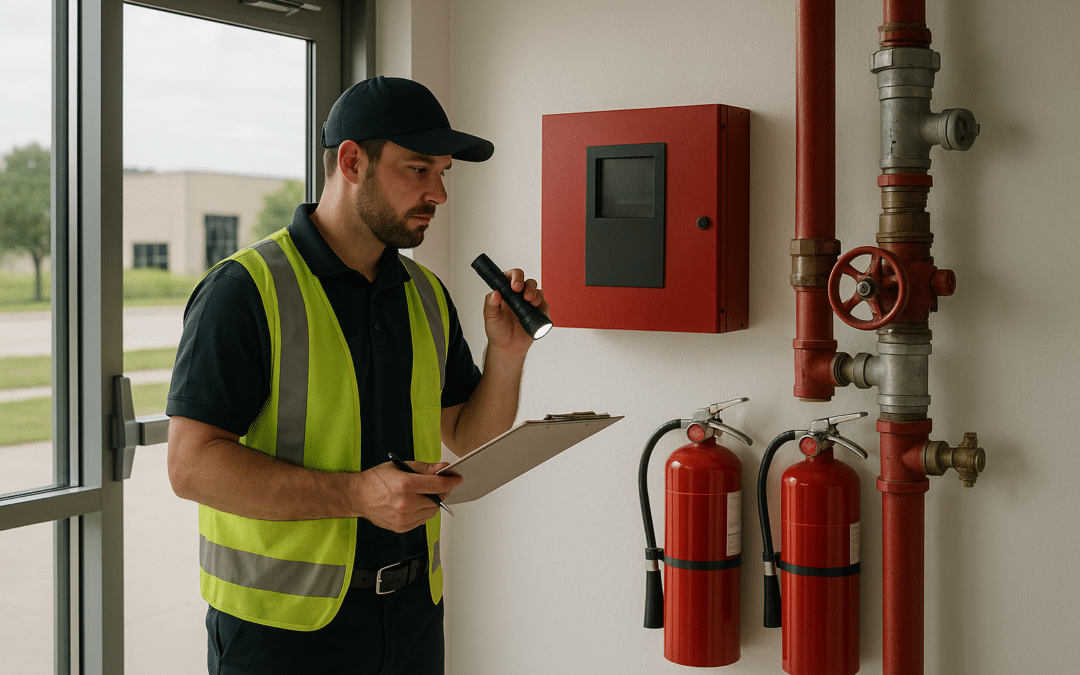
TL;DR: Passing an AHJ fire inspection in Houston means having current, documented NFPA inspections on every system — alarms, sprinklers, extinguishers, suppression, and backflow — plus clear access and up-to-date paperwork on hand. This guide walks property managers and facility directors through an 8-step prep process, the documents the Houston Fire Department or Harris County Fire Marshal will ask for, and the mistakes that most often trigger a failed inspection or deficiency report.
An AHJ fire inspection can shut down a Houston restaurant’s grand opening, delay a certificate of occupancy for a new office build-out, or trigger a 30-day deficiency clock for an existing property. Knowing exactly what the inspector checks — and getting your documentation in order beforehand — is the difference between a 20-minute walkthrough and a failed inspection that costs you tenants, revenue, or your permit.
This guide walks Houston-area property managers, facility directors, and business owners through preparing for a fire inspection from your local Authority Having Jurisdiction (AHJ), step by step.
Who Is Your AHJ in Houston?
The Houston Fire Department’s Fire Prevention Bureau is the authority having jurisdiction (AHJ) for properties within city limits; properties in unincorporated Harris County fall under the Harris County Fire Marshal.
If your property sits in Bellaire, Cinco Ranch, or another incorporated suburb, check with that municipality’s fire marshal directly, since
the AHJ in Houston is the HFD fire marshal, who can impose requirements more stringent than the statewide IFC adoption.
That local authority matters because
state and local Authorities Having Jurisdiction adopt, interpret, or amend the model codes for local enforcement
— meaning two buildings a few miles apart, one inside Houston city limits and one in unincorporated Harris County, can face slightly different inspection timelines or documentation expectations.
What Houston AHJ Inspectors Actually Check
Across most commercial, industrial, and multi-family occupancies, inspectors verify the same baseline systems:
installation and maintenance of a fire alarm system, operational fire extinguishers placed in accessible, code-required locations, regular inspection and testing of fire sprinkler and suppression systems, clearly marked emergency exits and current evacuation plans, employee training in fire safety protocols, and documentation of every test, inspection, and compliance activity, available for AHJ review.
For buildings with fire alarm systems,
annual fire alarm inspection under NFPA 72 is required for all Houston office buildings with a fire alarm system, performed by a contractor licensed by the Texas State Fire Marshal’s Office under the Texas Occupations Code Chapter 6002.
During that inspection,
every smoke detector, manual pull station, horn, strobe, duct detector, and supervisory device must be tested and documented.
Step-by-Step: How to Prepare for an AHJ Fire Inspection
-
Confirm your occupancy classification and applicable code edition
Know whether your building falls under business, mercantile, assembly, institutional, or high-hazard occupancy, since thresholds differ. For example,
office buildings in Houston are classified as Group B occupancies, and a monitored fire alarm system is required under IFC Section 907.2.2 when a Group B building exceeds three stories or 55,000 square feet, or when it has a sprinkler system.
Confirm which IFC and NFPA editions your specific AHJ currently enforces, since amendments can update referenced standards. -
Pull every current inspection report and tag
Gather your most recent fire alarm, sprinkler, extinguisher, kitchen hood suppression, backflow, and fire pump inspection reports. Inspectors will ask for these first —
that paperwork stays with the extinguisher and gets reviewed during fire marshal inspections, and incomplete or missing documentation is one of the most common violations businesses face. -
Check every fire extinguisher tag and placement
Walk the property and verify each extinguisher has a current annual service tag, hasn’t been obstructed, and is mounted correctly.
Extinguishers must be mounted in a visible and easily accessible location, with a travel distance of no more than 75 feet from any point.
Monthly checks still matter —
you’ll also need a trained employee to visually inspect the extinguisher monthly.
If you’re unsure your extinguisher program meets current Texas rules, our Texas fire extinguisher inspection checklist breaks down exactly what Houston businesses need on file. -
Verify sprinkler and standpipe inspection records are current
Water-based fire protection systems need layered inspection cycles — weekly, monthly, quarterly, annual, and 5-year.
Sprinklers require annual visual inspection, gauges require quarterly inspection, and main drain tests are required annually at each water supply riser.
If your last full NFPA 25 inspection and main drain test isn’t documented and within its window, that’s one of the first gaps an AHJ inspector will flag. Our NFPA 25 sprinkler inspection guide covers the full frequency table for Houston properties. -
Confirm fire pump and tank testing is up to date
If your building relies on a fire pump to maintain adequate water pressure, the AHJ will want to see current churn and flow test records.
Fire pumps require a full-flow performance test at churn, 100%, and 150% of rated capacity per NFPA 25 §8.3.3.
Weekly no-flow churn tests also need to be logged, since gaps in that weekly record are an easy red flag during inspection. -
Test your monitoring and verify central station records
Most Houston commercial occupancies that require a fire alarm also require monitoring.
Buildings with an occupant load of 50 or more, any building over three stories, and high-hazard occupancies including warehouses with high-piled storage must connect to a UL-listed or FM-approved central station.
Ask your monitoring provider for a printout of recent signal history —
the central station logs every event with a timestamp and transmits dispatch confirmation records, which property managers can use to satisfy AHJ documentation requirements during annual inspections. -
Walk your egress paths and exit signage
Clear every exit corridor, stairwell, and exit door of storage, equipment, and furniture. Confirm exit signs are illuminated and evacuation maps are posted and current, since blocked egress is one of the fastest ways to earn a life-safety deficiency.
-
Correct deficiencies before the inspector arrives, not after
If an in-house walkthrough turns up anything overdue, get it corrected ahead of the AHJ visit.
Buildings that fail annual inspection receive a deficiency report, which must be corrected and re-inspected within a timeframe set by the AHJ — typically 30 days for life safety deficiencies.
A proactive fix avoids that re-inspection cycle entirely, along with the scheduling delays it can cause for occupancy permits, lease turnovers, or health department openings.
Documents to Have Ready for the Inspector
- Current fire alarm inspection report (NFPA 72) and monitoring signal history
- Fire sprinkler/standpipe inspection and main drain test records (NFPA 25)
- Fire pump churn and annual flow test logs
- Fire extinguisher monthly inspection log and current annual service tags
- Kitchen hood suppression system service tag, if applicable
- Backflow preventer test report
- Evacuation plan and occupant load posting
- Prior inspection reports and any closed-out deficiency notices
Reports should be kept available on-site or readily accessible, since
inspection reports must be retained for at least one year and made available to the City of Houston Fire Prevention Bureau or Harris County Fire Marshal on request.
Common Mistakes That Cause a Failed AHJ Inspection
- Expired or missing extinguisher tags.
Missing or expired inspection tags on monthly inspection initials and annual service tags must be current — missing tags are treated as missing inspections. - Blocked access to equipment.
NFPA 10 §6.1.3.8 requires clear, unobstructed access at all times
to extinguishers, panels, and valves — stored inventory or furniture pushed in front of equipment is one of the most common violations found on walkthroughs. - Tenant build-outs that bypass permitting. In multi-tenant buildings,
property managers who allow tenant build-outs to proceed without coordinating fire alarm permits risk discovering during the next annual inspection that coverage gaps exist throughout the newly configured space. - Assuming the state inspects instead of the local AHJ.
The SFMO’s explicit policy is to defer to local AHJs and cancel inspection requests in areas served by certified local inspectors
— in Houston, that means HFD or the Harris County Fire Marshal, not the state office. - Treating monitoring and detection as separate from the inspection. If your detection devices and panel haven’t been fully tested, monitoring records alone won’t satisfy the AHJ. Our fire detection services page covers what a complete device test and inspection involves.
Why This Matters More in Houston’s Climate
Gulf Coast humidity and heat put extra stress on fire protection hardware.
Gulf Coast humidity and salt air accelerate extinguisher corrosion
, which means Houston-area properties often see components degrade faster than the national average between service visits — another reason to treat the monthly and quarterly checks as more than a box-ticking exercise.
Getting Ahead of Your Next AHJ Visit
Whether you manage a high-rise in Downtown Houston, a strip retail center in Cypress, a hotel in the Energy Corridor, or a multi-family property in Katy, the fastest path through an AHJ fire inspection is having every system current, tested, tagged, and documented before the inspector walks in. Reliable Fire Protection handles inspection, testing, and repair for fire alarms, sprinklers, suppression, extinguishers, backflow preventers, and fire pumps across Greater Houston, with 24/7 emergency response and same-day service when a deficiency needs fast correction. Visit our Houston fire protection services page to schedule a pre-inspection walkthrough before your AHJ visit.
Recommended Reads
- NFPA 25 Fire Sprinkler Inspection Requirements: A Complete Guide for Houston Properties
- Texas Fire Extinguisher Inspection Requirements: A Checklist for Houston Businesses
- What Happens During a Fire Pump Inspection and Test in Houston?
Sources