TL;DR: Houston schools must maintain a working fire alarm system tested annually under NFPA 72 and the Houston Fire Code, while also meeting Texas Education Code drill mandates and Houston’s own requirement of one fire drill per month in Group E occupancies. Falling behind on either side, inspections or drills, can put a campus out of compliance and at risk during a fire marshal review or insurance audit.
Keeping a Houston school in compliance means satisfying two separate but overlapping systems: the physical fire alarm equipment rules under NFPA 72 and the Houston Fire Code, and the drill and emergency-planning rules under Texas Education Code and Texas Administrative Code. Facilities directors who only track one side of this often get caught off guard by the other.
This guide breaks down what Houston-area school administrators, facilities directors, and charter and private school operators actually need to have in place, how it works, and where the common compliance gaps show up.
What Counts as a School Fire Alarm System Under Code
A school fire alarm system includes the control panel, smoke and heat detectors, manual pull stations, horns, strobes, and the connection to a monitoring service. In Houston, these systems fall under the city’s adopted fire code enforcement structure.
Under the city of Houston fire code, all commercial, industrial, and high-occupancy residential structures must install approved fire alarm systems that meet performance, monitoring, and notification standards.
Schools fall squarely into this category as Group E occupancies, and most campuses with an occupant load over 50 are also required to connect their system to a central monitoring station, as
buildings with an occupant load of 50 or more, any building over three stories, and high-hazard occupancies including warehouses with high-piled storage must connect to a UL-listed or FM-approved central station.
The standard that governs how the equipment itself is designed, installed, and maintained is NFPA 72, the National Fire Alarm and Signaling Code.
NFPA 72 covers the application, installation, location, performance, inspection, testing, and maintenance of fire alarm systems, supervising station alarm systems, public emergency alarm reporting systems, fire warning equipment and emergency communications systems, and their components.
Inspection and Testing Schedule: What NFPA 72 Requires
Fire alarm compliance isn’t a one-time install-and-forget event. NFPA 72 sets out layered inspection and testing intervals depending on the component:
- Monthly:
fire alarm control panels (verify normal condition indicators, no trouble signals), interface equipment, batteries (check for corrosion, swelling, leakage). - Quarterly:
notification appliances (horns, strobes, speakers) for physical condition, duct detectors for accessibility, guard tour equipment. - Semi-annually:
initiating devices (smoke detectors, heat detectors, manual pull stations) for physical condition and proper mounting. - Annually:
annual testing for most devices (smoke detectors, heat detectors, pull stations, notification appliances, panel functions).
Smoke detector sensitivity adds another layer.
Sensitivity is checked within the first year after installation, then every alternate year; after two consecutive tests show the detector holding within its listed range, the interval can be extended up to five years.
Locally, the Houston Fire Code sets its own baseline requirement on top of NFPA 72.
Fire alarm systems shall be tested, and service tagged at the main alarm panel, not less than annually.
That annual test must cover every initiating and notification device, not just the panel. School facilities in Spring Branch, the Heights, Willowbrook, and Memorial City are all enforced under the same City of Houston standard, while campuses in unincorporated Harris County answer to the county fire marshal’s office instead.
Who’s Allowed to Inspect a School’s Fire Alarm System
Texas law restricts fire alarm inspection, testing, and repair work to licensed contractors and technicians.
A firm doing fire alarm work in Texas must hold a certificate of registration from the State Fire Marshal’s Office, which the agency calls an Alarm Certificate of Registration.
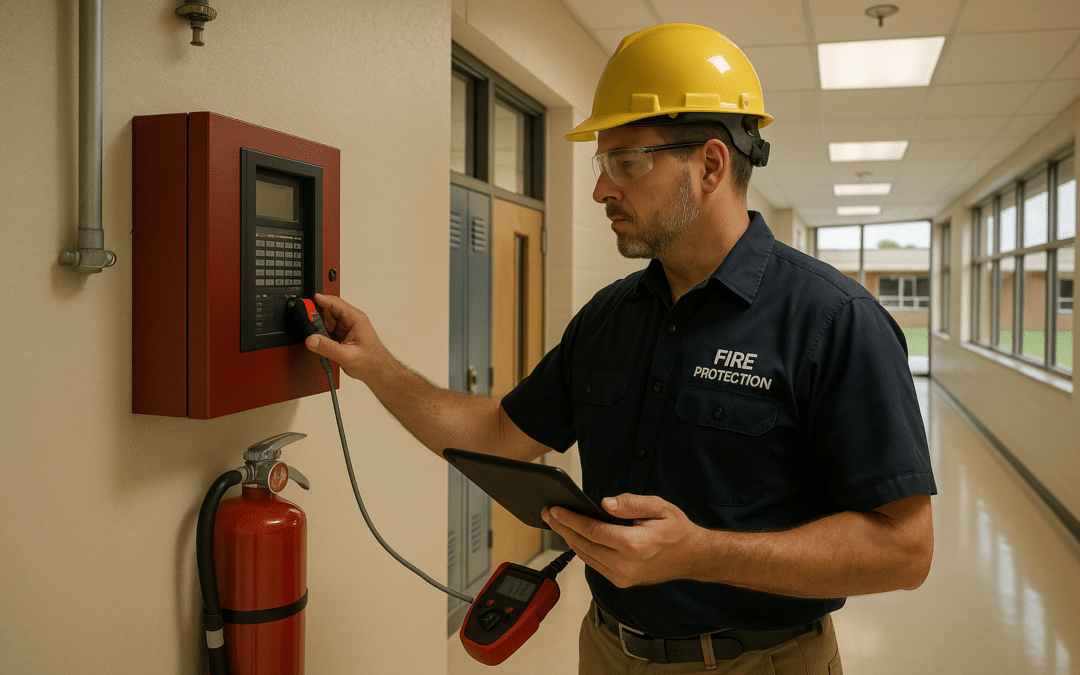
For a commercial system, the inspection is performed or directly supervised by a Fire Alarm Technician (FAL) or a Fire Alarm Planning Superintendent (APS).
This matters for school districts because a facilities team cannot legally self-perform the annual functional test, even if staff handle basic monthly visual checks. Using an unlicensed vendor can invalidate your inspection record entirely if the fire marshal or your insurance carrier ever audits it.
Fire Drill Requirements for Texas and Houston Schools
Drills are the other half of compliance, and Texas layers state education law on top of local fire code.
Under state law,
fire evacuation drill–school districts and open-enrollment charter schools should consult with the local authority having jurisdiction (e.g., fire marshal) and comply with its requirements and recommendations.
Where no local authority has adopted its own fire code, the state default applies:
a full fire evacuation drill must be conducted during each of the following time periods: within 10 school days after the start of the new school year, between November and the start of winter break, within 10 school days after returning from winter break, and between spring break and the end of the school year.
But Houston has adopted its own, stricter fire code requirement for schools.
The person in charge of any building classified as an Educational (Group E) Occupancy shall prepare an approved emergency evacuation plan for the building, which shall be submitted to the Fire Marshal.
Most notably,
it shall be the duty of the person in charge of each Educational Occupancy to conduct at least one (1) fire drill per month.
That’s far more frequent than the statewide minimum, and it’s the standard that applies to schools inside Houston city limits, including Downtown, Midtown, the Energy Corridor, and Bellaire.
Documentation matters as much as the drill itself.
All full fire evacuation drills and classroom exercises must be logged on a form created by the school district, and completed forms must be accessible at the school for three years, made available to the fire marshal upon request.
Local Enforcement: Who Shows Up and What They Check
Inside Houston city limits,
your local fire marshal enforces the code on your building — inside Houston city limits, that is the Houston Fire Marshal’s Office.
Campuses in unincorporated parts of Harris County, including some facilities near Cypress and Tomball, fall under a different office:
in unincorporated Harris County, it is the Harris County Fire Marshal’s Office, which conducts annual fire inspections of existing facilities.
Both offices have real enforcement teeth.
They can cite a building, order repairs, or red-tag a system.
For a school, a red tag on the fire alarm system is a serious operational problem, since it can affect continued occupancy until the system is restored and retested.
Permits are a related, often-overlooked piece.
Renew fire alarm and 911 key box permits annually
through the Houston Permitting Center, and keep the current permit on-site, since
issued permits shall be kept on the premises designated therein at all times and shall be readily available for inspection by the fire code official.
Pros and Cons of Different Compliance Approaches
In-House Monthly Checks Plus Contracted Annual Testing
Pros: Lower cost between annual visits; staff familiarity with the building; faster identification of obvious problems like a blocked pull station or missing extinguisher tag.
Cons: Facility staff generally cannot perform the legally required functional tests themselves; records can be inconsistent without a dedicated compliance system; it’s easy to miss the distinction between a visual inspection and a functional test.
Full-Service Contracted Inspection, Testing, and Monitoring
Pros: One licensed vendor handles required testing frequencies, documentation, and central station monitoring coordination; inspection reports are ready to hand to the fire marshal or your insurance carrier on demand; reduces risk of a missed interval triggering a violation.
Cons: Higher ongoing cost than a purely in-house approach; requires coordinating access and scheduling around the academic calendar.
For most Houston-area schools, a hybrid model works best: train staff to do basic monthly visual checks and keep drill logs current, while a licensed fire protection contractor handles the annual functional test, sensitivity testing, panel programming, and monitoring account.
When Compliance Gaps Typically Show Up
- After a renovation or portable building addition: New classrooms or modular buildings often need additional initiating devices and notification appliances wired into the existing panel, and any such change can require a new permit.
- At enrollment growth thresholds: Occupant load changes can trigger new monitoring or notification requirements.
- During staff turnover: If the person responsible for drill logging or alarm testing leaves, records can lapse without anyone noticing until an inspection.
- Multi-building campuses: Each building typically needs its own evacuation plan and may be inspected separately.
Campuses in Northwest Houston, Memorial City, and Willowbrook with aging alarm panels are especially prone to nuisance trouble signals and sensitivity drift that can go unnoticed between annual tests, which is why many facilities teams schedule a mid-year check alongside their monthly visual walkthroughs. If your district operates buildings across Northwest Houston, Memorial City, or Spring Branch, keeping each building’s inspection and permit records aligned on the same schedule simplifies audits significantly.
A Practical Compliance Checklist for Facilities Directors
- Confirm your fire alarm permit is current and posted on-site.
- Schedule the annual functional test with a licensed contractor registered with the Texas State Fire Marshal’s Office.
- Verify smoke detector sensitivity testing is on track for its alternate-year cycle.
- Conduct and log at least one fire drill per month if inside Houston city limits.
- Keep three years of drill logs accessible on-site.
- Confirm your system is connected to a UL-listed or FM-approved central station if your occupant load requires it.
- Review any recent renovations or portable buildings for added device coverage needs.
Final Thoughts
Fire alarm compliance for Houston schools isn’t a single checkbox; it’s an ongoing cycle of equipment testing, permit renewal, and documented drills enforced by two layers of authority: the fire marshal on the equipment side and state education law on the drill side. Falling behind on either one creates real risk, both for life safety and for the next inspection or insurance review.
Reliable Fire Protection works with school facilities teams across Greater Houston, including campuses near the Houston Heights and Willowbrook, to keep inspection schedules, permits, and monitoring aligned so nothing slips between academic semesters.
Recommended Reads
- Fire Alarm System Services in Northwest Houston
- Fire Alarm System in Memorial City Houston
- Fire Alarm System Services in Willowbrook, Houston