
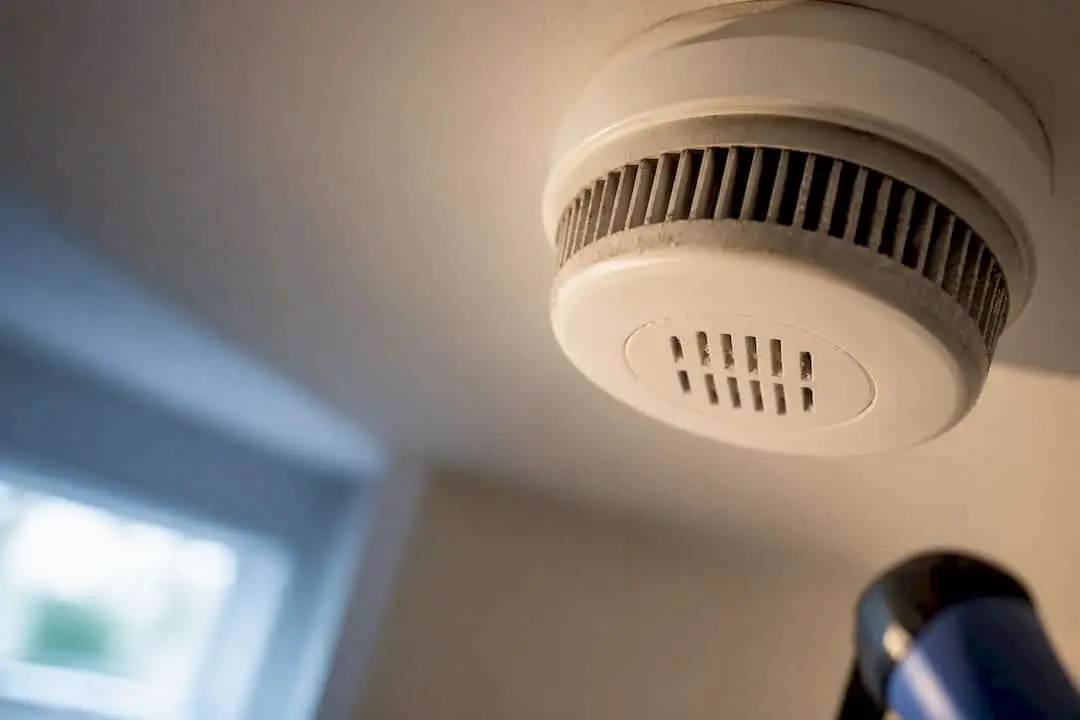
Replace household smoke alarms 10 years after their manufacture date, no exceptions for how clean they look or how well they tested last month. Carbon monoxide and combination alarms often need replacing sooner, on a schedule set by the specific model. Any alarm that fails a test, chirps persistently after a fresh battery, or shows cracks or corrosion needs to come down immediately, regardless of its age.
TL;DR:
- Replace smoke alarms every 10 years from their manufacture date, regardless of appearance or recent testing, to ensure sensor reliability.
- Carbon monoxide alarms typically last five to ten years, depending on the model, and must be replaced when the sensor wears out.
- Combo units should be replaced when the CO sensor reaches its shorter lifespan, not the smoke sensor’s longer limit.
- Chirping after battery replacement usually indicates an end-of-life alarm, not a low battery, requiring full replacement.
- Conduct monthly tests and record installation and maintenance dates to prevent undetected failures, especially in multi-unit or commercial properties.
Table of Contents
- Smoke Detector Lifespan Explained: Smoke, CO, and Combo Units
- Finding the Manufacture Date and Calculating Your Replacement Deadline
- Chirp Codes: End-of-Life vs. Low Battery vs. Test Failure
- Testing and Maintenance: The Schedule That Actually Works
- Hardwired Systems, Sealed Units, and Commercial Detectors
- Replacing an Alarm Yourself vs. Calling a Professional
- A Practical Checklist for Replacing Alarms Across a Property
- Why Scheduled Replacement Beats Waiting for a Failure
- Sources
Smoke Detector Lifespan Explained: Smoke, CO, and Combo Units
The 10 year rule for smoke alarms isn’t a marketing suggestion. It’s the standard set by both the U.S. Fire Administration and the National Fire Protection Association, and it exists because the sensing chamber inside a smoke alarm degrades with age. Dust, humidity, and slow chemical drift inside the sensor eventually make it less reliable, long before most owners notice anything wrong.
Carbon monoxide alarms play by different rules entirely. Their electrochemical sensors wear out faster than optical smoke sensors. Older CO alarms were often rated for 5 to 7 years, while Kidde’s current guidance puts many modern models at 7 to 10 years, with some sealed units rated a full decade.
Combo smoke/CO units inherit the shorter lifespan of whichever sensor wears out first. That’s almost always the CO sensor. A few things to keep in mind:
- Smoke alarms: 10 years from manufacture, no exceptions.
- CO alarms: check the model label; commonly 5 to 10 years depending on age and design.
- Combo units: replace on the CO sensor’s shorter timeline, not the smoke sensor’s longer one.
Finding the Manufacture Date and Calculating Your Replacement Deadline
Every alarm has a manufacture date printed somewhere on the housing, usually on the back or inside the battery compartment. Some newer models print an explicit “replace by” date instead, which saves you the math entirely.
Here’s how to work it out:
- Pop the unit off its mounting bracket and check the back panel or battery door for a stamped date.
- If you see a “replace by” date, that’s your deadline. Done.
- If you only see a manufacture date, add the rated life for that unit type (10 years for smoke, 5 to 10 for CO) to get your deadline.
- Write the date somewhere you’ll actually see it again, like a phone reminder or a printed sticker on the unit.
The clock starts at manufacture, not installation. A smoke alarm can sit in a warehouse or on a store shelf for a year or more before it ever gets mounted on your ceiling.
Pro Tip: When buying a new alarm, check the manufacture date on the box before you check out. A unit that’s already sat on a shelf for 18 months just cost you a year and a half of usable life.
Chirp Codes: End-of-Life vs. Low Battery vs. Test Failure
A chirping alarm isn’t always a battery problem, and treating every chirp the same way is how households end up with a dead detector they think is fine.
End-of-life chirp: a single, persistent beep every 30 to 60 seconds that keeps going even after you swap the battery. This is the sensor telling you it’s done, and no amount of fresh batteries fixes it. Replace the whole unit.
Low-battery chirp: looks nearly identical, a single beep on that same 30 to 60 second cycle, but it stops as soon as you install a new battery. If the chirping continues after a battery swap, you’re dealing with end-of-life, not a battery issue. Our battery replacement guide walks through the swap step by step.
Replace immediately if any of these show up:
- The unit fails its monthly test button check.
- Chirping persists after a fresh battery.
- The housing is cracked, discolored, or shows corrosion around the battery contacts.
- The alarm doesn’t respond at all when tested.
Testing and Maintenance: The Schedule That Actually Works
Monthly testing is non negotiable, and it’s the single habit most likely to catch a failure before it matters. Field research on installed smoke alarms shows some units fail well before their rated 10 year life, which is exactly why date tracking alone isn’t enough.
- Press and hold the test button until the alarm sounds. A pass means a loud, clear alert, not a weak or delayed one.
- Replace removable batteries once a year, even if they haven’t chirped yet.
- For sealed 10-year battery units, there’s no battery to swap. When the unit reaches its rated life, the whole thing gets replaced.
- Log the manufacture date, install date, and test results for every unit, especially in a rental property or multiunit building.
Pro Tip: Keep a simple spreadsheet with one row per alarm: location, manufacture date, replace-by date, last test date. It takes ten minutes to set up and saves hours during an inspection.
Hardwired Systems, Sealed Units, and Commercial Detectors
Hardwired alarms wired into your home’s electrical system usually carry a battery backup for power outages, but the sensor inside still ages on the same 10 year clock as any battery-only unit. Because these units tie into house wiring and often interconnect with every other alarm in the building, swapping one out sometimes calls for an electrician, particularly if the wiring harness doesn’t match the new unit.
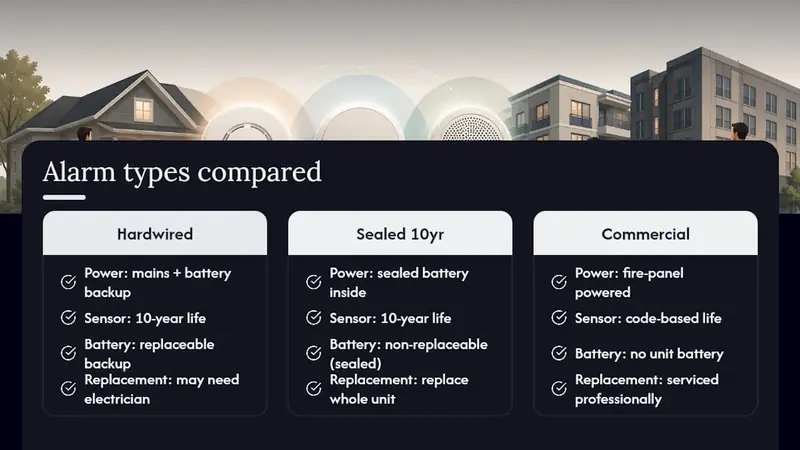
Sealed 10-year units solve the “dead battery at 3 a.m.” problem, but they don’t extend sensor life. When the decade’s up, the entire unit gets replaced, battery and all.
Commercial buildings play a different game altogether. Building fire alarm systems use detectors, not household alarms, and those get serviced under NFPA 72 inspection schedules rather than the consumer 10 year rule. Facility managers need documented, professional testing on a schedule set by code, not by a sticker on the unit.
Replacing an Alarm Yourself vs. Calling a Professional
Battery-only and plug-in smoke alarms are usually a straightforward swap. Cut power if it’s a plug-in model, match the new unit’s mounting bracket to the old one, and confirm the wiring harness connector matches before you commit.
Call a professional when:
- The unit is hardwired and interconnected with other alarms in the house.
- You’re replacing detectors as part of a commercial fire alarm system that requires code compliance verification.
- You’re not confident the new unit’s wiring harness matches the old one.
Expired sealed units contain lithium batteries and electronic components, so they shouldn’t go straight into household trash. Many municipalities offer e-waste or battery recycling drop-off points that accept them.
A Practical Checklist for Replacing Alarms Across a Property
Working through dozens of properties teaches you fast that “replace by” dates get missed constantly, usually because nobody wrote them down in the first place. A pre-replacement checklist closes that gap:
- Pull the manufacture or replace-by date off every unit and photograph the label for your records.
- Test each alarm and log pass or fail results.
- Flag any unit that fails, chirps persistently, or shows physical damage for immediate swap.
- Group remaining replacements by zone or floor so you’re not making a dozen separate trips over a year.
- Cross-check your replacement plan against NFPA guidance and keep dated records on hand for inspections.
Pro Tip: Align batch replacements with a property’s annual inspection cycle. You’re already touching every unit for the inspection; replacing anything near its expiry date at the same time cuts your service calls roughly in half.
Why Scheduled Replacement Beats Waiting for a Failure
Every property with enough units eventually has one that fails early, sometimes years before its rated life runs out. It’s rarely dramatic. A unit just goes quiet, or starts chirping in a pattern nobody catches until a tenant complains. That’s the real argument for date-based scheduling over the “wait until it acts weird” approach most people default to. A calendar doesn’t miss units the way a busy building manager can.
If you’re managing a handful of units, dates and battery swaps are enough. Once you’re managing dozens across a commercial or multi-tenant property, that spreadsheet approach starts breaking down, and that’s usually when a professional inspection and bulk replacement service makes more sense than doing it unit by unit. Some companies offer scheduling services for property managers who’d rather not track expiry dates by hand.
— Results
Sources
For deeper reading on replacement standards, the U.S. Fire Administration and NFPA’s installation guide cover smoke alarm rules in detail. For CO alarms, check Kidde’s replacement guidance and the CPSC’s carbon monoxide safety center. Consumer Reports offers a useful consumer-facing buying guide as well.
- Smoke alarms | U.S. Fire Administration
- Smoke Alarm Installation Guide (NFPA)
- When Should I Replace My Carbon Monoxide Alarm? | Kidde