
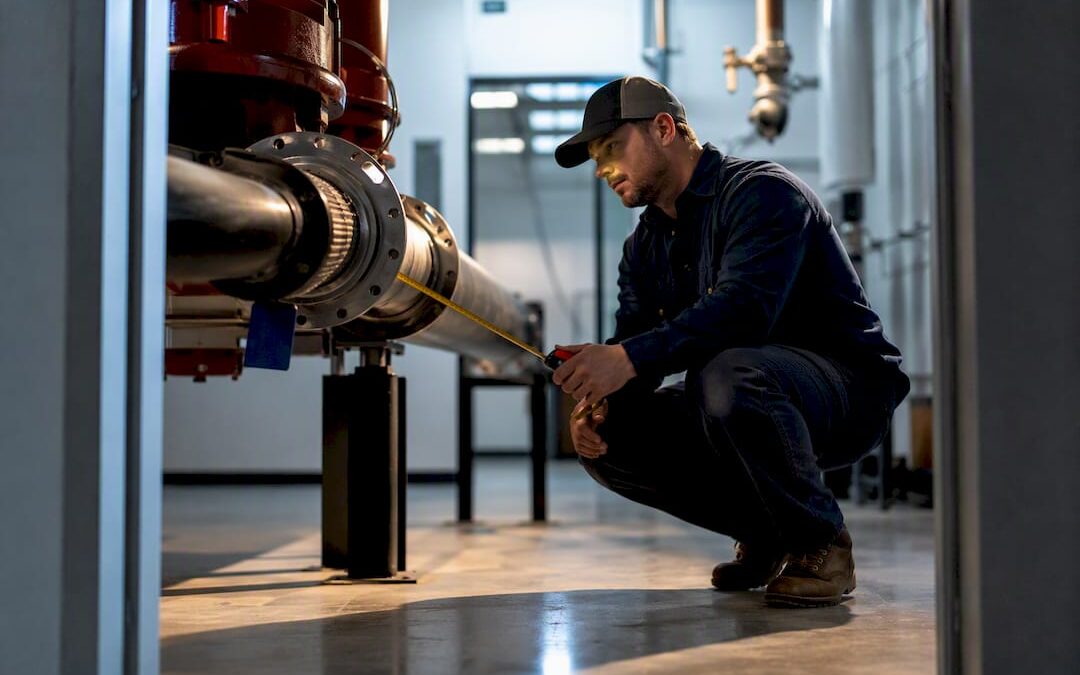
Replacing a commercial fire pump system typically costs from tens of thousands to over one hundred thousand dollars, depending on driver type, capacity, and piping conditions. Small electric units for a mid-size commercial building sit near the low end; packaged diesel systems for high-rise or industrial applications push toward the top. The three factors that move your quote the most are the pump package itself, piping and site labor, and certification or testing requirements. The breakdown below shows exactly where that money goes.
TL;DR:
- Piping modifications and site work can significantly increase costs, especially if the replacement pump’s footprint or flange orientation doesn’t match the existing system.
- The pump and driver package is the largest expense, with electric options generally cheaper upfront and on maintenance, while diesel units cost more but suit high-reliability sites.
- Permitting, engineering reviews, and commissioning typically add several thousand dollars and can extend project timelines by weeks depending on jurisdiction.
- Avoid overpaying by requesting itemized bids for the pump, piping, and testing, and aim for a match to existing dimensions to reduce custom fabrication costs.
- Deciding to repair or replace hinges on the pump’s age, current performance, parts availability, and remaining useful life, with repairs costing more if multiple failures occur recently.
Table of Contents
- What Does a Fire Pump Replacement Cost Include?
- What Factors Change Your Fire Pump Quote the Most?
- Should You Repair or Replace Your Fire Pump?
- How Long Does a Fire Pump Replacement Take?
- How Can You Lower Fire Pump Replacement Costs?
- How Reliable Fire Protection Supports Your Replacement Project
- Why Most Cost Guides Undersell the Real Risk
- Get a Fire Pump Replacement Quote From Reliable Fire Protection
- Sources
What Does a Fire Pump Replacement Cost Include?
A vendor quote for fire pump replacement is never just “the pump.” It’s a stack of separate line items, and knowing what belongs in each one is the fastest way to spot a lowball bid that’s missing scope or a padded one charging twice for the same work.
Pump package and driver. This is usually the single biggest line item, and it swings widely based on driver type. Electric-driven pumps generally cost less upfront and run cheaper to test and maintain over time, while diesel-driven packages cost more initially and carry ongoing engine service expenses, but they’re often specified where electrical reliability at the site is a concern. Industry pricing guides put small electric commercial units at moderate costs, with large packaged diesel systems for high-rise buildings costing significantly more.
Vertical turbine and specialty pumps follow their own pricing logic. A small 500 GPM turbine unit can start in the low thousands for the pump itself, but material choice changes the math fast — stainless-steel bowls and components for corrosive-service applications (coastal facilities, chemical plants, certain industrial sites) can add 30% to 50% over a standard cast-iron unit.
Controller. A fire pump controller is a separate purchase from the pump and driver, and it’s not optional hardware you can skip to save money. Controllers range from several thousand dollars for a basic electric unit to significantly higher for diesel controllers with full monitoring, transfer switches, and remote alarm capability. UL/FM-listed controllers cost more than unlisted units, but many authorities having jurisdiction (AHJs) and insurers require the listing outright.
Piping modifications and structural or electrical work. This is where quotes diverge the most between two contractors bidding the same job. If the new pump’s footprint, centerline height, or flange orientation doesn’t match the old unit, you’re paying for custom spool fabrication, field welding, and possibly structural changes to the pump room. Electrical work — including disconnects, conduit runs, and transfer switch wiring for diesel units — adds additional costs.
Labor. Installation labor is typically quoted separately from materials and can represent a large share of total project cost when piping or footprint changes are involved. A straightforward swap with matching dimensions costs far less in labor than a retrofit that requires re-routing suction and discharge piping.
Permits, engineering submittals, and commissioning. Every fire pump replacement requires AHJ review, and most jurisdictions require submittal drawings stamped by a licensed engineer before you can pull a permit. Commissioning under NFPA 20 includes witnessed acceptance testing, flow verification, and controller programming checks, all of which take contractor time and often a third-party witness fee.
Here’s how those pieces typically stack up on a mid-size commercial replacement:
- Pump and driver package: $20,000 to $150,000+ depending on type and certification
- Controller: $3,000 to $15,000+ depending on listing and features
- Piping modifications: highly variable, often the largest wildcard on the invoice
- Electrical work: $2,000 to $10,000+ depending on driver type and existing infrastructure
- Labor: quoted separately, higher when footprint or piping changes are needed
- Permits and engineering submittals: typically a few thousand dollars, varies by AHJ
- Commissioning and witnessed testing: usually bundled with installation labor, but confirm this in writing
Pro Tip: Ask every bidder to itemize the controller, piping, and commissioning costs separately from the pump package to enable clearer comparison between bids and avoid hidden scope issues.
Specifying a UL/FM-listed packaged system raises your upfront number, but it reduces long-term risk and may be non-negotiable if your insurer or AHJ requires the listing. Build that premium into your budget from the start rather than discovering it mid-bid.
What Factors Change Your Fire Pump Quote the Most?
Two buildings with nearly identical square footage can get wildly different quotes for what looks like the same job. The variables below explain why.
Required flow and pressure (GPM/TDH). Your building’s hydraulic demand, expressed in gallons per minute and total dynamic head, determines which pump model fits. A higher GPM/TDH requirement often pushes you into a larger pump class entirely, not just a bigger version of the same unit, and that jump in class is where costs escalate fastest.
Footprint mismatch. When the replacement pump’s centerline height, flange size, or orientation doesn’t match the pump it’s replacing, contractors have to fabricate custom pipe spools or modify the pump room structure to make the connection work. Matching those dimensions to the existing unit is one of the most reliable ways to control labor cost, since it lets the crew reuse existing suction and discharge runs instead of rebuilding them.
Permitting and AHJ review time. Engineering submittals, plan review, and inspection scheduling all add cost and, more importantly, time. Some jurisdictions turn around fire protection submittals in a couple of weeks; others take much longer, especially if your project also triggers a sprinkler system review under a related permit. Coordinating pump work with any sprinkler system upgrades happening at the same time can save a second round of AHJ review.
Site access and confined-space conditions. Pump rooms in older buildings are frequently tight, below grade, or accessible only through a narrow hallway. If a crane is needed to lower equipment through a roof opening, or if crews need confined-space certification to work in the pump room, expect a premium on labor that has nothing to do with the pump itself.
- Higher GPM/TDH demand usually means a larger, more expensive pump class
- Mismatched footprint drives custom fabrication and extra labor hours
- Slow AHJ review extends the timeline more than it inflates the price
- Confined or below-grade pump rooms add access-related labor costs
- Diesel installations need fuel storage, ventilation, and exhaust routing that electric units skip entirely
Local labor and material costs also matter more than most facility managers assume. A packaged diesel system installed in a major metro area will typically cost more in labor than the identical package installed in a smaller market, due to regional differences in skilled labor rates.
Should You Repair or Replace Your Fire Pump?
Age alone doesn’t tell you whether to repair or replace. What matters is the combination of age, performance, failure frequency, and parts availability.
- Check the age against expected service life. Most fire pumps are engineered for multi-decade service, but components like bearings, seals, and controller electronics wear out well before the pump housing does. A pump past 20 to 25 years old is worth a full condition assessment even if it’s still passing annual tests.
- Test actual output against rated flow. If your pump is delivering substantially less than its rated GPM at rated pressure during annual NFPA 25 flow tests, that’s an objective replacement signal, not a maintenance issue you can patch indefinitely.
- Count recent failures. One failure is a repair. Repeated failures within a short window, especially involving different components each time, usually point to a pump nearing the end of its useful life rather than a string of bad luck.
- Confirm OEM parts availability. If the manufacturer no longer stocks replacement parts for your specific model, every repair becomes a scramble for aftermarket substitutes or custom machining, both of which cost more and take longer than a straightforward parts order.
- Run the math. Add up the cost of the needed repair plus your best estimate of remaining useful life, then compare that against the amortized annual cost of a new pump over its expected service life. If the repair buys you only a few more years before the next major failure, replacement usually wins on a cost-per-year basis.
- Factor in warranty, efficiency, and liability. A new pump typically comes with a manufacturer warranty that a repaired 25-year-old unit cannot match, and modern electric drivers are often more energy-efficient than older models. If your insurer has flagged the pump’s age or reliability, that liability exposure belongs in the decision too.
How Long Does a Fire Pump Replacement Take?
Timeline depends almost entirely on whether you’re doing a straightforward swap or a full retrofit with piping changes.
- Site survey and specification (1 to 2 weeks). A contractor measures the existing footprint, verifies hydraulic requirements, and confirms driver type before drafting submittal drawings.
- Engineering submittal and AHJ review (2 to 6 weeks). Stamped drawings go to the local authority having jurisdiction for approval. Review time varies significantly by jurisdiction and season.
- Procurement and lead time (4 to 16 weeks). Standard electric pumps and controllers often ship faster than diesel packages or anything requiring custom materials like stainless-steel components.
- Installation (days for a matched-footprint swap; 1 to 3 weeks for a retrofit). Piping modifications, electrical work, and structural changes are what stretch this phase.
- NFPA commissioning and witnessed acceptance testing (1 to 3 days). This is required under NFPA 20 before the system can be placed in service, and it typically requires scheduling a third-party witness alongside the AHJ inspector.
- AHJ final sign-off. Some jurisdictions inspect same-day; others require a separate scheduled visit that adds another week or more to the calendar.
While the pump is out of service, most AHJs require a documented fire watch or an alternate water supply plan to maintain code compliance. Confirm this requirement with your local fire marshal’s office before scheduling the shutdown, not after the pump is already offline.
How Can You Lower Fire Pump Replacement Costs?
The cheapest replacement is the one that doesn’t require touching the piping at all. Request a transposition diagram from your vendor showing exact centerline height, flange dimensions, and suction/discharge orientation compared to your existing pump, and insist on a match wherever a comparable model exists. That single request often prevents the custom fabrication work that turns a modest quote into an expensive one.
- Bundle installation and commissioning with one contractor instead of hiring separately for each phase
- Negotiate a warranty and spare-parts package into the purchase price rather than paying for parts availability later
- Keep up with NFPA 25 testing and preventive maintenance, since annual electric pump testing service often runs around $1,200 and catches problems long before they force an emergency replacement
- Only consider refurbished components when your AHJ, insurer, and the original manufacturer all provide documentation supporting their use
Pro Tip: If your building has sat with an idle diesel pump for an extended period, budget for gland packing replacement during startup. Long idle periods degrade seals, and that repair alone can run into the thousands if it’s discovered after commissioning instead of before.
For a broader look at how other building mechanical systems approach lifecycle cost control, the maintenance workflow strategies used in commercial HVAC upkeep follow similar logic: preventive testing costs far less than emergency replacement.
How Reliable Fire Protection Supports Your Replacement Project
Reliable Fire Protection has served Houston-area commercial, industrial, healthcare, and hospitality properties with code-driven fire protection work, including system inspection, installation, and repair services that keep facilities aligned with NFPA requirements. Before requesting quotes on a fire pump replacement, a few resources are worth reviewing:
- Fire pump testing requirements covering NFPA 25’s 30-minute and 10-minute weekly run schedules and logging obligations
- Fire pump requirements for property owners, which walks through code and AHJ expectations that shape replacement scope
- NFPA 20 for the installation and commissioning standard governing every stationary fire pump project
- U.S. Fire Administration guidance (FA-43) on inspection and preventive maintenance practices that extend pump service life
When you’re ready to request quotes, copy this short checklist into your RFQ: current pump GPM/TDH rating and driver type, controller listing status (UL/FM), pump room access constraints, existing footprint dimensions, and whether piping modifications are anticipated. A contractor who can answer all five points in writing before bidding is one worth taking seriously.
Why Most Cost Guides Undersell the Real Risk
The conventional advice on fire pump replacement treats it like buying an appliance: get three quotes, pick the middle one, done. That approach misses the variable that actually determines your final invoice, which is footprint compatibility, not brand or driver type.
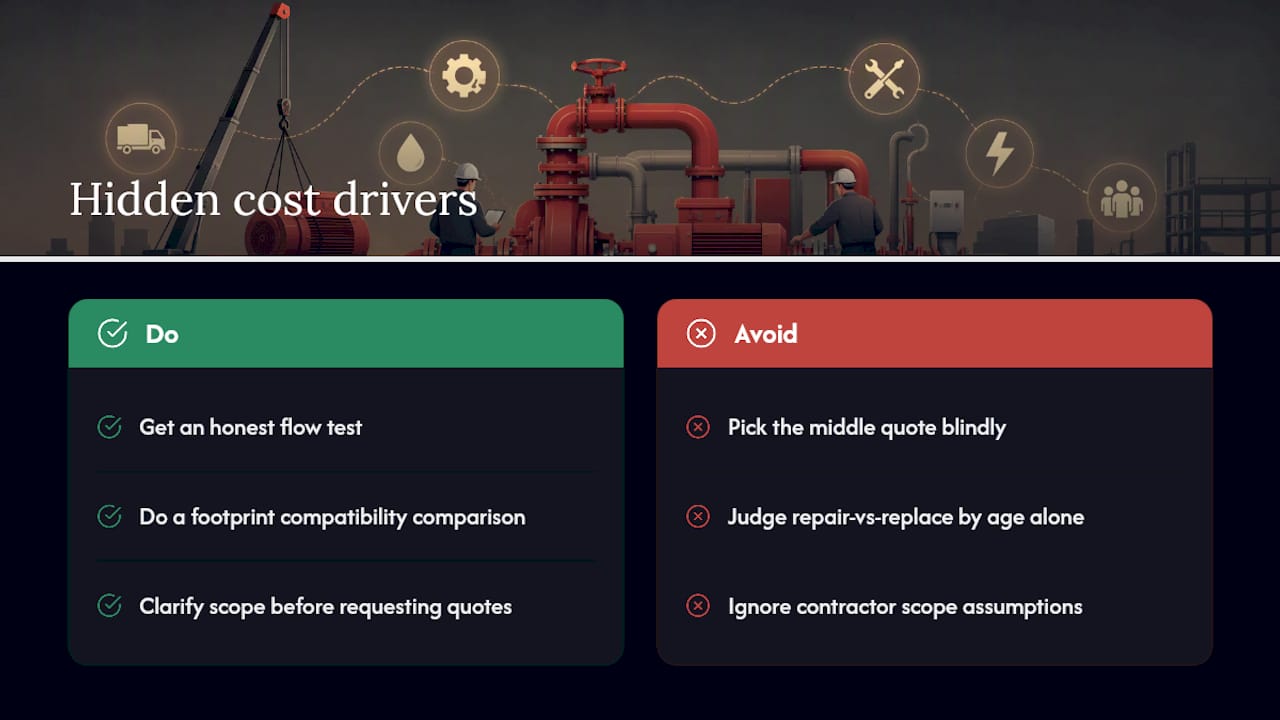
Two identical-looking quotes can differ by tens of thousands of dollars because one contractor assumed a matched-footprint swap and the other correctly priced in custom piping fabrication. Facility managers who get burned on this project almost always got burned on scope, not on the sticker price of the pump itself.
The other place conventional guidance falls short is treating repair-vs-replace as a pure age calculation. Age matters, but a five-year-old pump with a chronic parts-availability problem is a worse investment than a fifteen-year-old pump that still tests clean and has full OEM support. Prioritize getting an honest flow test and a footprint comparison before you request a single quote. Everything downstream, timeline, permitting, and final cost, gets easier once those two numbers are known.
— Results
Get a Fire Pump Replacement Quote From Reliable Fire Protection
Property and facility managers can use a single point of contact for the entire replacement process, from initial site assessment through NFPA 20 commissioning and AHJ sign-off, instead of juggling separate vendors for equipment, piping, and testing.
That matters most when a footprint mismatch or a controller listing requirement threatens to blow up your budget mid-project. Because Reliable Fire Protection handles fire alarms, sprinklers, suppression systems, and detection equipment alongside pump work, coordination between an aging pump and a related sprinkler system upgrade happens under one roof rather than through two contractors pointing fingers at each other over scope. If your pump is already showing the failure signals covered above, or you simply need a clear, itemized number to bring to your budget committee, request a free quote through Reliable Fire Protection’s services page and get a written scope before you commit to anything.
Sources
- NFPA 20 — Standard for the Installation of Stationary Pumps for Fire Protection
- U.S. Fire Administration — Fire Pump inspection/maintenance guidance (FA-43)
- Firepumps
- Vertical turbine fire pump price list — HYVTPPumps
- When to replace vs repair a fire pump — 91FirePump