

ESFR sprinklers are appropriate for high-piled or rack storage of Group A plastics and comparable commodities when the installation satisfies NFPA 13 clearance and obstruction rules, meets K-factor and discharge requirements, and follows storage-shelf criteria. Governing references include NFPA 13, the Fire Protection Research Foundation’s obstruction research, FMRC test metrics, and NFPA 25 for ongoing inspection. Miss any one of these, and the AHJ has grounds to reject the design.
TL;DR:
- Verify that the storage height, commodity classification, and ceiling clearance meet NFPA 13 requirements before designing an ESFR system.
- Continuous obstructions like ductwork require stricter offset allowances and thorough shadow analysis to avoid sprinkler performance issues.
- Selecting the appropriate K-factor depends on ceiling height, storage configuration, and hydraulic pressure, with detailed modeling necessary for compliance.
- Proper coordination with mechanical, electrical, and structural trades before finalizing sprinkler layouts prevents costly obstruction or clearance violations.
- Documented testing results and adherence to recent NFPA 13 updates are critical when justifying alternative configurations or engineered deviations to authorities.
Table of Contents
- Quick Checklist: Essential ESFR Sprinkler Requirements at a Glance
- What Are the NFPA 13 Obstruction and Clearance Rules for ESFR?
- How Do K-Factor and Hydraulic Requirements Work for ESFR Systems?
- Which Storage and Shelving Configurations Work With ESFR?
- How Do Fans, Heaters, and Conveyors Affect ESFR Placement?
- What Inspection and Maintenance Does NFPA 25 Require for ESFR?
- What Recent Research and Code Changes Affect ESFR Design?
- A Contractor’s View on Getting ESFR Approved the First Time
- How Reliable Fire Protection Handles ESFR Design and Compliance
- Standards and Reports Worth Keeping on File
- Sources
Quick Checklist: Essential ESFR Sprinkler Requirements at a Glance
Before spending hours on hydraulic calculations, run through the gating items that determine whether ESFR sprinkler requirements even apply to your project. A five-minute checklist here saves weeks of redesign later.
- Confirm the enforced code edition. AHJs adopt NFPA 13 on their own timeline, and a jurisdiction three editions behind current will apply different clearance tables than a newly updated one.
- Verify commodity classification. ESFR is built around Group A plastics, expanded/unexpanded plastics, and certain rolled or baled goods. Commodities outside those classes may need conventional control-mode density/area design instead.
- Check top-of-storage clearance. The typical minimum is 36 inches from the top of storage to the sprinkler deflector, though this shifts with ceiling height and commodity class.
- Map obstruction offsets. Horizontal and vertical clearance rules differ for continuous obstructions (long ductwork, conveyors) versus isolated ones (a single column or light fixture).
- Lock in K-factor and pressure/flow. The K-factor drives required discharge pressure and GPM at each head, which cascades into pipe sizing and pump selection.
- Line up NFPA 25 obligations. Inspection, flow testing, and documentation requirements start the day the system is accepted, not years later.
A project that clears every item above has a real shot at ESFR. A project that stumbles on commodity classification or top-of-storage clearance usually needs a different sprinkler technology entirely, and better to know that in week one than in month six.
What Are the NFPA 13 Obstruction and Clearance Rules for ESFR?
NFPA 13 splits obstructions into two categories, and the distinction changes everything about how much offset you need. A continuous obstruction runs the length of an aisle or bay, things like a duct run, a cable tray, or a conveyor. An isolated obstruction is a discrete object, such as a single column, a light fixture, or a sprinkler pipe crossing perpendicular to the protected area. NFPA 13 sets tighter tolerances for continuous obstructions because they block spray patterns over a much larger footprint.
The numeric thresholds designers reference most often:
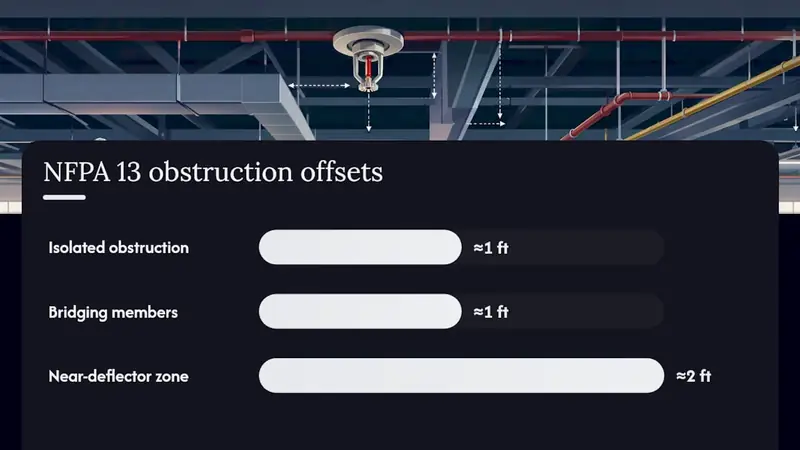
- A minimum horizontal offset of about one foot is generally required between an isolated obstruction and the sprinkler when the obstruction sits below the deflector plane.
- Continuous obstructions of certain widths demand a full evaluation of the shadow area beneath them since the standard shadow-and-offset math scales with obstruction width.
- Obstructions positioned within approximately two feet below the deflector face stricter horizontal offset math than the same object located lower.
- Round or curved obstructions are treated differently than flat obstructions of similar size, owing to their narrower spray shadow.
- Bridging members and bar joists have specific exceptions distinct from general obstruction rules, due to their common presence in warehouse ceilings.
That last point matters more than any other in this section. Bar joists and bridging members show up in almost every rack-storage building, and the Fire Protection Research Foundation’s obstruction study tested them directly. Full-scale testing found that certain configurations, including open web trusses in the typical mid-depth range offset horizontally, and bridging members positioned about one foot below the sprinkler, did not meaningfully degrade K-14 or K-17 ESFR performance under test conditions. That finding gave the technical committee real data to loosen what had been a conservative blanket rule.
Adding equipment after the sprinkler layout is finalized is where most obstruction violations happen. HVAC ductwork, new conveyor lines, or a mezzanine deck dropped into an existing rack aisle can turn a compliant system into a non-compliant one overnight. The question designers always ask: can you just add a pendent sprinkler beneath the new obstruction and call it solved? Sometimes, but only if the added head still meets spacing, K-factor, and discharge requirements for the commodity above and below it. It isn’t a universal fix, and NFPA 13 doesn’t treat it as one.
Pro Tip: When a proposed obstruction falls outside the standard NFPA 13 tables but closely resembles a configuration the FPRF actually tested, document that comparison and bring it to the AHJ as engineered justification rather than requesting a blanket variance. Reviewers respond far better to “this matches tested condition X” than to “trust our judgment.”
How Do K-Factor and Hydraulic Requirements Work for ESFR Systems?
K-factor selection is where ESFR sprinkler requirements stop being a code-reading exercise and start being a hydraulics problem. The K-factor determines how much water flows through a sprinkler orifice at a given pressure, and ESFR heads are manufactured in a range designed to hit specific discharge targets fast, since the entire ESFR concept depends on suppressing a fire before it grows past the sprinkler’s capacity.
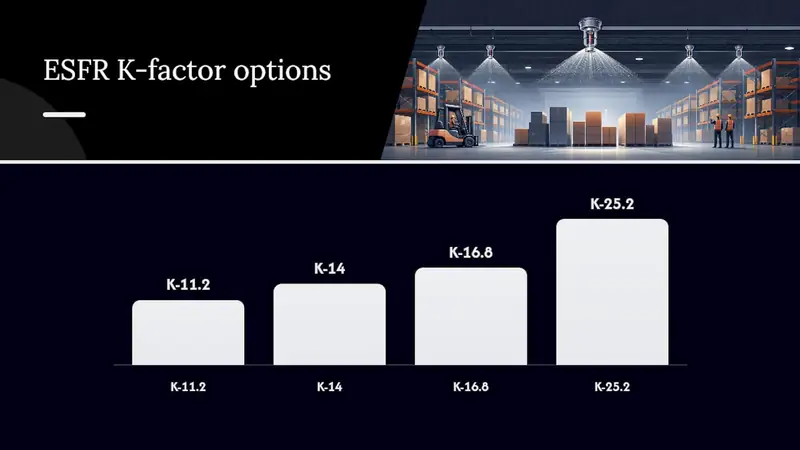
Commonly selected ESFR K-factors include K-11.2, K-14, K-16.8, and K-25.2, with the choice driven by ceiling height, storage height, and commodity classification. Higher K-factors generally support taller storage configurations but demand more water at the source, which is exactly where water supply and pump sizing enter the conversation early rather than late.
- Start with the manufacturer’s listed hydraulic table, not a generic NFPA 13 density chart, since ESFR approval is inherently tied to specific listed sprinkler models.
- Cross-check required pressure against available static pressure at the site before committing to a K-factor, particularly on sites without a dedicated fire pump.
- Model the design area at full hydraulic demand, including the number of sprinklers NFPA 13 requires operating simultaneously for the storage configuration in question.
- Flag pump capacity gaps early, because upsizing a fire pump mid-project is one of the most expensive change orders in commercial fire protection.
FM Global testing established the underlying performance thresholds that ESFR approval rests on. Documented results showed a minimum center-core thrust around 101.3 N/m2 measured 1.77 meters beneath the deflector, alongside a minimum water flux near 0.614 L/s/m2 across a 2.15 by 2.15 meter area in tested scenarios. Those numbers aren’t abstract lab trivia. They’re the physical basis for the pressure and flow figures listed on every approved ESFR sprinkler’s data sheet, and they explain why two sprinklers operating side by side in a design area change the flux math compared to a single-head scenario.
Only use listed ESFR sprinklers for the exact application they were tested against. Substituting a similar-looking head from a different K-factor family, or applying one outside its listed ceiling height range, voids the entire performance basis the standard relies on.
Which Storage and Shelving Configurations Work With ESFR?
ESFR sprinkler requirements are tightly bound to how the commodity is stored, not just what it’s made of. Group A plastics, expanded and unexpanded plastic products, and certain rolled or baled goods like paper rolls and tires are the classic ESFR candidates, largely because these commodities burn with the intensity and speed ESFR was engineered to suppress. Storage height, aisle width, and rack configuration all factor into whether a given commodity stays within ESFR’s tested envelope or needs supplemental in-rack sprinklers.
Solid shelving is generally prohibited under ESFR protection because it blocks vertical water penetration into the rack, which defeats the fast suppression mechanism the system depends on. Wire-mesh decking or other open-area shelving that allows water to reach lower tiers is the standard requirement instead.
- Transverse flue space of at least 6 inches between back-to-back racks is typically required to let water reach the base of the storage array.
- Longitudinal flue space guidance varies by configuration, but blocked or narrowed flues are a recurring cause of ESFR underperformance in real fires.
- Top-of-storage clearance of 36 inches from the highest point of storage to the sprinkler deflector is the standard benchmark, though this can shift with specific ceiling heights and commodity classes under the current edition.
- In-rack sprinklers may still be required for commodities or storage heights that exceed ESFR’s tested and listed range, even within an otherwise ESFR-protected building.
Practitioner guidance consistently frames this well: ESFR performance depends on an unobstructed spray path from deflector to commodity, and a blocked flue space or an unauthorized solid shelf is one of the most common failure points documented after fire events.
How Do Fans, Heaters, and Conveyors Affect ESFR Placement?
Field conditions defeat more ESFR designs than code misreadings do. Here’s what to coordinate before the sprinkler layout gets locked:
- HVLS fans need enough offset from sprinkler heads to avoid disrupting the thermal plume that triggers activation. A fan mounted too close to a sprinkler can delay or distort the heat signature the sprinkler is waiting to detect, so manufacturers publish specific minimum clearances that should be treated as a hard design constraint, not a suggestion.
- Unit heaters radiate heat that can push a nearby sprinkler’s fusible element toward its trigger threshold prematurely, or in some layouts, mask a real fire signature. Sprinklers near unit heaters often need a higher temperature-rated element to compensate.
- Conveyors and mezzanines frequently trigger a need for supplemental sprinklers beneath the obstruction, especially where the conveyor deck qualifies as a continuous obstruction under NFPA 13’s definitions.
- Roof slope matters more than most designers expect. A slope beyond roughly 2 inches per 12 inches of run changes deflector distance calculations and can push a design outside standard tables entirely.
- Bar joist bottom-chord width interacts directly with sprinkler placement options, and this is exactly where the FPRF testing on bridging members becomes practically useful rather than academic.
Site coordination with structural and mechanical teams on real is where good projects avoid bad surprises, especially following Electrical Code Corrections In Northeast Ohio | Tri-County for proper electrical coordination during ESFR installations. A fan supplier who doesn’t know sprinkler locations, or a mechanical contractor who routes ductwork after the sprinkler shop drawings are approved, is the single most common source of late-stage obstruction violations on commercial projects.
Pro Tip: Request final reflected ceiling plans from every trade, mechanical, electrical, and structural, before finalizing sprinkler head layout. A ten-minute coordination meeting in the design phase costs far less than a field change order after ductwork is already hung.
What Inspection and Maintenance Does NFPA 25 Require for ESFR?
ESFR systems don’t stay compliant on their own. NFPA 25 sets the inspection, testing, and maintenance intervals that keep a system performing the way it was designed to, and ESFR heads carry a few extra items worth watching closely.
- Visual inspections should check the thermal element for dust, paint overspray, or corrosion, since ESFR’s fast-response mechanism depends on an unobstructed, sensitive element.
- Orientation and physical damage checks matter more for ESFR than standard sprinklers, given the tighter deflector-to-storage clearance tolerances.
- Flow and pump testing must confirm the system can actually deliver the pressure and GPM the hydraulic design assumed, not just that water moves through the pipe.
- Documentation and tagging should be retained on-site and made available immediately during an AHJ inspection, since gaps in records are a common source of citations.
- Licensed contractor involvement is generally required for any repair or head replacement, given the listed-approval constraints tied to ESFR hardware.
Facility managers who treat NFPA 25 as an annual afterthought instead of a standing operational checklist are the ones who find out about a problem during a real fire event, which is the worst possible time to learn it. A structured inspection routine built into normal facility operations catches head damage and flow issues long before they become a code violation or, worse, a suppression failure.
What Recent Research and Code Changes Affect ESFR Design?
The FPRF’s multi-year obstruction study is the most consequential piece of ESFR research in the past decade, largely because it gave the NFPA 13 technical committee actual test data instead of decades-old conservative assumptions. The research produced an analytical obstruction tool designers can use to evaluate configurations that fall outside the standard tables, provided the scenario resembles something the study actually tested.
The FPRF’s full-scale testing demonstrated that several obstruction configurations long treated as automatic violations—deep open web trusses offset horizontally and bridging members positioned close beneath the deflector—did not meaningfully reduce K-14 and K-17 ESFR performance under the conditions tested. That single finding reshaped how the technical committee approached obstruction rules going into the next code cycle.
NFPA Journal’s coverage of the project traced how those findings moved from lab data into committee deliberation, which is worth understanding if you ever need to argue an engineered deviation in front of an AHJ. Showing that your obstruction scenario mirrors a tested condition from the FPRF work is a fundamentally stronger argument than asking for a variance on judgment alone.
The 2025 edition of NFPA 13 brought changes designers need on their radar for projects moving through 2026 design cycles:
- K-factor rationalization consolidated the range of approved options, cutting down on the guesswork that came with overlapping legacy K-factor listings.
- Expanded ceiling height tables now cover taller warehouse geometries for certain commodities, which can change whether in-rack sprinklers are still necessary.
- New cross-references to NFPA 855 address battery storage, a commodity category that’s become far more common in warehouse and logistics facilities than it was even five years ago.
Any project citing FPRF data or an engineered deviation should keep the full test report and obstruction-tool output in the plan review packet. AHJs respond to documented precedent, not verbal assurance.
A Contractor’s View on Getting ESFR Approved the First Time
Every ESFR project that goes smoothly has one thing in common: the contractor talked to the AHJ before the sprinkler shop drawings were finalized, not after. Early coordination catches commodity classification disagreements and clearance conflicts while they’re still cheap to fix. Contractors routinely walk jobs through a documentation package built specifically for AHJ review, hydraulic calculations, obstruction analysis, and manufacturer data sheets bundled together, because a reviewer who can see the full picture in one packet moves faster than one chasing down missing pieces.
Field fixes are sometimes the right call. Adding a pendent beneath a newly discovered obstruction can cost far less than redesigning a hydraulic zone, provided the fix still satisfies spacing and discharge requirements. Other times, the honest answer is that the layout needs to go back to the drawing board. Knowing which situation you’re in, fast, is what separates a project that ships on schedule from one that stalls in review.
— Results
How Reliable Fire Protection Handles ESFR Design and Compliance
Getting ESFR sprinkler requirements right on paper is one thing. Getting them right in a real Houston warehouse, with existing ductwork, an active rack layout, and an AHJ waiting on your submittal, is another. The process includes hydraulic calculations and K-factor selection on the design side, and full installation, testing, and documentation delivery once the system goes in.

The engagement typically starts with a site survey to catch obstruction conflicts, conveyor placements, and shelving configurations before they become change orders. From there, Reliable-fire-protection liaises directly with the AHJ, preparing the documentation packet, obstruction analysis, and manufacturer data, that reviewers actually want to see. Once the system is accepted, ongoing NFPA 25 inspection and maintenance planning keeps it compliant year over year instead of leaving that responsibility to whoever happens to notice a problem first. For facility managers coordinating trades on a live project, the fire sprinkler installation workflow resource maps out exactly how that coordination should run start to finish.
If your facility is evaluating ESFR for a new build or an expansion, request a project quote and get a site-specific read on what your storage configuration actually requires before the design is locked.
Standards and Reports Worth Keeping on File
Confirm which NFPA 13 edition your AHJ enforces before finalizing any ESFR design, since clearance and K-factor tables shift between editions.
- NFPA 13, Standard for the Installation of Sprinkler Systems
- FPRF obstruction research and analysis tool
- FMRC large-scale ESFR test data
- NFPA Journal coverage of ESFR obstruction research
Sources
- Obstructions and Early Suppression Fast Response Sprinklers — FPRF / NFPA
- FMRC / large-scale ESFR rack storage fire tests — IAFSS publication
- NFPA 13 (Standard for the Installation of Sprinkler Systems)
- NFPA Journal — ESFR sprinklers (2021)