
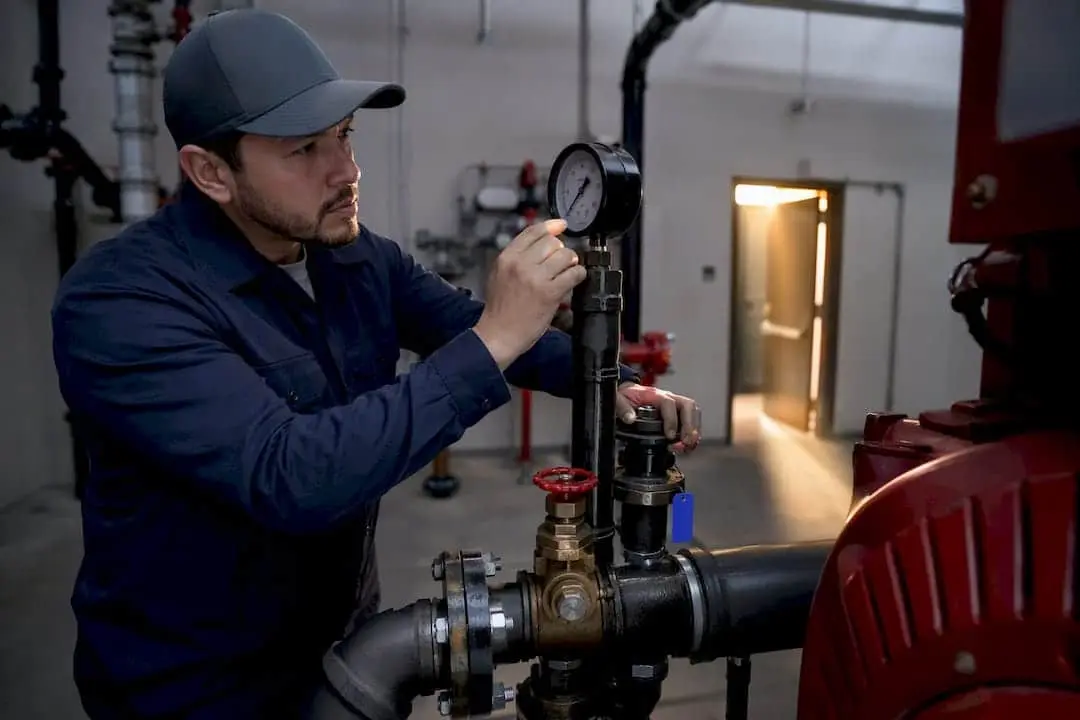
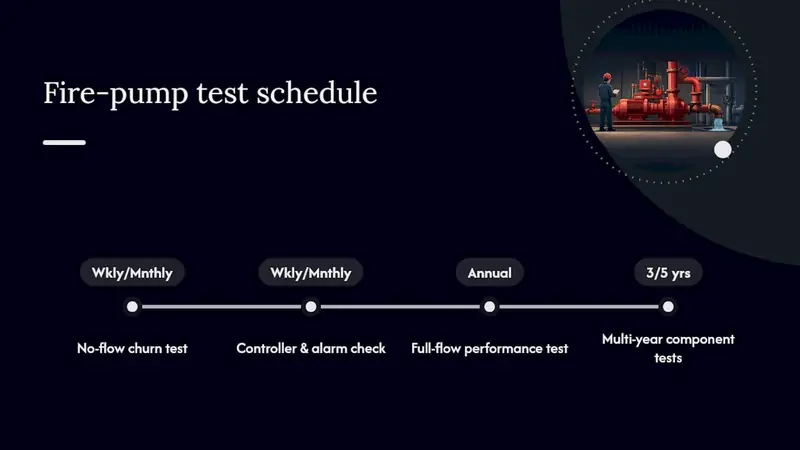
NFPA 25 requires weekly or monthly no-flow (churn) tests, an annual full-flow performance test, and periodic multi-year checks for every fire pump. Diesel pumps run 30 minutes weekly; electric pumps run 10 minutes monthly, unless exceptions apply. A qualified technician must handle the annual flow test, and you need signed records for all of it. If you don’t have a testing calendar posted right now, that’s the first thing to fix.
TL;DR:
- Regular weekly and monthly churn tests must be conducted by trained staff, with diesel pumps requiring 30-minute runs and electric pumps 10 minutes, unless exceptions apply.
- The annual full-flow test must be performed by a qualified contractor, involving three pressure points and detailed curve analysis to verify pump capacity within NFPA 25 standards.
- Proper documentation, including detailed logs of tests and technician interpretations, is critical for compliance and retention for at least three years or the expected lifespan of the pump.
- Supply-side issues, such as closed valves or obstructions, are the most common causes of failed tests, and troubleshooting should prioritize these before considering pump repairs.
- Contracting a fire protection specialist can ensure correct testing, accurate interpretation, and help maintain compliance ahead of inspection deadlines.
Table of Contents
- What NFPA 25 Requires for Fire Pumps
- Who Should Perform Each Fire Pump Test?
- How Do You Run a No-Flow Churn Test?
- What Happens During the Annual Full-Flow Test?
- Diesel Engine Testing: What Makes It Different
- Controller, Alarm, and Electrical Checks You Can’t Skip
- Documentation and Recordkeeping That Hold Up
- Why Do Fire Pumps Fail Their Tests?
- Building NFPA 25 Into Your Facility’s Routine
- How Reliable Fire Protection Supports NFPA 25 Compliance
- Sources
What NFPA 25 Requires for Fire Pumps
NFPA 25 governs the inspection, testing, and maintenance of water-based fire protection systems, and fire pumps sit at the center of that scope. The standard covers electric, diesel, and steam-driven pumps, along with the controllers, transfer switches, and alarm circuits that keep them ready to fire on demand. If your building has a standpipe or sprinkler system that relies on a booster pump to hit required pressure, that pump falls under NFPA 25, full stop.
Ownership of compliance sits with the property owner, not the contractor, not the alarm monitoring company, and not the fire marshal. You can delegate the physical work, but you can’t delegate the responsibility. That distinction trips up a lot of new facility managers who assume a signed service contract transfers liability. It doesn’t. The authority having jurisdiction, or AHJ, can hold the property owner accountable even when a third party performed the actual test.
Who counts as a “qualified person” varies by jurisdiction. Some states require licensed fire protection contractors for annual flow tests; others accept in-house staff who’ve completed manufacturer training. A technical advisory bulletin on fire pump testing notes that facility personnel commonly handle the routine no-flow tests, while experienced third-party contractors typically run the annual full-flow test. Before you build a staffing plan, check with your local AHJ and your insurance carrier. Some insurers add their own licensing or documentation requirements on top of the code minimum, and you don’t want to find that out after a claim gets denied.
NFPA 25 organizes fire pump testing into four tiers, and understanding how they nest together makes the rest of this article easier to apply:
Weekly or monthly no-flow tests. These “churn” tests run the pump against a closed system, verifying the driver starts and runs without moving significant water. Diesel pumps need this testing weekly; most electric pumps need it monthly, though exceptions may require more frequent testing.
Annual full-flow performance tests. Once a year, a qualified technician flows real water through the pump at shutoff, 100% of rated capacity, and 150% of rated capacity, then compares the results against the original acceptance curve.
Multi-year comprehensive tests. Certain components, like relief valves and some instrumentation, get deeper inspection on 3-year or 5-year cycles depending on the part and the edition of NFPA 25 your jurisdiction has adopted.
Controller and alarm verification. This runs on its own weekly, monthly, and annual cadence, layered on top of the mechanical pump tests, because a pump that works perfectly is useless if the controller won’t start it.
Each tier has its own pass/fail logic, its own paperwork, and often its own qualified-person requirement. Treating them as one undifferentiated “pump test” is the single most common compliance mistake facility managers make. A fire pump requirements guide for property owners walks through how these tiers map onto a typical annual maintenance calendar.
Who Should Perform Each Fire Pump Test?
The short answer: trained facility staff can usually handle the routine no-flow tests, but the annual flow test belongs to an experienced fire protection contractor. Here’s how that breaks down by frequency and why the line exists.
- Weekly diesel churn tests can be run by facility maintenance staff who’ve been trained on the controller and know how to log the required readings. No special license is typically needed for this tier, though some AHJs want a designated, named individual on file.
- Monthly electric churn tests follow the same in-house model, unless one of four exceptions applies. Those exceptions include pumps that serve high-rise buildings, pumps without a functioning pressure recording device, pumps that have a history of failing to start automatically, and pumps in jurisdictions where the AHJ has mandated weekly testing regardless of pump type. Any one of those bumps the schedule from monthly to weekly.
- Annual full-flow tests require a qualified person, and in practice that almost always means a licensed fire protection contractor with flow-test equipment and the training to interpret the resulting curve. This is where in-house teams should stop and hand off, even if they’re comfortable running the weekly churn test.
- Multi-year comprehensive tests typically require the same contractor-level qualification as the annual test, since they involve disassembly or specialized diagnostic work on components like the relief valve or the driver’s cooling system.
The minimum run times matter more than they look like on paper. NFPA guidance sets the no-flow test minimum at 10 minutes for electric pumps and 30 minutes for diesel pumps. The gap isn’t arbitrary. Diesel engines need sustained run time to reach normal operating temperature, circulate lubricant fully, and reveal problems like a weak battery or a clogged fuel filter that a short run would mask. Electric motors reach stable operation much faster, so 10 minutes is enough to confirm the motor starts, runs smoothly, and doesn’t trip a breaker.
Insurers and AHJs sometimes require more than the code minimum. A property with a documented history of pump failures, an aging diesel unit past its expected service life, or a high-value occupancy classification (a hospital, a data center, a high-rise) may be told to test weekly regardless of pump type, or to bring in a contractor for churn tests instead of relying on staff. If your insurance renewal paperwork mentions fire pump testing frequency at all, read that section carefully. It can override the NFPA minimum for your specific policy, and ignoring it puts coverage at risk even if you’re technically compliant with the code.
A workable staffing model for most mid-size commercial properties: designate one or two trained staff members for weekly or monthly churn tests, contract a licensed provider for the annual flow test and any multi-year work, and keep a written agreement clarifying who’s responsible for scheduling each tier. A fire compliance checklist for commercial properties can help formalize that split so nothing falls through the cracks between the in-house and contracted portions.
How Do You Run a No-Flow Churn Test?
A churn test starts the pump against a closed system and lets it run at essentially zero flow while readings get taken and logged. Getting the startup sequence right matters as much as the readings themselves.
The pump must start automatically in response to a pressure drop in the system, the same way it would during an actual fire event. Manually starting the pump at the controller and calling it a test defeats the purpose. If the automatic start sequence doesn’t fire the pump within the expected window, that’s a failure worth investigating on its own, separate from anything else you record during the run.
While the pump runs, log the following:
- Suction and discharge pressure readings at the gauge, taken at a consistent point during the run, not just at startup.
- Controller display readings and any fault codes or supervisory alerts that appear during the cycle.
- Unusual noise or vibration from the pump or driver, since both often precede mechanical failure well before a flow test would catch it.
- Packing gland or seal leakage rate, checked visually and, where practical, with a rough drip count.
- Total run time against the required minimum (10 minutes electric, 30 minutes diesel), confirmed against a timer, not estimated.
- Oil pressure and coolant temperature for diesel units, since a churn test doubles as an engine health check.
Personnel requirements for a churn test are modest. One trained person can usually run it alone, standing at the pump room or controller for the duration, though a second set of eyes helps for anyone still building familiarity with the equipment. Because the system stays closed, there’s no hose or nozzle setup involved, and no discharge water to manage. That’s what separates this tier from the annual flow test, which does require hose deployment, spatial planning, and more people.
Pro Tip: Keep a laminated churn-test card at the controller with the exact minimum run time, the readings to log, and space for a signature. Staff turnover is the number one reason churn tests get skipped or logged incorrectly, and a physical card at the pump beats a binder in an office nobody visits.
What Happens During the Annual Full-Flow Test?
The annual flow test is where a fire pump either proves it can do its job under real load or reveals that it can’t, and this is not a test to run casually. Before water moves, a qualified technician confirms gauge calibration, checks that the test header and hose connections are sound, and verifies the pump has been recently serviced enough that a known mechanical issue won’t produce a misleading result.
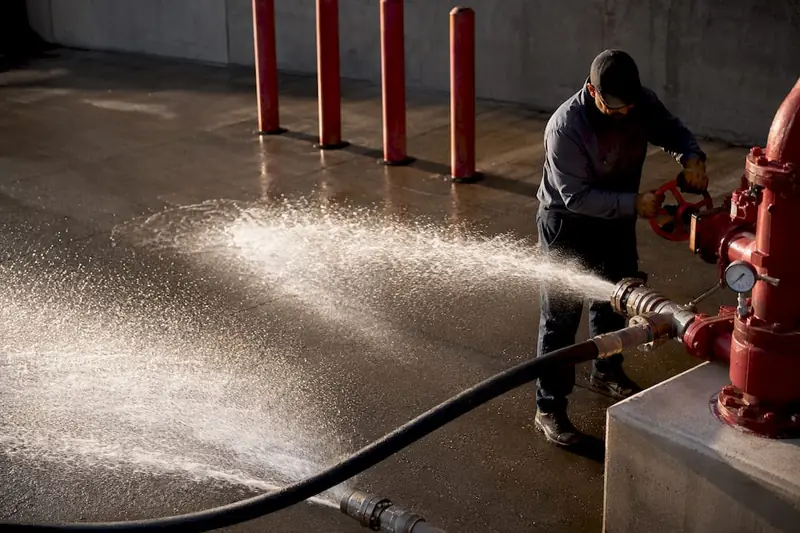
Because the annual test takes the pump temporarily out of service or reduces its protective margin, scheduling matters. Best practice is to run the test during low-occupancy hours and coordinate a temporary fire watch if the AHJ requires one, especially in occupied buildings like hotels, hospitals, or multi-tenant offices where evacuation during a pump outage isn’t practical. A guide on why annual system tests matter covers how to fold this into a broader facility risk calendar rather than treating it as an isolated event.
The test itself measures three points:
- Shutoff (zero flow). The pump runs against a closed system, and the technician records the maximum pressure the pump generates with no water moving. This should closely match the rated shutoff pressure from the original acceptance curve.
- 100% of rated flow. Water discharges through test headers or hoses at the pump’s rated capacity, and the technician records pressure at this flow rate.
- 150% of rated flow. The pump is pushed to 150% of its rated flow, and pressure is recorded again. NFPA 25 expects the pump to maintain at least 65% of its rated pressure at this point, which is the standard shape of a centrifugal fire pump curve.
Each of these three data points gets plotted against the original acceptance test curve for that specific pump. This isn’t a single pass/fail number. It’s a shape comparison across the whole operating range, and that’s exactly why an experienced contractor should interpret the results rather than a facility team reading raw numbers off a gauge.
Industry guidance generally treats a decline of more than about 5% from the acceptance curve as a signal to investigate, and a greater decline as one that typically calls for corrective action, whether that’s impeller cleaning, bearing replacement, or a deeper mechanical repair. Where the original acceptance curve isn’t available, NFPA-recommended reference points can substitute, but document why you used them instead of the pump’s own historical data.
Documentation from the annual test should include the three flow/pressure pairs, the curve comparison, instrument calibration records for the gauges and flow meters used, ambient conditions if relevant, and the technician’s written interpretation rather than a bare pass or fail stamp. That written interpretation is what lets you catch a slow decline over several years instead of only reacting once a pump fails outright.
Diesel Engine Testing: What Makes It Different
Diesel-driven pumps carry a heavier testing load than electric units, mostly because a diesel engine has far more moving parts that can fail quietly between tests. The weekly 30-minute run isn’t just a pump check; it’s an engine health check that happens to move some water on the side.
During the weekly run, record engine RPM, oil pressure, coolant temperature, battery voltage on both starting batteries, and the time it took the engine to reach rated speed after the automatic start signal. Watch for excessive exhaust smoke, which often points to a fuel or injector issue long before it shows up as reduced pump output.
Monthly and annual maintenance adds tasks that go beyond the run itself:
- Battery load testing and terminal cleaning, since a weak battery is one of the most common reasons a diesel pump fails to start on demand.
- Fuel filter and water separator inspection, plus a fuel quality check if the tank hasn’t been used or refilled recently.
- Governor calibration to confirm the engine holds steady rated speed under load rather than drifting.
- Exhaust system inspection for leaks or blockages that could affect both performance and safety in an enclosed pump room.
Cranking and start timing get specific attention under NFPA guidance. Engines are generally expected to reach rated speed within about 20 seconds of the automatic start signal, and the controller must sound an alarm if the engine fails to start after its programmed cranking cycles run out. If your weekly logs show start times creeping upward month over month, that trend is worth flagging before it becomes a failed start during an actual event.
Controller, Alarm, and Electrical Checks You Can’t Skip
A mechanically flawless pump is worthless if the controller doesn’t fire it or the alarm never reaches anyone. NFPA 25’s controller and alarm requirements run on a layered schedule, and skipping this tier is one of the easiest ways to fail an audit even when the pump itself tests fine.
- Weekly: Confirm the pump starts automatically in response to a pressure drop, and do a visual check of the controller for fault lights, tripped breakers, or physical damage. This piggybacks directly on the churn test you’re already running.
- Monthly: Test alarm transmission to confirm supervisory signals reach the monitoring station or fire department connection correctly, not just that a light blinks on the local panel. A signal that never leaves the building is functionally the same as no alarm at all.
- Annual: Run full electrical measurements, including voltage and current readings under load, and test the transfer switch to confirm the pump can shift to emergency power without a gap in coverage. This tier also includes phase-reversal protection testing, which catches wiring faults that could otherwise spin a three-phase motor backward.
Insurers frequently emphasize this tier in their own loss-control guidance, sometimes citing controller and transfer switch testing as a specific line item in policy renewal requirements, separate from the general NFPA 25 mandate.
Documentation and Recordkeeping That Hold Up
If a test isn’t written down, it didn’t happen, at least as far as an AHJ or an insurance auditor is concerned. Keep four distinct log categories rather than one general maintenance binder: weekly churn-test logs, annual flow-test reports with curve comparisons, diesel engine maintenance records, and a standalone deficiency log tracking anything that failed and how it got resolved.
Each log should capture the date, the technician’s name and qualification, the specific readings taken, pass or fail status against the acceptance criteria, and any corrective action initiated. For the annual report specifically, include the flow/pressure data at all three test points, the curve comparison, and proof of instrument calibration.
Retention practice varies by AHJ, but most facility managers keep at least three years of weekly and monthly logs and hold onto annual flow-test reports for the life of the pump, since each year’s data only means something in comparison to prior years and the original acceptance curve.
Key items for a solid recordkeeping system:
- A weekly log template with fields for start time, run duration, pressures, and any fault codes.
- An annual report template that includes the three flow points, curve overlay, and calibration certificates.
- A deficiency log that tracks open items by date raised, date resolved, and who signed off.
- A separate diesel maintenance record for battery, filter, and governor work.
When an annual test fails outside acceptable thresholds, notify the AHJ per your local reporting timeline and consider a temporary fire watch or an interim mitigation plan while repairs get scheduled. Silence after a failed test is the fastest way to turn a mechanical problem into a code violation. A master fire sprinkler system workflow offers a template for coordinating that reporting step across sprinkler and pump systems together.
Why Do Fire Pumps Fail Their Tests?
Most fire pump test failures trace back to one of four causes: a partially closed supply valve, an obstruction in the underground supply line, mechanical wear in the pump itself, or a calibration error in the test instruments. Sorting out which one you’re dealing with determines whether you’re looking at a five-minute fix or a major repair.
A failed annual flow test points to the water supply more often than to the pump itself. Valves get closed during unrelated construction work and never reopened. Underground mains develop sediment buildup over years of low flow. Before you authorize an expensive pump teardown, triage the supply side: check valve positions along the entire feed, and if possible, test static and residual pressure at the supply connection independent of the pump.
Immediate steps after a failure:
- Retest once to rule out a one-off instrumentation glitch before assuming a real mechanical problem.
- Walk the supply line and confirm every control valve is fully open and locked or supervised correctly.
- Put a fire watch in place if the deficiency can’t be resolved same-day, per your AHJ’s expectations.
- Bring in a contractor to inspect the pump internals only after supply-side causes have been ruled out.
Pro Tip: Before calling a contractor for a “failed pump,” walk the supply line first. A closed valve costs you nothing to fix and gets misdiagnosed as pump wear more often than any other issue on this list.
Building NFPA 25 Into Your Facility’s Routine
Most compliance gaps aren’t dramatic. They’re a missed monthly churn test because the assigned staff member went on vacation, or an annual flow test scheduled during a week when the building genuinely couldn’t afford the vulnerability window. Scheduling the annual test during a predictably low-occupancy period, and lining up a temporary fire watch in advance rather than scrambling for one, prevents most of the friction facility teams run into.
The item owners miss most often isn’t a mechanical reading. It’s the written interpretation of the annual curve comparison. A contractor who hands you a pass/fail sheet without commentary on trend direction is leaving value on the table. Ask for the interpretation every year, and file it next to the raw data.
The right moment to shift from in-house churn testing to contractor-run annual flow testing is the moment your team has to guess at what the curve means. That’s not a staffing failure. It’s the design of the system working as intended.
— Results
How Reliable Fire Protection Supports NFPA 25 Compliance
Staying ahead of NFPA 25 deadlines takes more than a calendar reminder. It takes someone who can run the annual flow test correctly, read the resulting curve, and hand you a report you can actually act on instead of a bare pass/fail stamp.
A fire protection company supports Houston-area facility managers across the full testing tier: training for weekly and monthly churn tests, annual full-flow performance testing with pump curve analysis, diesel engine service, and controller and alarm verification. An on-site visit typically includes a full test report, a curve comparison against your pump’s acceptance data, and a deficiency log flagging anything that needs follow-up before your next AHJ inspection. If your annual test is coming up, or you’re not sure your current documentation would hold up under review, request a quote and get your pump scheduled before the deadline creeps up on you.
Sources
For exact code language, consult NFPA 25 directly, since local jurisdictions adopt specific editions that can shift exact requirements. NFPA’s own blog on no-flow churn testing breaks down run-time rules in plain language. For annual flow-test mechanics and pump curve interpretation, the QRFS technical breakdown is a solid field reference, and the WTW technical advisory bulletin covers owner responsibilities and documentation expectations from an insurance perspective.
- NFPA 25 — Standard for the Inspection, Testing, and Maintenance of Water-Based Fire Protection Systems
- The Fire Pump Flow Test: NFPA 25 Requirements for Fire Pump Tests, Part 1 — QRFS
- Technical Advisory Bulletin — Fire Pump Testing (WTW)
- Fire Pump Testing and Maintenance — EMC Insurance loss control tech sheet