
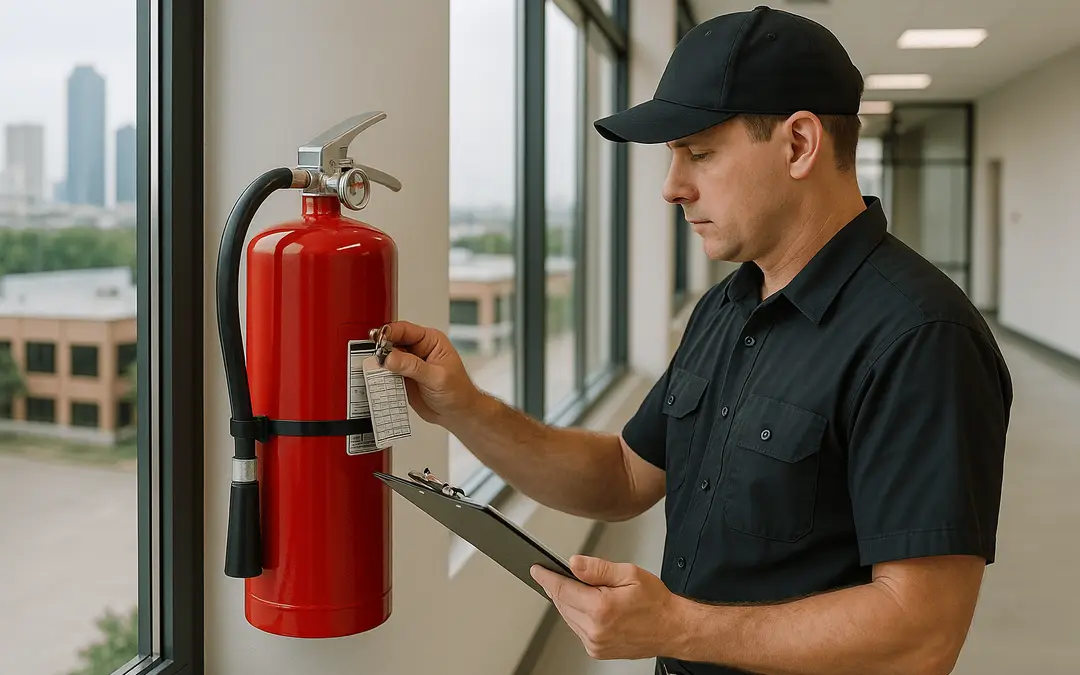
TL;DR: Texas businesses must follow NFPA 10 and OSHA 1910.157 rules for fire extinguisher placement, monthly visual checks, and annual maintenance by a licensed technician, plus periodic 6- and 12-year testing. This checklist breaks down exactly what Houston property managers, restaurant owners, and facility directors need to inspect, document, and hire for to stay compliant with the local AHJ.
If a fire inspector, insurance auditor, or the Houston Fire Marshal walks your property tomorrow, would every fire extinguisher pass? Most violations aren’t caused by missing equipment — they’re caused by missed inspections, expired tags, or extinguishers serviced by someone who isn’t actually licensed to do it in Texas.
This checklist walks Houston-area property managers, restaurant operators, healthcare administrators, and facility directors through exactly what Texas law and national fire codes require, in the order you should check them.
1. Know Which Rules Actually Apply to You
Three overlapping sets of rules govern fire extinguishers in Texas, and all three can be enforced at once:
- NFPA 10 (Standard for Portable Fire Extinguishers) sets the technical inspection, maintenance, and testing intervals.
- OSHA 29 CFR 1910.157 adds federal workplace obligations for employers, including training and placement.
OSHA 1910.157(b)(1) explicitly states that employers who provide extinguishers for employee use shall maintain them in accordance with NFPA 10, so NFPA 10 is incorporated into OSHA compliance by reference. - The local AHJ (Authority Having Jurisdiction) — typically your city or county fire marshal — can impose stricter requirements on top of the state minimum.
The AHJ, typically the local fire marshal or building official, can impose requirements that are more stringent than the state code, so always check with the local fire department before assuming the minimum statewide standard applies.
2. Confirm Your Extinguishers Are Properly Placed
Before you worry about inspection schedules, confirm placement is correct — this is one of the most commonly cited issues. Under OSHA, maximum travel distance depends on the hazard class:
- Class A (ordinary combustibles like wood, paper, cloth):
travel distance for employees to any extinguisher must be 75 feet or less. - Class B (flammable liquids):
travel distance from the Class B hazard area to any extinguisher is 50 feet or less. - Class C (electrical hazards):
distributed on the basis of the appropriate pattern for the existing Class A or Class B hazards. - Class D (combustible metals):
travel distance from the combustible metal working area to any extinguishing agent is 75 feet or less, and these are required in areas where combustible metal powders, flakes, shavings, or similarly sized products are generated at least once every two weeks. - Class K (commercial kitchen grease fires):
for cooking hazards, extinguishers must be within 30 feet.
Restaurants and hotels with commercial kitchens should also review our guide on kitchen hood fire suppression alongside extinguisher placement, since Class K coverage typically ties into the same hood suppression system.
3. Perform (and Document) Monthly Visual Inspections
This is the requirement most Houston properties overlook.
NFPA 10 §7.2 requires that every portable fire extinguisher be visually inspected once per month.
This does not require a certified technician — the building owner, a designated maintenance employee, or a trained facility staff member can perform it.
During each monthly check, staff should verify:
- Each unit is in its designated place and easily accessible; the pressure gauge reads within the proper range; the tamper seal and pull pin are intact; there is no corrosion, physical damage, broken welds, or obstruction; and operating instructions are legible.
If any of these checks fail,
NFPA 10 requires immediate corrective action — the unit stays out of service until the problem is resolved.
Documentation matters as much as the check itself.
Records of the monthly inspections need to be maintained by either putting a tag or label on the extinguisher or by having it recorded on paper or electronic files, and these records need to be maintained for at least 12 months.
4. Schedule Annual Maintenance With a Licensed Technician
Unlike the monthly check, the annual service is not a DIY task.
NFPA 10 §7.3 requires a full maintenance inspection annually, and this must be performed by a certified fire extinguisher technician.
OSHA 1910.157(e)(3) also requires an annual maintenance check.
Annual maintenance goes well beyond the monthly visual look — it’s a full teardown-level examination.
Because maintenance is required to include a thorough examination of the mechanical parts, extinguishing agent and expelling means of each portable fire extinguisher, it must be performed by a trained technician who has the proper tools, listed parts and appropriate manufacturer’s service manual(s).
New tamper seals are also required to be installed whenever maintenance is performed on rechargeable fire extinguishers.
5. Verify Your Technician Is Actually Licensed in Texas
This is where a surprising number of Houston properties get caught off guard during an audit or insurance review. Texas regulates fire extinguisher servicing far more tightly than many states.
- Texas requires anyone who services or maintains fire extinguishers to hold proper licensing from the Texas Department of Insurance (TDI) State Fire Marshal’s Office (SFMO), separate from any general contractor’s license or business license.
- If a company is in the business of portable fire extinguishers or fixed extinguisher systems, it must have a Fire Extinguisher Certificate of Registration (ECR).
- A company cannot be registered without a licensed employee.
- Texas adopts NFPA 10 (2018 edition) through the Texas Portable Fire Extinguisher Code, and penalties for violations range from $100 to $2,500 per violation, with Class B misdemeanor exposure for severe cases.
Before hiring any vendor, ask for their SFMO license number and confirm it’s active. Reliable Fire Protection technicians carry current Texas SFMO licensing for extinguisher, fixed-system, and kitchen (Type K) work.
6. Track the 6-Year Internal Examination
Beyond the annual check, stored-pressure dry chemical extinguishers need a deeper internal look on a longer cycle.
The 6-year internal examination applies to stored-pressure dry chemical types (NFPA 10 §7.3.3.1).
This is easy to miss because the extinguisher can look and test fine externally for years while still being due for this milestone service.
7. Track Hydrostatic Testing Intervals
Hydrostatic testing checks the structural integrity of the extinguisher cylinder itself, and the interval depends on the extinguisher type:
- 12-year hydrostatic pressure test for most dry chemical types (NFPA 10 §8.3).
- 5-year hydrostatic testing for CO2 and wet chemical (Class K) extinguishers.
Skipping this step isn’t just a paperwork problem — an overdue cylinder can be a genuine safety hazard, and it’s one of the fastest ways to fail a fire marshal walkthrough.
8. Don’t Confuse Electronic Monitoring With a Full Inspection
Some newer extinguisher cabinets include electronic monitoring or supervision. That technology has real value, but it doesn’t replace the human inspection cycle.
Devices tied to a fire alarm system are maintained under NFPA 72, and electronic monitoring replaces only the monthly inspection — not annual maintenance, internal examinations, or hydrostatic tests.
If your extinguishers are integrated with your fire alarm system, it’s worth reviewing how that fits into your overall NFPA 72 fire alarm testing schedule so nothing falls through the cracks between systems.
9. Understand Who Enforces Compliance — and Why It’s Not Just the Fire Marshal
Compliance is enforced by local fire marshals, insurance companies, and OSHA.
That means an outdated tag can trigger problems well beyond a fire code citation — it can affect insurance claims after a loss, jeopardize a certificate of occupancy renewal, or surface during a lender or franchise inspection.
10. Build a Single Compliance Calendar for All Your Fire Systems
Most Houston commercial properties don’t have just fire extinguishers — they also have sprinklers, alarms, and backflow preventers on their own inspection cycles. Rather than tracking each system separately, build one master calendar. If you haven’t mapped out your other systems yet, see our guides on NFPA 25 fire sprinkler inspection requirements and TCEQ backflow preventer testing requirements to line up all your renewal dates in one place.
Quick-Reference Checklist
- Monthly: Visual inspection by staff or a vendor, documented on a tag or log.
- Annually: Full maintenance by a Texas SFMO-licensed technician.
- Every 6 years: Internal examination for stored-pressure dry chemical units.
- Every 5 or 12 years: Hydrostatic testing, depending on extinguisher type.
- Ongoing: Confirm placement meets OSHA travel-distance rules for each hazard class present.
- Ongoing: Verify any vendor’s SFMO Certificate of Registration and technician license before signing a service agreement.
Reliable Fire Protection performs monthly, annual, and long-cycle fire extinguisher service for commercial, industrial, institutional, and multi-family properties throughout Greater Houston, backed by a 24-month satisfaction guarantee on parts, materials, and labor.
Recommended Reads
- NFPA 25 Fire Sprinkler Inspection Requirements: A Complete Guide for Houston Properties
- TCEQ Backflow Preventer Testing Requirements Every Houston Property Owner Should Know
- How to Get Your Backflow Preventer Certified in Texas (Step-by-Step)