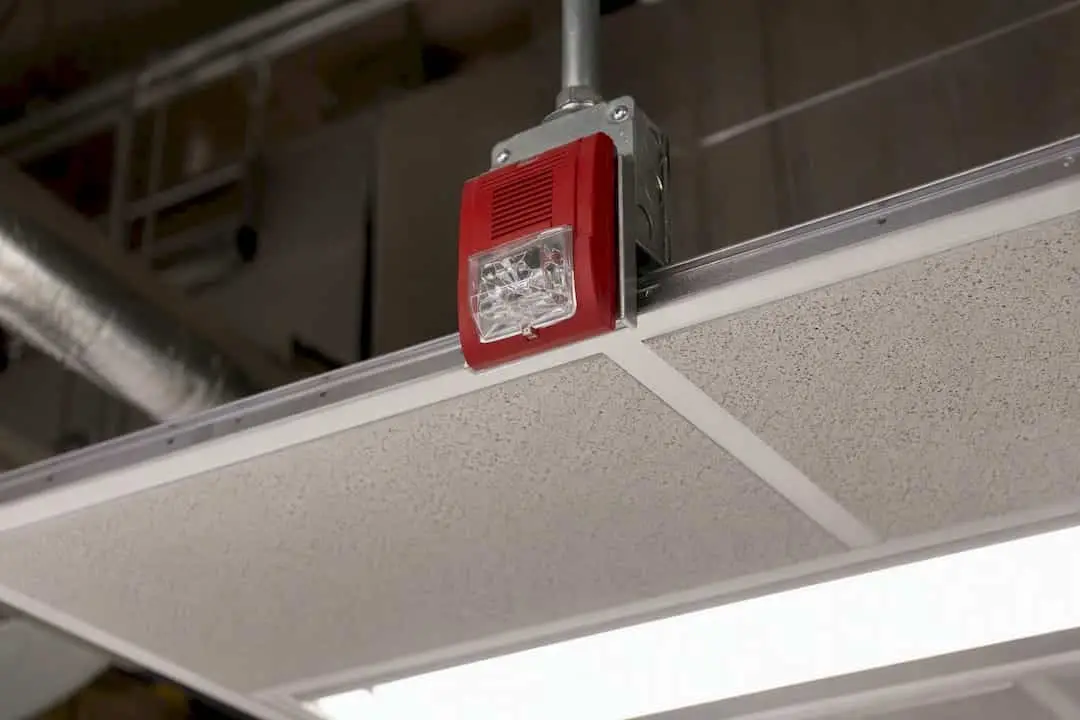
Every ADA fire alarm strobe requirement traces back to two documents: the 2010 ADA Standards, which say visible notification is mandatory wherever a fire alarm system exists, and NFPA 72, which sets the technical specs. Strobe lenses mount between 80 and 96 inches above the finished floor, flash rate between one and three flashes per second in clear or white light, sync with any other strobe in the same field of view, and get sized to their room using NFPA 72’s candela coverage tables. Miss any one of those five points and an inspection fails.
TL;DR:
- Compliance requires verifying that strobe mountings are between 80 and 96 inches above the finished floor, with exceptions only if documented and approved.
- Candela ratings must be accurately matched to room dimensions using NFPA 72 coverage tables, avoiding oversizing or undersizing that leads to inspections failing.
- Synchronization of multiple strobes and correct flash rates between one and three flashes per second are essential to prevent seizure risks and pass code checks.
- High-ceiling or visually obstructed areas require tailored solutions, such as higher candela devices or separate coverage zones, to ensure adequate notification.
- Regular testing of flash rate, synchronization, lens condition, and placement is mandatory, with documentation needed after any layout changes or maintenance.
Table of Contents
- Quick compliance checklist for on-site verification
- Where are visible strobes legally required?
- Getting mounting height and ceiling clearance right
- How do you size candela and place strobes correctly?
- What flash rate and color does code require?
- Handling high ceilings, blocked sightlines, and sleeping units
- What ongoing maintenance does ADA compliance require?
- How Reliable-fire-protection keeps strobe installations code-ready
- A candid take on where strobe compliance actually goes wrong
- Sources
Quick compliance checklist for on-site verification
Before you sign off on shop drawings or walk a punch list, run through these checks in order. Skipping the scoping question first is the most common way projects waste money on devices that get relocated later.
- Confirm scoping first. Does the building have (or is it adding) a fire alarm system? If yes, ADA visible appliance rules apply automatically.
- Measure mounting height. Lens should sit 80 to 96 inches above finished floor, with documented exceptions for low ceilings.
- Verify listed candela. Match the device’s candela rating to the room dimensions using NFPA 72’s coverage tables, not a guess.
- Check flash rate and sync. Confirm 1 to 3 Hz and that any strobes visible from the same vantage point are synchronized.
- Log annual testing. Functional tests and synchronization checks belong in your ITM records, not just your memory.
A fire alarm installation guide built around Houston property requirements walks through how these checks translate into actual shop-drawing markups.
Where are visible strobes legally required?
Visible notification is required in any building where an alarm system is provided, not just in buildings that the ADA singles out by name. That trigger, laid out in ADAS Section 215 of the 2010 ADA Standards, applies broadly to new construction and most alterations.
Public and common use areas need coverage: corridors, lobbies, restrooms, meeting rooms, and break rooms. Employee work areas often need strobes too, though the scoping rules carve out some exceptions depending on the space’s function. Sleeping units in hotels, dormitories, and certain multifamily housing carry their own rules, frequently requiring a percentage of units to have visible alarms with local jurisdictions sometimes raising that bar. The ADA National Network’s fire alarm fact sheet is worth bookmarking because it ties ADAAG’s technical language back to how NFPA 72 implements it. When scoping gets ambiguous, the authority having jurisdiction (AHJ) makes the final call, and that conversation goes smoother when you show up with the code sections already flagged.
Getting mounting height and ceiling clearance right
The rule is straightforward on paper: lens height between 80 and 96 inches above finished floor, measured to the lens itself rather than the device housing. That range also happens to satisfy typical protruding-object clearance rules, which is not a coincidence.
Low ceilings are where retrofits go sideways. If the space genuinely cannot accommodate an 80 inch minimum, NFPA 72 permits mounting within 6 inches of the ceiling, but that shortcut comes with a penalty: the effective coverage area must be reduced in proportion to the shortfall from the 80 inch minimum mounting height as specified by code guidance. Document the measured height, the coverage reduction math, and the candela selection on your shop drawings, because that’s exactly what an inspector or the AHJ will ask to see. Suspended ceilings, decorative soffits, and tall warehouse shelving are the usual culprits behind failed inspections.
How do you size candela and place strobes correctly?
Candela selection isn’t about picking the brightest device and calling it done. NFPA 72 links each listed candela rating to a maximum room coverage distance, and oversizing wastes money while undersizing fails inspection outright. Research behind ADAAG found that a 75 candela signal mounted 50 feet from a test subject alerted 90 percent of them, which is why 75 cd shows up so often as a baseline rating in mid-sized rooms.
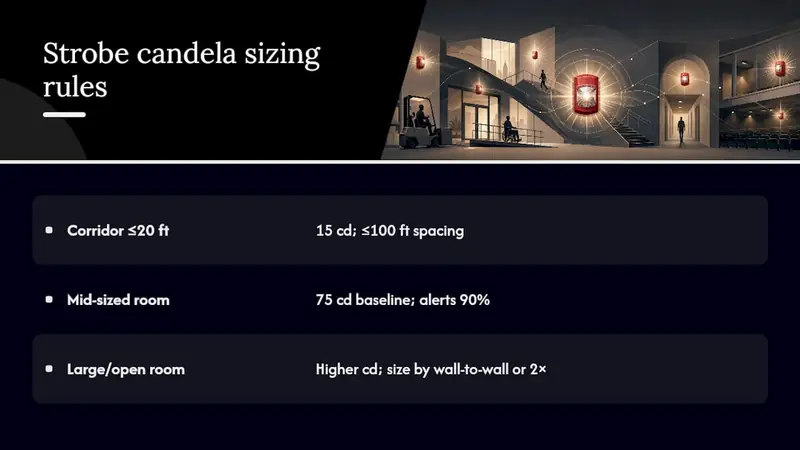
Two viewing methods exist: direct viewing with a clear line of sight to the strobe, and indirect viewing through reflected light, the latter allowed by NFPA 72 under certain conditions to optimize device placement. For room sizing, the standard approach uses wall-to-wall distance, or, for very large open rooms, twice the distance from a device to the farthest wall, to select the correct candela rating from the table.
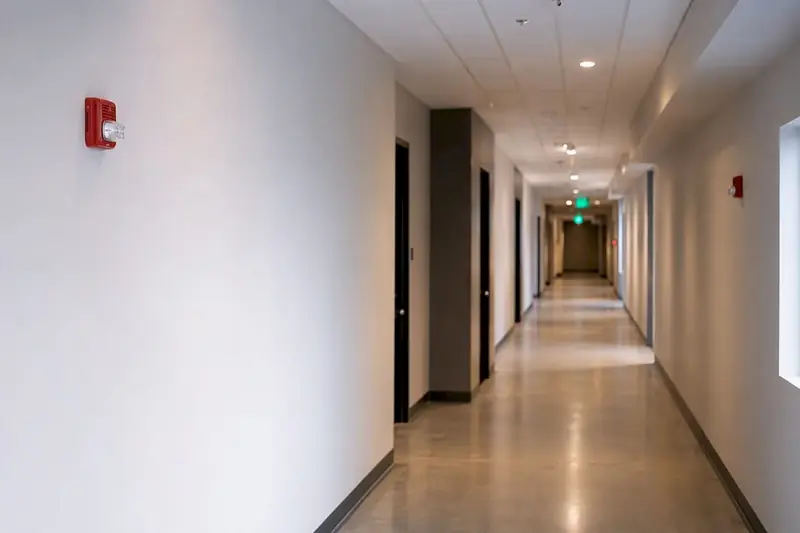
Corridors get their own rulebook. In corridors 20 feet wide or narrower, 15 candela devices are permitted, with one strobe required within 15 feet of each corridor end and no more than 100 feet between devices. Alternating strobes on opposite walls down a long corridor, rather than lining them all up on one side, keeps flash exposure more even and avoids overloading a hallway with excess light.
Pro Tip: Never mount two strobes facing directly at each other across a narrow room. The combined flash can create a disorienting composite effect for anyone standing between them, and it’s an easy fix during design that’s expensive to fix after installation.
What flash rate and color does code require?
NFPA 72 specifies flash rates for visual notification appliances between one and three flashes per second, and every strobe you specify needs to fall inside that window. Color must be clear or nominal white for primary fire alarm notification because it’s the most reliably discernible color across lighting conditions and occupant populations.
Synchronization is required whenever multiple strobes are visible from the same vantage point. Unsynchronized devices can produce a composite flash rate above 5 Hz, which creates a genuine seizure risk for photosensitive individuals. Most modern alarm control panels handle synchronization automatically across a notification circuit, but mixed-vintage systems or additions from different manufacturers can break that sync without anyone noticing until an inspector runs a stopwatch. If synchronization hardware isn’t available for a legacy panel, the AHJ may accept reducing the number of strobes visible from any single point, or increasing candela to compensate for fewer devices, as an alternative fix.
Handling high ceilings, blocked sightlines, and sleeping units
Standard mounting heights and coverage tables assume a fairly ordinary room. Atriums, warehouses, and gymnasiums don’t play by those assumptions.
For high-ceiling spaces, designers typically either suspend high-intensity strobes at a lower, code-compliant height or ring the perimeter walls with higher-candela devices sized for the extra distance. Visually obstructed sub-areas, think storage racks splitting a warehouse floor into isolated pockets, get treated as separate coverage zones, each needing its own device rather than relying on one strobe to somehow reach around a wall of shelving.
When a design genuinely can’t meet a prescriptive rule, equivalent facilitation lets a designer propose an alternate approach, usually backed by photometric calculations or a physical mockup, for the AHJ to approve in place of the literal code text. Sleeping units and transient lodging often need in-unit strobes at higher candela than a common corridor, and several jurisdictions layer local amendments on top of the base ADA and NFPA 72 requirements, so check with your local fire marshal before finalizing a multifamily retrofit.
What ongoing maintenance does ADA compliance require?
Visible notification appliances aren’t a one-time install and forget item. They fall under the same inspection, testing, and maintenance program that governs the rest of your fire alarm system, which means annual functional testing at minimum, plus regular visual inspections in between.
Each test should confirm flash rate, synchronization behavior, lens condition (cracks and yellowing reduce effective candela), and that the installed device still matches the catalog number on your original coverage calculations. Any layout change, a new partition wall, added shelving, a remodeled suite, warrants a fresh photometric review rather than assuming the old candela math still holds. Our own annual system test guidance covers what that documentation should look like. When synchronization modules fail or a device needs replacing with a higher-candela unit, that’s the point to bring in a qualified fire protection contractor rather than swapping parts and hoping.
How Reliable-fire-protection keeps strobe installations code-ready
We review shop drawings for three things before a device ever gets mounted: listed candela against the room’s actual dimensions, mounting height against the 80 to 96 inch window, and the synchronization method the panel manufacturer specifies. Catching a mismatch on paper costs nothing. Catching it during final inspection costs a change order.
Retrofit work makes up a good share of what we see, relocating strobes that ended up too low under a dropped ceiling, swapping in higher-candela devices where a renovation changed a room’s footprint, or adding synchronization modules to older panels that never had them. If you’re evaluating bids for a strobe retrofit or new install, ask every contractor three questions: how did they calculate coverage for each room, what’s their synchronization approach across the whole notification circuit, and what does their proposed ITM schedule look like after handoff. Reliable-fire-protection walks through exactly that during a site assessment, and we’ll put the coverage math in writing before any device goes on the wall.
A candid take on where strobe compliance actually goes wrong
Most facility managers assume ADA strobe compliance is about hitting a mounting-height number, and that’s the easy 20 percent of the problem. The part that actually causes failed inspections and expensive rework is candela sizing done by rule of thumb instead of the NFPA 72 tables, and synchronization that quietly breaks when a system gets added onto in phases over a decade of ownership changes.
Here’s the uncomfortable pattern we see across retrofit projects: a building passed inspection in 2004 with the equipment available then, added a wing in 2014 with a different panel manufacturer, and nobody verified that the two notification circuits still synchronize together. Every individual strobe might meet its candela and flash-rate spec in isolation. The composite flash across the whole visible field can still exceed 5 Hz, and that’s invisible to a walkthrough that just checks whether each device lights up. It takes an actual synchronization test, not a visual check, to catch it.
The other pattern worth naming: equivalent facilitation gets treated as a loophole when it should be treated as engineering. A photometric calculation that justifies fewer, better-placed devices in an oddly shaped room is legitimate code compliance, not a workaround, provided the AHJ signs off and the math is documented. Facility managers who skip that documentation and just wing it are the ones who get a stop-work order two years later when a new inspector asks for the calculations nobody kept.
— Results
Sources
Keep these on hand when discussing scope or design with your local fire marshal: the 2010 ADA Standards for scoping, NFPA 72 for coverage tables and technical performance, and the ADAAG visual alarms research bulletin for the candela research behind current benchmarks.
- 2010 ADA Standards for Accessible Design
- Strobe code compliance 101: Visible appliance requirements (Electrical Contractor Magazine)
- ADAAG visual alarms research and guidance (VA Technical Information Letter / ADAAG bulletin)