
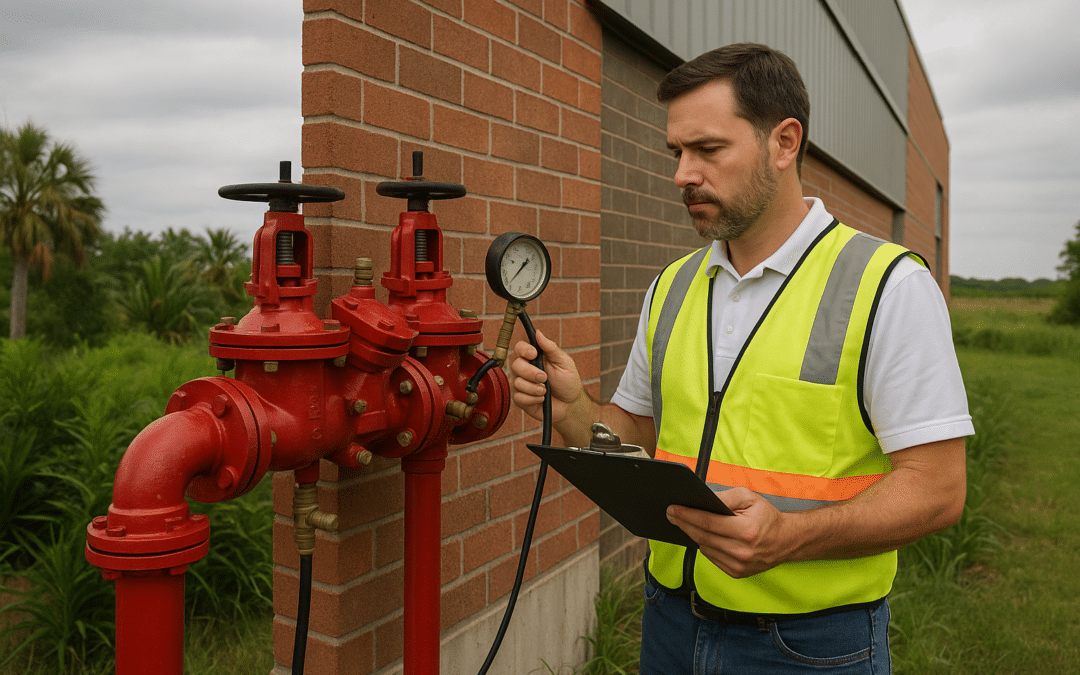
TL;DR: Texas law under 30 TAC §290.44 requires annual backflow preventer certification for most commercial properties. You must hire a TCEQ-licensed Backflow Prevention Assembly Tester (BPAT), complete the TCEQ Form 20700, and file results with your local water authority—typically within 30 days of testing. Skipping it can mean fines up to $2,000 per day and water service termination in Houston.
If you manage a commercial building, restaurant, apartment complex, industrial facility, or any other commercial property in Texas, your backflow preventer needs to be certified every year. This is not optional—it is state law, and local water authorities enforce it hard.
This step-by-step guide walks you through exactly what the process involves, what documents you need, who is legally allowed to do the testing, and the mistakes that put Houston property owners at risk of fines or a shut-off notice.
Why Texas Requires Annual Backflow Preventer Certification
A backflow preventer stops contaminated water from flowing backward into the public drinking water supply—a risk that exists any time there is a pressure drop on the municipal side.
The legal foundation is straightforward. The Texas Commission on Environmental Quality (TCEQ) administers the state-level program under 30 Texas Administrative Code (TAC) Chapter 290, which governs all public water system protections.
The legal foundation for backflow testing in Texas is 30 TAC Chapter 290, administered by TCEQ. Sections 290.44 and 290.46 set the minimum standards for cross-connection control and backflow prevention across public water systems statewide.
TCEQ rules establish that all required backflow prevention assemblies must be tested upon installation by a recognized tester and certified to be operating within specifications. Assemblies installed to protect against health hazards must also be tested and certified at least annually by a recognized backflow prevention assembly tester.
[30 TAC §290.44(h)(4)]
Federal and state laws require all water providers to meet certain standards to protect public health, and TCEQ requires all water providers to establish a Cross-Connection Control and Backflow Prevention Program.
For Houston specifically, the stakes are real.
The City of Houston Plumbing Code mandates testing backflow preventer assemblies at the time of installation, repair, relocation, and annually thereafter. Failure to comply will result in citations with fines of up to $2,000 per day and the risk of potential suspension of water services.
Which Assemblies Require Annual Certification?
Not every device on your property falls under the annual testing rule. You need to know what type of assembly you have.
Your immediate step is to identify whether you have a testable assembly—Reduced Pressure Principle Assembly (RP), Double Check Valve Assembly (DCVA), Pressure Vacuum Breaker (PVB), or Spill-Resistant Vacuum Breaker (SVB)—then schedule a TCEQ-licensed BPAT if you have not had a passing test within the last year.
Single-check valves are not recognized by TCEQ as backflow prevention assemblies. They cannot be tested or inspected to ensure they are working correctly and are not constructed with a back-up check valve or fail-safe design.
For fire protection systems specifically,
the three assembly types found on fire protection supply lines are: Reduced Pressure Zone (RPZ) assemblies, the highest level of protection used where a fire system is considered a high-hazard cross-connection; Double Check Valve Assemblies (DCVA), used for low-hazard connections; and Pressure Vacuum Breaker (PVB) assemblies, used in specific low-hazard configurations.
Residential non-hazardous devices are required to be certified every three years. Commercial devices are required to be certified annually.
If your building has a fire sprinkler system, irrigation system, boiler loop, chemical injection equipment, or any other high-hazard connection, expect annual testing to apply.
What You Need Before Scheduling the Test
- Device type and location: Know whether you have an RPZ, DCVA, PVB, or SVB, and where each one is installed (mechanical room, vault, utility corridor, rooftop).
- Prior test records: Locate your last TCEQ Form 20700 (Backflow Prevention Assembly Test and Maintenance Report) to confirm the assembly serial numbers and last pass date.
- Your water authority portal login: Most Houston-area utilities—including Houston Water, Municipal Utility Districts (MUDs), and suburban city utilities—require results to be submitted through an online tracking system such as BSI Online or Vepo.
- TCEQ-licensed tester: Only a licensed BPAT (Backflow Prevention Assembly Tester) may legally perform the test. See Step 3 below.
- Adequate clearance around the assembly: The tester needs unobstructed access to the device. Clear the area before the appointment.
Step-by-Step: How to Get Your Backflow Preventer Certified in Texas
-
Identify every testable assembly on your property.
Walk the property with your building plans and locate all backflow prevention assemblies. Confirm device type (RPZ, DCVA, PVB, SVB) and record the manufacturer, model, and serial number for each one. If you manage a fire-suppressed building, note that fire-line assemblies are subject to additional requirements—see Step 3.
-
Check your certification deadline.
Your annual certification window is typically one year from the last test date shown on your TCEQ Form 20700.
Test reports must be submitted to Houston Water within 30 days of the test date.
Do not wait until you receive an overdue notice—schedule testing before the anniversary date to give yourself room to handle any repairs if the device fails. -
Hire a TCEQ-licensed Backflow Prevention Assembly Tester (BPAT).
A person who repairs or tests the installation or operation of backflow prevention assemblies must hold a license issued by the TCEQ. Backflow prevention assembly testers are qualified to test and repair assemblies on any domestic, commercial, industrial, or irrigation service.
There is a critical exception for fire protection lines:
backflow prevention assembly testers may test and repair assemblies on fire lines only if they are permanently employed by an Approved Fireline Contractor. The State Fire Marshal’s Office requires that any person performing maintenance on fire lines must be employed by an Approved Fireline Contractor.
This means your fire sprinkler backflow preventer cannot be tested by just any licensed plumber or irrigation tester—it must be a BPAT who works for a state-licensed fire protection company.Verify the tester’s TCEQ license number before scheduling. Your local water authority’s website maintains an approved tester list.
-
Prepare site access on test day.
Ensure the tester can reach the assembly without delay.
Fire protection backflow preventers present unique challenges: they are often in mechanical rooms, vaults, or utility corridors that are infrequently accessed, and they are larger assemblies (2-inch to 8-inch) than residential backflow preventers.
Notify building tenants if water will be temporarily interrupted during testing. -
The tester performs the functional test.
Backflow prevention assemblies must be tested for operational effectiveness using methods approved by the TCEQ and described in the University of Southern California’s Cross Connection Manual (USC-CCM).
Each BPAT must use equipment calibrated by an approved gauge testing company within acceptable tolerances specified by the USC-CCM.
The annual test verifies that relief valves open at the correct differential pressure, check valves seat properly and hold, and shutoff valves are fully operational.
If the assembly passes, the tester records the results on TCEQ Form 20700 (Backflow Prevention Assembly Test and Maintenance Report). Keep a copy for your records.
-
Handle repairs immediately if the assembly fails.
Failed tests do not always mean replacement. Many backflow preventers can be rebuilt with new internals and pass certification. A qualified tester should diagnose whether a rebuild or full replacement is the right call.
Even if the assembly fails or needs repair, the failed form should still be submitted to the water supplier for recordkeeping.
Do not skip filing just because the device did not pass—submit the failed report, complete repairs, and schedule a re-test. -
File the test report with your water authority.
All backflow assembly test reports for existing and replacement backflow devices must be submitted via the applicable online backflow tracking system. All testing companies are required to submit test reports within 48 hours of the test date. Failure to do so will result in enforcement notification of the customer regarding the non-compliant status of their device.
In Greater Houston, your utility may use BSI Online, Vepo, or SC Tracking Solutions depending on the municipality or MUD. Confirm the correct portal with your water authority before testing day. A reputable fire protection and backflow testing company will handle this filing on your behalf.
-
Store your records and set next year’s reminder.
An adequate internal cross-connection control program must include an annual inspection and testing by a licensed backflow prevention assembly tester on all backflow prevention assemblies used for health hazard protection. Copies of all such inspection and test reports must be obtained and kept on file by the water purveyor.
Keep digital and physical copies for at least three years. Set a calendar reminder 60 days before next year’s due date.
Common Mistakes That Put Houston Property Owners at Risk
- Using an uncertified tester. Any test performed by a person without a current TCEQ BPAT license is invalid. Your water authority will reject the report and treat your property as non-compliant.
- Using a non-fire-line BPAT for fire sprinkler backflow preventers.
Backflow prevention assembly testers may test and repair assemblies on fire lines only if they are permanently employed by an Approved Fireline Contractor. The Texas Department of Insurance’s State Fire Marshal’s Office requires that any person performing maintenance on fire lines must be employed by an Approved Fireline Contractor.
Hiring the wrong tester means your test does not count. - Missing the filing deadline. Completing the test is not enough—
most utilities require annual test results to be filed by a licensed backflow tester within a defined window, and most utilities require submission within 30 days of the test date.
Late filing triggers enforcement notices. - Assuming a failing device can wait.
Failure to have annual backflow testing performed and reported to the city will result in escalated enforcement measures that may include termination of water service per City Ordinance.
A property without water is a property that cannot operate. - Delegating without accountability.
Property owners may delegate testing activities to tenants, site managers, or property managers; however, the property owner is responsible and will be held accountable for compliance in enforcement proceedings.
If your tenant fails to schedule the test, the citation goes to you. - Not testing newly repaired or relocated assemblies.
All backflow prevention assemblies must be tested upon installation, repair, replacement, or relocation
—not just on the annual cycle. Any work on the device resets the clock and requires a new certification test before the assembly is returned to service.
Fire-Line Backflow Preventers: What Commercial Properties Need to Know
If your building has a fire sprinkler system connected to the public water supply, you have a fire-line backflow preventer. These devices are larger, accessed less frequently, and governed by an additional layer of regulation on top of TCEQ rules.
The International Fire Code §903.3.5 requires backflow protection for fire sprinkler systems connected to potable water supplies. NFPA 13 §6.7 specifies the type of backflow protection required by system type, whether wet, dry, or antifreeze.
Because fire-line BPATs must work for a state-licensed fire protection contractor, understanding TCEQ’s specific requirements for Houston properties is essential before you schedule any service. Combining your annual backflow certification with your fire sprinkler inspection is an efficient way to keep all compliance dates aligned.
What Happens If You Miss Annual Certification in Houston?
Non-compliance is not a paperwork problem—it is an operational risk.
Failure to comply with Houston’s requirements will result in citations with fines of up to $2,000 per day and the risk of potential suspension of water services.
Houston Water retains authority to discontinue service for uncorrected cross-connection hazards under 30 TAC §290.46(j).
For restaurants, hotels, healthcare facilities, and multi-family properties, a water shutoff is a business-stopping event.
Ready to Schedule Your Annual Backflow Certification in Houston?
Reliable Fire Protection is a state-licensed fire protection company serving Greater Houston, including Downtown, Midtown, the Energy Corridor, Katy, Sugar Land, Cypress, Tomball, Pasadena, and 25 other neighborhoods and suburbs. Our licensed technicians are permanently employed by an Approved Fireline Contractor, which means we are authorized under Texas law to test and certify backflow preventers on fire protection lines—not just domestic and irrigation assemblies.
We handle the test, complete TCEQ Form 20700, and file results directly with your water authority’s online portal. Same-day service is available, and we offer free quotes with transparent, flat-rate pricing. All parts, materials, and labor are backed by our 24-month satisfaction guarantee.
Call us or request a free quote online to get your annual backflow certification scheduled before your deadline.
Recommended Reads
Sources
- tceq.texas.gov
- law.cornell.edu
- tceq.texas.gov
- houstonpublicworks.org
- austintexas.gov
- docs.bryantx.gov