

An aspirating smoke detection (ASD) system actively pulls air from a protected space through a pipe network to catch combustion particles long before they reach a spot detector’s sensing chamber. That head start, often minutes to hours, is why data centers, cleanrooms, and museums rely on it. The tradeoff is design complexity: pipe layout, transport time, and hole spacing all have to be calculated, not guessed.
TL;DR:
- Transport time from sampling holes to the detector chamber must be calculated before installation and verified on-site to ensure system reliability.
- Sensitivity classes differ between standards, with EN 54‑20 Class A being more sensitive than NFPA’s tiered warning categories, affecting warning times and false alarms.
- ASD is most valuable in high-risk environments like data centers, museums, and cleanrooms, where early detection prevents damage or preserves historic finishes.
- Proper pipe layout, hole size, placement away from airflow sources, and documented transport-time calculations are critical for effective ASD installation.
- Regular maintenance, including filter replacement and verifying transport time, prevents false alarms and maintains detection sensitivity.
Table of Contents
- How Aspirating Smoke Detection Works
- Standards And Sensitivity Classes: NFPA And EN Guidance
- Where Aspirating Smoke Detection Delivers Value
- Design And Installation Checks To Demand In Proposals
- Commissioning, Testing, And Maintenance Requirements
- ASD Versus Spot Detectors: The Real Trade-Offs
- What We See Go Wrong In The Field
- Get Aspirating Smoke Detection Designed And Commissioned Right
- Sources
How Aspirating Smoke Detection Works
An ASD unit draws air continuously through a network of small pipes and precision-drilled sampling holes, using an aspirator fan to move air from the protected space back to a central detector. Before the sample reaches the sensing chamber, it passes through multi-stage filtration that strips out dust and debris so the optics only see genuine combustion particles. Most systems use a laser-based nephelometer, measuring light scatter to detect particles at concentrations spot detectors can’t register, then run that signal through algorithms that separate real smoke from background haze.
Two mechanics matter more than any spec sheet number:
- Transport time, the interval between smoke entering a hole and reaching the chamber, which design software calculates and commissioning must verify in the field.
- The additive effect, where smoke pulled from many holes concentrates in one chamber, producing an alarm sooner than a single spot detector covering the same floor area would.
Sensitivity ranges span an enormous window. Some units detect obscuration as low as 0.00046% per foot, a threshold so fine it registers particles well before visible haze forms.
Standards And Sensitivity Classes: NFPA And EN Guidance
Two standards frameworks govern how ASD gets specified, and mixing them up in a proposal is a common, costly mistake. NFPA 72 treats each sampling port as an individual spot-type detector for spacing and location purposes, while NFPA 76 introduces tiered terminology: Very Early Warning Fire Detection (VEWFD), Early Warning Fire Detection (EWFD), and standard Smoke Fire Detection (SFD).
Sensitivity classes at a glance: EN 54‑20 sorts ASD performance into three classes, A, B, and C, Class A being the most sensitive and typically specified for high-value, high-airflow spaces like data halls, Class C matching roughly conventional spot-detector performance.
The two systems don’t test the same way. EN 54‑20 runs a longer test schedule with more prescribed test fires than comparable NFPA methods, so a Class A rating under EN 54‑20 isn’t a direct swap for an NFPA VEWFD claim. Practically, this affects two things you’ll live with daily: warning time (higher sensitivity classes catch smoldering fires earlier) and nuisance alarm risk (oversensitive settings in dusty or humid rooms trigger false alarms). Specify the class before the sensitivity, not after.
Where Aspirating Smoke Detection Delivers Value
Not every building needs air-sampling detection, and matching the technology to the risk profile keeps budgets honest.
- Data centers and server rooms. Under-floor and above-ceiling airflow dilutes smoke fast, so early, distributed sampling catches problems before hardware damage spreads.
- Telecom switching facilities. Continuous unattended operation means any delay in detection compounds into hours of undetected smoldering.
- Battery storage and UPS rooms. Thermal runaway events often smolder before flaming, which plays directly to ASD’s early-warning strength.
- Museums and archives. Ceiling-level spot detectors can’t be installed without disturbing historic finishes; discreet sampling pipes solve that.
- Cleanrooms. Positive-pressure, high-air-change environments dilute smoke quickly, and standard detectors often miss it entirely.
- High-ceiling warehouses. Stratification can keep smoke from ever reaching a ceiling-mounted spot detector, making sampling at multiple levels the only reliable option.
In every case above, HVAC design has to be part of the ASD design, not an afterthought. In lower-risk occupancies, ASD often works better as a supplement to conventional detection rather than a full replacement.
Design And Installation Checks To Demand In Proposals
A design that looks right on paper can still underperform in the field. Push back on any proposal missing these items.
- Sampling-hole spacing and hole diameter sized to the area covered, not defaulted to a manufacturer’s generic template.
- A clear answer on single-pipe versus branched-pipe layout, with maximum pipe length documented against the manufacturer’s datasheet, since Siemens’ FDA2X1 line, for example, lists monitoring area and pipe-length ceilings explicitly.
- Calculated transport time from the farthest hole to the sensing chamber, verified with design software before installation and confirmed again on-site.
- Sampling holes placed clear of supply diffusers and returns, since NFPA 72’s Annex A recommends at least 36 inches of separation from direct airflow sources.
- Pipe material and filter strategy suited to the environment, particularly in dusty industrial spaces where filter loading accelerates.
Pro Tip: Ask for the transport-time calculation as a signed document, not a verbal assurance. If the installer can’t produce one before the pipe goes up, that’s a sign the layout was never actually engineered.
For lower ceilings and standard offices, the same spacing logic that governs smoke alarm placement still applies conceptually, even though ASD hardware is different.
Commissioning, Testing, And Maintenance Requirements
Getting ASD into service correctly is a documented process, not a walkthrough.
- Normalize airflow and smoke-value readings during commissioning so the system’s baseline reflects actual site conditions, not factory defaults.
- Document transport time against the design calculation and file it with the alarm threshold settings used at each zone.
- Set a maintenance cadence covering filter replacement, physical inspection of sampling holes for blockage, airflow monitoring, and review of the event log for drift or repeated fault codes.
- Keep test records the authority having jurisdiction (AHJ) can review on demand, since ASD must comply with NFPA 72, NFPA 75, NFPA 76, and applicable local codes, even though the technology itself isn’t mandated everywhere.
Skipping the maintenance schedule is the single fastest way to turn a high-sensitivity system into a nuisance-alarm generator. Our fire alarm maintenance guidance for property managers covers the inspection cadence that keeps any detection system, ASD included, in compliance.
ASD Versus Spot Detectors: The Real Trade-Offs
Sensitivity is where ASD wins decisively. A well-designed system can flag combustion particles at concentrations conventional spot detectors never register, largely because multiple sampling holes feed one chamber, concentrating smoke that would otherwise dilute across a room.
- High-airflow rooms favor ASD, since dilution that defeats a spot detector’s threshold still reaches a sampling chamber through the additive effect.
- Low-risk, low-airflow spaces rarely justify the added pipe design and maintenance overhead ASD requires.
- Return-grille or AHU sampling often outperforms ceiling-level sampling in high-airflow rooms, because that’s where smoke concentrates before it disperses.
Many facilities run hybrid coverage: ASD in server rooms and archives, conventional spot detectors everywhere else. That split usually costs less than blanketing an entire building in air-sampling pipe.
What We See Go Wrong In The Field
The most common failure isn’t a bad detector. It’s routing errors, where installers snake pipe around obstructions without recalculating transport time, leaving the farthest hole minutes slower than design intent. Close behind: filters nobody scheduled for replacement, which quietly throttle sensitivity until the system either misses smoke or nuisance-alarms constantly.
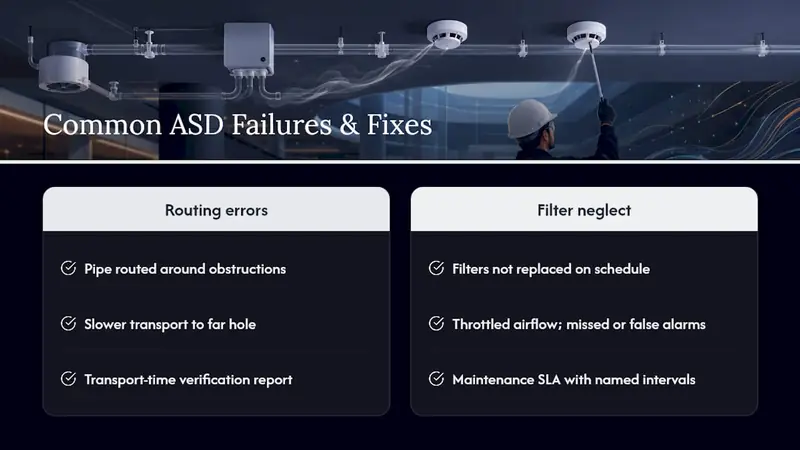
Before signing off on any ASD proposal, require a written transport-time verification report, a normalization log from commissioning, and a defined maintenance SLA with named intervals, not “as needed” language.
— Results
Get Aspirating Smoke Detection Designed And Commissioned Right
An alternative to guessing your way through an ASD proposal is to have a team review the design against transport-time math and hole spacing before anyone drills a hole.
Services include design review, installation, commissioning, and ongoing maintenance for advanced detection systems in commercial, industrial, and healthcare facilities, with support for code and permit coordination with local AHJs. When requesting a quote, it’s advisable to ask specifically for transport-time verification, a normalization report from commissioning, and a written maintenance SLA. These documents help distinguish a system that performs from one that just looks good on a submittal. Learn more about how fire alarm systems and advanced detection work together, or reach out directly for a facility survey and free quote.
Sources
- Aspirating smoke detector codes and standards comparison (Pechová et al.)
- Aspirating Smoke Detectors Applications Guide (Honeywell / FAAST)
- Code question — air-sampling network smoke detection (National Training Center)
- Siemens aspirating smoke detector (FDA2X1) datasheet
- Aspiration smoke detection: early fire protection (Facility Management Insights)