
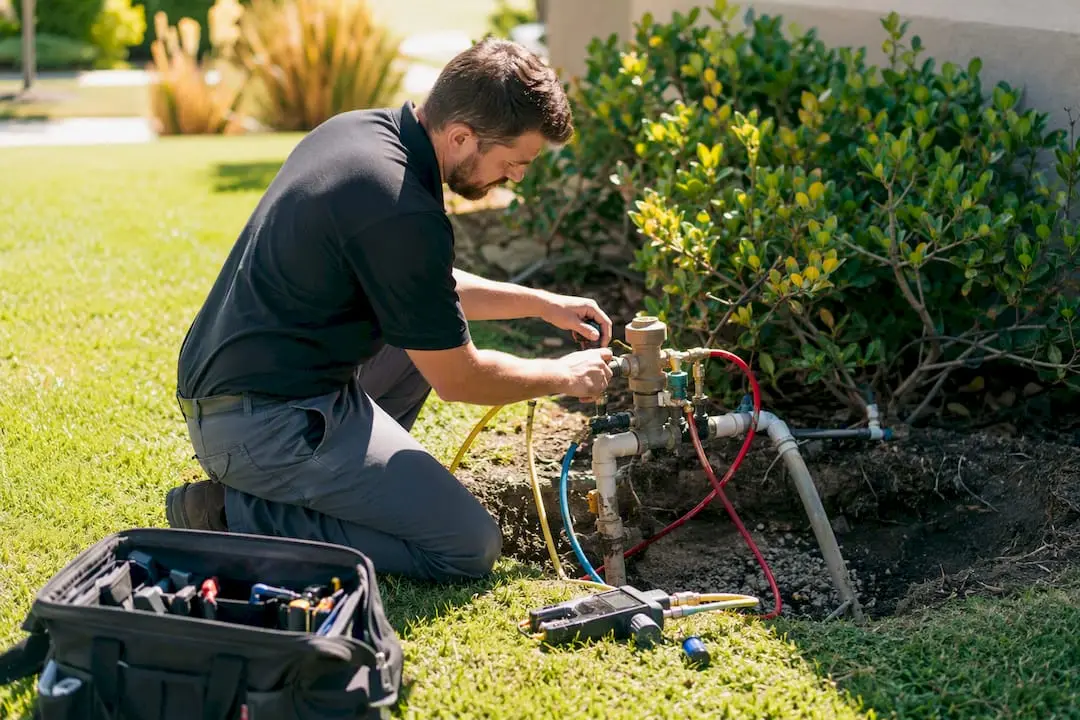
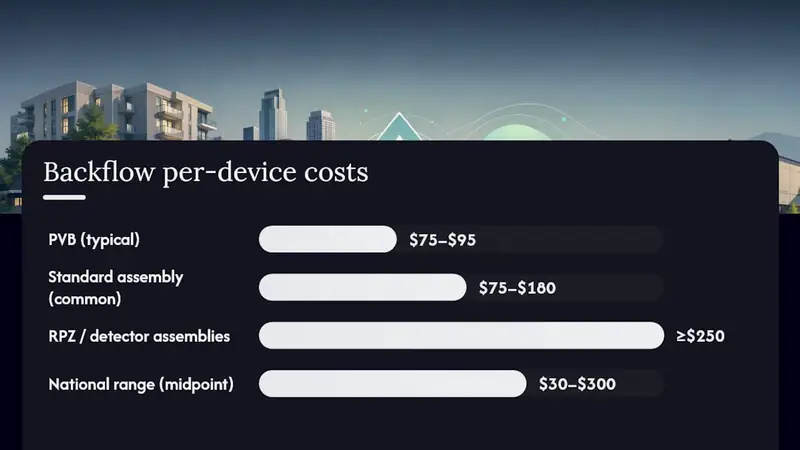
Expect to pay $75 to $180 per device for a standard backflow test, with a wider national range of $30 to $300 depending on the assembly. A single irrigation preventer typically costs less, while commercial RPZ assemblies are among the more expensive types to test. Your total bill depends primarily on the number of devices and their type.
Before you accept any quote, take one action: confirm the device type and get a price broken out per device, not a flat “whole property” number.
- Low end: $30–$75 for a simple PVB, often on a residential irrigation line
- Typical: $75–$180 per device for most DCVA and RPZ assemblies
- High end: $200–$300+ per device for detector assemblies or hard-to-access commercial units
Ask upfront whether the tester files results with your local water utility. That single question separates a complete quote from one that leaves you exposed to a missed deadline.
Key Takeaways
Backflow test cost depends primarily on device type and count, with PVBs costing the least and RPZ or detector assemblies costing the most per device.
| Point | Details |
|---|---|
| National cost range | Expect $30 to $300 per device, with $75 to $180 the most common range for standard assemblies. |
| Device type sets the price | PVBs run cheapest around $75 to $95; RPZ and detector assemblies often exceed $250. |
| Demand an itemized quote | A legitimate bid separates per-device price, filing fees, travel, and retest terms. |
| Know the repair threshold | Replace instead of repair once repair costs exceed roughly two-thirds of full replacement price. |
| Reliable-fire-protection files for you | Reliable-fire-protection provides certified testing, repair, and replacement with utility filing included in Houston. |
Table of Contents
- Backflow Test Cost by Device Type and Property Scenario
- What Drives the Price of a Backflow Testing Quote
- What Should Be Included in a Backflow Test Quote
- Repair vs. Replacement: What a Failed Test Costs Next
- How Long a Backflow Test Takes and When It’s Due
- Hiring a Certified Backflow Tester: Questions That Matter
- Reliable-fire-protection’s Backflow Testing Services
- Why Most Cost Guides Miss the Real Question
- Get an Itemized Backflow Testing Quote in Houston
- Frequently Asked Questions
- Sources
Backflow Test Cost by Device Type and Property Scenario
The type of backflow preventer on your property is the biggest single factor in what you’ll pay. Testing is not one flat service. It’s four different services wearing the same name, each with its own price band tied to how the assembly works and how long the test takes.
- PVB (pressure vacuum breaker): costs generally fall within a moderate range, common on residential and commercial irrigation systems
- DCVA (double check valve assembly): costs tend to be mid-range, found in small offices and multi-unit residential settings
- RPZ (reduced pressure zone assembly): typically higher cost, required on higher-hazard connections
- Detector assemblies / fire-line backflow devices usually are the most expensive due to fire-system integration
These bands come from current device-specific cost data, and they scale predictably with the number of devices on a property.
A single-family home with one irrigation PVB generally sees lower costs. A small office building with multiple DCVAs costs more, influenced by access and filing fees. A commercial campus with multiple RPZs or fire-line detector assemblies can reach high total costs depending on the number of devices across buildings.
Regional labor rates and local permitting rules matter too. Filing and permit costs alone can swing a final quote by 20 to 30 percent between jurisdictions, so a price that looks high for your area may simply reflect stricter local paperwork requirements rather than a padded bill.
What Drives the Price of a Backflow Testing Quote
Five variables explain nearly every dollar difference between two quotes on the same property.
- Device type, size, and count. A 3/4 inch PVB and a 3 inch RPZ are not the same job, and pricing per device should reflect that.
- Accessibility and site complexity. Devices in locked vaults, mechanical rooms, or high-rise mechanical floors take longer to reach and test, and technicians often price that time separately.
- Local filing and utility paperwork. Some water authorities charge submission fees or require specific report formats, which shows up as a line item on your invoice.
- Technician certification and equipment calibration. Certified testers use calibrated test kits that cost over $1,000 and require annual recalibration, a cost baked into every visit’s price.
- Urgency and scheduling. After-hours work, rush requests ahead of a compliance deadline, and long drive times between properties all add to the total.
Pro Tip: If you manage more than one property, ask providers about route pricing. Bundling several addresses into one technician’s route often reduces the per-device rate compared to booking each site separately.
What Should Be Included in a Backflow Test Quote
A legitimate quote is itemized, not a single lump number. Before you sign anything, confirm it spells out:
- Per-device testing price, listed separately for each assembly on your property
- Service call or travel fee, especially if your property sits outside a technician’s usual route
- Filing and administrative fees, and explicit confirmation of whether the tester submits results to your water utility or you have to
- Materials and estimated repair costs, in case the device fails and needs parts before it can pass
- Retest fee and warranty terms, so you know what a follow-up visit costs if the first test doesn’t pass
Presenting price per device with filing called out separately is the clearest way to compare bids across multiple technicians, especially on multi-device properties where a bundled number hides real differences.
Repair vs. Replacement: What a Failed Test Costs Next
Backflow devices fail tests for predictable reasons: worn O-rings, a stuck check valve, a cracked body, or a relief valve that won’t seat properly. Age and water quality both accelerate the wear, which is why older commercial properties see more failures than newer construction.
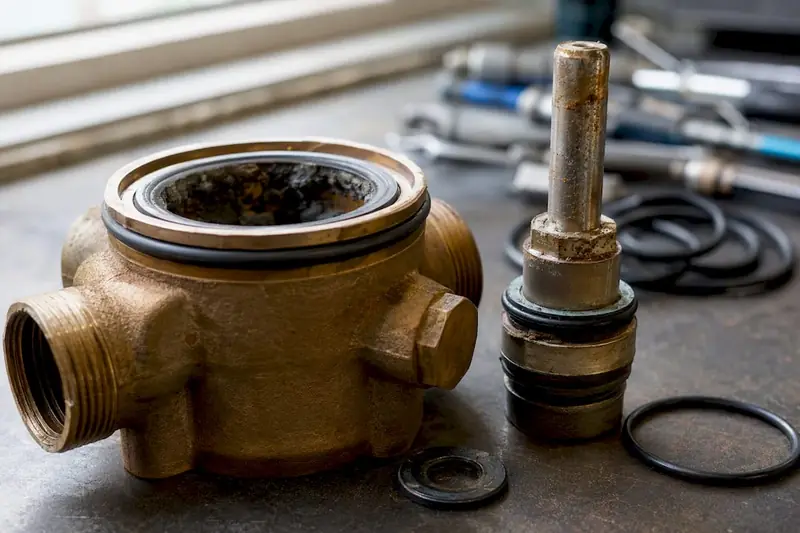
Most failures are fixable. Repair kits for soft parts typically run $25 to $275, plus labor for the technician to install them and retest the device. A cracked housing or a body that won’t hold pressure is a different story: that usually means full replacement, which ranges roughly $300 to $2,000 or more depending on device type and pipe size.
A $200 repair on a device that would cost $320 to replace still makes sense. A $220 repair on that same $320 device does not.
How Long a Backflow Test Takes and When It’s Due
Onsite time varies more than most property owners expect. A straightforward residential PVB test can take 10 to 15 minutes, while most DCVA and RPZ assemblies take 30 to 90 minutes once you count setup, gauge readings, and paperwork. Complex commercial sites with multiple devices or difficult access can stretch into several hours.
- Most municipalities require testing on a regular basis with formal submission of results to the water utility
- Retests after a repair typically must occur within a limited timeframe, usually days to a couple of weeks
- Missing a testing deadline can lead to fines, or in some districts, water service interruption
- Confirm who files the paperwork and what the retest policy is before the technician shows up
Hiring a Certified Backflow Tester: Questions That Matter
Not every technician holding a wrench is qualified to test your backflow preventer. Verify these before you book anyone.
- Is the technician certified by the state or local water authority? Ask for a registration number, not just a verbal assurance.
- Is the price per device, and does it include filing? Get this in writing before the visit, not after.
- Is their test equipment currently calibrated? Calibration is required annually, and an expired kit can invalidate your results with the utility.
- What’s the retest fee if a device fails? Some testers roll this into the original price; others charge a full second visit.
- What do after-hours or emergency visits cost? Get this rate before you need it, not during a compliance crisis.
Red flags to walk away from: no itemized quote, vague answers about who files with the utility, or a technician who can’t produce a certification number on request.
Reliable-fire-protection’s Backflow Testing Services
Reliable-fire-protection tests, repairs, and replaces backflow preventers for residential and commercial properties across the Houston area, and files results directly with the local water utility as part of the service. Property managers working with multiple buildings get itemized, per-device pricing rather than a single bundled estimate that hides what each assembly actually costs.
- Testing, repair, and full replacement for PVB, DCVA, RPZ, and detector assemblies
- Certified technicians with calibrated equipment and registered credentials
- Itemized quotes that separate labor, filing fees, and any parts needed for repair
- Emergency response availability when a failed test threatens a compliance deadline
- Resources for Houston property managers covering local filing timelines and seasonal maintenance
Request a written quote before your next testing cycle, and confirm it includes retest terms in case a device doesn’t pass the first time.
Why Most Cost Guides Miss the Real Question
Most articles on backflow test pricing fixate on the national average and stop there. That number is close to useless on its own, because a property manager with one irrigation PVB and a facility manager with six RPZ assemblies across a commercial campus are solving completely different budgeting problems with the same headline figure.
The more useful question isn’t “what’s the average cost.” It’s “what’s my per-device rate, and what’s bundled into it.” A quote that lists testing, filing, and travel separately is worth more to you than a lower flat number that turns into three surprise line items after the visit. Property managers who negotiate hardest on the wrong variable, chasing a lower per-device rate while ignoring filing responsibility, often end up paying for a missed submission deadline that costs more than the testing did.
Prioritize the paperwork trail first. A slightly higher quote from a technician who confirms utility filing and gives you a clear retest policy beats a cheaper one that leaves you guessing who’s responsible when the report doesn’t show up on time.
Get an Itemized Backflow Testing Quote in Houston
Reliable-fire-protection gives Houston property owners something most backflow testing bids skip: a quote broken down by device, with filing and retest terms spelled out before anyone shows up on site. That matters most for multi-property managers juggling PVBs, DCVAs, and RPZ assemblies across different buildings, where a vague lump-sum estimate makes it impossible to catch overcharges or missing coverage.
Because Reliable-fire-protection already handles fire protection compliance work across Houston, backflow testing gets bundled into the same relationship you’d use for fire sprinkler system inspections and other code requirements, which means one point of contact instead of three separate vendors chasing three separate deadlines. Technicians carry current certification and calibrated equipment, and results get filed with your water utility as a standard part of the visit, not an upsell.
If your test is coming due or a device just failed inspection, request a free itemized quote that spells out per-device pricing, filing fees, and retest terms before you commit.
Frequently Asked Questions
What is the average cost of a backflow test?
Most single-device tests fall between $75 and $180, though simple residential PVB assemblies can cost as little as $30 to $95 and complex commercial RPZ or detector assemblies can exceed $250.
Does backflow test cost include filing with the water utility?
Not always. Some testers bundle filing into the price; others charge it separately or leave it to the property owner. Always confirm this before booking.
Can I test my own backflow preventer to save money?
No, in practice. Testing requires a certified technician and a calibrated test kit that costs over $1,000 and needs annual recalibration, and most water utilities won’t accept results from an uncertified source.
How much does it cost to repair a failed backflow preventer?
Soft-part repairs like O-rings or check valve seats typically run $25 to $275 in parts plus labor. Full replacement, needed for cracked housings or major failures, ranges roughly $300 to $2,000 or more.
How often do I need to test my backflow preventer?
Most municipalities require annual testing with results submitted to the local water authority. Missing that deadline can lead to fines or, in some districts, water service interruption.
Sources
- Backflow testing cost — HomeGuide
- Backflow preventer testing 2026 costs and schedules — MyHomeScore
- Backflow Testing Cost: Typical Prices and What Impacts the Price — CurrentCost
- Common backflow test failures and how to fix — FlowCert