

TL;DR:
- Fire alarm annunciators serve as active extensions of the fire alarm control panel, providing immediate visual and audible alerts to responders. They display zone-specific or device-specific status, facilitating rapid identification and response during emergencies. Proper placement, regular testing, and correct system integration are essential for effective fire safety management and compliance.
Most people walk past fire alarm annunciators every day without giving them a second thought. That panel mounted near the lobby entrance or by the stairwell door looks like a simple status board, but it does far more than display lights. Fire alarm annunciators explained properly reveal a critical piece of safety infrastructure that extends the reach of your fire alarm control panel, speeds up emergency response, and gives first responders exactly the information they need the moment they walk through the door. Whether you manage a commercial property or you’re simply trying to understand how fire safety alarm systems work, this guide covers everything.
Table of Contents
- Key takeaways
- Fire alarm annunciators explained: core functions and components
- Types of annunciators and where they belong
- Integration with fire alarm systems and building safety protocols
- Maintenance, troubleshooting, and regulatory requirements
- My take on what most people get wrong about annunciators
- How Reliable Fire Protection can help
- FAQ
Key takeaways
| Point | Details |
|---|---|
| More than a display panel | Annunciators are active extensions of the fire alarm control panel, not passive monitors. |
| Standard four-button interface | Mute, Acknowledge, Reset, and Test buttons are the industry standard for managing alarm states. |
| Type determines application | Conventional annunciators suit smaller buildings; addressable models serve complex or large facilities. |
| Integration drives response speed | Proper connection with HVAC, elevators, and lockdown systems prevents confusion during emergencies. |
| Maintenance is non-negotiable | Routine testing and firmware compatibility checks keep annunciators reliable and code-compliant. |
Fire alarm annunciators explained: core functions and components
A fire alarm annunciator is a remote interface that mirrors the status of your main fire alarm control panel (FACP). Think of the FACP as the brain of your fire safety alarm system. The annunciator is its eyes and voice placed exactly where people need them most, usually near building entry points, security desks, or fire command centers.
When a detector triggers an alarm, the annunciator receives that signal and responds with both visual and audible alerts. LEDs and buzzers highlight active alarm points and allow staff or responders to prioritize their actions without running to a back room to find the main panel. That immediacy matters enormously in real emergencies.
The components you’ll find on a typical annunciator panel include:
- Zone or device indicators: LED lights labeled by zone number or device address show exactly where the alarm or fault originated.
- Audible alert (horn or buzzer): Provides a local sound alert whenever a new alarm or fault condition is present.
- Status LEDs: Separate indicators for alarm (typically red), fault (typically yellow), and supervisory (typically amber) conditions.
- Control buttons: Four standard buttons cover Mute (silences the local buzzer while visual indicators stay active), Acknowledge (confirms the alarm has been seen), Reset (clears the panel after a resolved event), and Test (verifies indicator and horn function).
The annunciator does not replace the FACP. It extends it. Security staff can acknowledge an alarm at the lobby annunciator while maintenance locates the source, all without either person touching the main panel. That division of labor cuts response time significantly.
Pro Tip: Place annunciators at every building entry point used by fire departments. Firefighters arriving on scene should be able to read zone status in under 10 seconds without assistance from building staff.
Types of annunciators and where they belong
Not every building needs the same type of annunciator, and choosing the wrong one creates either unnecessary cost or dangerous limitations. The two primary categories are conventional and addressable, and they reflect the type of fire alarm system they connect to.
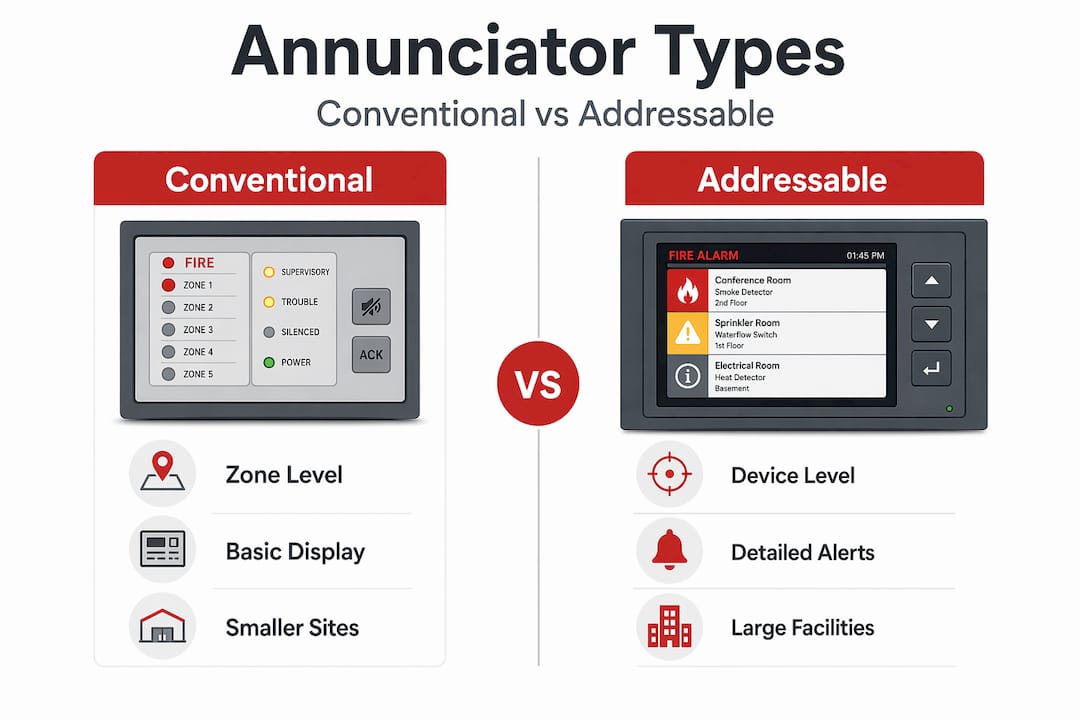
A conventional annunciator works with zone-based fire alarm systems. Fire alarm control panels group detectors into zones, and the conventional annunciator displays which zone is active. You know the fire is in Zone 3 (say, the second floor east wing), but not which specific detector triggered. This works well in smaller or simpler buildings where zone boundaries are clear and compact.

An addressable annunciator connects to systems where every device has a unique address. It displays the exact device that triggered, including a text description in many models. Addressable panels transmit detailed information that lets firefighters know precisely which room or corridor to target, cutting critical minutes off response time in large or complex structures.
| Type | Pros | Cons | Best use case |
|---|---|---|---|
| Conventional | Lower cost, simple to operate | Zone-level only, less precise | Small offices, retail stores, single-family residential |
| Addressable | Device-specific alerts, text displays | Higher cost, more complex setup | Hospitals, hotels, large commercial or industrial facilities |
| Graphic annunciator | Visual floor plan display, intuitive | Most expensive, requires design | High-rises, campuses, facilities with complex layouts |
| Remote LCD annunciator | Text-based detail, compact | No graphic overview | Mid-size offices, schools, multi-tenant buildings |
Beyond the technical categories, application context matters just as much:
- Industrial settings often require annunciators rated for harsh environments with ruggedized enclosures and clear zone separation for hazardous areas.
- Commercial buildings benefit from addressable LCD panels that give security staff actionable information without requiring fire alarm training.
- Residential applications (multi-family buildings especially) lean toward simpler zone-based displays positioned in a lobby or management office.
The global demand for addressable and IoT-capable annunciators is accelerating. The fire alarm equipment market is projected to reach $7.2 billion by 2030, driven largely by smart integrations and stricter building codes pushing facilities toward more precise detection and monitoring.
Integration with fire alarm systems and building safety protocols
Understanding how fire alarm annunciators work within a larger system is where things get genuinely important, and where mistakes cause real harm. Annunciators connect to the FACP through specific communication circuits. The three you need to know are:
Initiating Device Circuits (IDC): These carry signals from detectors and pull stations back to the FACP. The annunciator reads the resulting panel status, not the raw IDC signal itself.
Signaling Line Circuits (SLC): Used in addressable systems, these carry two-way communication between the panel and each addressable device. The annunciator taps into the panel’s processed output from this circuit.
Notification Appliance Circuits (NAC): These activate horns, strobes, and speakers. Some annunciators also connect here to display notification status or allow selective silencing.
Beyond fire alarm circuits, modern annunciators often integrate with HVAC systems (triggering shutdown to prevent smoke spread), elevator controls (enabling recall to a designated floor), and access control systems. Annunciator panels integrate HVAC, elevator, and other building safety signals for coordinated emergency response, which is exactly why clear configuration is non-negotiable.
The risk of cross-system confusion is real. Clear signal differentiation when integrating annunciators with lockdown or invacuation systems is critical. If a lockdown signal triggers the same visual indicator as a fire alarm, building occupants and responders face dangerous confusion. Fire safety must always take priority in the signal hierarchy.
Misconfigured annunciators can delay emergency response by failing to provide accurate real-time fire location data. That’s not a theoretical risk. It’s a documented problem when systems are installed by technicians who treat annunciators as afterthoughts rather than primary response tools.
Pro Tip: During any system design or retrofit, require the installing contractor to demonstrate that fire alarm signals take visual and audible priority over all other integrated system alerts on every annunciator panel. Test it before signing off.
Maintenance, troubleshooting, and regulatory requirements
A fire alarm annunciator that hasn’t been tested recently is an unknown quantity. And an unknown quantity in an emergency is a liability.
Routine maintenance covers several key areas:
- Regular indicator tests: The Test function on the annunciator verifies that all lamps, LEDs, and audible devices operate correctly. This should happen at every scheduled inspection.
- Functional alarm simulation: Inspectors trigger a test alarm from a device in each zone or at an addressable address to confirm the annunciator displays the correct status and location.
- Communication path verification: Confirm that the annunciator is receiving live data from the FACP, especially after any panel firmware update or hardware change.
- Physical inspection: Check for damaged indicators, loose connections, and any unauthorized modifications to the panel face or wiring.
One maintenance issue that catches facility managers off guard involves firmware. Older annunciator models can face firmware mismatches when connected to upgraded or replaced fire alarm control panels. The annunciator might display incorrect zone information, fail to acknowledge commands, or generate false fault signals. Always verify firmware compatibility when upgrading any component of the fire alarm system.
On the regulatory side, NFPA 72 (the National Fire Alarm and Signaling Code) sets the baseline requirements for annunciator placement, visibility, and functionality. It mandates that annunciators be located where they are accessible to emergency responders, that they clearly display alarm, fault, and supervisory conditions, and that they meet testing documentation requirements. Local jurisdictions may layer additional requirements on top of NFPA 72, so always check with your local Authority Having Jurisdiction (AHJ).
Smart annunciators with remote monitoring capabilities are becoming a practical compliance tool. These units send real-time alerts to facility managers via mobile or web platforms, flag maintenance issues before they become violations, and generate digital inspection logs automatically.
My take on what most people get wrong about annunciators
I’ve worked with fire alarm systems long enough to have a strong opinion on this: annunciators are the most underestimated component in the entire system. Property managers will spend months selecting the right sprinkler heads and then accept whatever annunciator the lowest bidder installs near the front door.
The danger in that attitude is real. I’ve seen buildings where the annunciator displayed zone labels that no longer matched the actual layout after a renovation. The main panel was updated, but nobody updated the annunciator’s zone legend. When an alarm triggered, responding staff went to the wrong floor. That’s a configuration failure, and it’s entirely preventable.
My position on smart, IoT-enabled annunciators is that they aren’t a luxury for large facilities anymore. For any property where staff can’t physically monitor a traditional panel 24 hours a day, remote alerting capability is a basic requirement. Understanding how fire alarm systems work at a system level, including annunciator roles, is what separates a facility that’s truly prepared from one that just passes inspection.
If you’re a professional specifying or installing these systems, push back on clients who treat annunciator placement and configuration as an afterthought. And if you’re a property owner or manager, the importance of fire alarms in your building extends directly to how well your annunciators are configured, maintained, and understood by the people who use them daily.
— Reliable-fire-protection
How Reliable Fire Protection can help

At Reliable Fire Protection, we’ve seen what separates a fire alarm system that performs in an emergency from one that creates confusion. Our Houston-based team specializes in designing, installing, and maintaining fire alarm systems where every component, including annunciators, is configured correctly from day one.
We work with both residential and commercial clients across Houston and surrounding neighborhoods, handling everything from initial system design through ongoing maintenance and code compliance. Whether you need a new addressable annunciator panel for a commercial facility or a full fire alarm system assessment that covers your existing annunciator setup, our certified technicians bring the expertise to get it right.
Contact Reliable Fire Protection today for a free quote and find out how our fire safety solutions protect what matters most to you.
FAQ
What is a fire alarm annunciator?
A fire alarm annunciator is a remote display and control panel connected to the fire alarm control panel (FACP). It shows alarm, fault, and supervisory status using visual and audible indicators, allowing staff and first responders to identify the emergency location without accessing the main panel.
How does a fire alarm annunciator work?
The annunciator receives processed signals from the FACP and displays them using LEDs, text, or graphic displays. Standard controls include Mute, Acknowledge, Reset, and Test buttons, letting operators manage alarm states directly at the annunciator.
What is the difference between conventional and addressable annunciators?
Conventional annunciators display zone-level alarms suitable for smaller buildings, while addressable annunciators show the exact device that triggered, providing pinpointed location data that speeds up emergency response in larger or more complex facilities.
Where should fire alarm annunciators be located?
NFPA 72 requires annunciators to be placed where they are accessible to emergency responders, typically near main building entrances, fire command centers, or security stations. The goal is for firefighters to read system status within seconds of arriving on scene.
How often should fire alarm annunciators be tested?
Annunciators should be tested at every scheduled fire alarm system inspection, which NFPA 72 typically requires at least annually for most components. The Test function verification confirms all lamps, LEDs, and audible devices are operational.