
TL;DR:
- Firestop systems are essential passive fire protection components that seal penetrations in fire-rated walls and floors, preventing fire and smoke spread. Proper selection, installation, inspection, and ongoing maintenance of these systems are crucial to maintain structural compartmentation and compliance. Without active oversight, firestop failures due to modifications or deterioration can compromise building safety over time.
Most Houston property owners know they need fire sprinklers and alarms. Far fewer understand fire stop systems, and that gap quietly creates serious compliance failures and life-safety risks hiding inside walls and floors. Fire stop systems explained properly is not just a regulatory checkbox exercise — it’s the difference between a fire staying contained to one floor and spreading through your entire building before the fire department arrives. This guide walks you through exactly how these systems work, what the ratings mean, how to choose the right products, and what ongoing maintenance actually looks like in practice.
Table of Contents
- What are fire stop systems and why do they matter?
- Understanding fire stop system ratings and test standards
- Selecting and installing the right firestop system for your building
- Inspection and ongoing maintenance: safeguarding firestop integrity over time
- The hidden challenge: why firestop systems often fail without your active oversight
- Protect your Houston property with reliable fire safety solutions
- Frequently asked questions
Key Takeaways
| Point | Details |
|---|---|
| Fire stop basics | Fire stop systems seal penetrations in fire-rated walls and floors to prevent fire and smoke spread. |
| Critical firestop ratings | System ratings like F and T measure flame resistance and temperature control at penetrations. |
| Match product to penetration | Proper firestop depends on selecting the tested system for the specific pipe or cable type and wall material. |
| DIIM management | Design, installation, inspection, and maintenance are essential to preserve firestop integrity over time. |
| Owner engagement needed | Property managers must actively ensure firestop compliance throughout the building lifecycle to avoid failures. |
What are fire stop systems and why do they matter?
Fire stop systems are specialized sealing assemblies installed at every point where a pipe, cable, conduit, or duct passes through a fire-rated wall or floor. Those openings are called penetrations, and without proper sealing, they become pathways for flame, smoke, and toxic gases to travel freely between fire compartments.
This is a form of passive fire protection — meaning it works automatically, without power or human activation, to slow fire spread. Unlike active systems such as sprinklers or alarms, passive systems like firestopping are built into the structure itself. They buy critical time for occupants to evacuate and for firefighters to control the situation. As the principle goes, firestopping at openings is part of passive fire protection, sealing penetrations in fire-rated elements to maintain compartmentation integrity and prevent fire and smoke spread.
The concept of compartmentation is central here. A building designed with fire-rated walls and floors is divided into compartments that should, in theory, contain a fire. Every penetration that isn’t properly sealed breaks that compartment. One poorly sealed cable bundle can render an entire fire-rated wall useless.
Here’s what firestopping protects against:
- Flame travel through gaps around pipes and conduits
- Smoke migration, which causes most fire deaths before flames even arrive
- Hot gases that preheat materials in adjacent compartments, accelerating spread
- Structural heat transfer that can weaken floor and ceiling assemblies faster than expected
If you want a broader picture of how firestopping fits into your building’s overall protection strategy, our passive fire protection guide covers Houston-specific requirements in detail. It’s also worth noting that even low-voltage systems require attention to penetration sealing, as firewall protection in low voltage systems explains in the context of code compliance.
A fire stop system is only as effective as its weakest penetration. One unsealed opening in a rated wall can compromise an entire compartment’s fire resistance in minutes.
Understanding fire stop system ratings and test standards
When a firestop system is tested and listed, it earns specific ratings that tell you exactly how it will perform under fire conditions. The two governing standards you’ll see on every listing document are UL 1479 and ASTM E814. These are harmonized, meaning they measure the same things using equivalent methods. UL 1479 and ASTM E814 are harmonized standards evaluating through-penetration firestop systems, producing ratings for flame passage (F), temperature rise (T), air leakage (L), and water resistance (W).
Understanding what each rating letter actually means will help you ask smarter questions when your contractor submits firestop documentation.
| Rating | Full name | What it measures | When it matters most |
|---|---|---|---|
| F | Flame rating | Time before flame passes through the assembly | All fire-rated assemblies |
| T | Temperature rating | Heat rise on the unexposed side | Combustible materials near the penetration |
| L | Air leakage rating | Smoke and gas leakage at ambient and elevated temps | Hospitals, clean rooms, sensitive occupancies |
| W | Water resistance rating | Resistance to water infiltration | Below-grade and exterior-adjacent assemblies |
The F and T ratings are the most universally required. A 2-hour fire-rated wall needs firestop systems with at least a 2-hour F-rating at every penetration. The T-rating matters when combustible materials, like wood framing or plastic conduit, are within 1 inch of the penetration on the unexposed side.
The L-rating is one that often gets overlooked in commercial buildings outside healthcare. But if you manage office space with dense cabling infrastructure or a building with sensitive laboratory environments, the L-rating determines how well your firestop controls smoke migration before temperatures climb. This directly affects survivability in adjacent compartments.
- Match your firestop system’s F-rating to the wall or floor’s fire-resistance rating
- Require T-ratings when combustible materials are within 1 inch of penetrations
- Specify L-ratings for hospitals, labs, or any occupancy where smoke control is critical
- Document W-ratings for basement penetrations and below-grade assemblies
For context on how these ratings connect to your overall building safety program, reviewing your fire safety system components is a useful next step.
Selecting and installing the right firestop system for your building
Here’s where most compliance failures originate. Property owners and even some contractors assume that any product labeled “firestop” will work in any situation. It doesn’t.
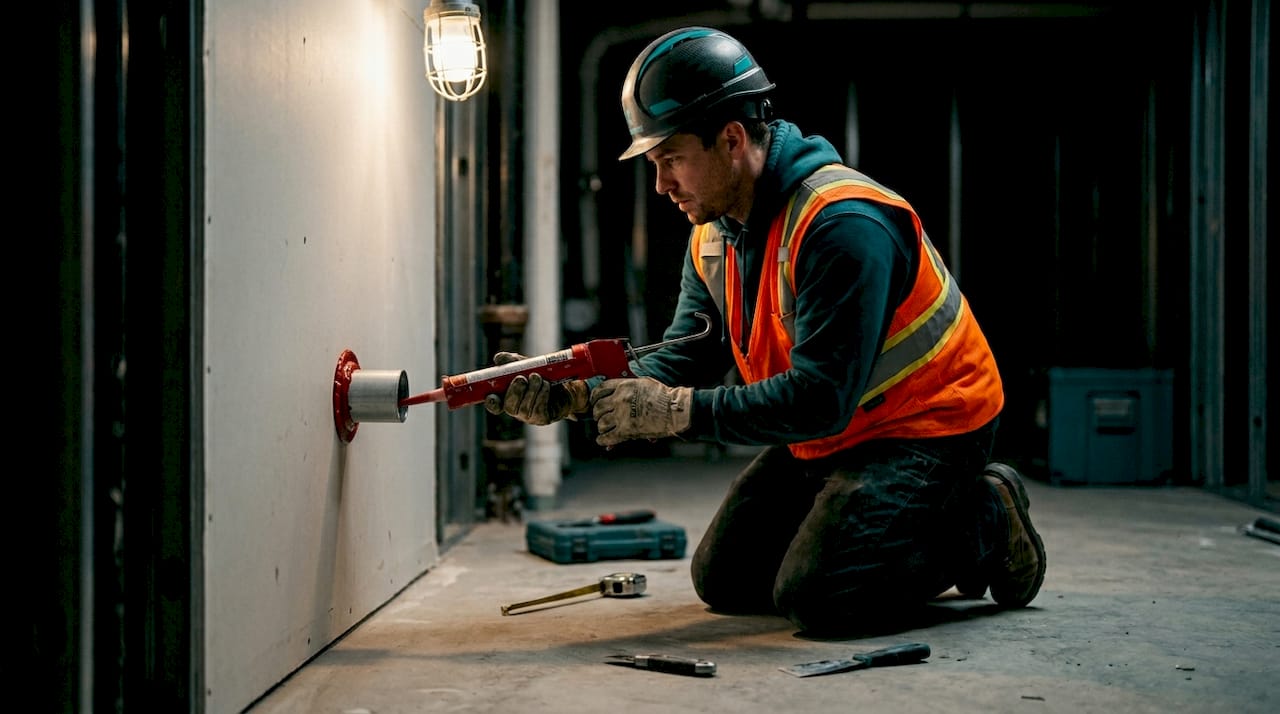
Selecting firestopping correctly depends on penetration type and material, penetration size and annular space, and barrier type. Using the wrong product or installation detail causes failures that require complete rework and often mean failed inspections.
Every penetration scenario requires a specific UL-listed system. The system listing specifies the exact product, the exact barrier assembly (concrete wall, gypsum wall, concrete floor, etc.), the exact penetrant type and size, and the exact installation method. Nothing is interchangeable. Critically, a firestop product by itself does not carry a fire-resistance rating. The rating belongs to the tested system: product plus barrier plus penetrant plus installation method. Swapping any element means you no longer have a listed system.
Here’s how product selection breaks down by penetration type:
| Penetration type | Common firestop product | Notes |
|---|---|---|
| Steel/iron pipe | Firestop sealant or mortar | Annular space must match listing dimensions |
| PVC/CPVC plastic pipe | Intumescent collar or wrap strip | Collar expands to crush pipe as it melts |
| Electrical conduit | Firestop putty pad or sealant | Conduit fill affects product choice |
| Cable bundles | Firestop sealant with backing material | Cable fill ratio is critical to listing |
| HVAC ductwork | Firestop wrap or combination system | Often requires damper integration |
Intumescent products deserve special mention. These are materials that expand dramatically when exposed to heat. Around a plastic pipe, an intumescent collar will expand inward as the pipe softens and melts, sealing the void left behind. Without it, a 4-inch PVC drain pipe creates a 4-inch open hole in your fire-rated floor the moment the fire reaches it.
Common installation failures include:
- Insufficient sealant depth (most listings require a minimum depth of 1 inch or more)
- Missing backing materials like mineral wool in oversized openings
- Using a concrete-wall listing in a gypsum wall assembly
- Installing products in conditions outside their listed ambient temperature range
- Filling too little or too much of the annular space around the penetrant
Pro Tip: Request the specific UL system number from your contractor before installation begins, not after. Cross-check it against the actual wall assembly type and penetrant dimensions. This one step prevents most inspection failures.
Understanding how firestopping fits within a broader suppression and life-safety context helps when managing full building projects — our fire suppression systems workflow article explains how these layers connect.
Inspection and ongoing maintenance: safeguarding firestop integrity over time
Even a perfectly installed firestop system can fail over a building’s lifetime. Renovations, added cabling, changed penetrants, and deferred maintenance all create gaps that eventually compromise compartment integrity. Managing this over time requires a structured approach.
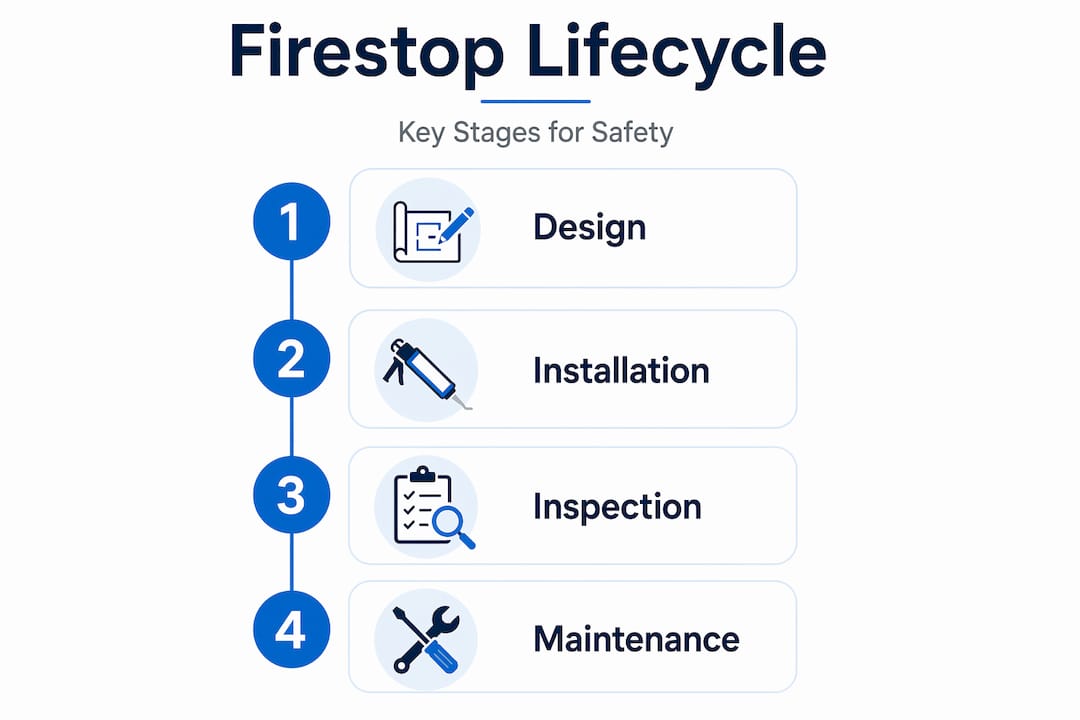
The industry’s leading model is the DIIM framework, developed by the Firestop Contractors International Association. A complete firestop program includes four pillars: Design, Installation, Inspection, and Maintenance/Management. Each pillar depends on the others. Great design with poor installation means nothing. Good installation with no maintenance eventually fails.
Here’s what each pillar requires in practice:
- Design: Firestop systems must be specified by a qualified professional before construction or renovation begins, not selected on-site by whoever happens to be installing pipes that day.
- Installation: Every penetration must be installed by trained personnel following a specific UL-listed system. Documentation must be created at time of installation, including photos and system numbers.
- Inspection: Independent third-party inspection verifies that installation matches the listed system. Firestop inspections are commonly phased, with rough-in checks before walls and floors are closed and final verification after completion.
- Maintenance/Management: Ongoing review and documentation of any penetration changes, repairs to damaged seals, and records management to support future inspections and AHJ (Authority Having Jurisdiction) reviews.
The phased inspection point is especially critical for Houston property owners managing ground-up construction or major renovations. Once a wall is closed, inspecting what’s behind it requires destructive investigation. Getting inspectors in before concealment is not optional — it’s the only way to verify proper installation.
Pro Tip: Create a firestop log for your building that tracks every penetration location, the UL system number used, installation date, and inspector sign-off. This log becomes invaluable during AHJ inspections and insurance reviews.
For ongoing support with maintaining fire safety compliance in Houston properties, our team provides fire system maintenance services that include firestop program review.
Compartment integrity is not a one-time achievement. It requires active management across the full building lifecycle.
The hidden challenge: why firestop systems often fail without your active oversight
Here’s the uncomfortable reality that most firestop guides won’t tell you directly: the majority of firestop failures in existing buildings are not from original installations. They come from everything that happens after.
A pipe gets rerouted during a tenant buildout. Someone adds a data cable through an already-sealed wall and doesn’t restore the system. A water leak damages an intumescent seal, and the maintenance request gets deferred. Three years later, your fire-rated wall is no longer fire-rated, and nobody knows.
The biggest failure mode isn’t bad specification — it’s loss of compartment integrity over the building life cycle, as FCIA research confirms. This happens because property managers assume that once firestop was installed properly, it stays compliant forever. It doesn’t.
The DIIM framework is the right model, but it only works as a living program. The “M” in DIIM is where most buildings quietly fail. Maintenance and management of firestop systems requires treating every penetration change as a fire safety event, not just a facilities task. That mindset shift is what separates buildings that maintain genuine compartment integrity from those that only appear compliant on paper.
We’ve seen this pattern repeatedly: a building passes initial inspection, management turns attention elsewhere, and several years of normal building activity erode what was once a compliant system. The fix is not complicated, but it requires that someone in your organization owns the firestop program the way they own other critical building systems. Accountability structures matter more than the product you install.
If you want to understand the broader challenges of keeping fire safety systems current in Houston’s commercial environment, our perspective on fire system maintenance challenges covers what proactive programs look like in practice.
Protect your Houston property with reliable fire safety solutions
Firestopping handles the passive side of fire protection, but a complete safety plan includes active systems that detect and respond the moment a fire starts.
At Reliable Fire Protection, we work with Houston property owners and managers to build fire safety programs that cover both sides. Our certified team provides fire alarm system installation, testing, and monitoring alongside fire system maintenance services that keep your property compliant and your occupants safe. Whether you’re navigating an initial buildout, preparing for an AHJ inspection, or managing an aging building with evolving fire safety needs, we provide the expertise and local knowledge that Houston properties require. Contact us for a free consultation.
Frequently asked questions
What is the difference between UL 1479 and ASTM E814 firestop tests?
UL 1479 is harmonized with ASTM E814, meaning results are functionally equivalent and both are accepted interchangeably by code officials and AHJs across the country.
Why does a firestop product alone not have a fire resistance rating?
A firestop product itself does not carry a fire-resistance rating because the rating belongs to the complete tested system: the specific product, barrier assembly, penetrant type, and installation method combined.
How often should firestop systems be inspected?
Firestop inspections are commonly phased with rough-in checks before concealment and final inspections after, plus ongoing maintenance reviews whenever penetrations are added or modified.
Can I use any sealant labeled as firestop for all penetrations?
No. You must use products tested and listed for the specific penetration type, barrier assembly, and installation configuration, because using the wrong product or wrong installation detail causes inspection failures and requires complete rework.
What is the DIIM framework in firestop management?
The DIIM framework stands for Design, Installation, Inspection, and Maintenance/Management: four pillars that together ensure firestop systems remain effective and compliant across the full life of a building.