

TL;DR:
- Many Houston property managers confuse fire barriers with fire walls, risking non-compliance. Fire barriers subdivide interior spaces to control fire spread but lack structural independence, requiring specific code compliance. Proper firestopping and documented penetrations are essential to maintain their effectiveness during inspections and renovations.
Many Houston property managers treat fire barriers and fire walls as the same thing, and that single misconception can quietly undo an entire building’s code compliance. The role of fire barriers is specific: they subdivide space within a building to control fire spread across mixed occupancies, exit enclosures, and fire areas. They are not fire walls, and the difference matters legally and structurally. This guide breaks down what fire barriers actually do, which codes govern them in Houston, how firestopping makes or breaks their performance, and what you need to do right now to stay compliant and keep your property protected.
Table of Contents
- Understanding fire barriers and their code requirements
- Critical fire barrier components: firestopping and joint systems
- Common challenges and misconceptions in fire barrier compliance
- Ensuring proper installation and ongoing maintenance of fire barriers
- Why most fire barrier compliance advice misses the mark for Houston property managers
- Explore fire safety solutions tailored for Houston properties
- Frequently asked questions
Key Takeaways
| Point | Details |
|---|---|
| Fire barriers definition | Fire barriers are continuous fire-rated walls separating fire areas inside a building to prevent fire spread. |
| Supporting systems matter | Proper firestopping and joint systems are essential to maintain fire barrier integrity through penetrations and joints. |
| Common compliance pitfalls | Confusion between fire barriers and other barriers plus post-renovation gaps cause many fire barrier failures. |
| Installation best practices | Matching UL-tested designs and rigorous field verification reduce risk of fire barrier non-compliance. |
| Maintenance is ongoing | Regular inspections and sealing of any new penetrations ensure fire barriers retain effectiveness over time. |
Understanding fire barriers and their code requirements
The International Building Code (IBC) §707 defines a fire barrier as a fire-resistance-rated wall assembly that limits fire spread between spaces within a single building. That last phrase matters. Unlike a fire wall, which is designed to allow a building to collapse on one side without the wall failing, a fire barrier is not structurally independent. It works as part of the building’s frame, which means it carries different construction and continuity requirements.
A fire barrier is required wherever code separates mixed occupancies, fire areas, exit stairways, or shaft enclosures within a building and must extend continuously from floor to floor, with ratings ranging from 1 to 4 hours depending on occupancy and use. In Houston, that covers a wide range of properties: multi-tenant commercial buildings, mixed-use developments, parking garages attached to office towers, and any building where two occupancy types share a structure.
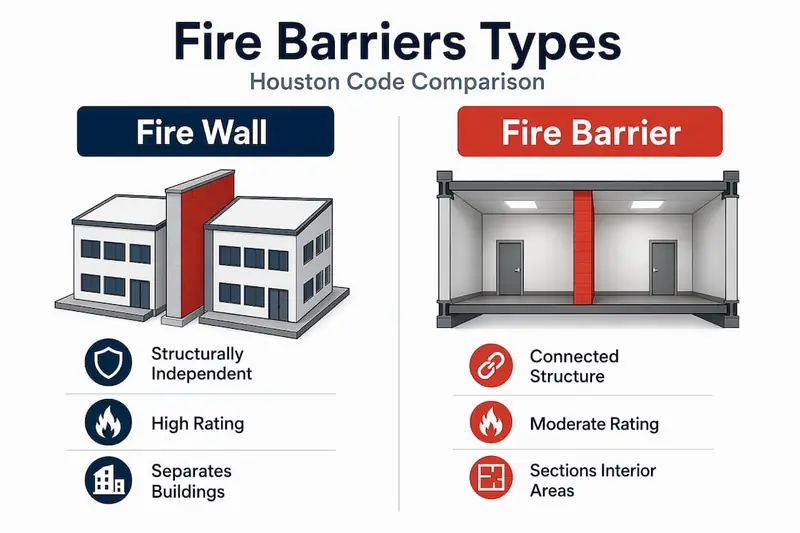
The table below clarifies how fire barriers compare to other fire-resistant assemblies you will encounter in IBC-governed buildings:
| Assembly type | Structural independence | Typical rating | Key purpose |
|---|---|---|---|
| Fire wall | Yes (can stand alone) | 2 to 4 hours | Property line separation; allows collapse on one side |
| Fire barrier | No | 1 to 4 hours | Occupancy, fire area, exit, shaft separation within a building |
| Fire partition | No | 0.5 to 1 hour | Corridor walls, tenant separations, dwelling unit separations |
| Smoke barrier | No | 1 hour (usually) | Smoke compartment separation, not flame-rated |
Openings in fire barriers are strictly controlled. No single opening can exceed 156 square feet, and total openings cannot exceed 25 percent of the wall’s length. Every opening requires a rated door, window, or damper assembly that matches the barrier’s hourly rating. Understanding occupancy classifications for fire safety is where this starts to get complicated for multi-use Houston properties.
Key code triggers requiring fire barriers in your building include:
- Separating mixed occupancy groups (e.g., Group B office from Group S storage)
- Enclosing exit stairways and exit ramps
- Creating shaft enclosures for mechanical, electrical, or plumbing systems
- Dividing fire areas that exceed allowable square footage limits
- Separating incidental uses such as boiler rooms or generator rooms from main occupancy spaces
Critical fire barrier components: firestopping and joint systems
A fire barrier wall assembly without proper firestopping is like a sealed vault with an open drain. The wall can be perfectly constructed, but any unsealed pipe penetration, cable tray, or duct opening creates a path for flames, smoke, and toxic gases to travel exactly where the barrier was meant to stop them.
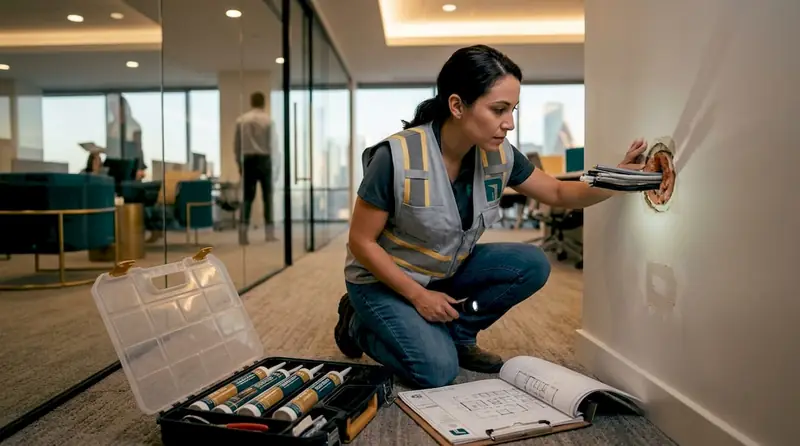
Firestopping systems must be tested and listed per ASTM E814 or UL 1479 to maintain the fire-resistance ratings of the wall or floor assembly at every penetration point. That applies to metal pipes, plastic pipes, cable bundles, conduit, ductwork, and any other element that passes through the barrier. The tested listing must match the actual field condition, including the annular space (the gap around the penetration), the substrate material, and the firestop product being used.
Fire-resistant joint systems are a separate but equally critical requirement. At locations where a fire barrier meets another barrier, a floor, or a ceiling, and at expansion joints that allow the building to move during temperature changes, joint systems must be tested to ASTM E1966 or UL 2079 to maintain the required fire-resistance rating while accommodating structural movement.
Here is what every Houston property manager should confirm about firestopping and joint systems on their property:
- Every penetration through a rated fire barrier has a tested and listed firestop system installed, not just a generic caulk or sealant.
- The product installed matches the UL or FM listing for that specific penetration type, pipe material, and wall assembly.
- Joint systems at barrier intersections are rated to match the barrier and allow the movement expected at that location.
- All firestop materials have been installed per the manufacturer’s written instructions, not field-improvised.
- Documentation of the firestop systems used is retained on site for Authority Having Jurisdiction (AHJ) review during inspections.
Pro Tip: Before accepting a new installation or renovation, ask the contractor for the specific UL or FM listing number for every firestop and joint system used. A tested system installed in the wrong application fails as surely as no system at all. Confirm fire safety best practices are being followed before you sign off.
Common challenges and misconceptions in fire barrier compliance
Confusion between fire barriers and cavity barriers is a persistent issue that undermines compliance and fire safety effectiveness across the industry. Cavity barriers seal concealed spaces in construction cavities to stop fire traveling through voids. They are not rated assemblies like fire barriers, and specifying one when you need the other leaves occupants unprotected and your property out of code.
Here are the compliance mistakes Houston property managers most commonly make:
- Substituting a fire barrier where an IBC fire wall is actually required, meaning the separation does not meet structural independence requirements
- Ignoring dual exposure ratings, which applies when a fire barrier must be rated from both sides, not just one
- Installing fire doors rated lower than the barrier itself, which voids the entire assembly’s rating at that opening
- Assuming old fire barriers installed before a renovation still meet current code after new penetrations were added
- Failing to upgrade firestopping when the occupancy classification of a space changes after a tenant buildout
Renovations are where most Houston properties lose fire barrier compliance without realizing it. A contractor adds a data cable run, cuts through a rated wall, and fills the gap with standard drywall compound. It looks fine. It fails catastrophically in a fire. The greatest failure mode of fire barriers is continuity breaks created after renovations when firestopping is not properly maintained.
“Fire barrier compliance is not a one-time checkbox. Every penetration added after original construction is a new vulnerability until it is properly firestopped and documented.” This is the standard applied by experienced passive fire inspectors and what any Houston AHJ will look for during a compliance audit.
Practical steps to stay compliant through property changes:
- Add fire barrier review to your standard renovation scope before any contractor starts work
- Require written firestopping plans as part of your contractor RFP process
- Conduct a post-renovation inspection with a qualified fire protection professional before occupying the modified space
- Keep a living record of all penetrations, their firestop systems, and the tested listings for every fire-rated assembly in your building
For a full grounding in passive fire systems, a solid passive fire protection guide is worth reviewing alongside this article.
Ensuring proper installation and ongoing maintenance of fire barriers
Reliably compliant fire-rated assemblies require matching tested UL design numbers, installer field verification, and compatible firestop and joint systems to prevent rework during inspection. The installation phase is where most future compliance problems are either created or prevented.
Best practices for fire barrier installation:
- Verify the UL design number on the wall assembly matches the actual materials, stud spacing, and board thickness being installed on site.
- Confirm that all penetrating items were included in the original tested design or have a separately listed through-penetration firestop system.
- Install all firestopping materials per manufacturer instructions without field substitutions.
- Inspect the assembly for continuity before closing with finish materials, particularly at floor and ceiling interfaces.
- Document the installed assembly with photographs, product data sheets, and listing numbers before the wall is concealed.
Ongoing maintenance is equally important. Fire system maintenance tips for fire barriers specifically include visual inspections after any mechanical, electrical, or plumbing work that required wall penetrations, and a formal inspection by a qualified professional at least annually.
Pro Tip: Request a “firestop traceability package” from your installation contractor. This document links every penetration location to its tested system listing, the installer’s name, and the product batch used. When an AHJ walks your building for an inspection, this package turns a potentially difficult audit into a straightforward sign-off. Combine this with consistent attention to fire alarm maintenance and you have a defensible, documented fire safety program.
Why most fire barrier compliance advice misses the mark for Houston property managers
Most guidance on fire barriers focuses almost entirely on the wall assembly: stud type, board layers, UL design number. That focus is necessary, but it misses where properties actually fail. The wall itself rarely fails. What fails is everything done to it after it was built.
Houston is a high-renovation market. Tenant turnover in commercial buildings here is frequent, construction crews change constantly, and subcontractors are rarely briefed on the rated assemblies they are cutting through. Every new lease buildout is a potential continuity break waiting to happen. The biggest failure mode of fire barriers is continuity breaks created after renovations, not deficiencies in the original wall assembly.
“Passive fire protection does not advertise when it has been compromised. A fire barrier with three unsealed cable penetrations looks identical to a code-compliant one until the building is on fire.”
The practical solution is a traceability-first mindset. Every fire-rated assembly in your building should have a documented trail: the original UL design, a record of every penetration ever added, the firestop listing used for each one, and the most recent inspection date. This is not bureaucratic overhead. It is the only way to prove compliance to an AHJ and, more importantly, the only way to actually know your barriers are performing as designed.
Integrating fire barrier reviews into your renovation planning, rather than treating it as a post-construction afterthought, is the single highest-value change most Houston property managers can make to their fire safety program. Understanding fire protection for Houston buildings starts with accepting that fire barriers are living systems, not permanent fixtures you install and forget.
Explore fire safety solutions tailored for Houston properties
Knowing the role of fire barriers is valuable. Having a qualified local team to verify, install, and maintain them is what converts that knowledge into real protection for your tenants and your investment.
Reliable Fire Protection works with Houston property owners and managers to assess fire barrier conditions, identify firestopping gaps, and support compliance with current IBC requirements and local AHJ expectations. From initial consultation to ongoing fire system maintenance, the team brings hands-on expertise to every property type in the Houston area. Whether you need a compliance review after a recent renovation or a complete fire protection assessment, connecting with a credentialed local professional is the fastest way to close gaps before an inspection forces the issue. Start with fire alarm maintenance guidance or explore how fire alarm systems work alongside your barrier strategy for a fully integrated approach to building fire safety.
Frequently asked questions
What is the main purpose of a fire barrier in a building?
A fire barrier is designed to limit fire spread between different areas within a building by providing fire-resistance-rated separations that protect occupants and property. Per IBC requirements, fire barriers extend continuously with ratings from 1 to 4 hours to separate mixed occupancies or fire areas.
How do firestopping systems contribute to fire barrier effectiveness?
Firestopping systems seal penetrations and joints in fire barriers, preventing flames, smoke, and gases from bypassing the barrier and maintaining its rated protection. Firestopping must be tested and listed to form an effective barrier maintaining the integrity of fire-resistance-rated walls and assemblies.
Can renovations affect the performance of existing fire barriers?
Yes, renovations often create continuity breaks such as uncapped penetrations or gaps that compromise fire barrier integrity unless properly sealed with firestopping. Continuity breaks after renovations are the most common reason fire barriers fail in real-world inspections.
What documentation should Houston property managers request to ensure fire barrier compliance?
Managers should ask for traceability records linking the installed UL-tested assembly design, field verification by installers, and compatible firestop and joint systems with required ratings. Reliable compliance requires traceability from UL design numbers through installer verification to firestop system ratings.
Recommended
- Passive fire protection: essential guide for Houston properties
- Fire Safety Regulations Explained: Impact on Houston Property Managers
- Fire Protection Best Practices for Houston 2025
- Fire Protection Explained: Safeguarding Houston Properties
- Fire Alarm System University Place TX
- Fire Alarm System Services in Bellaire, TX