
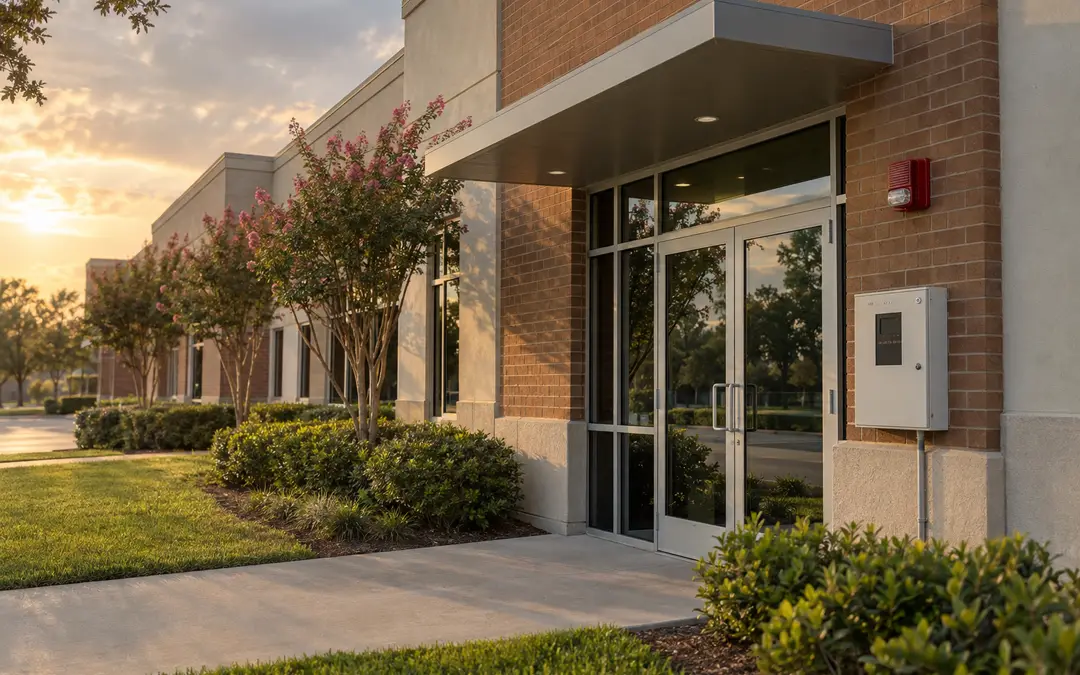
TL;DR: In Houston, a commercial fire alarm system costs more than the install bill. Over its life you also pay for permits and plan review, yearly NFPA 72 testing, monitoring, batteries and devices, retesting after renovations, and finally a new panel. Most of these costs are predictable, so you can budget for them ahead of time.
The real commercial fire alarm system cost in Houston is more than the install bill. Over the life of the system you also pay for permits and plan review, yearly testing, monitoring, replacement batteries and devices, retesting after renovations, and in the end a new panel. If you plan for each one, you avoid surprise bills and failed inspections.
This post covers that full lifecycle. For the up-front side, see our guide to commercial fire alarm installation cost in Houston. We don’t list prices here because every building is different. Instead, we explain what drives each cost so you can budget and ask better questions.
What costs come after a fire alarm system is installed?
Most of what you spend on a fire alarm comes after day one. Here are the items Houston facility managers should expect to pay for:
- Permits and plan review for the first install and for later changes.
- Regular inspection and testing under NFPA 72.
- Central station monitoring, if your system reports off site.
- Standby batteries, which wear out and get replaced on a schedule.
- Detectors and other devices that fail tests or get damaged.
- Reacceptance testing after renovations or tenant finish-outs.
- A new panel once parts or support run out.
You can’t skip any of these and stay in good standing with the fire marshal. The good news is that most of them are predictable.
How do Houston permits add to commercial fire alarm system cost?
Permits cost you fees and time, and the time often matters more. Inside city limits, the Houston Fire Marshal’s Office has a fire alarm and sprinkler team that takes part in plan review at the Houston Permitting Center. The office also inspects commercial buildings across the city.
The city’s process has four steps:
- The contractor submits plans.
- The review team checks them against code.
- After approval, the contractor schedules an on-site inspection.
- The permit is finalized once that inspection passes.
If a plan gets rejected or an inspection fails, you go through another round. Every round adds labor and can push back an opening or a certificate of occupancy. The City of Houston also requires fire alarm contractors to hold a license from the Texas Department of Insurance State Fire Marshal’s Office and to be registered with the city.
Outside city limits, the rules can change. Bellaire is its own city, and unincorporated areas like Cypress and Cinco Ranch usually fall under county fire officials. Before you set a budget, confirm the permit process with your fire marshal or AHJ.
How often does a commercial fire alarm need testing?
Most fire alarm devices must be tested at least once a year, and some parts get visual checks more often. The International Fire Code, which Houston adopts with local amendments, points to NFPA 72 for fire alarm testing and maintenance. Chapter 14 of NFPA 72 sets the schedules for inspections and tests.
As Facilitiesnet explains, those Chapter 14 rules apply to systems already in service, no matter how old they are. They also make the building owner, or the owner’s designated representative, responsible for the work. So testing is a cost you pay every year, not once. A building with more devices takes longer to test. So does a system tied into elevators, HVAC shutdown or door holders, because those connections get checked too. Your AHJ or insurance carrier can require more than the minimum, so confirm the schedule for your building.
Should you repair, upgrade or replace an aging fire alarm?
Repair makes sense while parts are still available and the panel passes its tests. Replacement makes sense once parts are discontinued, trouble signals keep coming back, or a renovation would mean big changes anyway. Here is how the options compare.
| Option | Best fit | What drives the cost | Permit and testing |
|---|---|---|---|
| Repair a device or board | Supported panel that mostly passes testing | Whether parts are available, time to find the fault | Retest of the affected parts |
| Add or move devices | Tenant finish-out or new space | Number of new devices, wiring runs, room left on the panel | Plan review plus reacceptance testing |
| Replace the panel only | Old panel, but wiring and devices are in good shape | Whether devices work with the new panel, programming, labor | Usually a permit and acceptance test |
| Replace the full system | Panel, devices and wiring all near end of life | Building size, device count, ceiling access, phased work | Full plan review and acceptance test |
Renovations are an easy cost to miss. An NFPA Journal article on reacceptance testing explains that when a change affects site-specific software, NFPA 72 calls for testing the changed devices plus 10 percent of unaffected initiating devices, up to 50. That comes up often in Downtown Houston and the Energy Corridor, where office floors get rebuilt for new tenants.
Signs it’s time to call a pro
- The panel shows trouble signals that keep coming back after a reset.
- Your last inspection report listed deficiencies that are still open.
- Your technician says parts for your panel are hard to find.
- You’re planning a remodel, an expansion or a change in how the space is used.
- The system went into trouble during or after a storm power outage.
- You can’t find current testing records for the building.
What raises lifetime fire alarm costs in Houston buildings?
Local conditions add a few cost drivers that a national price guide won’t cover.
- Hurricane season, June through November. Long power outages put the load on standby batteries. Weak batteries often show up as trouble signals after a storm.
- Heat and humidity. Houston’s climate is hard on equipment in hot, damp spots like warehouses, loading docks and parking garages. Dust and moisture can lead to dirty detectors and false alarms.
- Frequent build-outs. Office, retail and mixed-use buildings that change tenants often pay for plan review and retesting again and again.
- Equipment choice. A panel that only a few technicians can service can make future repairs slower and harder to schedule.
Why Reliable Fire Protection fits Houston fire alarm owners
We are a family-owned company at 3522 Bolin Road in northwest Houston.
We are open 24 hours a day, 7 days a week.
We install, inspect, maintain, repair and monitor fire alarm systems, including panel replacements.
We sell and install Fire-Lite and System Sensor fire alarm equipment.
Our technicians are state-licensed.
Sean Ellis leads our team and handles inspections, quotes and installations.
We help with permitting for renovations and with testing for certificates of occupancy.
When a system fails inspection, we work with the inspector to get it to a pass.
Our customers include schools like Vanguard Academy in Katy and Montessori School of Downtown, plus retail stores and companies with several Houston locations.
Reliable Fire Protection has a 4.7-star Google rating from 199 reviews as of November 2026.
You can learn more about our fire alarm system services in Northwest Houston.
Want a clear picture of what your system will cost to own over the next 5 to 10 years? Call (832) 345-5360 or book a free estimate.
Frequently Asked Questions
Is fire alarm monitoring billed separately from inspection and testing?
Usually, yes. Monitoring is an ongoing service that sends alarm, trouble and supervisory signals off site, while inspection and testing are scheduled visits. Ask your provider to list each one separately so you can compare quotes fairly.
Who pays for fire alarm testing in a leased commercial building?
It depends on your lease. NFPA 72 makes the owner, or the owner’s designated representative, responsible for inspection, testing and maintenance, so check your lease to see who is assigned that job.
Do I need a permit to replace a fire alarm panel in Houston?
In most cases, a panel replacement involves a permit and an acceptance test. Confirm the exact requirements with the Houston Fire Marshal’s Office or the AHJ for your building’s location.
Can I get a multi-year budget for my building’s fire alarm?
Yes. Ask for an estimate that covers yearly testing, battery replacement, any open deficiencies and the age of your panel. Reliable Fire Protection offers free estimates for businesses across Greater Houston.
What records should I keep to control fire alarm costs?
Keep every inspection and test report, deficiency list, battery replacement date and permit document. Good records help you plan ahead and give the fire inspector what they ask for during a visit.
Recommended Reads
- How Much Does a Commercial Fire Alarm System Cost in Houston?
- Fire Alarm System Services in Northwest Houston
- Fire Alarm System in Memorial City Houston