
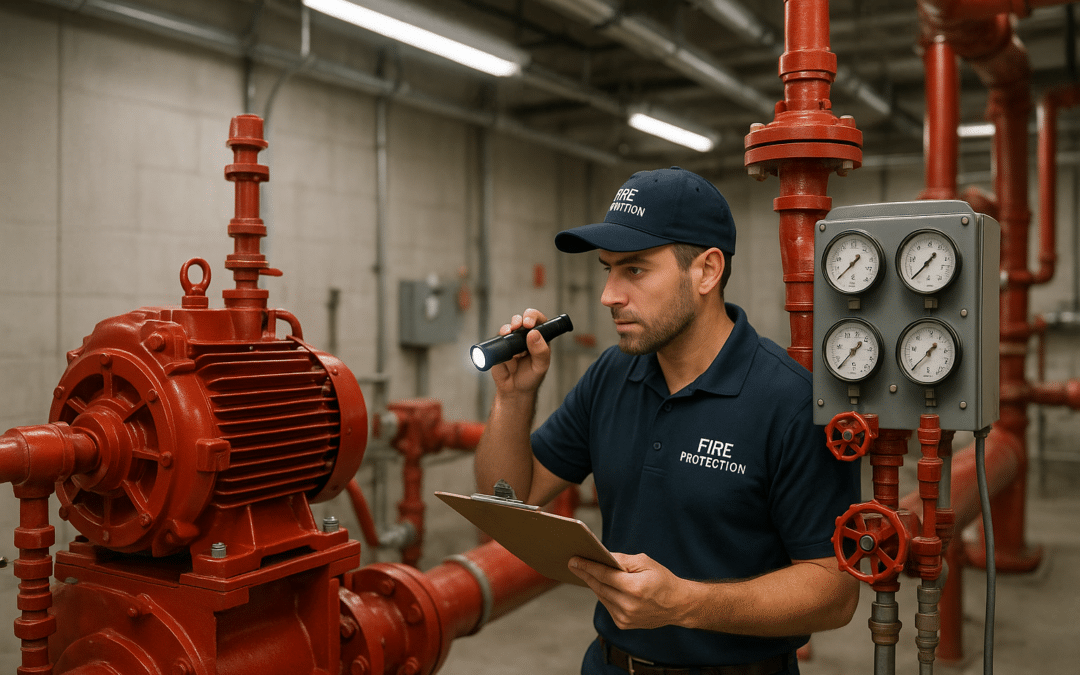
TL;DR: Fire pumps that supply sprinkler systems in Houston need weekly or monthly no-flow churn tests plus a full annual flow test under NFPA 25 and the Houston Fire Code. This guide walks through exactly what happens during each type of test, why Houston’s water supply and climate make it especially important, and how to stay compliant with your local AHJ.
If your Houston commercial building, hospital, warehouse, or high-rise relies on a fire pump to move water through its sprinkler system, that pump has to prove — on a schedule, with documentation — that it will actually work during a fire. That proof comes from routine churn tests and an annual flow test performed under NFPA 25.
Here’s exactly what happens during each type of fire pump inspection and test, how often Houston properties need them, and what the results mean for your compliance and your insurance.
Why Fire Pumps Need Their Own Testing Program
A fire pump exists because gravity or the municipal water main alone can’t always deliver the pressure your sprinkler system needs. Fire pumps are critical for buildings that supply their sprinkler systems through water storage tanks which don’t generate gravity-fed water pressure, and buildings where the municipal supply doesn’t create enough pressure on its own.
That makes the pump one of the single points of failure in a fire protection system. If it doesn’t start, doesn’t reach rated pressure, or can’t sustain flow, sprinklers downstream may never get the water volume they were designed to deliver. Regular testing is how you catch that before a fire does.
The Codes Behind Houston Fire Pump Testing
Testing requirements for Houston properties come from two layers:
- NFPA 25 — the national standard for inspection, testing, and maintenance of water-based fire protection systems, which sets the frequency and procedure for every fire pump test.
- Houston Fire Code and Harris County Fire Code — local amendments adopted from the International Fire Code, which give the Houston Fire Department authority to require acceptance testing, permits for pump work, and documentation. Fire pump systems and all other fire protection systems and appurtenances are subject to acceptance tests as contained in the installation standards and as approved by the fire code official.
Houston also has its own equipment rules layered on top of NFPA 20 and NFPA 25. Fire pumps must be listed by Factory Mutual, Underwriters Laboratories, or another approved agency and must not deliver less than the required fire flow and pressure in accordance with the listing, and such pumps must be automatic operation. A construction permit is required any time a pump, controller, jockey pump, or fuel tank is installed or modified, though
maintenance performed in accordance with the code is not considered a modification and does not require a permit
.
The Three Levels of Fire Pump Testing
1. Weekly Churn Tests (Diesel Pumps)
A churn test — also called a no-flow test — runs the pump with the discharge valve closed to confirm it starts automatically, builds pressure, and runs without overheating. A fire pump churn test runs the pump without flowing water into the system, and it answers whether the pump will start on its own, hold pressure, and keep running.
For diesel-driven fire pumps, this test happens every week. Diesel driven pumps should be churn tested for at least 30 minutes on a weekly basis. The technician checks:
- Automatic start on a simulated pressure drop (not the manual start button)
- Engine temperature, oil pressure, and battery condition
- Fuel system pressure and cooling system operation
- Discharge and suction pressure readings
2. Monthly Churn Tests (Electric Pumps)
Most standard electric fire pumps only need a monthly no-flow test.
Most standard electric pumps moved from weekly to monthly churn testing in more recent editions of NFPA 25.
The pump runs for at least 10 minutes to confirm automatic starting and stable pressure.
Some electric pumps still require weekly testing.
A defined set of higher-risk installations stayed weekly, including pumps with limited-service controllers, vertical turbine pumps, and pumps protecting buildings beyond what the local fire department can supply by pumper.
This matters in Houston, where high-rises in Downtown, the Energy Corridor, and the Galleria area often exceed HFD’s pumper reach and fall into that weekly category.
3. The Annual Flow Test
This is the big one. Once a year, every fire pump — diesel or electric — gets tested under real flow conditions at multiple points on its performance curve. An annual test of each pump assembly is conducted by qualified personnel under no-flow (churn), rated flow, and 150 percent of the pump rated capacity flow, by controlling the quantity of water discharged through approved test devices.
During the test, technicians typically:
- Install calibrated gauges, flow meters, and recording equipment on the pump.
- Run the no-flow (churn) test and record baseline pressure.
- Open the discharge to 100% of rated flow and record pressure, voltage, amperage, and speed.
- Push the pump to 150% of rated capacity to confirm it holds up under peak demand.
- Plot the results against the manufacturer’s pump curve and the previous year’s data.
The accuracy bar is strict. The gauges and transducers used during the flow test must be unique to the test because their measurements need to be within +/- 1 percent to accurately identify trends over time. Flow meters have their own tolerance:
flow meters must be calibrated annually to an accuracy level of ±3 percent.
To pass, the pump has to hold up against its original performance data. A fire pump passes its annual flow test when it can meet full sprinkler system demand and test results don’t deviate by more than five percent from the pump’s nameplate data or original unadjusted field test curve.
What Happens If the Pump Fails
A failed annual test doesn’t necessarily mean a new pump.
If the pump does not generate enough pressure, it may need maintenance or replacement
— common fixes include impeller wear repair, alignment correction, controller recalibration, or clearing a restricted suction line.
Alignment is checked every year regardless of flow results.
Parallel and angular alignment of the pump and driver is inspected during the annual test, and any misalignment must be corrected.
Diesel pumps get extra scrutiny on top of the flow test, since
engines with electronic fuel management control systems must have their backup electronic control module and primary and redundant sensors tested annually.
Why This Matters More in Houston
Houston’s water and climate work against fire pump longevity in a few specific ways:
- Hard, mineral-rich water. Houston sits atop ancient Gulf Coast sediments rich in limestone and calcium carbonate deposits, and as groundwater moves through these mineral-rich formations it dissolves calcium and magnesium, creating hard water across Harris County. That mineral content contributes to scale and sediment inside pump casings and piping over time.
- Corrosion risk from testing itself. Ironically, the tests that keep a pump compliant can also introduce a slow threat. Fire pump tests allow oxygen to enter the piping in the vicinity of the fire pump when water is discharged and replenished. Combined with Gulf Coast humidity, this is a real reason to have a qualified technician inspect fittings and FDC piping during every visit, not just run the numbers.
- Humid, high-heat conditions. Pump rooms across Katy, Cypress, Sugar Land, and Pasadena see extended periods of high heat and humidity that stress motor windings, batteries, and electrical components faster than in drier climates.
Who Needs a Fire Pump Testing Program
If your property has any of the following, you almost certainly have a fire pump that needs a documented testing schedule:
- A high-rise office tower in Downtown or the Energy Corridor
- A hospital, assisted living facility, or medical campus
- A hotel or large multi-family complex in Midtown, Bellaire, or Sugar Land
- A warehouse or industrial plant with high-piled storage in Pasadena or Cypress
- Any building supplied by a tank, well, or low-pressure municipal connection instead of city main pressure alone
Keeping Records the AHJ Will Accept
Every test needs a paper (or digital) trail. Reports must include all data necessary for a complete evaluation of fire pump performance, including suction and discharge pressures, voltage and amperage readings, and pump speed at each flow rate tested. Houston’s fire code official can ask to see these logs at any inspection, and gaps are one of the fastest ways to end up with a citation or a failed annual inspection.
Fire pump testing doesn’t happen in isolation — it’s one piece of a property’s overall water-based fire protection compliance, alongside backflow preventer testing and fire alarm testing. If you’re coordinating multiple systems, our guide to TCEQ backflow preventer testing requirements and our breakdown of NFPA 72 fire alarm testing requirements cover the other pieces of the puzzle.
How Reliable Fire Protection Handles Fire Pump Testing in Houston
Reliable Fire Protection is a family-owned, state-licensed fire protection company based on Bolin Rd in Houston, serving commercial, industrial, institutional, and multi-family properties across the Greater Houston area — from Downtown and Midtown to Katy, Cypress, Sugar Land, and Bellaire. Our technicians perform weekly, monthly, and annual fire pump testing to NFPA 25 and Houston/Harris County Fire Code requirements, with transparent pricing, non-proprietary equipment, and a 24-month satisfaction guarantee on parts, materials, and labor.
If your fire pump is overdue for its annual flow test, or you’re not sure which testing frequency applies to your equipment, visit our Houston fire pump and tank services page for a free quote, or reach out for 24/7 emergency support if your pump has already failed a test or shut down unexpectedly.
Recommended Reads
- #1 Houston Fire Pumps & Tanks Repair & Installation Services
- TCEQ Backflow Preventer Testing Requirements Every Houston Property Owner Should Know
- NFPA 72 Fire Alarm Testing Requirements Explained for Houston Commercial Properties