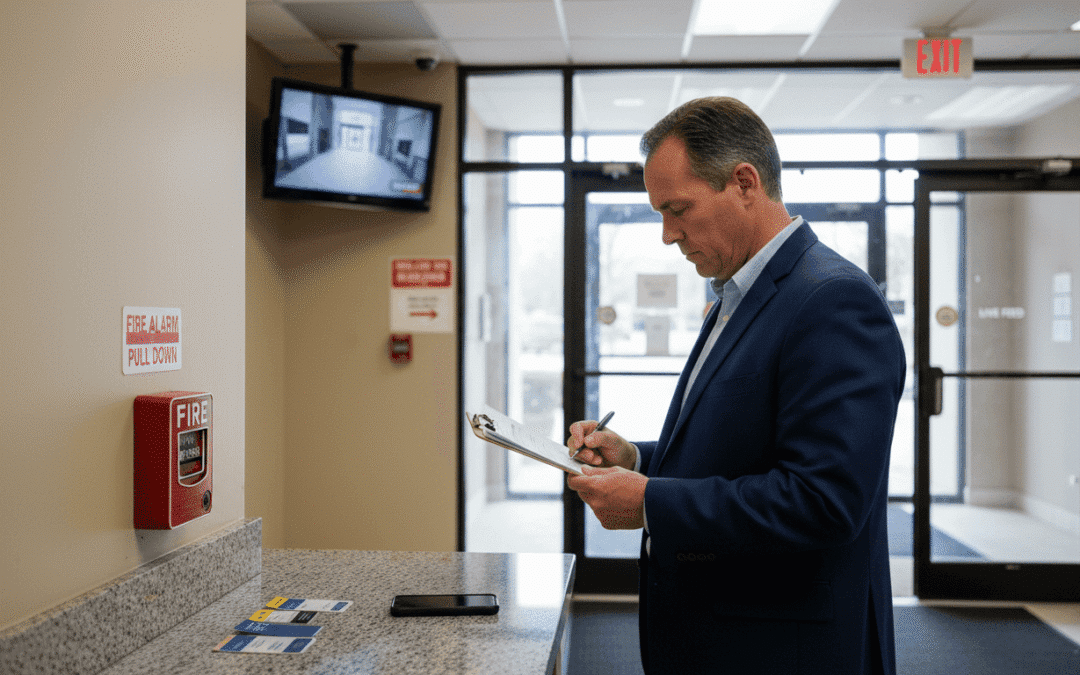
A single missed fire alarm can turn a manageable incident into a devastating loss for any Houston commercial property manager. Fire system monitoring is more than just another code requirement—it stands between your tenants’ safety and catastrophic property damage. Discover how professional monitoring transforms your fire system into a lifeline for emergency response, debunks costly myths, and helps you maintain full compliance with Houston’s strict regulations while protecting both your reputation and your bottom line.
Table of Contents
- Fire System Monitoring Defined and Myths
- Common Myths That Cost Property Managers Money
- Why This Matters for Houston Property Managers
- Types of Fire Monitoring Systems in Houston
- Central Station Monitoring
- Proprietary Station Monitoring
- Remote Station and Local Signaling
- Fire Alarm System Types Within Monitoring
- How Professional Monitoring Works
- The Step-by-Step Monitoring Process
- Why Verification Matters
- System Supervision and Integrity Monitoring
- Houston Compliance and Legal Requirements
- Permit Requirements and Installation Procedures
- Inspection and Testing Requirements
- Liability and Insurance Implications
- Building Classification and System Requirements
- Risks, Liabilities, and Financial Implications
- Direct Financial Losses from Fire Incidents
- Legal Liability and Lawsuit Exposure
- Insurance Consequences
- Regulatory Fines and Enforcement Actions
- Risk Mitigation Through Professional Monitoring
- Choosing the Right Monitoring Provider
- Essential Provider Qualifications and Certifications
- False Alarm Management and Verification Protocols
- Technology Infrastructure and Communication Redundancy
- Local Presence and Customer Service Quality
- Comparing Proposals and Service Agreements
Key Takeaways
| Point | Details |
|---|---|
| Professional Monitoring is Essential | Professional fire system monitoring is crucial for rapid emergency response and reduces the risk of property damage and liability. |
| Compliance with Regulations | Houston’s fire code mandates monitoring for most commercial properties, ensuring compliance protects against fines and potential legal issues. |
| Understanding Different Monitoring Systems | Familiarize yourself with the types of fire monitoring systems available to choose the best fit for your property’s needs and compliance. |
| Regular Reviews and Documentation | Schedule routine evaluations of monitoring service agreements and maintain thorough documentation to support compliance and insurance claims. |
Fire System Monitoring Defined and Myths
Fire system monitoring is the automated, continuous surveillance of your fire detection and suppression equipment to ensure it responds immediately when danger strikes. When a fire alarm triggers at your Houston commercial property, a monitoring station receives the signal and verifies the alert before dispatching emergency responders. This isn’t just about having equipment installed and hoping it works—it’s about having trained professionals watching your systems 24/7, ready to act within seconds.
Here’s what actually happens during monitoring: Your fire detection system sends a signal to a professional monitoring center the moment it detects smoke, heat, or manual activation. The monitoring operator receives this signal and follows specific protocols to verify the alarm before contacting Houston Fire Department. This process differs significantly from unmonitored systems, where alarms might go unnoticed for critical minutes. Supervising station alarm systems are governed by NFPA 72, which establishes strict standards for operator qualifications, signal verification, and response times that protect both your property and occupants.
Common Myths That Cost Property Managers Money
Many Houston property managers operate under misconceptions that compromise their fire safety and create compliance violations. Let’s address the ones that show up most often:
- “My fire alarm system will alert building occupants automatically.” Reality: Fire alarms alert people in your building, but monitoring stations alert emergency responders. Without monitoring service, nobody on the outside knows there’s a problem.
- “False alarms aren’t a big deal.” Reality: Houston Fire Department charges penalties for false alarms, and excessive false alarms strain resources. Signal verification procedures reduce false dispatches by confirming the threat before contacting emergency services.
- “I don’t need professional monitoring if I have sprinkler systems.” Reality: Sprinklers extinguish fires, but monitoring detects problems early and ensures responders arrive faster. Fire system design integrates detection and suppression as complementary components, not replacements for each other.
- “Monitoring means someone watches a camera feed of my building.” Reality: Monitoring refers to receiving and responding to system signals, not video surveillance. Operators respond to alarm signals, not visual observation.
Professional monitoring transforms your fire detection system from a local alert device into a direct line to emergency responders, dramatically reducing response times and property loss.
Why This Matters for Houston Property Managers
Houston’s fire code requires monitoring for most commercial properties, but compliance is only one piece of the puzzle. The real value is speed. When a fire starts in a tenant space, minutes matter. A monitored system contacts emergency responders within seconds of detection. An unmonitored system depends on someone being present, aware, and able to call for help.
Property managers also face liability questions when fires occur. Tenants expect their safety to be prioritized, and documentation of professional monitoring demonstrates that you’ve taken reasonable precautions. Insurance companies often offer better rates for monitored systems because the data shows reduced loss severity and faster suppression.
Pro tip: Schedule a quarterly review of your monitoring service agreement to confirm response protocols match your building’s current occupancy and hazard profile—property changes like new tenants or equipment installation may require monitoring adjustments.
Types of Fire Monitoring Systems in Houston
Houston properties rely on four distinct monitoring system types, each designed for different building sizes, occupancy levels, and operational structures. Understanding which system protects your property is critical because the monitoring method directly affects response times, regulatory compliance, and your liability exposure. The good news is that modern Houston fire codes and insurance requirements make it straightforward to determine which system your building needs.
Central Station Monitoring
Central station systems connect your fire detection equipment to a dedicated, independently owned monitoring facility staffed 24/7 by trained operators. When your system triggers, the signal travels directly to this remote center, where professional operators verify the alarm and dispatch Houston Fire Department. These centers operate under strict NFPA 72 standards and must maintain backup power, redundant communication lines, and documented response protocols.
Central station monitoring works best for property managers who want maximum professional oversight without managing on-site staff. The monitoring company assumes responsibility for signal receipt, verification, and dispatch coordination. You get detailed event reports, which create valuable documentation for insurance claims and compliance audits.
- 24/7 professional staffing at dedicated facilities
- Automatic signal verification before emergency dispatch
- Detailed event logging for compliance and liability protection
- Backup communication lines (phone, internet, wireless) ensure signal delivery
- Best for: Multi-tenant buildings, office complexes, and properties without constant on-site security
Proprietary Station Monitoring
Proprietary systems are monitored by a dedicated control center owned and operated by the same company that manages your other building systems. This setup works when larger organizations manage multiple facilities and maintain their own monitoring staff. The monitoring center receives signals from your fire detection system and follows the same verification and dispatch procedures as central station operations.
Proprietary monitoring makes sense for corporations running large campuses or real estate investment companies managing dozens of properties across Houston. The advantage is direct control over response procedures and integrated oversight of all your fire protection systems. However, you absorb the responsibility and cost of maintaining 24/7 staffing and backup systems.
- Direct operational control over monitoring procedures
- Integrated with your building management systems
- Lower per-property cost when monitoring multiple facilities
- Full responsibility for staffing, backups, and compliance
- Best for: Large organizations with dedicated facilities management teams
Remote Station and Local Signaling
Remote station systems operate similarly to central stations but may be geographically closer to your property or owned by a different entity than the central station. The key distinction is the independence and dedication of the monitoring facility. Fire sprinkler monitoring supervision under NFPA 13 and NFPA 72 establishes requirements for signal receipt, operator qualifications, and dispatch procedures across all these categories.
Local signaling systems are less common for Houston commercial properties because they rely on audible alarms at constantly attended locations rather than remote professional monitoring. These work for buildings with 24/7 on-site staff who can hear alarms and call emergency services themselves. However, they don’t meet monitoring requirements for most commercial properties under Houston fire code.
Here’s a quick summary of fire monitoring system options and how they impact property management decisions:
| System Type | Key Advantage | Typical Monthly Cost | Insurance Discount Potential |
|---|---|---|---|
| Central Station | External 24/7 oversight | $30–$60 | 10–20% premium reduction |
| Proprietary Station | Direct in-house control | $15–$40 (multi-site) | Negotiate with insurer |
| Remote Station | Regional coverage flexibility | $25–$50 | Varies by insurer |
| Local Signaling | Immediate on-site response | Minimal extra cost | Rarely eligible |
Comparison of monitoring system types:
| System Type | Staffing | Best For | Compliance Level |
|---|---|---|---|
| Central Station | Professional monitoring company | Most Houston commercial properties | NFPA 72 compliant |
| Proprietary | Your organization’s staff | Large corporations with multiple buildings | NFPA 72 compliant |
| Remote Station | Independent monitoring facility | Properties needing regional coverage | NFPA 72 compliant |
| Local Signaling | On-site staff | 24/7 attended facilities only | Limited compliance |
Fire Alarm System Types Within Monitoring
Your monitoring system works with conventional, addressable, or networked fire alarm systems depending on your building’s complexity. Conventional systems divide your property into zones and trigger a general alarm for each zone. Addressable systems identify exactly which detector triggered and its location. Networked systems integrate multiple buildings and allow remote management from centralized hubs.
Which fire alarm type you choose affects how quickly operators pinpoint the fire location and how efficiently responders can target their efforts. Larger Houston properties almost always use addressable or networked systems because they provide the precision monitoring centers need to guide emergency responders to the exact hazard location.
The monitoring system type you select is a long-term infrastructure decision that influences your building’s safety capability, insurance premiums, and compliance standing for years to come.
Pro tip: Review your current monitoring service contract to confirm whether you have central station monitoring or another system type, then verify with Reliable Fire Protection that your setup meets current Houston fire code requirements for your property class.
How Professional Monitoring Works
When a fire alarm activates at your Houston property, a coordinated sequence of actions unfolds in real time. Your fire detection system sends a signal to a professional monitoring center, where trained operators receive and verify the alert within seconds. This process is far more sophisticated than simply forwarding an alarm to emergency responders—it involves operator expertise, system verification protocols, and communication standards that ensure only genuine emergencies trigger costly emergency response.
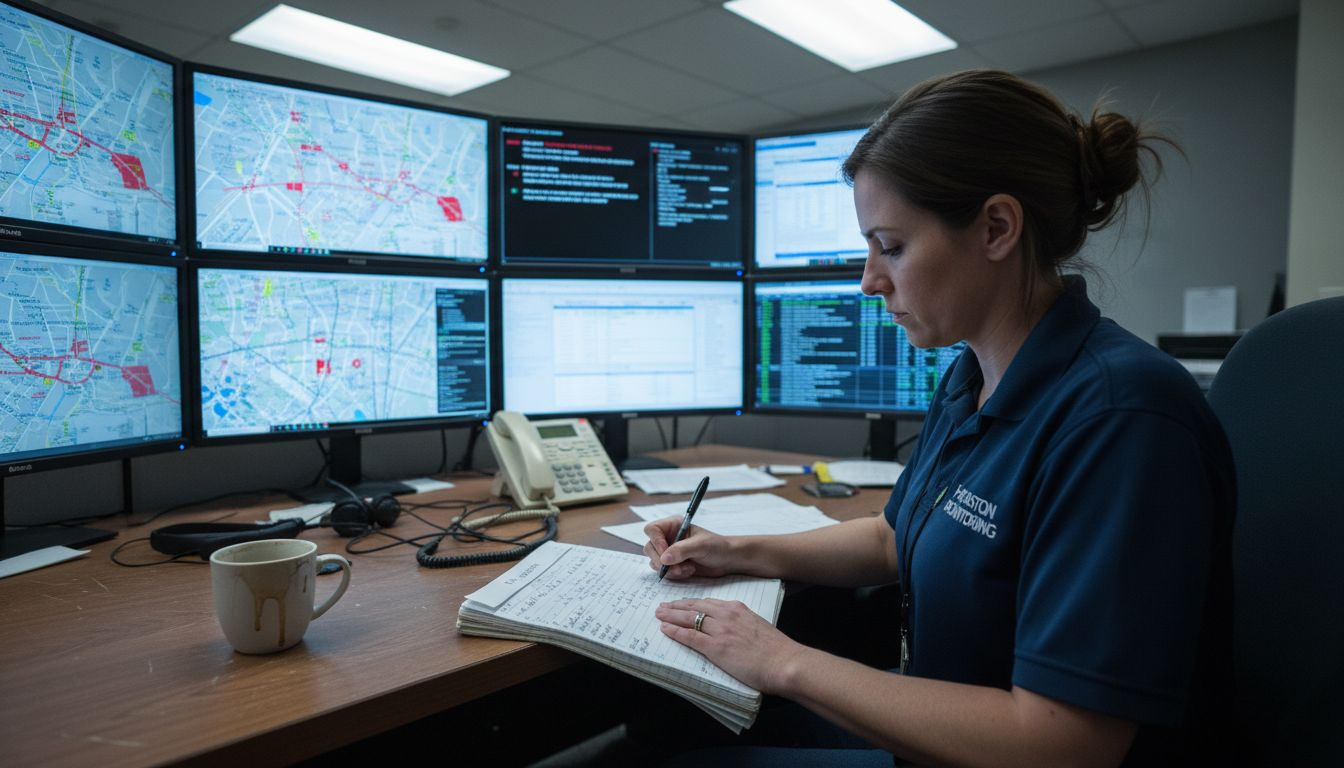
The entire operation depends on reliable signal transmission from your building to the monitoring center. Your fire alarm control panel continuously transmits status information through redundant communication paths: primary phone lines, backup internet connections, and wireless systems ensure the signal reaches the monitoring station even if one communication method fails. This redundancy is mandated by NFPA 72 and is not optional for commercial properties in Houston.
The Step-by-Step Monitoring Process
Here’s exactly what happens from the moment your fire detection system activates:
- Signal transmission: Your fire alarm control panel sends an encoded signal to the monitoring center within 10 to 90 seconds of activation, depending on your system type and communication method.
- Operator reception: A trained monitoring operator receives the signal and identifies your property, the type of alarm (fire, trouble, supervisory), and the specific zone or device that triggered.
- Signal verification: The operator attempts to verify the alarm through established procedures. For fire signals, supervising station alarm systems follow NFPA 72 requirements for operator qualifications and verification protocols designed to distinguish genuine fires from false alarms caused by dust, humidity, or equipment malfunction.
- Emergency dispatch: Upon verification, the operator immediately contacts Houston Fire Department and provides your building address, alarm type, and any additional information from your account.
- Documentation: The entire event is recorded with timestamps, operator notes, and dispatch confirmation for your compliance records and insurance documentation.
Why Verification Matters
False alarms waste firefighter resources and generate substantial penalties for Houston properties. Your monitoring company verifies alarms by reviewing detection information, attempting to contact your building, or accessing video feeds if available. This verification step typically takes 30 to 60 seconds and significantly reduces false dispatches without delaying response to genuine emergencies.
Operators must be NFPA 72 certified and trained extensively on building occupancy types, common false alarm triggers in commercial spaces, and proper questioning techniques. They understand that a single detector activation in a warehouse differs dramatically from five simultaneous activations across your building—context matters.
- Reduces false dispatch penalties while protecting genuine emergencies
- Decreases response time by providing dispatch with exact location information
- Creates audit trails documenting every alarm event and operator action
- Protects responder safety by confirming hazard type before arrival
System Supervision and Integrity Monitoring
Professional monitoring extends beyond fire detection. Fire alarm control units supervise detection devices and notification appliances to ensure your entire system remains operational and ready. This supervision detects problems like disconnected wiring, low battery levels in wireless devices, or degraded speaker performance.
When a supervisory trouble signal reaches the monitoring center, operators log the issue and may notify your building management depending on your service agreement. This prevents scenarios where your fire alarm system appears operational but contains hidden failures that would render it useless during an actual emergency.
Your monitoring company maintains records of all events—fire alarms, trouble signals, system tests, and communications. These records become invaluable during insurance claims, regulatory inspections, and litigation. Houston fire marshals review monitoring records when investigating commercial property fires to determine whether your fire protection systems functioned properly.
Professional monitoring transforms your fire detection equipment from a local alert device into a direct channel to emergency responders, guaranteeing that trained professionals validate your alarm and dispatch help even if nobody is in your building when the fire starts.
Pro tip: Request quarterly event reports from your monitoring company to review alarm history, identify any recurring false alarms or system troubles, and confirm operators are following proper verification procedures for your building type.
Houston Compliance and Legal Requirements
Houston’s fire safety regulations aren’t suggestions—they’re legally binding requirements that protect occupants and expose property managers to substantial liability when ignored. The Houston Fire Department enforces a comprehensive municipal fire code that mandates specific fire system installations, monitoring standards, and inspection schedules for commercial properties. Violating these requirements can result in fines, loss of occupancy permits, and personal liability if a fire causes injury or death.
Most Houston commercial properties must install and maintain monitored fire alarm systems, sprinkler systems, and detection equipment based on building size, occupancy type, and fire risk classification. A small office building has different requirements than a warehouse or multi-tenant complex. Understanding which regulations apply to your specific property is the first step toward compliance. The Houston Fire Department provides official guidelines on fire permits and inspection requirements through their permitting system, which outlines permit types for fire alarms, sprinkler systems, and hazardous materials storage.
Permit Requirements and Installation Procedures
Before installing or modifying any fire protection system, you must obtain the appropriate permit from the Houston Fire Department. This isn’t bureaucratic busywork—the permit process ensures that licensed contractors perform installations according to code, that equipment meets specifications, and that final inspections confirm everything functions properly.
The permitting process varies by system type:
- Fire alarm system permits require detailed plans showing detector placement, control panel location, and monitoring service details
- Sprinkler system permits require hydraulic calculations, system drawings, and water supply verification
- Fire suppression system permits (for kitchens, paint shops, etc.) require specialized system design documentation
- Hazardous materials permits apply when storing flammable or combustible materials exceeding threshold quantities
The Houston Fire Permits Office issues fire prevention permits and manages the administrative process for obtaining compliance. Permit applications include facility diagrams, equipment specifications, and contractor licensing information. Processing typically takes 5 to 10 business days, though expedited review is available for an additional fee.
Inspection and Testing Requirements
Obtaining a permit is only half the battle—Houston requires regular inspections to verify that your fire systems remain operational and compliant. The inspection schedule depends on system type and building occupancy classification.
Fire alarm systems require:
- Initial acceptance inspection after installation before the system goes live
- Annual inspections by a licensed fire alarm contractor
- Quarterly monitoring service verification to confirm the monitoring station is receiving signals
- Five-year full system testing with comprehensive equipment and component checks
Sprinkler systems require:
- Hydrostatic testing every five years to verify pipe integrity
- Annual flow tests to confirm water pressure and delivery capacity
- Inspection of control valves, check valves, and pressure switches annually
Failing inspection creates immediate compliance violations. The fire marshal can issue citations, impose fines, or revoke your occupancy permit. More importantly, failed systems leave your property unprotected during an actual fire.
Liability and Insurance Implications
Houston property managers face personal and corporate liability when fire system violations contribute to fire incidents. If a fire occurs and investigation reveals that your fire alarm system wasn’t monitored, wasn’t properly maintained, or didn’t meet code requirements, you’re personally liable for damages far exceeding any permit fee or maintenance cost.
Insurance companies typically require proof of compliance as a condition of coverage. Many policies include specific requirements for monitored fire alarm systems, annual inspections, and documentation of testing. Non-compliance can result in denial of claims or policy cancellation.
Documentation is critical. Maintain records of:
To help property managers prioritize compliance, here is a checklist of key fire system documentation required for Houston regulations:
| Document Type | Purpose | Who Requires It |
|---|---|---|
| Fire system permit | Legal installation approval | Houston Fire Dept |
| Monitoring contract | Proof of professional service | Insurance companies |
| Inspection report | Operational compliance | Fire marshal, insurer |
| Maintenance record | Evidence of ongoing upkeep | Regulator, insurer |
- Permit applications and approvals
- Inspection reports and sign-offs
- Maintenance and testing records
- Monitoring service contracts and verification
- Fire marshal correspondence and inspection results
Houston’s fire code compliance isn’t optional—it’s a legal obligation that protects occupants, protects your property, and protects you from personal liability in the event of a fire loss.
Building Classification and System Requirements
Your specific fire system requirements depend on your building’s classification under the Houston Fire Code. Office buildings, apartments, warehouses, and retail spaces have different mandates. The Houston Fire Department assigns classifications based on occupancy type, building height, total occupant load, and fire risk factors.
High-rise buildings (typically over 75 feet) require more stringent monitoring and additional safety features. Buildings with hazardous materials require specialized suppression systems beyond standard fire alarms. Healthcare facilities require additional notification systems to alert staff before occupants.
Pro tip: Contact Reliable Fire Protection to schedule a compliance audit of your current fire systems—we’ll review your building classification, identify any gaps between your current setup and Houston code requirements, and provide a written action plan for achieving full compliance.
Risks, Liabilities, and Financial Implications
Skipping fire system monitoring isn’t just a compliance issue—it’s a financial decision that can cost you hundreds of thousands of dollars, personal bankruptcy, and criminal liability. When a fire occurs at your Houston property and investigation reveals that your fire alarm system wasn’t monitored, wasn’t properly maintained, or failed to function, you’re personally liable for every dollar of damage and every injury that resulted from that failure.
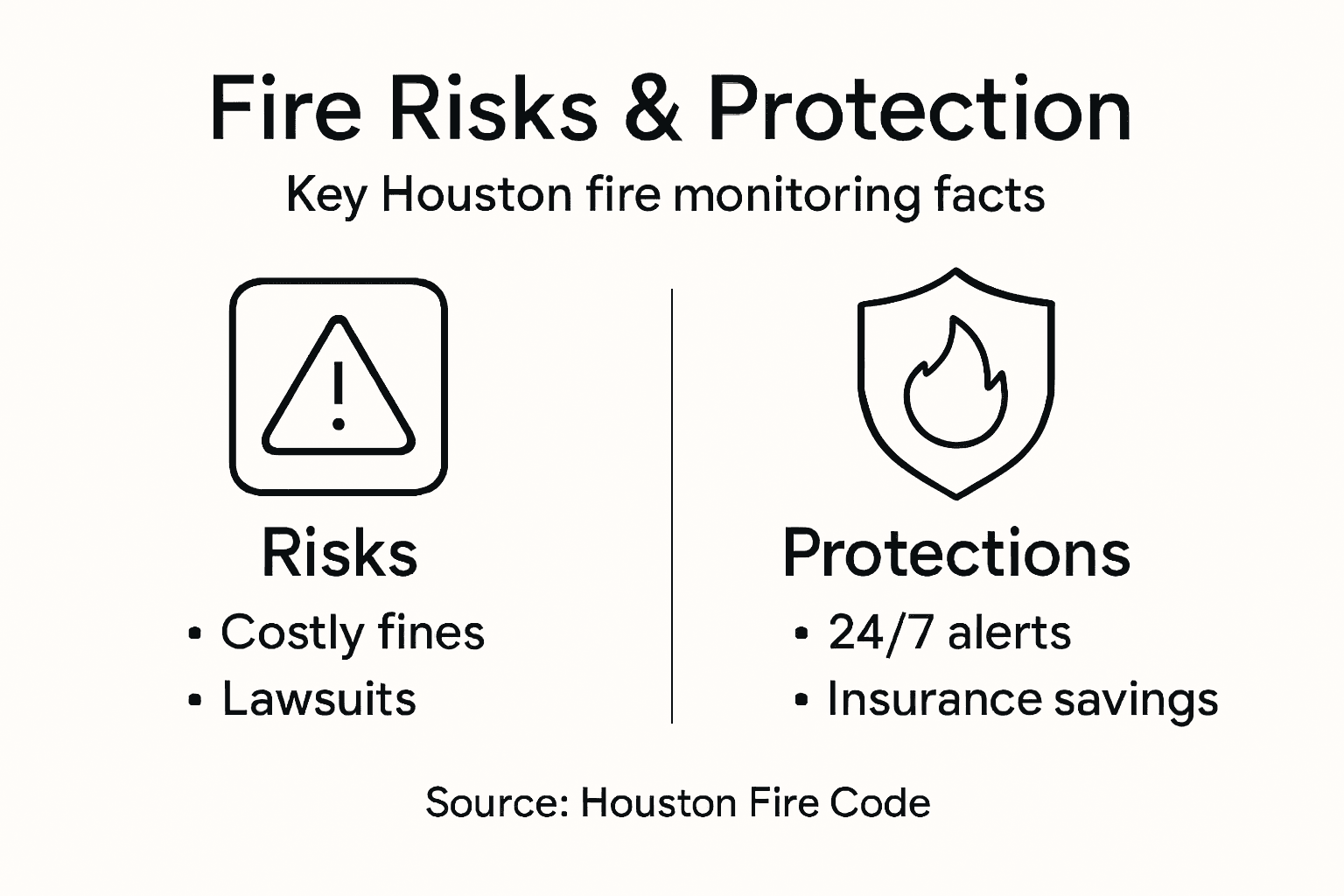
Property managers often underestimate the financial exposure. A single-story commercial building fire can easily cause $1 million to $3 million in damages. If that fire spreads to adjacent properties or causes injuries, your liability multiplies. Insurance companies deny claims when non-compliance is discovered, leaving you to pay damages directly. Worse, lawsuits from injured tenants, neighboring property owners, or emergency responders can exceed insurance limits and attach your personal assets.
Direct Financial Losses from Fire Incidents
When a fire occurs at an unmonitored or inadequately monitored property, the financial consequences cascade across multiple categories. The initial property damage is just the beginning—it’s the secondary losses that devastate financial statements.
Direct property losses include:
- Building structure damage and reconstruction costs
- Contents destruction (equipment, inventory, fixtures)
- Business interruption and lost revenue during closure
- Temporary relocation costs for displaced tenants
Secondary losses compound the damage:
- Extended business interruption while investigating cause and rebuilding
- Loss of tenant occupancy and rental income
- Increased insurance premiums or policy cancellation
- Emergency response costs charged back to property owners
Response time directly affects financial loss severity. When fire detection is monitored, emergency responders arrive within minutes of activation. When detection is local-only (audible alarm only), responders arrive only after someone notices the alarm, calls 911, and waits for dispatch—often 10 to 20 minutes later. In those extra minutes, a contained fire becomes a structure fire. Monitored sprinkler systems significantly reduce property damage by containing fire spread while emergency responders are en route. The difference between a $50,000 loss (monitored response) and a $500,000 loss (delayed response) is substantial.
Legal Liability and Lawsuit Exposure
Fire incident lawsuits typically name multiple defendants: the property owner, the property manager, the contractor who installed systems, and the monitoring company. Your liability insurance covers some exposure, but negligence claims often exceed coverage limits when non-compliance is documented.
Here’s where personal liability becomes real: if you failed to maintain required fire systems despite knowing the requirements, courts may find gross negligence or willful misconduct, which insurance doesn’t cover. You personally pay the judgment. Tenants injured in fires frequently sue for:
- Medical expenses and ongoing care
- Lost wages during recovery
- Pain and suffering damages
- Punitive damages (designed to punish negligence)
Neighboring property owners sue when fires spread to adjacent buildings. Building code enforcement agencies pursue civil penalties and fines. In rare cases of deaths caused by fire spread due to negligent maintenance, criminal charges are possible.
Insurance Consequences
Insurance is your critical line of defense against financial catastrophe—but only if you maintain compliance. Most commercial property policies include specific requirements for monitored fire alarm systems, sprinkler systems, and regular maintenance. These aren’t suggestions in the fine print; they’re conditions precedent to coverage.
What happens when non-compliance is discovered:
- Claim denial: Insurance companies deny entire claims when discovering non-compliance, leaving you to pay all damages
- Policy cancellation: Insurers cancel policies immediately upon discovering violations
- Premium increases: Renewal policies cost significantly more after any fire incident
- Coverage gaps: New policies may exclude fire-related damage or require expensive system upgrades before issuing coverage
Fire investigations reveal how monitoring failures contribute to liabilities and allow insurers to determine whether violations existed before the loss. Documentation of compliance becomes your only defense against claim denial.
Regulatory Fines and Enforcement Actions
The Houston Fire Department and City of Houston impose financial penalties for fire code violations. These aren’t small administrative fees—they’re serious fines that accumulate.
Typical penalty structures:
- First violation: $1,000 to $5,000 fine plus mandatory correction within 30 days
- Continued violation: $5,000 to $10,000 per violation plus loss of occupancy permit
- Violation contributing to fire incident: $10,000 to $25,000 plus potential shutdown of operations
Beyond fines, enforcement actions include occupancy permit revocation, which forces business closure. You lose all rental income until systems are corrected and re-inspected. Multi-tenant properties face tenant lease termination claims when occupancy permits are revoked.
Unmonitored fire systems don’t just fail to protect people—they create financial exposure that can exceed millions of dollars, drain insurance coverage, trigger personal liability, and destroy your financial standing as a property manager.
Risk Mitigation Through Professional Monitoring
The cost of professional monitoring is trivial compared to potential losses. Central station monitoring typically costs $30 to $60 monthly per property—roughly $400 to $700 annually. That investment provides:
- 24/7 professional verification reducing false alarms
- Immediate dispatch coordination with emergency responders
- Documented compliance meeting insurance requirements
- Event records protecting you during investigations
- Liability protection demonstrating reasonable precautions
A single fire incident prevented by professional monitoring saves you hundreds of thousands of dollars. Insurance companies recognize this and typically offer premium discounts of 10 to 20 percent for properties with professional monitoring.
Pro tip: Obtain written verification from your monitoring company confirming service activation, backup systems, and response procedures—keep this documentation with your insurance policy, permits, and maintenance records as proof of compliance during any future fire incident investigation.
Choosing the Right Monitoring Provider
Not all monitoring providers are created equal. Some operate with outdated technology, minimal staffing, and loose compliance standards. Others maintain state-of-the-art facilities, employ extensively trained operators, and treat your property’s safety as their primary responsibility. The monitoring company you select will directly impact response times, false alarm rates, and your liability protection during fire emergencies.
Choosing a monitoring provider is one of the most critical fire safety decisions you make as a property manager. This isn’t a commodity service where price alone determines value. A $5 monthly discount with an unreliable provider costs thousands of dollars when false alarms generate penalties or when a real fire receives delayed response. The right provider combines technical capability, regulatory compliance, local expertise, and customer service excellence.
Essential Provider Qualifications and Certifications
Before signing a monitoring contract, verify that your potential provider meets industry standards and regulatory requirements. NFPA 72 certification is non-negotiable—it means the provider’s facility, operators, and procedures have been independently audited and approved. This certification also means the provider maintains detailed records and follows strict protocols for alarm verification and dispatch.
Look for these critical qualifications:
- UL (Underwriters Laboratories) certification for central station operations
- NFPA 72 compliance with documented operator training and certification
- Local Houston Fire Department approval and good standing
- Business continuity planning with backup power and redundant communication systems
- Professional liability insurance protecting you if the monitoring company fails
When evaluating central station monitoring provider capabilities, confirm they maintain 24/7 staffing with no single points of failure. Ask about their worst-case scenario response: if their primary facility loses power, can their backup facility assume all monitoring responsibilities within 10 minutes? If the answer is vague or uncertain, look elsewhere.
Certifications and compliance standards exist because lives depend on them. A provider claiming “equivalent” standards without formal certifications is cutting corners. Regulators and insurance companies don’t recognize non-certified operations as meeting Houston fire code requirements.
False Alarm Management and Verification Protocols
A significant factor distinguishing excellent monitoring providers from mediocre ones is their false alarm management. Houston Fire Department penalizes properties with excessive false alarms. A provider that activates emergency dispatch too quickly drives up your false alarm penalties. A provider that verifies too aggressively delays genuine emergency response.
The best providers balance verification rigor with speed. They understand building occupancy types and can distinguish between a single detector activation in a warehouse (likely a false trigger) and five simultaneous activations across a multi-story office building (likely genuine fire). They know when to ask clarifying questions and when to dispatch immediately.
Ask potential providers:
- What is their average signal verification time? (Should be 30-60 seconds, not longer)
- How do they handle ambiguous signals? (Do they call your building, check video feeds, or dispatch immediately?)
- What is their false alarm reduction rate? (Good providers show year-over-year improvements)
- How many of your clients were cited for excessive false alarms last year? (If the number is high, they’re not managing verification effectively)
Supervising station operators must comply with NFPA 72 verification requirements and maintain detailed records documenting their verification decisions. Ask to review sample event reports showing how they documented recent alarms at similar properties.
Technology Infrastructure and Communication Redundancy
Modern monitoring relies on multiple communication paths to transmit signals from your building to the monitoring center. A provider using only a single phone line for communication creates unacceptable risk. Equipment failure, service interruption, or line congestion could delay your alarm signal by critical minutes.
Demand redundant communication systems:
- Primary path: Dedicated phone line or broadband connection
- Backup path: Cellular or wireless connection
- Tertiary path: Secondary internet service provider or additional cellular carrier
- System monitoring: The monitoring center must know immediately if any communication path fails
This redundancy isn’t an upgrade—it’s a requirement under NFPA 72. Cheap providers skip backup communication, betting that failures won’t happen. That bet fails eventually, and you pay the price.
Also verify that your provider uses encrypted, industry-standard signal protocols. Older “proprietary” protocols create vendor lock-in and limit your flexibility if you need to change providers later. Modern providers use established signal formats that work with multiple equipment types.
Local Presence and Customer Service Quality
A monitoring provider based in another state can handle your alarm, but a Houston-based provider understands local fire codes, local fire marshal preferences, and local emergency response procedures. They know which Houston Fire Department stations serve your area and have relationships with dispatchers.
When evaluating providers, ask:
- Do they maintain a local Houston office? (If not, who is your local contact?)
- How many Houston properties do they monitor? (Experience with local conditions matters)
- Can you reach a person when you call, or just an automated system? (Good providers prioritize accessibility)
- Do they provide quarterly reporting and proactive system recommendations? (This indicates they’re engaged with your property beyond basic monitoring)
Call their customer service line during business hours and outside business hours. If you reach voicemail outside hours, ask them what happens if you call with a system problem at 2 AM. The answer matters.
Review their online reputation through Google reviews, Better Business Bureau ratings, and industry forums. Look for patterns. One negative review happens; consistent complaints about slow response or poor customer service indicate systemic problems.
The best monitoring provider treats your property as their responsibility, maintains cutting-edge technology, responds to every alarm with professional precision, and acts as a true partner in your fire safety strategy.
Comparing Proposals and Service Agreements
When you receive monitoring proposals, don’t just compare monthly fees. The proposal should clearly specify:
- Service level: What response time is guaranteed for verified fire alarms?
- Backup procedures: What happens if the monitoring center loses power or communications?
- Reporting and documentation: Will they provide monthly or quarterly event reports?
- Contract terms: What is the commitment period, and what are early termination penalties?
- False alarm procedures: How do they document verification decisions to help you contest invalid penalties?
- Equipment requirements: Can they work with your existing fire alarm system, or do they require specific hardware?
Request references from 5 to 10 current Houston customers with properties similar to yours. Call them and ask specific questions about response quality, false alarm rates, and customer service. Most property managers are happy to share candid feedback.
Pro tip: Request a 90-day trial period in your monitoring contract—this allows you to evaluate response quality, false alarm management, and customer service before committing to a long-term agreement, and most quality providers will agree because they’re confident in their performance.
Protect Your Houston Property with Expert Fire System Monitoring Solutions
Understanding the critical role of professional fire system monitoring is the first step toward safeguarding your commercial property from costly fire-related damages and liabilities. This article highlights real challenges Houston property managers face like delayed emergency response, false alarm penalties, and compliance risks. Reliable Fire Protection offers comprehensive fire safety services tailored to eliminate these challenges by providing 24/7 monitoring, system supervision, and expert compliance guidance. We specialize in integrating advanced fire alarm systems and sprinkler monitoring to ensure your building responds immediately when every second counts.
Take control of your property’s fire safety today with Reliable Fire Protection. Explore our full range of fire protection solutions designed specifically for Houston properties. Don’t wait for a fire emergency or a costly fine — visit Reliable Fire Protection now and schedule a free consultation to confirm your system meets all Houston code requirements and insurance standards. Protect your tenants, your investment, and your peace of mind with trusted local experts by your side.
Frequently Asked Questions
What is fire system monitoring?
Fire system monitoring is the automated, continuous surveillance of your fire detection and suppression equipment, ensuring immediate response when there’s a fire. It involves trained professionals who receive signals from your system and dispatch emergency responders promptly.
Why is professional monitoring important for fire alarms?
Professional monitoring is crucial because it connects your fire alarms to a dedicated monitoring center that verifies alarms and contacts emergency responders. This system reduces the risk of false alarms and ensures a quicker response in case of a real emergency.
What are the different types of fire monitoring systems available?
The main types of fire monitoring systems include central station monitoring, proprietary station monitoring, remote station monitoring, and local signaling systems. Each system differs in oversight structure, response times, and suitability based on property size and risk.
How do I choose the right fire monitoring provider?
Choose a monitoring provider that holds necessary certifications (like NFPA 72), has a solid infrastructure with redundant communication paths, and demonstrates a good track record of false alarm management and customer service. Request references and evaluate proposals before committing.
Recommended
- Fire System Monitoring Explained: Houston Facility Safety
- Fire Protection Best Practices for Houston 2025
- What Is Alarm Monitoring? Impact on Houston Safety
- Fire Alarm Monitoring: Essential Protection for Houston Businesses
- Key Control: Protecting Access for Property Managers – A To Z Locksmith Inc
- States At Highest Risk Of Property Damage Loss – Public Adjusters USA
- Fire Alarm System University Place TX
- Fire Alarm System Bellaire TX