TL;DR: Kitchen hood fire suppression systems use wet chemical agents to instantly detect and knock down grease fires before they spread into ductwork. Houston restaurants must meet NFPA 96 and UL 300 standards with semi-annual inspections, and Reliable Fire Protection installs, services, and certifies these systems across Greater Houston.
Cooking equipment is the number one cause of restaurant fires nationwide, and Houston’s dense, fast-growing restaurant scene is no exception. Cooking equipment accounted for over 60% of fires in eating and drinking establishments between 2014 and 2018, according to NFPA data, and these fires can result in more than 100 civilian injuries and a staggering $165 million in property damage each year. For any restaurant, hotel, hospital, school, or commercial kitchen operating in Houston, Bellaire, Cinco Ranch, Cypress, or Downtown, a properly designed and maintained kitchen hood fire suppression system is not optional — it’s code-required protection that stands between a small grease flare-up and a total kitchen loss.
What Is a Kitchen Hood Fire Suppression System?
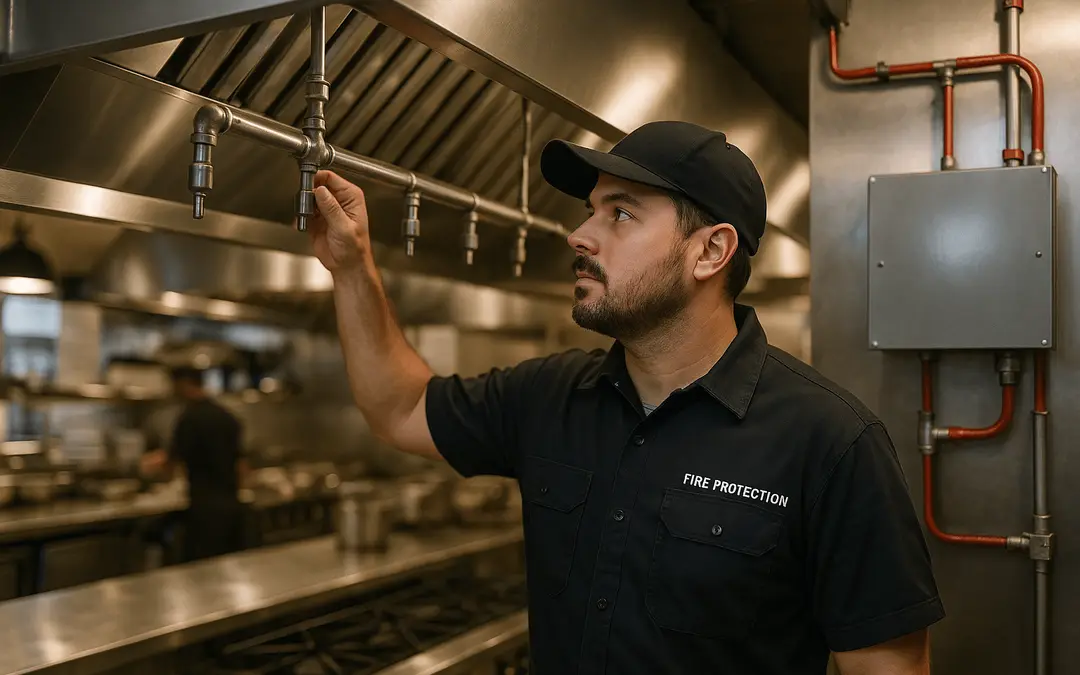
A kitchen hood fire suppression system is a fixed, automatic fire protection system installed directly in and above the exhaust hood over your fryers, ranges, grills, and other cooking appliances. Unlike a building sprinkler system that uses water, hood suppression systems discharge a wet chemical agent engineered specifically to fight grease and cooking-oil fires.
When heat from a fire triggers a detection element (usually a fusible link or heat sensor), the system automatically:
- Discharges wet chemical agent through nozzles aimed at the cooking surface, plenum, and duct
- Shuts off the gas or electrical supply to the affected cooking equipment
- Activates an alarm and, where connected, notifies a monitoring center or the fire department
The agent cools the burning oil, forms a soap-like barrier over the surface to smother flames, and helps prevent the fire from reigniting or traveling up into the duct and roof structure.
How the System Works, Step by Step
- Detection: Fusible links or heat detectors positioned over each appliance and in the duct sense abnormal heat.
- Activation: The mechanical or electrical release triggers the agent tank to discharge.
- Discharge: Wet chemical agent sprays through calibrated nozzles positioned over fryers, griddles, ranges, and the hood plenum/duct opening.
- Fuel shutoff: A gas or electrical shutoff valve cuts power to the protected appliances simultaneously.
- Manual backup: A manual pull station near the kitchen exit allows staff to trigger the system by hand if they spot a fire before automatic activation.
Modern systems installed after 2008 must be UL 300 listed. All commercial kitchen hood fire protection systems must meet UL 300 standards as of January 2008, a standard that addresses the fire suppression challenges created by modern cooking oils and high-efficiency equipment, requiring wet chemical suppression systems specifically designed for commercial cooking equipment protection. If your building still has an older dry-chemical system, it likely needs to be upgraded to stay compliant.
Why This Matters More in Houston
Houston’s restaurant and hospitality market is large, dense, and diverse — from high-volume fry stations in fast-casual chains along the Energy Corridor to full-service kitchens in hotels Downtown and institutional cafeterias in Katy and Sugar Land school districts. That volume means more grease-producing equipment running longer hours, which raises fire risk and code scrutiny.
Houston also layers local enforcement on top of national standards. The Houston Fire Department enforces strict fire code requirements for commercial kitchen hood fire suppression systems under HFD LSB Standard 02. Locally, vent hood systems must be inspected at least every six months and again after each time the system activates in a fire, and portable fire extinguishers must be inspected, tested and serviced annually. A licensed, registered contractor is also required to pull permits and coordinate inspections with the city. The Houston Permitting Center requires a licensed, registered mechanical contractor to obtain this permit, schedule inspections, and keep approved documents on-site, tying the permit directly to fire safety compliance and ongoing hood system maintenance required by the Houston Fire Department.
For restaurants in flood-prone or humid corridors like Spring Branch, Pasadena, and areas near Buffalo Bayou, grease buildup combined with Gulf Coast humidity can accelerate corrosion on nozzles and piping, making regular professional inspection even more important than the code minimum might suggest.
NFPA 96 and UL 300: The Standards That Govern Your System
NFPA 96, the Standard for Ventilation Control and Fire Protection of Commercial Cooking Operations, is the backbone code referenced by Houston and virtually every other AHJ in the country. NFPA 96 applies to all commercial kitchens that use open-flame cooking equipment and have a hood and duct system to remove smoke and heat, including restaurants, hotels, supermarkets, and other facilities with commercial kitchens.
Under NFPA 96, semi-annual professional inspection is the baseline requirement. The kitchen hood suppression system inspection required by section 11.6 must occur at least every 6 months, performed by a trained, factory-authorized technician, covering nozzle condition, piping integrity, detection links, agent level, gas shutoff valve operation, manual pull station function, and alarm connection. One detail many operators miss: metal-alloy fusible links must be replaced at every semi-annual service because grease coating raises their effective melting temperature, meaning a coated link may not activate during a fire.
It’s also important to understand that hood and duct cleaning is a separate service from suppression system inspection. Maintaining commercial kitchen exhaust cleaning requirements under NFPA 96 requires two separate contractors with different qualifications — a kitchen exhaust cleaner handles hood and duct cleaning on the Table 11.4 schedule, while a certified fire suppression technician handles the semi-annual system test. A clean hood does not mean your suppression system is compliant, and vice versa.
Pros and Cons of Kitchen Hood Suppression Systems
Advantages
- Fast, automatic response — the system activates without waiting for staff to notice or react
- Purpose-built agent — wet chemical formulas cool grease fires and prevent flare-back, unlike water
- Automatic fuel shutoff — cuts gas or power the instant the system triggers, reducing reignition risk
- Insurance and liability protection — a documented, code-compliant system supports claims and reduces premiums
- Keeps you open — a contained incident is far less likely to shut down your kitchen for weeks of repairs
Limitations to Plan Around
- Requires disciplined maintenance — semi-annual inspections and periodic component replacement are mandatory, not optional
- Any menu or equipment change matters — adding a new fryer, char-broiler, or moving equipment can require nozzle repositioning and re-certification
- Post-discharge cleanup — after activation, the kitchen needs professional cleaning of agent residue before returning to service
- Upfront and ongoing cost — design, installation, and recurring inspection carry real costs, though far less than fire damage or a shutdown
When Does This Matter Most for Your Property?
If you operate any of the following in Greater Houston, a compliant, well-maintained hood suppression system is a code requirement, not a nice-to-have:
- Full-service or fast-casual restaurants with fryers, grills, or char-broilers
- Hotel and hospitality kitchens in Downtown, Midtown, or the Galleria area
- Healthcare and assisted living facility kitchens
- School, university, and cafeteria kitchens across Katy, Sugar Land, Cypress, and Tomball ISDs
- Multi-family properties with commercial-grade communal kitchens
- Government and institutional food service facilities
You should also schedule an inspection immediately (not just at the six-month mark) any time you:
- Add, remove, or relocate cooking equipment
- Change your menu in a way that adds new grease-producing appliances
- Experience a suppression system discharge, even a partial one
- Notice a bent, missing, or grease-caked nozzle during your own visual checks
What a Professional Inspection Includes
When Reliable Fire Protection technicians service your hood suppression system, the visit typically covers:
- Verifying nozzle position and coverage over every protected appliance
- Testing detection (fusible links or heat sensors) and replacing links as required
- Checking agent tank pressure and chemical condition
- Testing the manual pull station and automatic gas/electrical shutoff
- Confirming alarm and monitoring connections function properly
- Tagging the system and filing documentation the Houston Fire Department and your insurer will want on record
Because these systems often tie into your building’s broader fire detection and alarm system, coordinated testing helps confirm that a kitchen fire actually triggers the notification and monitoring response you’re counting on — not just the local discharge.
Kitchen Suppression Is Part of a Bigger Fire Protection Picture
A hood suppression system protects the cooking line, but a fully compliant commercial kitchen also needs backflow prevention on fire lines connected to the domestic water supply, working extinguishers, and — in many Houston commercial buildings — a coordinated fire suppression system strategy across kitchen, storage, and mechanical areas. If your property has backflow preventers tied to irrigation or fire protection lines, those need their own annual testing; our team can bundle that into the same service visit through our backflow preventer testing and maintenance services.
Local Service Across Greater Houston
Reliable Fire Protection is based at 3522 Bolin Rd in Houston and serves restaurants, hotels, healthcare facilities, schools, and multi-family properties throughout Downtown Houston, Midtown, the Energy Corridor, Bellaire, Spring Branch, Katy, Cinco Ranch, Sugar Land, Cypress, Tomball, Pasadena, and 29 neighborhoods and suburbs total. As a family-owned, state-licensed contractor, we design, install, inspect, and repair kitchen hood suppression systems using non-proprietary equipment, back our work with a 24-month satisfaction guarantee on parts, materials, and labor, and offer 24/7 emergency response and same-day service when a system needs attention fast.
Whether you need a new UL 300 system designed for a build-out, a semi-annual inspection to stay ahead of your Houston Fire Department deadline, or emergency repair after an activation, our technicians handle the design, documentation, and code coordination so you can stay open and focused on service.
Recommended Reads
- Fire Suppression Systems Houston | Reliable Fire Protection
- Why Data Centers in Houston Need Clean Agent Fire Suppression Systems
- Houston's #1 Reliable Fire Protection Services