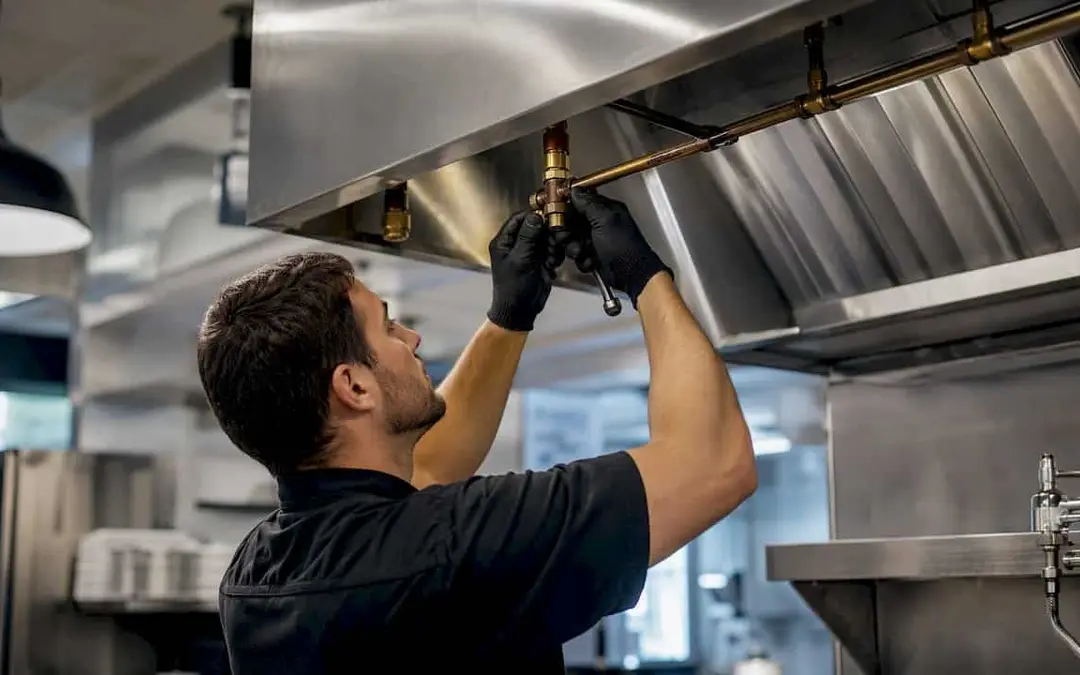
A typical installed commercial kitchen hood suppression system in the United States generally costs several thousand dollars for most restaurants, with small single-hood setups at the lower end and multi-hood or complex retrofits costing substantially more. That installed price generally covers the wet-chemical system kit, piping and nozzles, labor, permits, commissioning, and the first inspection tag.
Three variables move the price more than anything else: hood linear footage, the type and number of appliances underneath (deep fryers and charbroilers require more agent and more nozzles than a flat-top griddle), and whether you’re retrofitting an older hood that needs a UL 300 upgrade to meet current code. Get those three numbers clear before you call an installer and you’ll get a far more useful first quote.
Here’s what a typical installed price includes:
- Wet-chemical suppression system kit (tank, agent, valve, nozzles)
- Piping, fittings, and nozzle brackets inside the hood plenum
- Labor for installation, tie-ins to gas and electrical shutoffs
- Permit fees and AHJ plan review
- Commissioning, functional test, and first inspection tag
Pro Tip: Schedule your suppression installation at the same time as a hood cleaning service. Bundling both with one contractor typically saves 10–15% on combined annual cost and cuts the number of kitchen shutdowns you need to coordinate.
Key Takeaways
A properly installed, UL 300-compliant kitchen hood suppression system costs $3,000–$25,000+ depending on hood size, appliance type, and retrofit complexity, with most US restaurants landing in the $6,000–$15,000 range once permits and commissioning are included.
| Point | Details |
|---|---|
| Installed cost range | Most restaurants pay $3,500–$15,000 installed; multi-hood or retrofit jobs reach $10,000–$25,000+. |
| Top cost drivers | Hood linear footage, appliance type (fryers/charbroilers), and UL 300 retrofit requirements move the price most. |
| Ongoing annual costs | Budget $300–$700/year for semiannual inspections and service; add $500–$1,200 for a recharge if the system discharges. |
| Retrofit contingency | Add a 5–15% contingency to any retrofit estimate to cover ductwork surprises and AHJ re-inspection fees. |
| Reliable-fire-protection | Offers free on-site surveys with itemized quotes covering hardware, labor, permits, and commissioning for Houston-area kitchens. |
A compliant suppression system also carries a real insurance ROI: avoiding a single structure fire and the weeks of closure that follow it typically recovers the full installation cost many times over.
Table of Contents
- What does kitchen hood suppression cost by kitchen size?
- What factors drive your suppression system price up or down?
- How does a hood suppression installation actually work?
- What are the ongoing costs after installation?
- Which codes and standards affect your installation cost?
- How do you get an accurate quote and avoid surprises?
- How Reliable-fire-protection scopes a job in the field
- What most restaurant owners get wrong about budgeting for suppression
- Reliable-fire-protection offers free site surveys and itemized quotes
- Sources
What does kitchen hood suppression cost by kitchen size?
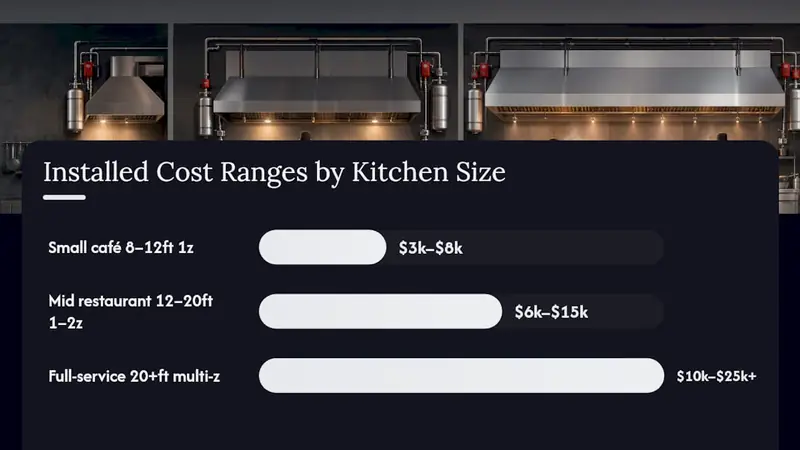
The table below maps common kitchen configurations to realistic installed price ranges. These are U.S. national figures; urban markets and complex retrofits trend toward the high end.
| Kitchen Type | Hood Size | Typical Installed Cost | What’s Usually Included |
|---|---|---|---|
| Small café / food truck | 8–12 ft | $3,000–$8,000 | Single-zone kit, labor, permit, commissioning |
| Mid-size restaurant | 12–20 ft | $6,000–$15,000 | 1–2 zone kit, piping, controls, permit, tag |
| Full-service / high-volume | 20+ ft | $10,000–$25,000+ | Multi-zone, upgraded tank, wiring, permits, test |
National sample data puts most restaurant installs in the $3,500–$10,000 band, with small setups closer to $2,500–$5,000 and large or complex jobs exceeding $12,000. A pre-engineered Ansul wet-chemical kit alone runs $1,500–$8,000 before labor, permits, or controls, which is why the hardware-only price a supplier quotes rarely resembles the final installed number.
A few scenario notes worth keeping in mind:
- A small café with a single 10 ft hood over a fryer and a griddle typically lands at $4,000–$6,500 installed, assuming no ductwork surprises and a straightforward permit.
- A mid-size restaurant with a 16 ft hood over a charbroiler, two fryers, and a range will often run $8,000–$14,000 once controls, wiring, and a two-day install are factored in.
- A full-service kitchen with 24+ ft of hood coverage and multiple appliance zones can push past $20,000, especially when the job involves a UL 300 retrofit or roof-level duct access.
Regional labor rates shift totals by roughly ±10–25%, so a Houston quote and a San Francisco quote for the same scope can differ by several thousand dollars.
What factors drive your suppression system price up or down?
Hood linear footage is the single biggest lever. Every additional foot of hood coverage typically means more nozzles, more piping, and more agent capacity. A 20 ft hood doesn’t cost twice what a 10 ft hood costs, but it’s not far off once you account for the extra hardware and the longer install day.
Appliance type matters almost as much. Deep fryers, charbroilers, and wok ranges produce the highest heat loads and require more suppression agent per nozzle than a standard range or griddle. An installer scoping a hood over four fryers will spec a larger tank and more nozzle drops than one scoping the same linear footage over a flat-top.
- Retrofit vs. new construction: Retrofitting an existing hood that doesn’t meet current UL 300 standards can more than double the labor portion of a quote. Duct access, plenum geometry, and existing piping all create variables that a new-construction install avoids entirely.
- Ceiling height and access: Ceilings above 12 ft add rigging time and sometimes require a lift or hoist, adding $500–$1,500 or more to labor.
- Permitting and AHJ requirements: Permit fees vary widely by jurisdiction. Some AHJs require stamped engineering drawings; others accept manufacturer-listed pre-engineered designs. Plan review can add two to four weeks to the schedule.
- Emergency or after-hours scheduling: If your kitchen can’t shut down during business hours, night or weekend work typically adds a 15–25% labor premium.
- Freight and disposal: Large system kits shipped to remote locations or disposal of an old suppression system add line items that quotes sometimes omit.
Pro Tip: When a retrofit requires UL 300 modifications, ask the installer to measure plenum depth before finalizing the nozzle layout. If the factory-listed nozzle spacing doesn’t fit your hood geometry, custom piping and design hours get added to the scope — and that’s easier to price before work starts than after.
How does a hood suppression installation actually work?
The process follows a predictable sequence, though the timeline compresses or stretches depending on AHJ responsiveness and kitchen availability.
- Site survey and design: The installer measures hood dimensions, inventories appliances, checks duct routing and ceiling access, and identifies gas and electrical shutoff locations. A pre-engineered system design is selected or a custom layout is drawn.
- Plan submittal and permit: The design package goes to the AHJ for review. Simple pre-engineered submittals can be approved in a few days; jurisdictions requiring stamped drawings may take two to four weeks.
- Hardware delivery: System kits, piping, nozzles, and controls are ordered. Lead times on pre-engineered kits are typically one to two weeks; custom or large-volume orders can run longer.
- On-site installation: A crew of two to four technicians installs the piping, nozzles, tank, and controls inside the hood plenum and ties into gas and electrical shutoffs. A mid-size restaurant install typically takes one to two days; a large multi-hood job runs two to four days.
- Commissioning and functional test: The installer performs a dry-run functional test, verifies gas and electrical interlocks, and confirms nozzle coverage per the listed design.
- AHJ inspection and sign-off: The authority having jurisdiction inspects the completed installation. If corrections are needed, a re-inspection adds time. Once approved, the installer affixes the inspection tag and provides the owner with documentation.
Common schedule delays: AHJ inspection backlogs (one to three weeks in busy markets), kitchen shutdown windows that limit work to nights or weekends, and hardware back-orders on specialty nozzles or tanks. Each of those can add cost if the crew has to mobilize twice.
For a detailed look at the commissioning workflow, Reliable-fire-protection’s installation guide walks through each step with the documentation checklist an owner should expect at sign-off.
What are the ongoing costs after installation?
The installed price is not the total cost of ownership. Budget for these recurring expenses:
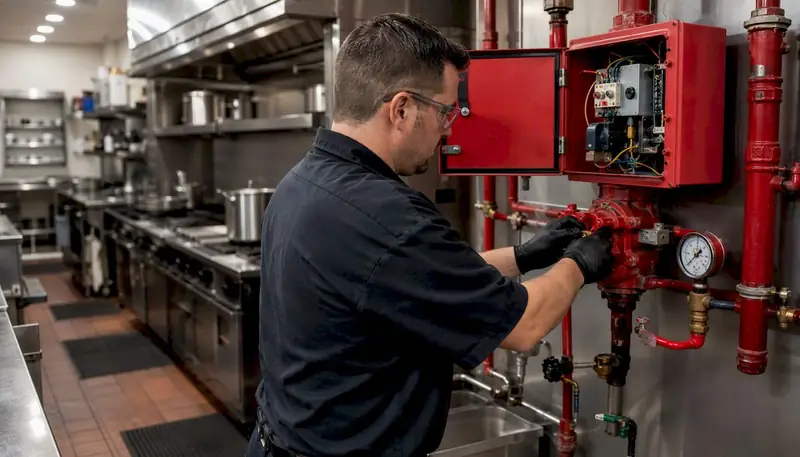
- Semiannual inspections: Most jurisdictions and NFPA 96 require inspections every six months. Typical inspection fees run $150–$350 per visit, covering visual checks, fusible link condition, agent level, nozzle caps, and tag update.
- Annual service contract: A maintenance agreement that covers both semiannual inspections plus minor adjustments typically runs $300–$700 per year for a single-hood system, more for multi-hood kitchens.
- Recharge after discharge: If the system activates, recharging the agent tank and replacing expended components costs $500–$1,200 depending on tank size and agent volume. That figure doesn’t include any hood cleaning or kitchen restoration costs after a fire event.
- Fusible link replacement: Kitchen hood fusible link replacement is a routine inspection item. Individual links are inexpensive, but a full set replacement across a large hood can add up to $100–$300 in parts per inspection cycle.
- Nozzle caps and small parts: Low per-item cost, but missing or damaged caps are a common inspection failure that delays your tag.
Pro Tip: Pair your suppression inspection contract with your hood cleaning schedule. Bundling both services with one provider simplifies AHJ documentation and often reduces the combined annual spend. It also means one less vendor to coordinate when inspection records are due.
Preventive maintenance has a direct insurance angle. Many commercial property insurers offer premium reductions for kitchens with current suppression inspection tags and documented cleaning records. The savings won’t cover the full inspection cost, but they narrow the gap.
Which codes and standards affect your installation cost?
Two standards govern virtually every commercial kitchen suppression install in the United States: UL 300 and NFPA 96.
UL 300 is the listing standard for wet-chemical suppression systems. Any system installed today must be UL 300 listed. Older kitchens with pre-UL 300 systems (installed before the mid-1990s) face a harder choice: a full system replacement or a UL 300 upgrade kit. Either path adds cost. A straight swap of suppression heads on an older hood often isn’t code-compliant without also verifying the hood geometry meets current listing requirements, which is where retrofit costs climb sharply.
NFPA 96, Standard for Ventilation Control and Fire Protection of Commercial Cooking Operations, sets the design and maintenance requirements that AHJs enforce. Key cost implications:
- Semiannual inspection frequency is an NFPA 96 requirement, not optional.
- Duct clearances, grease trap access, and hood-to-appliance distance all affect whether an existing hood passes or requires modification.
- High-volume cooking operations (solid-fuel appliances, wok ranges) trigger more stringent requirements and often require a custom-engineered system rather than a pre-engineered kit.
The AHJ (authority having jurisdiction) interprets and enforces both standards locally. Permit fees vary from under $100 to several hundred dollars depending on the jurisdiction. Some AHJs require a licensed fire protection engineer to stamp the drawings; others accept the manufacturer’s listed design documentation. That distinction alone can add $500–$2,000 to a project. For Houston-area operators, the local fire marshal’s office sets the plan review timeline and inspection scheduling, which directly affects how quickly you can open or reopen after an install.
Documentation the owner should receive at project close: itemized written quote (hardware, labor, permits, testing), manufacturer installation certificate, AHJ inspection approval, and the annual inspection tag affixed to the system. Keep those records. Insurers and health inspectors ask for them.
How do you get an accurate quote and avoid surprises?
The single best predictor of an accurate final cost is a transparent, itemized quote that separates hardware, labor, permits, and commissioning into distinct line items. A quote that gives you one lump number with no breakdown is a red flag, not a bargain.
What a reputable installer should inspect on site before quoting:
- Hood dimensions (linear feet, plenum depth, height above cooking surface)
- Full appliance inventory: model, fuel type, BTU rating if available
- Duct routing and roof or ceiling access points
- Existing suppression hardware (age, listing, agent type)
- Gas and electrical shutoff locations and condition
- Any structural or ceiling work that affects piping runs
Questions to ask in writing:
- Is the quote itemized by hardware, labor, permits, testing, and commissioning?
- Which system is specified, and is it UL 300 listed?
- Does the quote include AHJ permit handling and plan submittal?
- What is the warranty on parts and labor, and who handles warranty claims?
- What are the semiannual inspection terms and cost?
- Is there a contingency allowance for ductwork or access surprises?
Red flags to watch for:
- A single-line quote with no itemization
- No mention of UL 300 or NFPA 96 compliance
- Installer who won’t pull permits or says permits “aren’t required”
- Price significantly below market without a clear explanation of what’s excluded
- No written scope of work or site survey documentation
Ask whether a phased option makes sense. If your existing system is relatively recent and only needs a head replacement or agent recharge, a full replacement may not be necessary. A reputable installer will tell you honestly which path is code-compliant and cost-effective.
How Reliable-fire-protection scopes a job in the field
Before Reliable-fire-protection issues a written estimate, a technician conducts a structured on-site survey. Here’s what that looks like in practice:
- Hood measurements: Linear feet, plenum depth, and height above each appliance are recorded and photographed. These numbers determine nozzle count, piping layout, and whether the existing hood geometry is compatible with a listed pre-engineered design.
- Appliance inventory: Every piece of cooking equipment is logged by model, fuel type, and BTU or kW rating where available. Fryers, charbroilers, and solid-fuel appliances are flagged as UL 300 triggers that may require additional nozzle drops or a larger agent tank.
- Access and logistics: Roof access, ceiling height, duct routing, and any structural obstacles are documented. If a crane or hoist is needed, that’s identified before the quote is written, not after the crew arrives.
- Existing system review: If a suppression system is already in place, the technician checks the listing date, agent type, and inspection history to determine whether a UL 300 upgrade or full replacement is required.
Pro Tip: Have your appliance spec sheets or model numbers ready before the site survey. Knowing the BTU rating on your fryers and charbroilers lets the technician confirm nozzle sizing on the spot rather than returning for a second visit, which keeps your quote timeline shorter.
The written estimate Reliable-fire-protection provides separates hardware, labor, permits, and commissioning into line items, identifies who handles AHJ plan submittal, and includes a recommended maintenance schedule. That documentation is what makes bids comparable when you’re evaluating multiple quotes.
For Houston-area kitchens, Reliable-fire-protection’s technicians are familiar with the local fire marshal’s plan review process and typical inspection timelines, which reduces scheduling surprises.
What most restaurant owners get wrong about budgeting for suppression
The installed price is the number operators fixate on, and it’s the wrong number to anchor to. The real cost question is: what does this system cost over five years, including inspections, one likely recharge event, and any permit or AHJ re-inspection fees?
Most owners also underestimate retrofit complexity. A kitchen that’s been operating for 15 years almost always has at least one surprise: a duct that’s been rerouted, a plenum that’s shallower than the drawings show, or a hood that predates UL 300 and needs modification before a new system can be listed to it. On a $10,000 install, that’s $500–$1,500 held in reserve, which is far less painful than a change order mid-project.
The third mistake is treating the lowest quote as the best quote. A quote that omits permit handling, commissioning, or the first inspection tag looks cheaper on paper but delivers a system that may not pass AHJ inspection without additional work. The total installed and compliant cost is the only number worth comparing across bids.
Reliable-fire-protection offers free site surveys and itemized quotes
Reliable-fire-protection gives Houston-area restaurant operators a concrete alternative to the guesswork of phone quotes: a free on-site survey that produces an itemized written estimate covering hardware, labor, permits, commissioning, and a recommended maintenance schedule. No lump-sum numbers, no hidden line items discovered after the crew arrives.
The survey covers everything described in the field checklist above: hood measurements, appliance inventory, UL 300 compliance check, access logistics, and AHJ permit handling. Reliable-fire-protection’s factory-trained technicians handle plan submittal and coordinate the AHJ inspection, so you’re not managing that process yourself while also running a kitchen.
Ongoing service contracts are available to cover semiannual inspections, fusible link replacement, and agent recharges, keeping your system tagged and your insurance documentation current. To schedule your free site survey or request an itemized quote, visit Reliable-fire-protection’s services page or call directly. Have your hood dimensions and appliance list ready and the first visit moves faster.
Sources
The figures and code references in this guide draw from the following sources. National averages reflect installer and industry survey data; your local AHJ and a certified installer’s site survey will always be the most accurate source for your specific project.
- Restaurant Fire Suppression System Guide (2026) – RestOps
- Ansul Fire Suppression System Cost 2026 | Official Site
- Restaurant Fire Suppression System Cost and Pricing Guide 2026 – Well Built Florida
- Restaurant Fire Suppression System Installation Cost: A Comprehensive Guide for Business Owners | 119 Fire Control
This article is general information, not a substitute for advice from a qualified lawyer. Consult a qualified legal professional about your own circumstances before acting on anything here.