TL;DR: NFPA 72 is the national standard governing fire alarm inspection, testing, and maintenance for commercial buildings, and Texas enforces it through the State Fire Marshal’s Office. Houston property managers must meet specific testing schedules — ranging from semiannual visual checks to annual functional tests and periodic sensitivity testing — or risk fines, insurance claim denial, and liability. Documented records are legally required and must be available to the AHJ on demand.
If you manage a commercial building in Houston, one code number you cannot afford to ignore is NFPA 72. It governs nearly every aspect of your fire alarm system — from how devices are placed to how often they are tested and how the results are documented.
This guide breaks down what NFPA 72 actually requires, what the testing schedule looks like device by device, how Texas and Houston’s local Authority Having Jurisdiction (AHJ) layer on top of the national standard, and what happens when records are missing.
What Is NFPA 72?
NFPA 72, the National Fire Alarm and Signaling Code, is a standard published by the National Fire Protection Association every three years and covers the installation of fire alarm systems and emergency communication systems across the United States.
The code covers the application, installation, location, performance, inspection, testing, and maintenance of fire alarm systems, supervising station alarm systems, public emergency alarm reporting systems, fire warning equipment, and emergency communications systems (ECS), and their components.
In plain terms: if your Houston commercial property has a fire alarm system, NFPA 72 sets the rules for how it must be maintained and verified throughout its entire life.
Inspection vs. Testing vs. Maintenance: Understanding the Difference
These three terms are used interchangeably in conversation, but NFPA 72 treats them as distinct activities with different schedules and procedures.
- Inspection — A visual examination to verify that fire alarm equipment appears to be in good operating condition and is free from physical damage. Inspection frequencies are typically weekly, monthly, semiannual, or annual depending on the component.
- Testing — A procedure to determine that a device or system operates as intended, requiring physical activation of the device and verification of the correct system response. Testing frequencies are typically semiannual or annual.
- Maintenance — Work performed to keep equipment in operable condition, including cleaning, adjustment, and minor repair.
The code defines two separate schedules that many contractors conflate: inspection frequencies (Table 14.3.1) for visual checks and testing frequencies (Table 14.4.3.2) for functional verification. They are not the same thing.
NFPA 72 Chapter 14: The Core Testing Framework
Chapter 14 of NFPA 72 establishes the requirements for ongoing inspection, testing, and maintenance (ITM) of fire alarm systems after installation. This chapter is the primary reference for building owners and inspection companies responsible for keeping fire alarm systems in proper working condition.
The chapter applies to all fire alarm systems regardless of type — including conventional, addressable, analog, and networked systems — and covers initiating devices like smoke detectors and pull stations, notification appliances like horns and strobes, control equipment including fire alarm control panels and transponders, interconnections with other systems like elevator recall and HVAC shutdown, and emergency communication systems.
Who Is Responsible?
The property or building or system owner — or the owner’s designated representative — is responsible for inspection, testing, and maintenance of the system and for alterations or additions to this system. Section 14.2.3.3 does allow for third-party inspections to be conducted on the owner’s behalf if there is a written contractual agreement.
Testing Frequency by Device Type
Not every component in your fire alarm system is tested on the same schedule. Here is a practical breakdown of the most important intervals:
Semiannual (Every 6 Months)
- Fire alarm control panels, smoke detectors, heat detectors, notification appliances, and supervisory signal devices require semiannual visual inspection per Table 14.3.1.
- Smoke detectors — both photoelectric and ionization types — must be functionally tested semiannually by introducing smoke or a listed smoke analog into the detection chamber to verify the detector sends a signal to the fire alarm control panel.
Annual (Every 12 Months)
- Functional testing for most initiating devices and notification appliances is required annually per Table 14.4.3.2.
- All smoke detectors must be functionally tested at least annually. Heat detectors, pull stations, notification appliances, and control equipment are also tested annually.
- Batteries must be tested annually for capacity.
Sensitivity Testing (Every 1–2 Years)
Sensitivity testing is one of the most commonly skipped NFPA 72 requirements — and one of the most cited during inspections.
- Smoke detectors must have their sensitivity tested within one year of installation and then every two years thereafter using a calibrated test instrument. Alternatively, the detectors may be tested by the manufacturer’s approved method.
- If the detector’s control unit continuously monitors sensitivity and signals when it drifts outside the listed range, NFPA 72 permits extending manual sensitivity testing to annually (§14.4.3.2).
- Detectors that test above or below the listed sensitivity window must be replaced.
Reacceptance Testing (After Any System Change)
All components, circuits, system operations, or site-specific software functions known to be affected by changes or modifications made to the system must be 100 percent tested. Ten percent of initiating devices that are not directly affected, up to a maximum of 50 devices, must also be tested and proper operation verified.
In short: any time you renovate, add a tenant, or modify the panel, a reacceptance test is required — not just a routine annual visit.
Texas and Houston: What the Local AHJ Adds
NFPA 72 sets the national floor. Texas and local Houston authorities raise it in several important ways.
- State licensing: Inspections must be performed by a contractor licensed by the Texas State Fire Marshal’s Office under the Texas Occupations Code Chapter 6002.
- Annual inspection scope: An annual inspection includes 100% of the devices as required by Table 10.4.4 in NFPA 72.
- Record access: Inspection reports must be retained and made available to the Authority Having Jurisdiction on request. Harris County Fire Marshal and the City of Houston Fire Prevention Bureau can request inspection documentation during business permit renewals.
- High-risk occupancies: In high-risk environments — such as schools, hospitals, and other facilities with vulnerable populations — more frequent testing and maintenance may be required to address heightened safety concerns and ensure systems are always ready to respond in an emergency.
- Monitoring requirement: Fire alarm systems required by the 2006 IFC or by the 2006 IBC shall be monitored by an approved supervising station in accordance with NFPA 72.
Always confirm the specific edition of NFPA 72 your local AHJ has adopted. Every fire protection system is unique, with specific inspection, testing, and maintenance requirements determined by system type, manufacturer specifications, building use, and local regulations. Consult a qualified fire protection professional or your local Authority Having Jurisdiction to ensure compliance with applicable standards.
Documentation: The Requirement That Trips Up Most Properties
Completing the test is only half the requirement. Documenting it properly is the other half — and it carries just as much legal weight.
NFPA 72 requires that all inspection, testing, and maintenance activities be documented and retained on site. This documentation must be available to the AHJ, insurance carrier, and fire marshals upon request. In the event of a fire, incomplete or missing inspection records can expose building owners to significant legal and financial liability, regardless of whether the system functioned correctly.
Your inspection records must contain:
- The date of inspection, name of the inspector, equipment tested, results obtained, and any corrective actions taken.
- The name, license number, and certification level of the technician performing each inspection.
- Every deficiency found, documented with the date discovered, nature of the deficiency, corrective action taken, and date resolved. Unresolved deficiencies must be tracked until closed.
- Notification records confirming that all affected parties were notified prior to any scheduled system test — including building occupants, the monitoring company, and the fire code official.
Records of all inspections, tests, and maintenance activities must be kept for the life of the system. These records ensure ongoing compliance and provide a history of system performance and any corrective actions taken.
One practical note: starting with the 2013 edition of NFPA 72, fire alarm documentation can no longer be stored inside the control panel itself. Records must be kept in an accessible location separate from the panel.
Consequences of Non-Compliance
Skipping or improperly documenting fire alarm testing is not a paperwork problem — it is a legal and financial liability.
- OSHA 29 CFR 1910.164 carries penalties up to $16,550 per serious violation for fire detection maintenance failures.
- Insurance carriers review ITM records after a fire — documented maintenance gaps provide grounds for claim denial.
- In civil litigation, courts treat NFPA 72 as the applicable standard of care.
- Non-compliance can lead to hefty fines, business license suspension, and even criminal liability in the event of injury or death.
What a Compliant Annual Inspection Covers
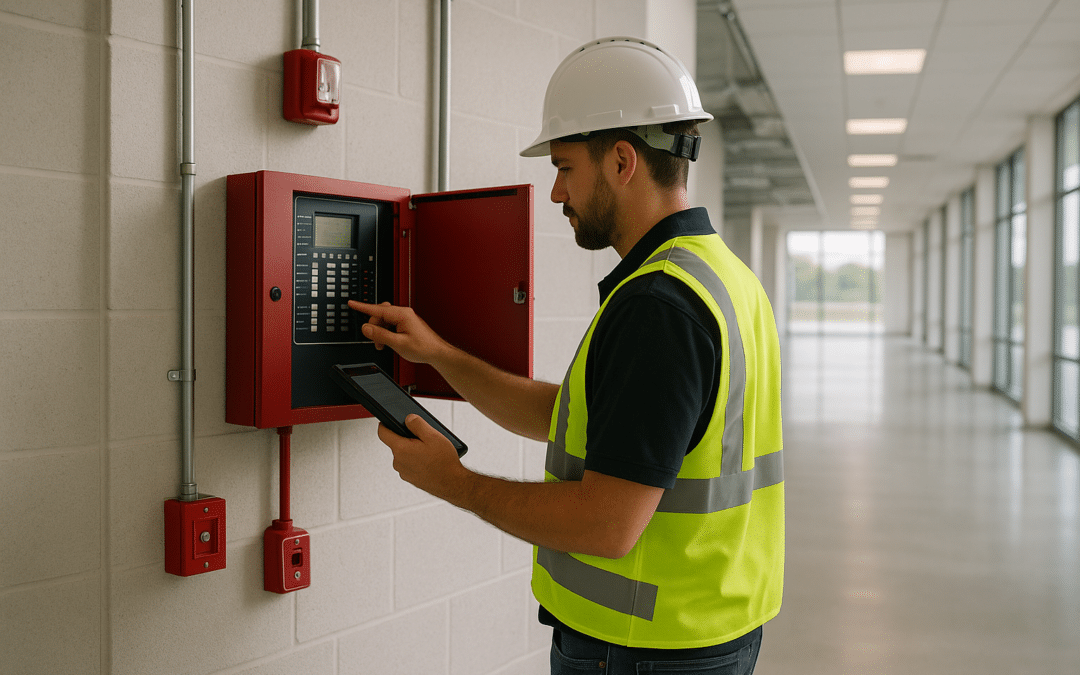
When a licensed technician performs your annual NFPA 72 inspection, expect the visit to include:
- Visual walkthrough of all devices for physical damage, obstruction, or tampering
- Functional testing of every smoke detector, heat detector, manual pull station, horn, strobe, and duct detector
- Control panel review — battery backup load test, annunciator verification, and trouble signal check
- Monitoring verification — confirming signal transmission to the central station
- Sensitivity testing (if due per the alternating-year schedule)
- Written documentation of every result, deficiency, and corrective action
During the inspection, every smoke detector, manual pull station, horn, strobe, duct detector, and supervisory device must be tested and documented. In multi-tenant office buildings, the inspection covers all tenant spaces and common areas — which requires coordination between the property management team and each tenant to ensure access.
Before any scheduled test, all affected parties must be notified prior to any scheduled testing of the fire alarm system. Those notified should include, but not be limited to, building occupants — such as visitors, staff, and patients/residents — and the monitoring company or agency.
Houston Property Managers: Practical Next Steps
Here is what to do if you are unsure of your current compliance status:
- Pull your last inspection report. Confirm the date, the technician’s license number, and whether all devices were tested — not just a sample.
- Check your sensitivity testing schedule. Sensitivity testing gets skipped more often than any other single NFPA 72 requirement, which means it is disproportionately likely to be the item that turns a routine inspection into a citation.
- Verify your monitoring connection. Central station monitoring is required for most Houston commercial properties, and signal transmission must be tested at each annual inspection.
- Schedule reacceptance testing after any renovation. Tenant build-outs, panel replacements, or system expansions all trigger additional testing obligations.
- Engage a Texas SFMO-licensed contractor. Only licensed contractors can legally perform fire alarm inspections in Texas — confirm licensure before signing any service agreement.
Reliable Fire Protection performs NFPA 72-compliant fire alarm inspections, testing, repairs, and central station monitoring for commercial, industrial, institutional, and multi-family properties across Greater Houston — including Downtown, the Energy Corridor, Katy, Sugar Land, Cypress, and Pasadena. We use non-proprietary equipment, provide full written documentation after every visit, and back all parts, materials, and labor with a 24-month satisfaction guarantee. Call or request a free quote to get your property on a compliant ITM schedule.
Recommended Reads
- TCEQ Backflow Preventer Testing Requirements Every Houston Property Owner Should Know
- How to Get Your Backflow Preventer Certified in Texas (Step-by-Step)