
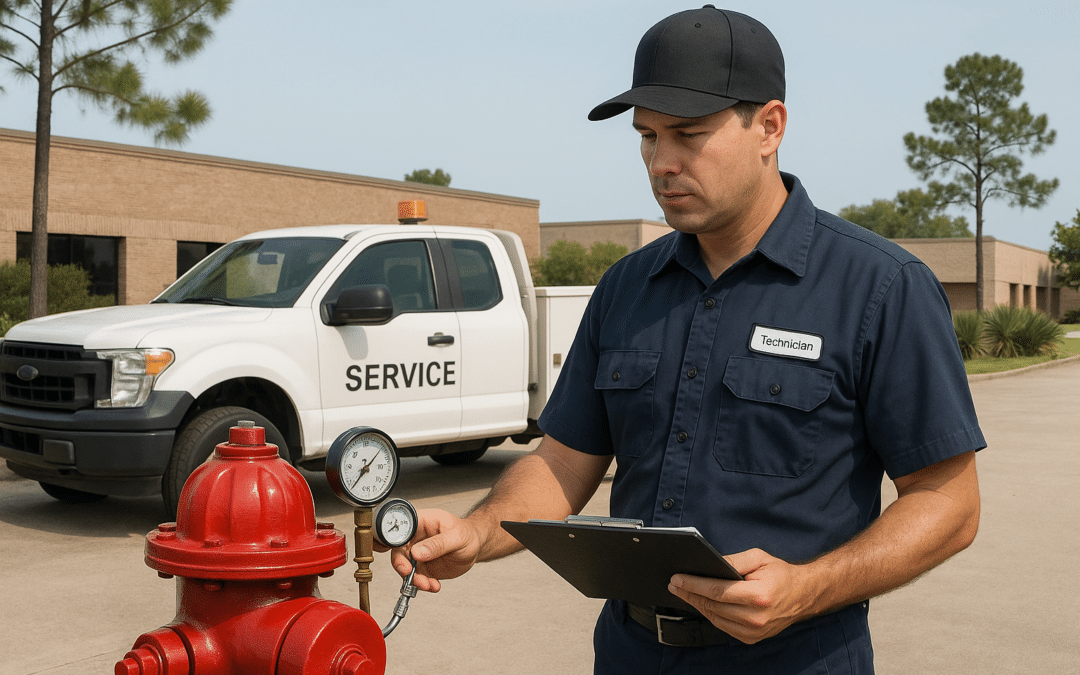
TL;DR: Houston properties with private fire hydrants must have them inspected and flow tested annually by a licensed company, per Houston Fire Code and NFPA 25. This guide explains how the test works, why Houston’s clay soil makes it especially important locally, and what happens if a hydrant fails.
If your commercial property has a fire hydrant on-site rather than out on the public street, that hydrant is your responsibility, not the city’s. Houston Fire Code requires it to be inspected and flow tested every year, and skipping that test can mean a failed inspection, a code violation, or a hydrant that doesn’t deliver water when firefighters need it most.
Here’s what private fire hydrant testing actually involves, why Houston’s climate and soil make it especially important here, and what to expect when a licensed contractor comes out to test yours.
What Is a Private Fire Hydrant?
Any hydrant on private property rather than city owned property is considered a private hydrant, providing a valved connection to a water main to supply water to fire protection equipment, such as a fire hose, during a fire emergency.
You’ll typically find them on large commercial, industrial, and multi-family sites, shopping centers, hospital campuses, and business parks — anywhere the building footprint is too large or too far from a public hydrant for firefighters to reach effectively.
A fire hydrant on private property is required by the International Fire Code when the distance between a structure and the nearest public fire hydrant is too far for emergency personnel to reach, specifically when a structure is more than 400 feet from the public fire hydrant as measured by an approved fire code official.
Houston’s adopted fire code uses this same 400-foot threshold to determine when on-site hydrants are required.
Unlike the hydrants lining your street, which the city or local water utility maintains,
a fire hydrant on private property is the responsibility of the property owner, who carries the liability to comply with private fire hydrant requirements including inspecting, testing, and maintaining the hydrant.
Why Private Fire Hydrant Testing Is Required
A hydrant that looks fine from the outside can still fail under pressure. Corroded internal parts, seized valves, debris in the line, or a collapsed underground main can all prevent a hydrant from delivering adequate flow — and none of those problems are visible without actually opening it up and flowing water.
Testing exists to catch exactly that, before a fire.
Private fire hydrants are flow tested annually to clear any foreign material from the private service main, since rocks or other debris can get into the fire line and cause blockages, and testing allows the inspector to identify potential problems before they get worse.
Houston’s Testing Requirements: Annual Inspection, Annual Flow Test
Houston Fire Code and the Houston Fire Department Life Safety Bureau spell out the schedule clearly. Under the adopted fire code,
private fire service mains and water tanks must be periodically inspected, tested, and maintained in accordance with NFPA 25, with private fire hydrants of all types inspected annually and after each operation, and flow tested and maintained annually.
The Life Safety Bureau’s own compliance language is even more direct about commercial properties:
private dry barrel and wet barrel fire hydrants, and wall hydrants, installed for fire department use shall be inspected and flow tested by an approved service company annually, with testing conducted in accordance with NFPA 25 and a written report of the findings and deficiencies provided.
This is stricter than the national baseline. The underlying national standard, NFPA 291,
recommends public fire hydrants be flow tested every 5 years to verify capacity and marking
— but that 5-year interval applies to municipal hydrant networks, not private on-site hydrants. For private hydrants specifically,
NFPA 25 requires annual flow testing, and your fire marshal expects documented results.
Houston’s code folds both standards together: annual inspection and flow testing for the hydrant itself, plus a longer-interval flow test for the underground piping that feeds it.
What About the Underground Piping?
The fire service main piping that feeds your private hydrants has its own separate schedule. Per Houston’s adopted code,
fire service main piping requires inspection of exposed sections annually, with a full flow test every 5 years.
That 5-year main test is a bigger undertaking that confirms the underground system can still deliver the volume and pressure your fire protection design calls for — related to, but distinct from, the annual hydrant-level test.
What Happens During a Private Fire Hydrant Test
A licensed technician will typically:
- Visually inspect the hydrant body — checking the operating nut, caps, outlet threads, barrel, and drain for damage, corrosion, or missing parts.
- Confirm accessibility — making sure nothing (parking, landscaping, stored materials) is blocking fire department access to the hydrant.
- Open the hydrant fully and flow water until any debris or sediment clears from the line.
-
Flow the hydrant for not less than one minute
, confirming it opens smoothly and discharges a strong, steady stream. - Measure static and residual pressure using a gauge and pitot tube to calculate available flow in gallons per minute.
- Check drainage after shutoff —
full drainage shall take no longer than 60 minutes
to confirm the hydrant isn’t trapping water that could freeze or corrode internal parts. -
Lubricate stems, caps, plugs, and threads annually
to keep everything operating smoothly. - Document deficiencies and provide a written report for your records and the fire marshal.
If your property also has a backflow preventer protecting the domestic water supply from the fire line, that’s typically tested on its own schedule. See our guide on TCEQ backflow preventer testing requirements for how that piece fits in.
Why This Matters More in Houston Specifically
Houston’s geography and climate create conditions that are tougher on buried fire protection infrastructure than in many other parts of the country.
- Expansive clay soil. Much of Greater Houston, including Katy, Sugar Land, and Cypress, sits on heavy, reactive “black gumbo” clay
that is rich in montmorillonite minerals, acting like a giant, dense sponge
that swells when wet and shrinks when dry. - Seasonal drought-to-downpour swings.
Heat usually brings drought to the Greater Houston area, creating a secondary threat to buried pipe: soil contraction.
That cycle of shrinking and swelling stresses underground joints and connections on fire mains the same way it does on domestic water lines. - A documented local pattern of main breaks. Houston Public Works has publicly attributed a surge in water line failures to this exact mechanism:
intense heat and a drop in annual rainfall dry out the soil, causing a shift in water lines, and when the pipes shift, the pipe joints can break, causing water leaks, with aging, brittle lines more susceptible to failure.
None of that is a reason to panic, but it is a strong argument for not skipping your annual hydrant test. A hydrant that flowed fine last year can develop a blocked line or a seized valve after a hot, dry summer followed by heavy fall rain — exactly the cycle Houston sees most years.
Pros and Cons of Staying on Schedule
Benefits of Annual Testing
- Confirms your fire protection water supply will actually perform in an emergency, not just look fine on paper.
- Keeps you compliant with Houston Fire Code and avoids Life Safety Bureau violations during inspection.
- Produces documented records insurers and AHJs may require for coverage or certificate-of-occupancy renewals.
- Catches minor issues (a stuck cap, a slow-draining barrel) while they’re cheap repairs, before they become a failed hydrant during a fire.
Trade-Offs to Plan For
- Flow testing requires discharging a significant volume of water, which some property managers want scheduled around landscaping or parking lot use.
- A failed test may surface a repair or main replacement need that takes time and coordination with your water utility.
- Testing must be done by a qualified, licensed contractor — it isn’t a task in-house maintenance staff can self-certify.
Who’s Responsible, and What Happens If You Skip It
The property owner carries the liability here, full stop. If Houston Fire Department Life Safety Bureau cites a deficiency, the compliance instruction is specific:
have the fire hydrant inside the property tested by a licensed sprinkler company, and provide documentation on all testing, repairs, and maintenance.
An unresolved violation can hold up a certificate of occupancy, trigger re-inspection fees, or create liability exposure if a fire occurs and the hydrant doesn’t perform.
Because private hydrants are fed from the same underground system as your fire pump and sprinkler supply in many buildings, testing often gets coordinated alongside other water-based system checks. If your property has a fire pump, see our explainer on what happens during a fire pump inspection and test in Houston for how the two overlap.
When to Schedule Your Test
Most Houston commercial properties schedule their annual hydrant test alongside other required annual fire protection inspections — fire alarm testing, sprinkler inspections, and extinguisher checks — to minimize disruption and keep all your compliance dates aligned. If you’re not sure when your hydrant was last tested or whether your property even has a documented ITM (inspection, testing, maintenance) record on file, that’s the first thing to check before your next fire marshal visit.
Reliable Fire Protection performs private fire hydrant inspection and flow testing for commercial, industrial, institutional, and multi-family properties throughout Houston, Bellaire, Cinco Ranch, Cypress, Downtown Houston, the Energy Corridor, and surrounding communities, with same-day scheduling and full documentation for your AHJ. Learn more about our full range of services on our Houston fire protection services page.
Recommended Reads
- TCEQ Backflow Preventer Testing Requirements Every Houston Property Owner Should Know
- NFPA 72 Fire Alarm Testing Requirements Explained for Houston Commercial Properties
- What Happens During a Fire Pump Inspection and Test in Houston?