
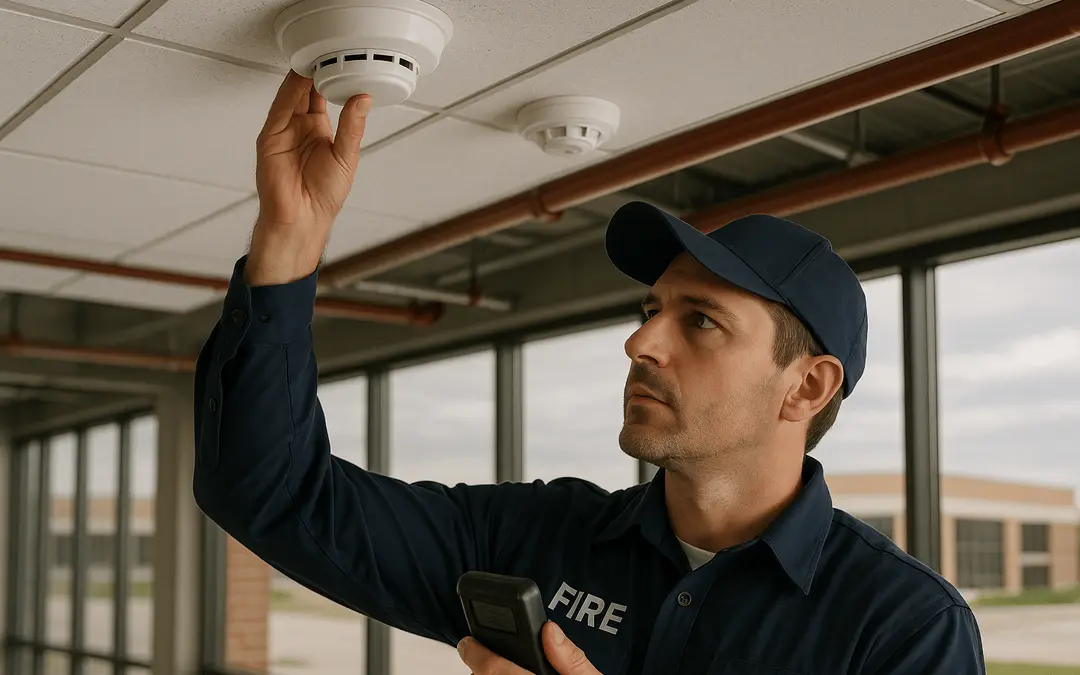
TL;DR: Smoke detectors and heat detectors serve different purposes: smoke detectors catch fires early in occupied spaces, while heat detectors avoid nuisance alarms in kitchens, garages, and dusty industrial areas. Most Houston commercial buildings need a mix of both, placed and spaced according to NFPA 72 and inspected under the local fire code adopted by Houston and Harris County.
If you manage a commercial, industrial, or multi-family property in Houston, you’ve probably wondered whether your building needs smoke detectors, heat detectors, or both. The answer matters: the wrong device in the wrong room can mean constant nuisance alarms, a failed fire marshal inspection, or worse, a fire that goes undetected too long.
This guide breaks down how each detector type works, where each one belongs in a Houston building, and how local climate and code requirements affect your choice.
Smoke Detectors vs. Heat Detectors: The Basic Difference
Smoke detectors sense the byproducts of combustion, smoke particles, in the air. They are designed to catch a fire in its early, smoldering stage, often well before visible flame or significant heat develops. That early warning is why smoke detectors are required in most occupied spaces, sleeping areas, corridors, and egress routes.
Heat detectors, by contrast, respond only to a rise in ambient temperature. They come in two main types:
- Fixed-temperature detectors, which activate once the surrounding air reaches a set threshold
such as 135°F or 155°F
. - Rate-of-rise detectors, which trigger on a rapid temperature increase rather than a fixed number.
Heat detectors are used where smoke detectors would generate nuisance alarms, such as dusty or steamy environments, or where very early warning is less critical than reliability.
That tradeoff is central to choosing the right device for each room in your building.
How Placement and Spacing Actually Work
Detector placement isn’t a guess, it’s governed by NFPA 72, the National Fire Alarm and Signaling Code. A few key rules that apply to nearly every Houston commercial job:
- Heat detectors are typically listed for 50-foot spacing on centers, covering about 2,500 square feet per detector on smooth, flat ceilings up to 10 feet high, with a maximum distance from any wall of half the listed spacing.
- Smoke detectors generally use a maximum spacing of 30 feet on smooth ceilings, though the “Point 7 Rule” allows alternative spacing as long as every point on the ceiling stays within 21 feet of a detector.
-
Heat detectors require spacing reductions as ceiling height increases, while spot-type smoke detectors do not have an equivalent mandatory height-based reduction table.
That matters in warehouses, gyms, and distribution centers common in Cypress, Katy, and the industrial corridors around Pasadena. - Detectors should never be placed directly in line with HVAC diffusers or high-velocity air streams, since that delays smoke or heat detection response.
These are technical rules with real consequences:
under-spaced devices waste budget without improving protection, while over-spaced devices leave coverage gaps that allow a fire to grow undetected.
An experienced Houston fire protection contractor draws these layouts before installation so your plans clear AHJ review the first time.
Where Each Detector Type Makes Sense in a Houston Building
Smoke Detectors: Best For
- Offices, classrooms, hotel corridors, and common areas
- Multi-family hallways and stairwells across properties in Midtown, Bellaire, and Sugar Land
- Healthcare and assisted living facilities, where early evacuation time is critical
- Server rooms and record storage areas with high-value contents
Heat Detectors: Best For
- Commercial kitchens and dish-pit areas, where steam and cooking exhaust would trip a smoke detector constantly
- Attached garages and loading docks with vehicle exhaust
- Attics, mechanical rooms, and boiler rooms
- Warehouses and manufacturing floors with high dust loads, common in industrial parts of the Energy Corridor and Tomball
Storage areas with combustibles generally benefit from ionization-type detection, while kitchens and mechanical rooms often call for heat detectors specifically because smoke-based devices would trigger nuisance alarms in those environments.
Many Houston restaurants pair heat detection with a dedicated kitchen suppression system rather than relying on smoke detection over the cookline. If your property has a commercial kitchen, see how detection integrates with our fire suppression systems for hood and cooking-line protection.
Why This Matters More in Houston’s Climate
Gulf Coast humidity, heavy HVAC use, and dust from ongoing construction across Greater Houston all affect detector performance over time.
Detectors can drift out of their listed sensitivity range between annual tests due to dust accumulation, humidity, or age.
That’s one reason routine inspection and sensitivity testing aren’t optional extras, they’re what keeps your system reliable in a climate that’s harder on electronics than drier regions.
Local Code Requirements Houston Building Owners Should Know
Houston and Harris County both enforce fire alarm testing through the International Fire Code, which in turn points back to NFPA 72 for the technical details.
- Houston adopted the 2021 International Fire Code under Ordinance No. 2023-9071, effective January 1, 2024.
- Harris County has enforced the 2021 International Fire Code since January 1, 2025.
- The International Fire Code requires fire alarm systems to be inspected, tested, and maintained under NFPA 72, making yearly testing the floor inside Houston and unincorporated Harris County.
On top of the annual test, most systems need more frequent checks.
Smoke detectors need semi-annual visual checks, annual functional testing, and sensitivity testing starting in year one and every other year after that, while notification appliances like horns and strobes are tested annually.
Heat detectors also get functional testing on that same semi-annual/annual cycle.
All inspection records must be retained for a minimum of five years,
and documentation gaps are one of the most common reasons Houston buildings fail inspection even when the hardware itself is working fine.
Devices don’t last forever, either.
Smoke detectors must be replaced 10 years from their manufacture date regardless of whether they still pass testing, while non-restorable heat detectors must be replaced at 15 years.
If your building still has original detectors from a decade-old buildout, that’s worth a look during your next inspection.
Pros and Cons at a Glance
Smoke Detectors
- Pros: Earlier warning, required in most occupied spaces, better for life-safety-critical occupancies like healthcare and multi-family housing.
- Cons: Prone to nuisance alarms in kitchens, steamy bathrooms, dusty warehouses, or near HVAC discharge.
Heat Detectors
- Pros: Reliable in harsh, dirty, or humid environments; far fewer false alarms; long service life.
- Cons: Slower to respond than smoke detection, not a substitute for smoke detection in sleeping or occupied areas.
Most Buildings Need Both
In practice, almost every commercial building in Greater Houston, from a Downtown office tower to a Cinco Ranch shopping center, uses a combination of smoke and heat detection tied into one fire alarm control panel. The right mix depends on occupancy type, ceiling height, kitchen or industrial processes on site, and what your local AHJ requires for your specific occupancy classification.
Because heat and smoke detection typically integrate with waterflow switches, kitchen suppression interlocks, and elevator recall, it’s worth having your whole fire protection system, not just the detectors, reviewed together. A qualified fire sprinkler system and detection layout should be designed as one coordinated life-safety package, not bolted together piecemeal.
Getting Your Houston Property Up to Code
Whether you’re designing detection for a new build, retrofitting an older property, or just catching up on overdue inspections, Reliable Fire Protection designs, installs, and services smoke and heat detection systems for commercial, industrial, institutional, and multi-family properties across Houston, Bellaire, Cypress, Cinco Ranch, and the surrounding suburbs. Our technicians work to NFPA 72, the Houston Fire Code, and Harris County requirements, with non-proprietary equipment and a 24-month satisfaction guarantee on parts, materials, and labor.
If it’s been more than a year since your last full detector test, or you’re not sure whether your kitchen, warehouse, or mechanical room has the right detector type installed, request a free quote and inspection from our Houston fire protection team.
Recommended Reads
- Fire Detection Company in Houston | Reliable Fire Protection
- Houston's #1 Reliable Fire Protection Services
- Fire Suppression Systems Houston | Reliable Fire Protection