TL;DR: Texas law under 30 TAC Chapter 290 requires all testable backflow prevention assemblies to be tested at installation and at least annually by a TCEQ-licensed tester. In Houston, test reports must be submitted to Houston Public Works, and non-compliance can trigger fines up to $2,000 per day plus water service suspension. Fire sprinkler lines add a second layer: NFPA 25 requires a separate annual forward flow test that is distinct from the TCEQ backflow test.
If you manage a commercial building, industrial facility, restaurant, apartment complex, or any property connected to Houston’s public water supply, backflow preventer testing is not optional. It is a state-mandated, locally enforced requirement — and missing a deadline can cost you thousands of dollars in fines or even the loss of your water service.
This guide breaks down exactly what TCEQ requires, how Houston enforces those rules, which assemblies must be tested, who can legally perform the test, and what happens if your assembly fails.
What Is Backflow and Why Does It Matter?
Backflow is the unintended reversal of water flow in a plumbing system. Two physical mechanisms cause it: back-pressure, where downstream pressure exceeds supply pressure (common in boiler systems and elevated irrigation zones), and back-siphonage, where negative pressure in the supply main draws contaminated water backward through an open connection.
When backflow occurs, contaminants from private plumbing — chemicals, biological waste, fire suppressant additives, fertilizers — can be drawn into the potable water distribution network that serves your entire neighborhood. A properly functioning backflow prevention assembly (BPA) stops this from happening. But because BPAs are mechanical devices, they can and do fail over time, which is why regular testing is required by law.
The Legal Foundation: TCEQ and 30 TAC Chapter 290
In Texas, the Texas Commission on Environmental Quality (TCEQ) regulates backflow prevention through Title 30 Texas Administrative Code Chapter 290. Sections 290.44 and 290.46 set the minimum standards for cross-connection control and backflow prevention across public water systems statewide.
The TCEQ requires all water providers to establish a cross-connection control and backflow prevention program. At the local level, the City of Houston Public Works and Engineering Department enforces cross-connection control requirements for properties served by the municipal water system.
Core Testing Requirements at a Glance
State rules and regulations and the City of Houston Plumbing Code mandate testing backflow preventer assemblies at the time of installation, repair, relocation, and annually thereafter.
Here is what that means in practice:
- Upon installation: Every new BPA must be tested before it is put into service.
- After any repair, replacement, or relocation: All backflow prevention assemblies must be tested upon installation, repair, replacement, or relocation.
- Annually: TCEQ requires all backflow devices or assemblies to be tested at least once annually. Additional testing may be required depending on the health hazard.
- Report submission: Results must be submitted to Houston Public Works within 30 days of testing.
The program requires property owners to maintain responsibility for ensuring their backflow prevention device is in good working order and providing annual test reports as proof of compliance. Backflow testing is the owner’s responsibility and is paid for by the owner.
Which Assemblies Must Be Tested?
Not every backflow device is a testable assembly. Understanding which type you have is the first step to compliance.
Testable assemblies (annual testing required):
- Reduced Pressure Principle Assembly (RP/RPBA), Double Check Valve Assembly (DCVA), Pressure Vacuum Breaker (PVB), and Spill-Resistant PVB (SVB) are all testable assemblies.
Non-testable devices (testing not required, but still need maintenance):
- Single-check valves and atmospheric vacuum breakers are not testable assemblies.
The type of hazard at hand will determine the type of backflow prevention assembly required to be installed. Licensed professionals as well as your public water system are responsible for determining the type of backflow-prevention assembly required, based on the degree of hazard.
Who Needs a Backflow Preventer in Houston?
The short answer: most commercial, industrial, and multi-family properties. Regulations typically require certain commercial, industrial, and even some residential properties to install and regularly test backflow prevention assemblies. Properties with irrigation systems, fire suppression systems, or those handling potentially hazardous materials are often at the top of the list.
Common property types that require BPAs include:
- Restaurants and food service operations
- Hotels and hospitality properties
- Healthcare facilities and assisted living communities
- Industrial and manufacturing plants
- Multi-family apartment complexes
- Properties with fire sprinkler systems
- Properties with in-ground irrigation systems (the State of Texas requires every lawn sprinkler system installed in the state to be protected by a certified backflow prevention device)
Who Can Legally Perform the Test in Houston?
A person who repairs or tests the installation or operation of backflow prevention assemblies must hold a license issued by the TCEQ. Backflow prevention assembly testers are qualified to test and repair assemblies on any domestic, commercial, industrial, or irrigation service.
There is a critical extra rule for fire lines: backflow prevention assembly testers may test and repair assemblies on fire lines only if they are permanently employed by an Approved Fireline Contractor. This means the company you hire to test the backflow preventer on your fire sprinkler system must hold an active Approved Fireline Contractor designation — not just a general BPAT license.
All backflow prevention assembly testing must be completed by a TCEQ-licensed tester listed on Houston’s Cross-Connection Control Program Backflow Testing Company List. You can verify any tester’s credentials directly on the TCEQ occupational licensing page.
A note for Houston property managers: unlike some states that accept ASSE certification alone, Texas requires the TCEQ license specifically. National certifications (ASSE 5110, ABPA) are valuable credentials but do not substitute for the state license.
The Special Case: Fire Sprinkler System Backflow Preventers
If your property has a fire sprinkler system, your backflow preventer is subject to a dual compliance mandate — two separate tests with two different legal authorities.
For fire protection systems, backflow assemblies face a dual mandate: NFPA 25 requires a forward flow test to ensure adequate water delivery to sprinklers, while state and local water authorities require a separate backflow prevention test to protect public health.
Per NFPA 25, all backflow preventers installed in fire protection system piping shall be exercised annually by conducting a forward flow test at a minimum flow rate of the system demand. This test verifies that the check valves within the assembly will open fully when the sprinkler system needs to flow water during an actual fire — a distinct concern from the TCEQ water-quality test.
The NFPA 25 forward flow test and the water authority backflow prevention test are separate requirements. Passing one does not satisfy the other. Both must be completed annually.
Additionally, NFPA 25 Section 13.7.1.3 requires internal inspection of backflow preventers every five years to verify that all components operate correctly, move freely, and are in good condition.
To learn more about how these requirements intersect with your overall fire sprinkler system inspection and maintenance obligations, speak with a licensed fire protection specialist who holds an Approved Fireline Contractor designation.
What Happens During a Backflow Test?
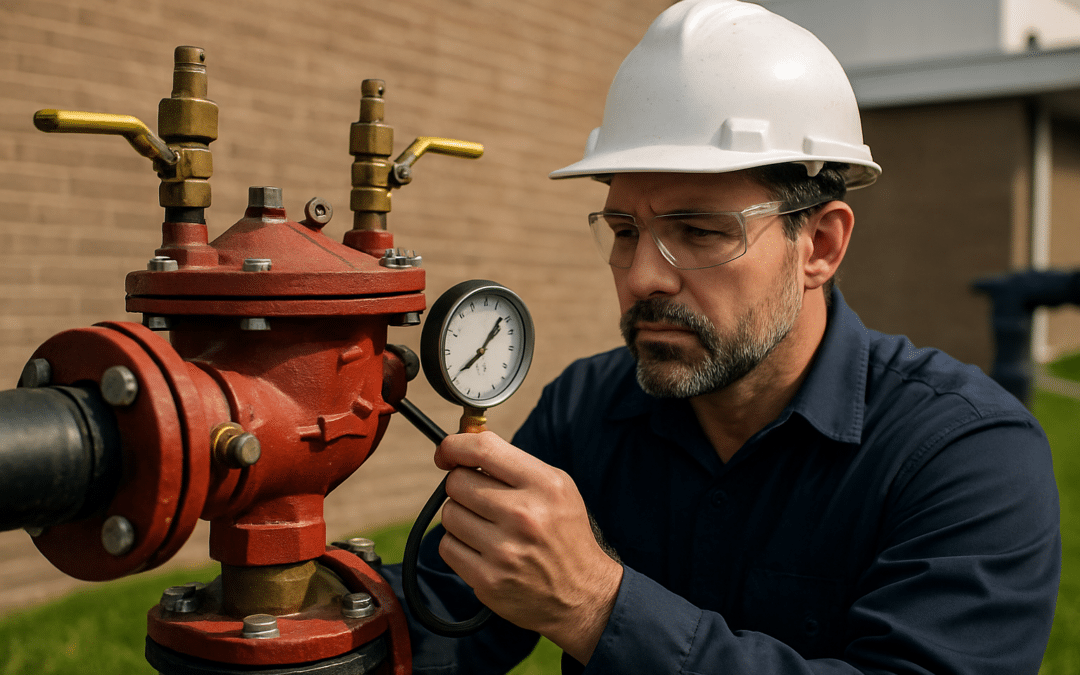
The tester must close the upstream and downstream shutoff valves to isolate the assembly during testing. Water to the fire sprinkler system is interrupted for approximately 10–20 minutes. Domestic water service on a separate line is not affected.
A single assembly test typically takes 30–60 minutes including setup, the 3-part test procedure, and documentation. Buildings with multiple assemblies — for example, separate domestic and fire service backflow preventers — will take longer.
The tester checks that:
- Check valves seal properly under pressure
- The relief valve opens at the correct differential pressure (typically 2 PSI)
- All shutoff valves operate freely
Test reports must include the tester’s certification number, test kit calibration date, specific pressure readings, and be retained for a minimum of one year after the next test.
Penalties for Non-Compliance in Houston
The stakes are high for property owners who let their testing lapse. Failure to comply with these requirements will result in citations being issued with fines of up to $2,000 per day and the risk of potential suspension of water services.
Beyond fines and service shutoff, there is an insurance dimension. Many insurance carriers require documented backflow preventer testing as a condition of coverage. Failed or untested devices can result in denied claims following a fire incident.
What Happens If Your Assembly Fails?
A failed test does not mean immediate disaster, but it does require prompt action.
- Repair or replace immediately. All repairs, replacements, or overhaul assemblies must also be performed by a licensed backflow prevention assembly tester and permitted by the City.
- Retest after repair. The assembly must pass a new test before it is returned to service.
- If it is a fire line assembly: A failed or out-of-service backflow assembly may impair your fire sprinkler system. Notify your fire alarm monitoring company and implement a fire watch per NFPA 25 Section 15.5 until repairs are complete.
Need help with a failed assembly? Our team provides backflow preventer inspection, testing, and repair across Greater Houston with same-day service and transparent pricing.
How to Stay Compliant Year-Round: A Simple Checklist
- ✅ Know your assembly type (RP, DCVA, PVB, or SVB) and confirm it is testable
- ✅ Schedule annual testing before your compliance deadline — don’t wait for a city notice
- ✅ Verify your tester holds a current TCEQ BPAT license and is on Houston Public Works’ approved tester list
- ✅ Confirm your fire line tester works for an Approved Fireline Contractor
- ✅ Ensure test reports are submitted to Houston Public Works within 30 days of testing
- ✅ For fire sprinkler systems, schedule the NFPA 25 forward flow test separately from the TCEQ backflow test
- ✅ Schedule a 5-year internal inspection per NFPA 25 if your assembly protects a fire line
- ✅ Keep copies of all test reports on file for at least one year beyond the next test
The Bottom Line
Backflow preventer testing in Houston operates at the intersection of TCEQ state rules, Houston Public Works enforcement, and NFPA 25 standards — and each layer has its own requirements, deadlines, and documentation obligations.
Reliable Fire Protection is a state-licensed, family-owned fire protection company based in Houston. We are an Approved Fireline Contractor, meaning our TCEQ-licensed testers are authorized to test and repair backflow prevention assemblies on fire lines — which most general plumbers are not. We serve commercial, industrial, multi-family, and institutional properties across Greater Houston, including the Energy Corridor, Katy, Sugar Land, Midtown, Cypress, and Pasadena.
Call us for a free quote, same-day scheduling, and a 24-month satisfaction guarantee on all parts, materials, and labor.