

TL;DR:
- Fire drills are scheduled practice evacuations that test an organization’s Emergency Action Plan and identify weaknesses.
- They should be conducted regularly based on occupancy type, with detailed documentation and scenario variation to ensure effectiveness.
Fire drills are defined as scheduled practice evacuations that train occupants to exit a building safely and efficiently when a fire alarm activates. The role of fire drills goes well beyond a legal checkbox. They test your Emergency Action Plan (EAP) under real conditions, expose gaps in evacuation routes, and build the muscle memory that keeps people calm when seconds matter. Regulatory bodies like OSHA and the NFPA mandate or recommend drill frequencies based on occupancy type, making them a cornerstone of both legal compliance and genuine risk management for homes, schools, and commercial facilities alike.
What are the key objectives of fire drills?
Fire drill objectives center on one outcome: every occupant exits safely and is accounted for. That sounds simple, but achieving it requires hitting several measurable targets during each exercise.
The most widely cited performance benchmarks are a total evacuation time under 4 minutes and a full headcount confirmed within 6 minutes. Those numbers reflect real fire behavior. Smoke and heat conditions deteriorate fast, so any evacuation plan that cannot meet those benchmarks in practice is not a safe plan.
Specific objectives include:
- Full occupant evacuation within the 4-minute Total Evacuation Time (TET) benchmark from alarm activation to the last person clearing the building
- 100% headcount accuracy at the designated assembly point, with every visitor, contractor, and staff member logged
- Identification of bottlenecks, such as congested stairwells, locked secondary exits, or unclear warden assignments
- Alarm and communication testing to confirm that audible and visual alert systems reach every area of the building
- Training for specific populations, including fire wardens, staff assisting mobility-impaired occupants, and new employees unfamiliar with exit routes
- Muscle memory development so occupants respond automatically rather than hesitating or searching for instructions
One objective that organizations frequently underestimate is mobility-impaired evacuation. Performance-based drills that simulate assisting these occupants reveal whether Personal Emergency Egress Plans (PEEPs) actually work before a real fire tests them.
Pro Tip: Record the TET for every drill and post it alongside the previous drill’s time. Visible progress motivates wardens and gives management a concrete metric to track.

How often should fire drills be conducted?
No single federal rule sets a universal drill frequency for all buildings. OSHA 1910.38 requires employers to maintain functional EAPs but does not prescribe specific drill intervals for general industry. The NFPA 101 Life Safety Code fills that gap with occupancy-specific schedules.
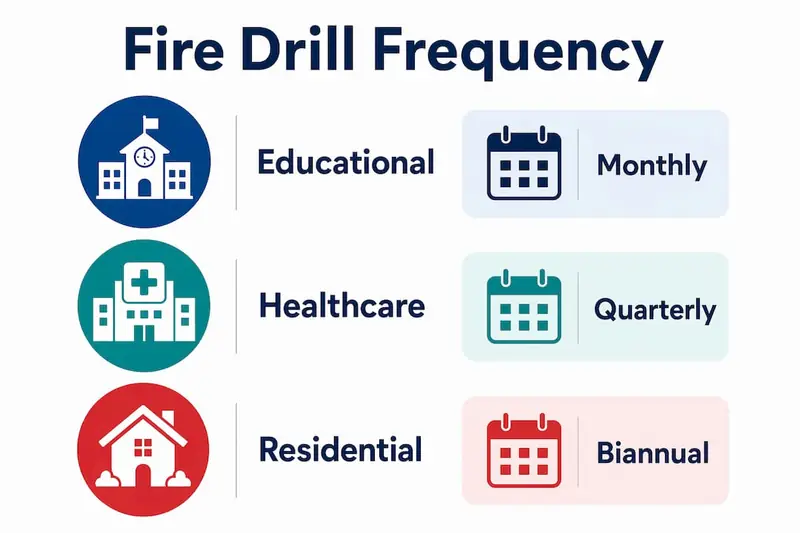
| Occupancy Type | NFPA 101 Drill Frequency |
|---|---|
| Educational (schools) | Monthly while occupied |
| Healthcare facilities | Quarterly per shift |
| Assembly and business | Annually |
| Residential (recommended) | At least twice per year |
These are minimums. Local fire codes in cities like Houston often add requirements on top of NFPA 101, so always verify with your local authority having jurisdiction (AHJ).
Residential properties sit outside most mandatory frameworks, but home fire drills should be practiced at least twice a year, with at least one drill conducted at night. Nighttime drills matter because most fatal residential fires occur while occupants are asleep. Testing two escape routes from every room and establishing a permanent outdoor meeting point are non-negotiable elements of any home drill.
For healthcare and high-rise facilities, nighttime drills between 9 PM and 6 AM may use coded announcements instead of full alarm activation per regulatory allowances, while still requiring visual alarm activation. This balances patient safety with realistic staff response testing.
The consequences of skipping drills are severe. Noncompliance can result in fines, building closures, and lawsuit exposure characterized as “reckless indifference.” That legal standard means courts treat the absence of drills as evidence of deliberate negligence, not just an oversight.
Pro Tip: Schedule at least one unannounced drill per year. Announced drills measure preparation; unannounced drills measure actual readiness.
What are best practices for planning and conducting effective fire drills?
Effective fire drills require deliberate design, not just a pulled alarm and a walk outside. The following steps produce drills that genuinely test your evacuation plan.
- Design scenario-based exercises. Vary the time of day, block a primary exit, or simulate a stairwell obstruction. Unpredictability in drill timing prevents complacency and better prepares occupants for conditions that real fires create.
- Activate the actual alarm system. Using a verbal announcement instead of the alarm defeats the purpose. Occupants need to associate the alarm sound with immediate action.
- Include everyone. Visitors, contractors, and temporary staff must participate. Evacuation plans that exclude any group create dangerous gaps.
- Deploy trained wardens at every exit and floor. Wardens direct traffic, check restrooms and conference rooms, and report to the assembly point warden once their zone is clear.
- Conduct a strict headcount. A drill is not complete until every occupant is confirmed at the assembly point. Socializing at assembly points reduces headcount accuracy and produces false “all clear” reports regardless of how fast the building emptied.
- Measure Total Evacuation Time. Start the clock at alarm activation and stop it when the last occupant clears the building. Compare against the 4-minute benchmark.
- Run an after-action review within 24 hours. Assign corrective actions with named owners and deadlines. A gap identified but never fixed is worse than no drill at all.
- Document everything. Drill records must capture the date, time, facilitator name, response times, headcount results, communication effectiveness, participant logs including visitors and contractors, and all corrective actions taken.
For commercial properties, a fire compliance checklist helps confirm that drill documentation meets audit standards before an inspector arrives.
Pro Tip: Use a two-person accountability system at the assembly point: one person calls names from the roster while a second person physically confirms each occupant is present. This catches errors that a single counter misses.
The most common mistakes that undermine otherwise well-run drills are predictable timing, incomplete records, and allowing occupants to check phones or chat at the assembly point before headcount is complete. Each of these errors produces a false sense of readiness that a real fire will expose.
How do fire drills integrate with fire safety training and emergency action plans?
Fire drills are the practical test of your EAP, not a separate activity. Every gap a drill exposes is a direct instruction to update the plan and retrain the relevant staff. Updates to evacuation procedures triggered by drill findings satisfy OSHA training requirements, which means a well-run drill program simultaneously improves safety and maintains compliance.
The integration works in both directions:
- Drills validate training. If wardens hesitate or occupants use the wrong exit, the training program needs revision, not just the drill schedule.
- Drills update the EAP. A blocked exit discovered during a drill must be reflected in the written plan before the next exercise.
- Drills train specific populations. PEEPs for mobility-impaired occupants only work if they are practiced. A written plan that has never been tested is not a functional plan.
- Drills demonstrate due diligence. Under OSHA 1910.38 and local fire codes, a documented drill history is the primary evidence that an organization takes occupant safety seriously.
- Drills serve as diagnostic tools. They reveal facility-level risks, such as doors that do not latch, exit signs that are obscured, or assembly points that are too small for the building’s occupant load.
For healthcare organizations, the healthcare fire safety compliance requirements are especially detailed, with quarterly per-shift drills designed to test staff across all hours of operation. A well-documented drill program with after-action reviews and corrective action tracking is the most defensible record under audit or litigation.
Fire safety training and drills also reinforce each other over time. Organizations that run drills quarterly rather than annually report faster evacuation times and fewer procedural errors. The frequency itself builds the habit, and habit is what saves lives when the alarm is real.
Key Takeaways
Fire drills are the single most effective tool for validating evacuation plans, building occupant readiness, and protecting organizations from legal liability when emergencies occur.
| Point | Details |
|---|---|
| Drill frequency by occupancy | NFPA 101 sets monthly drills for schools, quarterly per shift for healthcare, and annually for business and assembly occupancies. |
| Performance benchmarks | Target total evacuation under 4 minutes and full headcount confirmed within 6 minutes of alarm activation. |
| Scenario-based design | Vary timing, block exits, and include all occupants to prevent complacency and reveal real weaknesses. |
| Documentation is legal protection | Drill records capturing response times, headcount, and corrective actions are critical evidence in negligence lawsuits. |
| Drills improve the EAP | Every gap found in a drill must update the written Emergency Action Plan and trigger retraining before the next exercise. |
Why most fire drills fail before the alarm even sounds
The shift from a “tick-box” drill to a genuinely useful exercise is harder than it looks. I have seen facilities that run drills every quarter and still cannot evacuate within 6 minutes because the drill design never changes. Same time of day, same exits open, same wardens standing in the same spots. Occupants stop taking it seriously, and the drill stops measuring anything real.
The drills that actually work are the ones that make people slightly uncomfortable. A blocked stairwell. A drill at 7:30 AM before the building is fully staffed. A scenario where the primary assembly point is unavailable. These conditions feel disruptive, but they are far closer to what a real fire looks like than a calm Tuesday afternoon walkout.
The legal dimension reinforces this point. Absence of documented drills significantly increases catastrophic liability and regulatory penalties. Courts do not just ask whether you ran drills. They ask whether your drills were realistic, documented, and followed by corrective action. A folder of identical drill reports with no noted deficiencies is not evidence of a safe building. It is evidence of a program that was never designed to find problems.
The organizations that get this right treat every drill as a diagnostic, not a performance. They want to find the gap before the fire does.
— Results
How Reliable-fire-protection supports your fire drill program
A fire drill is only as effective as the alarm system that triggers it. If occupants cannot hear or see the alert, the drill measures nothing real.

Reliable-fire-protection provides fire alarm system installation, inspection, and maintenance for residential and commercial properties across Houston. Their certified technicians confirm that every audible and visual device performs to code before your next drill. Understanding how fire alarm systems work is the first step toward building a drill program that produces accurate results. For facilities that need advanced detection, Reliable-fire-protection also installs addressable alarm systems that pinpoint the exact location of an alarm activation, giving wardens precise information during an evacuation. Contact Reliable-fire-protection for a free quote and make sure your alarm system is ready before your next drill.
FAQ
What is the primary role of fire drills?
Fire drills train occupants to evacuate safely and efficiently by practicing exit routes and procedures before a real emergency occurs. They also test the Emergency Action Plan and identify procedural gaps that need correction.
How often are fire drills required by law?
Frequency depends on occupancy type. NFPA 101 requires monthly drills for schools, quarterly per shift for healthcare facilities, and annual drills for most business and assembly occupancies.
What should fire drill records include?
Records must capture the date, time, facilitator name, total evacuation time, headcount results, communication effectiveness, participant logs including visitors and contractors, and all corrective actions assigned after the drill.
What is Total Evacuation Time and why does it matter?
Total Evacuation Time (TET) measures the interval from alarm activation to the last occupant clearing the building. Most offices target a TET under 4 minutes, reflecting how quickly dangerous fire conditions develop.
What happens if an organization does not conduct fire drills?
Noncompliance with fire drill requirements can result in fines, building closures, and severe legal liability. Courts have characterized the absence of drills as “reckless indifference,” which significantly increases exposure in negligence lawsuits.