
TL;DR:
- Traditional fire detectors trigger false alarms up to 95%, causing disruptions and compliance issues.
- Advanced detectors use multiple sensors and AI to improve accuracy and reduce false alarms.
- Investing in modern detection systems enhances safety, compliance, and long-term cost savings.
Most property managers assume their fire detection system is doing its job. The uncomfortable reality is that traditional detectors trigger false alarms up to 95% of the time, eroding trust, disrupting tenants, and quietly creating compliance gaps. In Houston’s fast-growing commercial landscape, outdated single-sensor units simply can’t keep pace with modern building complexity. Advanced fire detectors change that equation entirely. This guide breaks down what makes a detector truly advanced, which technologies work best for specific building types, and how to make a smart choice that keeps your property compliant and genuinely protected.
Table of Contents
- What makes a fire detector advanced?
- Core technologies: From multi-sensor to AI-enabled detectors
- Choosing the right solution for your Houston property
- Real-world benefits: Reliability, compliance, and peace of mind
- The uncomfortable truth: Upfront investment vs. long-term safety
- Protect your property with trusted advanced fire detection
- Frequently asked questions
Key Takeaways
| Point | Details |
|---|---|
| Multi-sensor advantage | Advanced detectors combine multiple sensor types for greater reliability and accuracy. |
| Reduced false alarms | AI-powered systems cut down nuisance alarms, saving time and money for Houston properties. |
| Smarter compliance | UL/FM listed advanced detectors make it easier to satisfy NFPA72 fire code requirements. |
| Specialized solutions | Choosing the right technology depends on your space—warehouses benefit from ASD or image-based detection. |
What makes a fire detector advanced?
To understand why so many alarms are unreliable, let’s define what really sets advanced detectors apart.
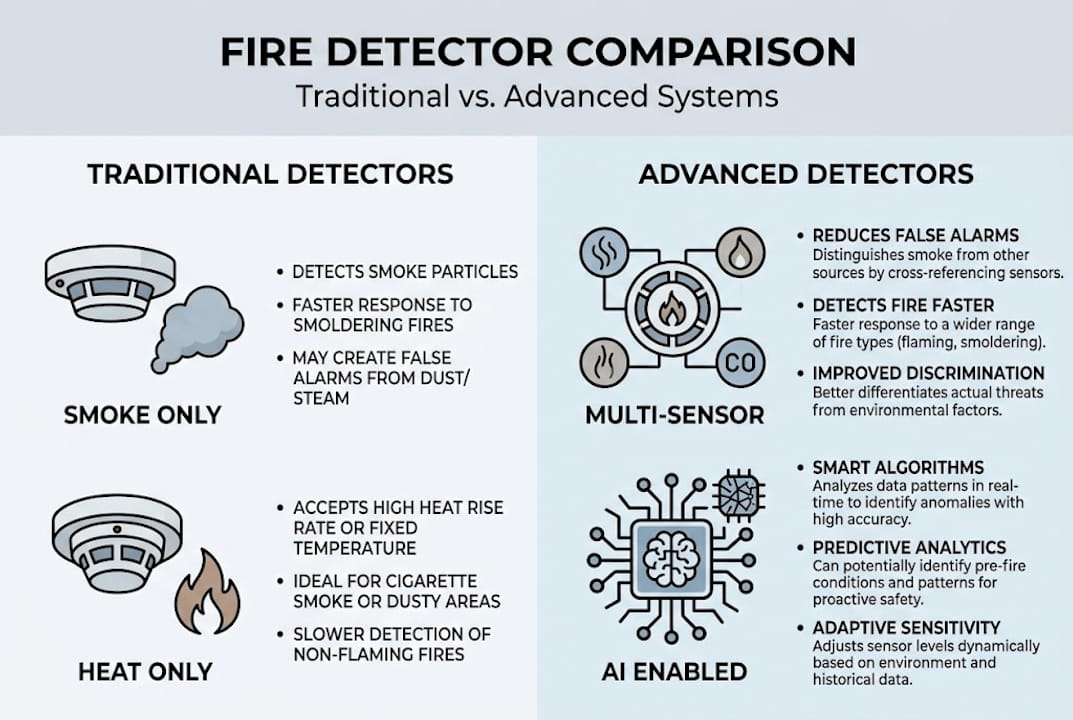
A traditional detector monitors one thing, usually smoke or heat, and reacts when that single reading crosses a threshold. An advanced detector combines multiple sensing inputs, smoke, heat, carbon monoxide (CO), flame, and gas, and then cross-references those signals before triggering an alert. The result is a system that “thinks” before it acts.
Advanced detection systems layer machine learning and AI on top of that sensor fusion. Instead of a simple threshold trigger, the system learns from patterns, compares current conditions to historical data, and flags only genuine fire signatures. That process dramatically cuts false alarms without sacrificing detection speed.
For Houston property managers, this distinction carries real weight. A false alarm in a busy office building means evacuating dozens of people, potential fire department fees, and a slow grind back to productivity. A missed real fire is obviously worse. Advanced detectors are designed to eliminate both failure modes.
Pro Tip: Always verify that any detector you specify is UL or FM listed. Houston’s local fire code aligns with NFPA 72, and listed devices are the baseline for passing inspections without headaches.
Here are the primary categories of advanced fire detection you should know:
- Multi-sensor detectors: Combine smoke, heat, CO, and sometimes flame or gas inputs into one unit
- Aspirating smoke detection (ASD): Actively draws air samples through a pipe network for ultra-early warning
- Image-based detectors: Use optical or thermal cameras to identify fire or smoke visually
- Addressable systems: Each device has a unique address, pinpointing the exact location of an alarm event
Exploring top fire detection technologies gives you a sharper look at which of these systems fits specific Houston building profiles. If you are newer to detection fundamentals, reviewing fire detection basics first will make the technology comparisons much easier to follow.
Core technologies: From multi-sensor to AI-enabled detectors
Now that you know what counts as advanced, here’s how modern detectors apply technology for superior fire protection.
Multi-sensor detectors are the foundation. They pull data from smoke, CO, heat, and sometimes flame or gas sensors simultaneously. When two or more of those inputs signal danger in a correlated pattern, the system fires an alert. One input alone, like steam from a kitchen or dust from a renovation, gets filtered out rather than triggering a building-wide evacuation.
The next step up involves deep learning models. Research published in Nature Scientific Reports found that multi-sensor DA-GRU models combining temperature and CO data achieved over 96% detection accuracy. DA-GRU stands for dual-attention gated recurrent unit, a type of neural network that weighs sensor inputs differently based on which signals matter most at a given moment. The practical takeaway: AI doesn’t just process more data, it processes it smarter.
“AI-enabled fire detectors don’t replace human judgment. They make sure the right information reaches the right people fast enough to act.”
Convolutional neural networks (CNN) and gated recurrent units (GRU) are increasingly common in next-generation commercial systems. These models can integrate with building management systems (BMS), sending automated alerts, locking fire doors, and activating suppression systems without manual intervention.
Here’s how the main detector categories compare:
| Feature | Single-sensor | Multi-sensor | AI/ML-driven |
|---|---|---|---|
| Detection accuracy | Low to moderate | High | Very high (96%+) |
| False alarm rate | High | Moderate | Low |
| BMS integration | Rare | Possible | Standard |
| Upfront cost | Low | Moderate | Higher |
The typical workflow for an AI-enabled system follows four steps:
- Sensor fusion: Multiple inputs collected simultaneously
- Data analysis: AI model compares patterns against known fire signatures
- Automated alerts: Verified events trigger notifications and physical responses
- Building integration: System communicates with sprinklers, HVAC, access control, and BMS
For a side-by-side breakdown of specific products, the fire detection systems comparison resource is worth bookmarking. If you’re specifically considering addressable panels, reviewing addressable detector options will help you match panel capability to your building’s layout.
Choosing the right solution for your Houston property
With these technical advances in mind, let’s look at how to actually choose and apply the right technology for your building type.
Building type is the first filter. A mid-size office building typically performs best with multi-sensor detectors placed in each zone. These units handle the mix of human activity, electronics, and HVAC airflow without nuisance alarms. A high-ceiling warehouse is a completely different challenge. Standard point detectors mounted at 30 or 40 feet often react too slowly or miss early smoke that disperses before reaching the sensor.

ASD and image-based detectors consistently outperform point detectors in large or high-bay spaces, making them critical for warehouses, distribution centers, and open commercial complexes. ASD actively samples air at low levels, catching smoke particles long before visible fire develops. Image-based systems cover large areas with a single camera unit, reducing installation complexity.
Mixed-use properties, where retail, office, and residential floors share one structure, usually need a combination approach. Addressable systems tie everything together, giving facility managers one dashboard showing which zone is affected and what type of event triggered the alert.
Pro Tip: More coverage with fewer false alarms means fewer disruptions, better tenant confidence, and much smoother compliance audits. Inspectors want to see a system that works correctly, not one that technically passes on paper.
Before specifying a system, run through these key questions:
- What is the ceiling height and total floor area?
- Are there specific hazards like cooking equipment, flammable storage, or industrial machinery?
- Does the system need to integrate with existing HVAC, BMS, or access control?
- What are the local AHJ (authority having jurisdiction) requirements beyond NFPA 72?
For detailed placement and zoning guidance, the system setup guide walks through Houston-specific code points. If your building uses multiple alarm panels or control systems, understanding fire alarm integration will save you costly retrofitting later.
Real-world benefits: Reliability, compliance, and peace of mind
With the right solution in place, here’s the practical impact for safety, compliance, and daily operations.
The most immediate benefit is fewer disruptions. Every false alarm costs time: tenant evacuations, fire department responses, paperwork, and sometimes fines. Multi-sensor systems paired with UL/FM listing help properties comply with NFPA 72 and cut false alarm frequency significantly. Fewer alarms means your tenants stay productive and your reputation stays intact.
Compliance inspections also get easier. Modern addressable systems generate detailed event logs, which inspectors can review to confirm the system is functioning correctly. A building with documented, verified alarm events passes inspections faster than one with a history of unexplained triggers.
AI-enabled detectors add another layer of operational value. When a genuine fire event is detected, the system can automatically notify emergency responders, close fire dampers, pressurize stairwells, and shut down relevant HVAC zones. That automated response chain can shave critical minutes off response time.
“Detection accuracy above 96% isn’t just a statistic. It represents fewer missed fires, fewer false evacuations, and a system your tenants can actually trust.”
The tangible benefits for Houston property managers stack up quickly:
- Less downtime: Fewer false alarms mean uninterrupted business operations
- Cost savings: Avoid fire department false-alarm fees and compliance penalties
- Higher tenant trust: Reliable systems signal professional, responsible management
- Lower liability exposure: Documented, compliant systems strengthen your legal position
For a solid grounding in how all these components connect, reviewing how fire alarm systems work gives you the full picture from sensor to control panel to emergency response.
The uncomfortable truth: Upfront investment vs. long-term safety
Here’s the perspective most vendors won’t give you: the conversation about cost almost always focuses on the wrong number.
Property managers naturally gravitate toward lower-cost single-sensor units. They pass the basic code check, they’re easy to install, and the invoice looks manageable. But traditional single-sensor units generate false alarms up to 95% of the time, and every one of those false alarms carries a real cost in tenant disruption, potential fines, and staff time.
The hidden math rarely gets calculated: a system that costs less upfront but triggers four false alarms a year, each costing several hundred dollars in fees and lost productivity, erases any savings within a couple of years. Add in a missed real fire event, and the liability exposure dwarfs any initial cost savings.
We’ve seen this pattern in Houston properties repeatedly. The managers who invest in essential fire safety systems upfront spend less time managing alarm incidents, pass inspections cleanly, and retain tenants who trust the building’s safety infrastructure. Advanced detectors aren’t a luxury upgrade. They’re the smarter financial decision over any realistic ownership horizon.
Protect your property with trusted advanced fire detection
Ready to make your property safer and compliant? Expert support makes the difference between a system that looks good on paper and one that genuinely protects your building.

At Reliable Fire Protection, we work with Houston property managers and business owners to design and install advanced fire detection systems tailored to your specific building, occupancy, and code requirements. Whether you need to understand how modern alarm systems work before committing, or you’re ready to schedule a full site assessment, we’re here to guide you through every step. We serve properties across Houston, including Houston Heights and surrounding neighborhoods. Reach out today to explore the top fire detection solutions available for your property and get a free quote.
Frequently asked questions
How do advanced fire detectors differ from traditional ones?
Advanced detectors combine sensor types and AI cross-verification to dramatically cut false alarms and improve accuracy compared to older, single-sensor models that react to one isolated input.
What type of fire detector is best for a high-ceiling warehouse?
Aspirating smoke detection and image-based detectors consistently outperform standard point detectors in large or high-bay spaces because they sample air actively or cover wide areas optically.
Will these systems help my building meet fire code in Houston?
Yes. UL/FM listed multi-sensor and ASD systems are designed to support NFPA 72 compliance and satisfy local Houston AHJ requirements during inspections.
Are advanced fire detectors really worth the higher cost?
Advanced detectors generate far fewer false alarms than single-sensor units, reducing fines, tenant disruptions, and liability exposure in ways that offset the higher upfront price over time.