
TL;DR:
- Proper fire safety requires a combination of smoke and heat detectors tailored to each environment.
- Houston fire codes mandate annual inspections and documentation for compliance.
- Strategic placement and understanding device limitations enhance overall fire protection and reduce false alarms.
Most property owners and managers treat smoke and heat detectors as if they are the same device with a different name. They are not. Houston’s fire codes, built around NFPA 72 and the International Fire Code, draw a clear line between the two, and choosing the wrong one for the wrong space can mean failed inspections, liability exposure, or worse, a fire that goes undetected long enough to cause real harm. This guide breaks down exactly how each detector works, where each belongs, and how to build a system that keeps your Houston property both safe and fully compliant.
Table of Contents
- What smoke and heat detectors do: A quick primer
- Key differences: Smoke vs heat detectors
- Houston fire code and compliance: What property owners need to know
- Application in the field: Matching detector types to real Houston spaces
- A fire safety pro’s perspective: Blending both for true protection
- Need help designing or upgrading your fire detection system?
- Frequently asked questions
Key Takeaways
| Point | Details |
|---|---|
| Detectors serve different roles | Smoke and heat detectors detect fires differently and are needed for full code compliance. |
| Houston has strict requirements | Both detector types are mandated by local fire codes and must be maintained annually. |
| Match detector to environment | Choose smoke or heat detectors based on your property’s unique risks and conditions. |
| Expert advice enhances safety | Consulting a fire safety professional helps ensure true protection beyond minimum compliance. |
What smoke and heat detectors do: A quick primer
Understanding how these devices work is the starting point for making any smart decision about your fire protection system. They are not interchangeable tools. They detect fire in fundamentally different ways, and each fills a gap the other cannot.
Smoke detectors identify fire by sensing the particles or gases that combustion produces before flames even become visible. There are two primary technologies at work. Ionization detectors use a small radioactive source to create a current inside the chamber. When smoke enters, it disrupts that current and triggers the alarm. Photoelectric detectors use a light beam inside the chamber. Smoke scatters that beam onto a sensor, setting off the alarm. Ionization types respond faster to fast-flaming fires, while photoelectric types are more sensitive to slow, smoldering fires. Each has a role depending on the environment.
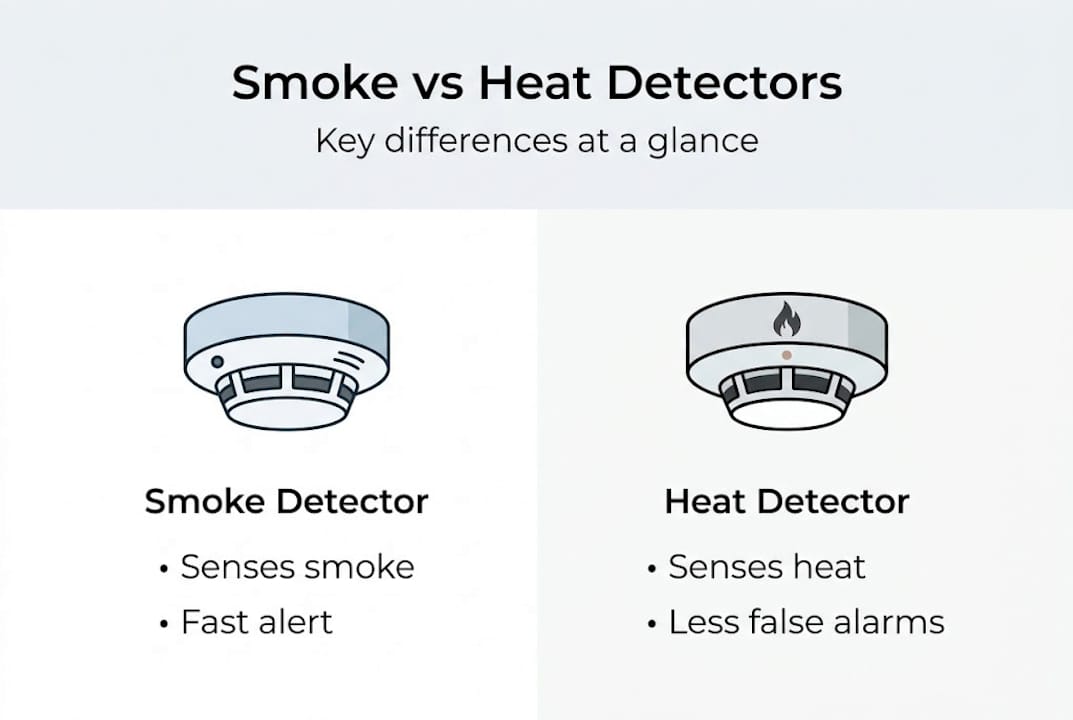
Heat detectors do not look for smoke at all. They respond to temperature. Fixed-temperature heat detectors trigger when the air around them reaches a preset threshold, typically 135°F or 194°F depending on the model. Rate-of-rise detectors respond when temperature climbs quickly, usually more than 15°F per minute. This makes them ideal for spaces where fire spreads rapidly but smoke signals may be absent or misleading.
Houston properties operating under local fire codes must comply with NFPA 72 standards, which require fire alarm systems to include both smoke and heat detection in appropriate locations. Neither device alone satisfies code across all areas of a building.
Here is a quick feature snapshot of each detector type:
| Feature | Smoke detector | Heat detector |
|—|—|—|
| Detection method | Particles/gases | Temperature change |
| Best fire type | Smoldering/flaming | Fast-flaming |
| False alarm risk | Moderate to high | Low |
| Typical cost | Lower | Slightly higher |
| Ideal location | Bedrooms, hallways, offices | Kitchens, garages, warehouses |
For a deeper look at how these systems come together, fire alarm installation basics provides a solid overview of what a full system design looks like in practice.
- Smoke detectors provide the fastest warning for occupant evacuation.
- Heat detectors offer reliable detection in environments hostile to smoke sensors.
- Both types serve specific code-mandated roles under NFPA 72.
- Neither type covers every scenario on its own.
Key differences: Smoke vs heat detectors
Having established what each detector does, let’s compare them side by side for real-world property management. The difference that matters most is not technology. It is application.
Smoke detectors react faster to smoldering fires, which are the most common type of fire in occupied buildings. A smoldering fire can fill a room with toxic smoke for minutes before a flame appears. In that scenario, smoke detection is life-saving. But speed has a trade-off. Smoke detectors are sensitive. Steam from a shower, dust from renovation work, or grease vapor from a nearby kitchen can all trigger a false alarm.
Heat detectors have a very different profile. They will not react to steam, dust, or cooking smoke. Their false alarm rate is dramatically lower. The trade-off is response time. A heat detector only activates when the temperature rises to a dangerous level, which means more of the fire cycle has already occurred before the alarm sounds. In areas where people are sleeping or working, that delay matters.
“In large spaces with high ceilings, smoke can stratify and fail to reach the detector in time. Heat detectors are often better suited for rapid fire environments where temperature rise is the more reliable signal.”
| Comparison factor | Smoke detector | Heat detector |
|---|---|---|
| Response speed | Faster for smoldering | Faster for flash fires |
| False alarm risk | Higher | Lower |
| Best environment | Living spaces, offices | Kitchens, industrial areas |
| Maintenance sensitivity | Higher | Lower |
| Code-required spaces | Bedrooms, corridors | Mechanical rooms, garages |
Understanding fire alarm roles in buildings helps clarify why a single device type will never fully cover a mixed-use property. Smart placement using both types is always the correct approach.
- Smoke detectors are better for early evacuation warning in occupied spaces.
- Heat detectors are better for reliability in challenging environments.
- False alarms from smoke detectors can create alarm fatigue, which is a real safety risk.
- Some spaces legally require one type over the other per NFPA 72.
Houston fire code and compliance: What property owners need to know
With the practical differences clear, it is crucial to understand the legal and safety requirements for Houston properties. Getting this wrong is not just a safety problem. It is a liability problem.
Houston follows the International Fire Code and NFPA 72 for all commercial and multi-family residential properties. These standards specify where smoke detectors and heat detectors must be installed, what detection technology is acceptable in each space, and how those systems must be tested and maintained. There is no flexibility to pick one and skip the other across your entire building.
Annual inspections are mandatory for all fire alarm systems. The Authority Having Jurisdiction (AHJ) can require access to inspection records, maintenance logs, and test results at any time. If your records are missing, you are out of compliance even if the hardware is working.
Here are the core steps every Houston property owner should follow:
- Audit your current system against NFPA 72 to identify gaps in smoke and heat coverage.
- Hire a licensed fire alarm contractor to inspect and certify the system.
- Review fire alarm inspection steps specific to Houston properties.
- Schedule your annual inspection and log the results.
- Stay current with fire safety testing requirements to avoid lapses in coverage or certification.
- Store all documentation in a single binder or digital folder accessible during an AHJ audit.
Statistic worth noting: commercial property fires cause an estimated $3.3 billion in direct property damage annually in the United States. Proper detector placement and code compliance are among the most effective tools to reduce that exposure.
Pro Tip: Keep a dedicated compliance binder at each property with the most recent inspection report, the contractor’s license number, and a copy of the detector placement map. AHJ inspectors appreciate organized documentation, and it can prevent costly re-inspection fees.
Application in the field: Matching detector types to real Houston spaces
Knowing the law is only half the battle. Let’s see how to apply this practically in common Houston properties. Theory matters less than knowing which device goes in which room.
Apartment buildings should prioritize smoke detectors in every bedroom, hallway, and living area. Residents need the fastest possible warning to evacuate safely. Heat detectors can supplement coverage in laundry rooms or utility closets where steam might trigger false alarms.
Warehouses and industrial facilities are a different story entirely. Dust, fumes, and high ceilings create conditions where smoke detection is unreliable. Dusty environments strongly favor heat detectors to prevent the nuisance alarms that lead workers to ignore the system entirely. For spaces with very high ceilings, beam smoke detectors or heat detectors placed at lower levels may be required.

Commercial kitchens are one of the most common sources of false alarms in Houston. Grease smoke, steam, and high ambient temperatures make standard smoke detectors nearly useless in these areas. Heat detectors are the correct choice above cooking equipment. Smoke detectors still belong in adjoining dining areas and hallways.
Office buildings typically require a combination. Open-plan office floors need smoke detectors for fast occupant warning. Server rooms, electrical closets, and mechanical spaces may call for specialized heat detectors or even aspirating smoke detection systems.
For guidance on choosing fire alarms for property type, reviewing the specific layout and occupancy class of each building is the right starting point.
Pro Tip: Never assume that because a previous tenant or owner installed detectors, the system is still code-compliant for your current use. A change in occupancy type often triggers a fresh compliance review.
- Apartments: Smoke detectors in all sleeping and living areas.
- Warehouses: Heat detectors throughout, supplemented as needed.
- Kitchens: Heat detectors above cooking equipment, smoke elsewhere.
- Offices: Mixed system designed to match each zone’s risk profile.
A fire safety pro’s perspective: Blending both for true protection
You now know the technical and legal requirements, but here is what most guides never tell you. Compliance is the floor, not the ceiling of fire safety.
We have walked through enough Houston properties to know that managers who pass inspection and feel finished are leaving real risk on the table. A single detector type, even the right one, creates blind spots. An open-plan office floor with no heat detection in the electrical room is a compliance pass with a hidden failure waiting to happen. A warehouse with only heat detectors and no smoke coverage near exit corridors may meet code but still leave workers without enough warning time.
The properties that perform best in real fire events are those designed around occupancy patterns, not just code minimums. That means asking hard questions. Where are people during non-business hours? Which areas have the highest ignition risk? Where would a slow smoldering fire go undetected the longest?
Staff training is just as important as hardware. A system that triggers false alarms regularly will be ignored. A system no one knows how to respond to fails even when it works correctly. Review your alarm maintenance tips regularly and make sure your team knows what to do when an alarm sounds.
Need help designing or upgrading your fire detection system?
Understanding the difference between smoke and heat detectors is the first step. Putting the right system in place is where Reliable Fire Protection comes in.

We work with Houston property owners and managers to design detection systems that go beyond minimum compliance. From reviewing how fire alarm systems work in your specific building type to handling full installation and annual inspections, our team handles every step. We serve properties across Houston, including resources specific to the Houston Heights area and surrounding neighborhoods. If you are ready to schedule a compliance review or get a free quote, visit Reliable Fire Protection and connect with our team today.
Frequently asked questions
Are smoke detectors or heat detectors required in all Houston commercial properties?
Houston fire codes require both smoke and heat detectors, installed per NFPA 72 standards and local regulations, depending on the area and occupancy type of the building.
Where should heat detectors be used instead of smoke detectors?
Heat detectors are recommended for areas prone to dust or steam, such as kitchens and warehouses, because dusty environments cause false alarms that reduce system reliability and occupant trust.
How often do fire alarm systems in Houston need inspection?
Houston regulations require annual fire alarm inspections for all commercial properties to maintain code compliance and avoid penalties from the Authority Having Jurisdiction.
Can I replace smoke detectors with heat detectors to reduce false alarms?
Switching certain detectors to heat models may reduce false alarms in specific zones, but Houston’s NFPA 72 requirements still mandate smoke detection in sleeping areas, corridors, and other designated spaces.
Recommended
- Top 7 Fire Detection Systems Comparison for 2026
- Top 2026 fire detection technologies for Houston facilities
- Step-by-Step Fire Detection System Setup Guide
- Fire Detection Basics Explained for Houston Businesses
- Kazán szénmonoxid veszély jelei otthon – Kazán szerelő Kecskemét, Kazán szerviz Kecskemét, Kazáncsere Kecskemét
- Fire Alarm System University Place TX
- Fire Alarm System Services in Bellaire, TX