
TL;DR:
- Texas lacks a uniform statewide fire code; compliance depends on local jurisdiction and amendments.
- Property owners must verify their local fire marshal’s adopted code and keep detailed maintenance records.
- Non-compliance fines can reach $45,000, but regular inspections significantly reduce violation risks.
Most Texas business owners assume fire code compliance works the same across the entire state. It does not. Texas lacks a uniform statewide fire code for general commercial buildings, meaning your obligations depend entirely on where your property sits, what your local jurisdiction has adopted, and what amendments they have added on top. Miss those local details, and you face fines, failed inspections, and real liability. This guide cuts through that confusion, laying out exactly who sets the rules, what you need to do, and how to keep your business protected and compliant.
Table of Contents
- Understanding fire code authority in Texas
- Step-by-step: The Texas fire code compliance process
- What Texas fire codes require for commercial properties
- Special scenarios and edge cases: What trips up compliance?
- Why fire code compliance in Texas is more complex—and more vital—than most realize
- How Reliable Fire Protection helps Texas businesses stay compliant
- Frequently asked questions
Key Takeaways
| Point | Details |
|---|---|
| No uniform code | Fire code requirements in Texas depend on local adoption and amendments, not a single statewide standard. |
| Stepwise compliance process | Compliance includes researching codes, assessing equipment, obtaining permits, inspections, and ongoing maintenance. |
| Essential fire safety gear | Most commercial properties need alarms, extinguishers, sprinklers, emergency lighting, and proper exit signage. |
| Penalties for violations | Fines, reinspection fees, and even business shutdown can result from non-compliance. |
| Local authority is key | Always check code requirements with your local Authority Having Jurisdiction before taking action. |
Understanding fire code authority in Texas
Here is the reality: Texas fire code adoption is not a single system. Local jurisdictions across the state choose their own edition of the International Fire Code (IFC), often the 2021 or 2024 version, and layer on their own amendments. Neighboring cities can have meaningfully different requirements. That gap is where compliance failures happen.
The State Fire Marshal’s Office (SFMO) does hold authority, but only for specific occupancy types. The SFMO adopts NFPA 1 Fire Code and NFPA 101 Life Safety Code for state-licensed facilities, certain public buildings, and occupancies under state jurisdiction. For most standard commercial properties, your local fire marshal is the one with power over your compliance status.
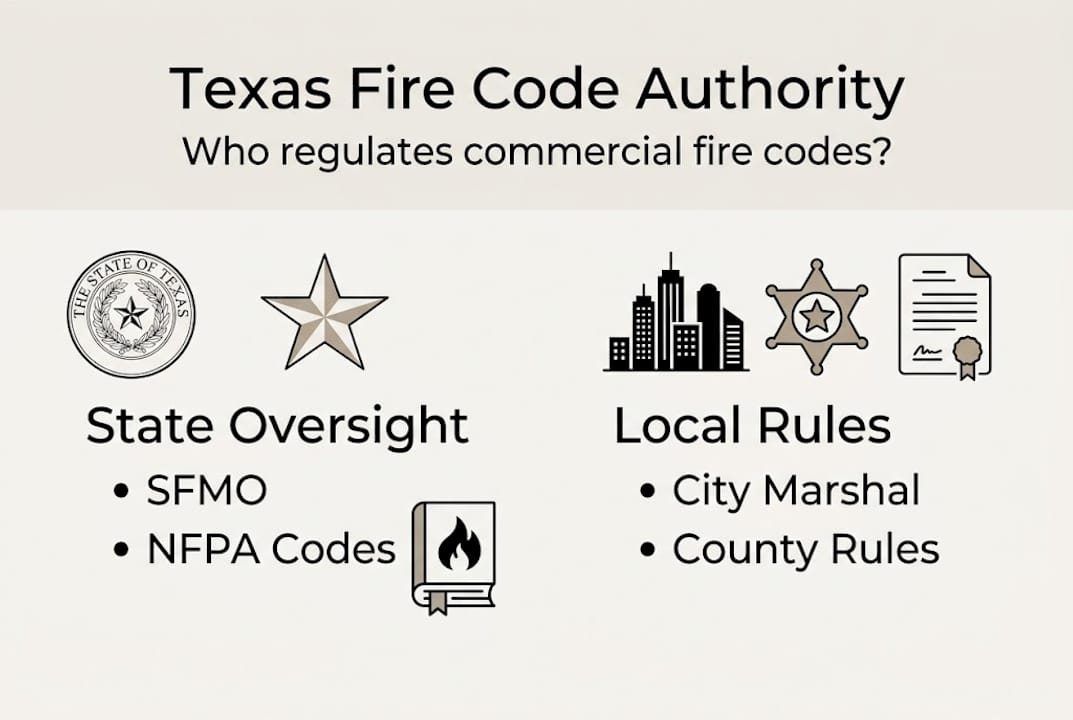
The key term every property manager in Texas needs to know is Authority Having Jurisdiction, or AHJ. Your AHJ is the official body with the legal authority to interpret and enforce fire code for your specific property. Always confirm your AHJ before making any assumptions about which code version applies to you.
Common misconceptions that trip up business owners:
- “Texas has one statewide fire code” (it does not)
- “The IFC is the IFC everywhere” (local amendments change everything)
- “State inspection covers my property” (only for state-jurisdictional occupancies)
- “If I passed last year, I’m still compliant” (codes and amendments update)
- “My contractor handles all code questions” (you, as the property owner, are ultimately responsible)
Here is a quick comparison of how authority breaks down:
| Authority | Scope | Code Used |
|---|---|---|
| Local fire marshal | Most commercial buildings | IFC (local edition + amendments) |
| State Fire Marshal (SFMO) | State-licensed and public facilities | NFPA 1, NFPA 101 |
| Both (dual enforcement) | State-licensed buildings in IFC cities | IFC + NFPA standards |
Familiarizing yourself with industry fire safety standards gives you a stronger foundation before engaging your local AHJ. Think of it this way: knowing the baseline national standards helps you catch gaps when local amendments create higher requirements than you expected.
“No statewide uniformity means you must always verify your local AHJ’s adopted edition and any amendments before assuming what applies to your building.”
Step-by-step: The Texas fire code compliance process
Now that you know which code applies, here is how to navigate the fire safety compliance process from start to finish without missing critical steps.
- Research your local code adoption. Contact your local fire marshal’s office to confirm which IFC edition is in effect and what amendments apply to your property type.
- Inventory existing equipment. Walk your property and document every fire safety system: alarms, sprinklers, extinguishers, suppression systems, emergency lighting, and exit signage.
- Obtain permits for new installations or renovations. Any new construction or fire system upgrade requires proper permits before work begins.
- Schedule inspections. Coordinate with your local fire marshal or SFMO if applicable. First-time inspections often require more preparation than annual renewals.
- Perform regular maintenance on schedule. Fire alarms and extinguishers need at least annual servicing, while sprinklers require quarterly visual checks and annual testing. Use your fire safety checklist to track each system.
Documentation is not optional. You need dated records for every inspection, test, and maintenance visit. Your annual inspection guide can help you understand exactly what inspectors look for and how to prepare.
Pro Tip: Assign one dedicated staff member to own compliance records. One person tracking all dates, permits, and inspection reports eliminates the “I thought someone else handled it” problem that leads to lapses.
The financial stakes are real. According to compliance maintenance benchmarks, non-compliance fines can reach $8,500 to $45,000 over five years for repeat violations. More importantly, properties that maintain regular inspections see violation rates drop by up to 92 percent compared to those that skip routine servicing. Compliance is not just safer. It is cheaper.
What Texas fire codes require for commercial properties
With the process in mind, it is crucial to know exactly what you are expected to provide and maintain. Requirements vary by building type and occupancy, but the core list applies broadly.
Standard equipment and requirements for most commercial properties:
- Fire alarm systems with detectors and pull stations
- Essential fire safety equipment including ABC-rated extinguishers in general areas and Class K extinguishers in commercial kitchens
- Sprinkler systems (required in many buildings based on size and occupancy)
- Emergency lighting and illuminated exit signs
- Clear, unobstructed egress paths at all times
- Proper storage practices (no blocking electrical panels, no piling materials in egress routes)
- Visible building identification for emergency responders
Here is how key requirements typically break down by property type:
| Requirement | Applies To | Inspection Frequency |
|---|---|---|
| Fire alarms | Nearly all commercial buildings | Annually |
| Sprinklers | Many commercial buildings 5,000+ sq ft | Quarterly visual, annual testing |
| Fire extinguishers | All commercial occupancies | Annually (monthly staff checks) |
| Kitchen suppression | Restaurants, food service | Semi-annually |
| Emergency lighting | All commercial occupancies | Annually |
| Exit signage | All commercial occupancies | Annually |
Pro Tip: Restaurant and food service operators often overlook the semi-annual servicing requirement for hood suppression systems. A missed service visit can trigger a failed inspection and forced closure even when every other system is current. Use your preventive checklist to keep all service windows on your radar year-round.
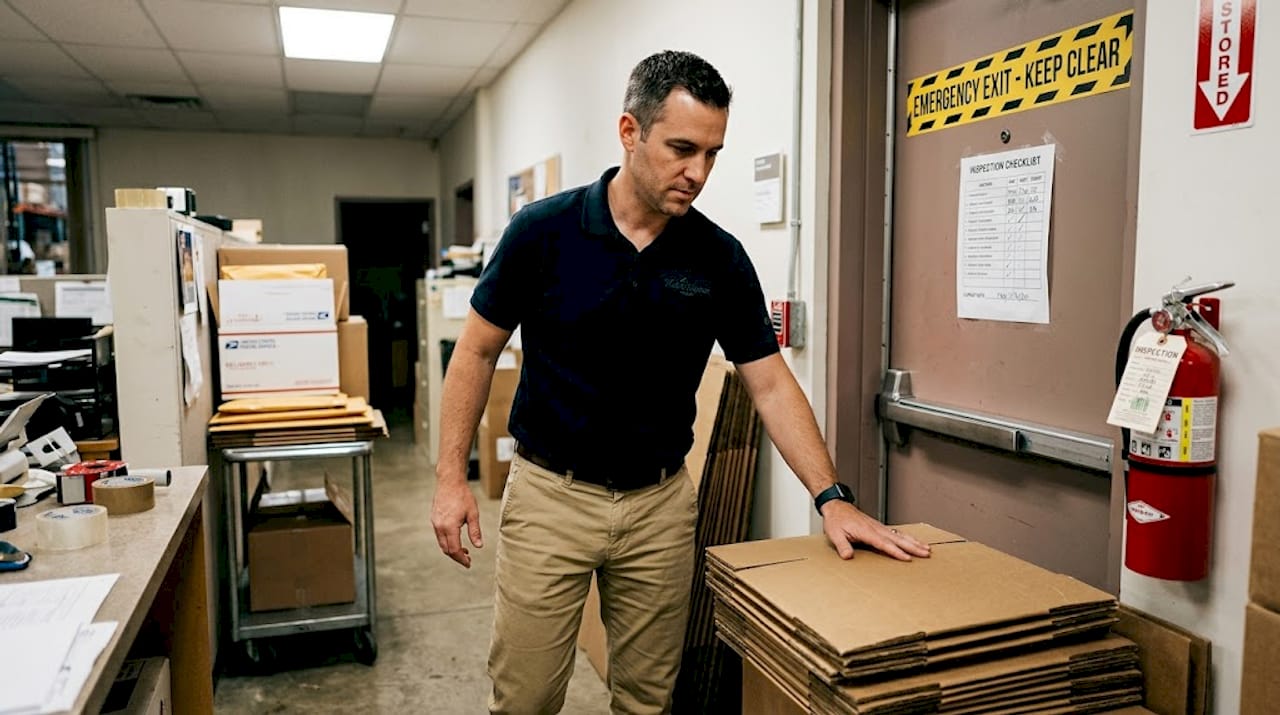
For offices, the biggest compliance gaps tend to be blocked exits and overloaded power strips. Warehouses often struggle with aisle clearance and sprinkler obstruction from improper stacking. Retail properties frequently miss monthly extinguisher checks. Check your fireproofing compliance requirements as well, especially if you store flammable materials.
Special scenarios and edge cases: What trips up compliance?
Even with standard requirements covered, certain property types and project situations create compliance challenges that catch business owners completely off guard.
Common edge cases that lead to violations:
- High-rise buildings require annual inspections of fire systems plus additional life safety measures not found in low-rise code requirements
- Commercial kitchens must have dedicated suppression systems, not just standard extinguishers
- Self-storage facilities generally require sprinkler systems despite a perception that stored goods pose low risk
- New construction in some Texas counties triggers third-party plan reviews before permits are issued
- Supply shortages for specific equipment (such as certain sprinkler heads) may require SFMO guidance to manage temporary alternatives without falling out of compliance
Local amendments are the most common surprise. A city might require sprinklers in buildings that the base IFC edition would not mandate. Another jurisdiction might have stricter spacing requirements for extinguishers. According to the step-by-step inspection guide framework, these variations are especially prevalent in mixed-use buildings and properties undergoing change-of-occupancy renovations.
For county fire code information specific to your region, always consult your local authority directly before finalizing renovation plans.
“Never assume a general compliance checklist covers your property. Always verify your local AHJ’s amendments before any renovation or occupancy change.”
The most important habit you can build is calling your local fire marshal before any significant property change. A quick pre-renovation conversation can prevent months of costly rework.
Why fire code compliance in Texas is more complex—and more vital—than most realize
After years of working with Texas property owners, we have noticed a consistent pattern: the businesses that struggle most with compliance are not the ones who ignore fire safety. They are the ones who treat compliance as a box to check rather than a system to manage.
The local flexibility in Texas fire codes is often seen as a headache. We see it differently. When your local code allows for amendments, that means your jurisdiction has tailored requirements to actual local conditions, building stock, and risk patterns. That specificity is an opportunity to build safety systems that genuinely fit your operation rather than generic minimums.
Properly maintained fire systems reduce fire deaths and property loss by over 50 percent according to NFPA data, and annual inspections reduce violations by 83 to 92 percent while helping you avoid $8,500 to $45,000 in fines over five years. Those numbers make the case better than any argument about regulatory obligation.
Our take: expert compliance insights confirm that the businesses with the strongest safety records treat compliance as leadership, not paperwork. They are the ones their employees trust, their insurers reward, and their tenants choose to stay with long term.
How Reliable Fire Protection helps Texas businesses stay compliant
Navigating Houston’s local fire code amendments, scheduling inspections, and keeping every system current is a real operational challenge. That is exactly where we come in.
At Reliable Fire Protection, we bring hands-on familiarity with local AHJ requirements across Houston and surrounding neighborhoods. Whether you need fire alarm system design from the ground up, a clear sprinkler compliance workflow for an existing building, or guidance on the right type of extinguisher for your specific occupancy, our certified team covers it all. We handle installations, inspections, and ongoing maintenance so you stay ahead of violations and focused on your business.
Frequently asked questions
Who enforces fire codes for businesses in Texas?
Local fire marshals enforce codes for most businesses, while the State Fire Marshal applies authority to state-licensed occupancies and certain public facilities where NFPA standards govern.
How often do fire alarm and sprinkler systems need inspection in Texas?
Fire alarms require annual inspection, while sprinkler systems need quarterly visual checks and full annual testing, with staff-level extinguisher checks recommended monthly.
What are the penalties for failing a fire code inspection?
Penalties vary by jurisdiction, but Travis County, for example, uses a civil penalty matrix up to $200 per violation based on risk level, plus reinspection fees ranging from $35 to $150, with serious repeat violations risking shutdowns or lawsuits.
Do all Texas commercial buildings require sprinklers?
Not all, but many commercial buildings must have sprinklers based on occupancy type, building size, and local IFC adoption or amendments specific to their jurisdiction.
What is an AHJ and why does it matter for fire codes?
An Authority Having Jurisdiction is the local official with authority to interpret and enforce the fire code for your property, and their adopted edition and amendments always take precedence over general statewide assumptions.