

TL;DR:
- Fire doors prevent fire and smoke spread, ensuring safe evacuation and limiting building damage.
- Compliance requires specific labels, rated hardware, seals, annual inspections, and proper installation.
- Maintaining a safety culture and system integration is essential for true fire protection.
Non-compliance with fire door regulations is one of the top reasons Houston commercial buildings fail fire safety inspections. Yet many property owners walk past their fire doors every day without knowing whether those doors would actually hold in an emergency. A fire door is not just a heavier version of a regular door. It is a rated, tested, and code-mandated life safety component. If you manage a building in Houston, whether a mid-rise office, a warehouse, or a multi-family complex, understanding how these doors work, what the codes require, and how to stay compliant is not optional. This guide lays it all out clearly.
Table of Contents
- What makes fire doors essential for Houston properties?
- Houston fire door regulations: Codes and compliance essentials
- Identifying compliant fire doors: Features and maintenance
- Integrating fire doors with overall fire protection systems
- The hidden truth: What most property owners miss about fire doors
- Take the next step: Fire door compliance and protection solutions
- Frequently asked questions
Key Takeaways
| Point | Details |
|---|---|
| Critical fire safety tool | Fire doors are central to preventing fire spread and protecting lives and property. |
| Strict Houston regulations | Houston adopts national codes with local amendments, requiring specific fire door standards and inspections. |
| Compliance is ongoing | Proper maintenance, labeling, and integration with other systems are essential for fire door effectiveness and legal compliance. |
| Culture beats checklists | A proactive safety culture ensures real fire protection, not just passing audits. |
What makes fire doors essential for Houston properties?
Fire doors do one job that nothing else in your building can replicate: they stop fire and smoke from moving between compartments long enough for occupants to escape and for firefighters to respond. This concept, called compartmentalization, is the backbone of building fire safety strategy. Without it, a fire that starts in a stairwell or mechanical room can spread through an entire floor in minutes.
Standard interior doors, even solid-core ones, are not tested or rated for fire resistance. A fire door is assembled from components that have been tested together as a system, including the door leaf, frame, hardware, seals, and closer. Remove or replace any one of those components with an unrated part, and the entire assembly loses its rating. That distinction matters enormously during an inspection.
Houston’s specific conditions make fire doors even more critical. The city’s high humidity accelerates wood swelling and seal degradation. Dense urban development, including mixed-use high-rises and close-set commercial strips in areas like the Energy Corridor and Midtown, means fires can threaten neighboring occupancies quickly. Older building stock in neighborhoods like Montrose or the Heights adds another layer of risk, since aging infrastructure may already have compromised fire containment.
Fire safety regulations in Houston require fire doors in stairwells, corridors, mechanical rooms, and between occupancies of different use. The HC Fire Code Amendments confirm that fire doors are mandated for commercial buildings under local Houston codes that incorporate both the International Fire Code and NFPA 80.
Top benefits of compliant fire doors for property stakeholders:
- Contain fire and smoke to the room or zone of origin
- Provide protected egress paths during evacuation
- Reduce structural damage and loss of equipment or inventory
- Lower insurance liability exposure
- Satisfy code requirements and avoid fines or occupancy suspensions
- Support coordination with alarm and sprinkler systems
“A fire door is only as effective as its weakest component. One missing closer or damaged intumescent seal can render the entire assembly non-compliant and functionally useless in a real emergency.”
If you want to build a stronger foundation before diving into code specifics, reviewing fire prevention tips for Houston property owners is a useful starting point.
After understanding why fire doors are critical, let’s examine the specific codes that define compliant installation in Houston.
Houston fire door regulations: Codes and compliance essentials
Houston adopts the International Fire Code with local amendments, and those amendments reference NFPA 80 for all details governing fire door operation, hardware, and inspections. Harris County follows the same framework. The Houston Fire Department and Harris County Fire Marshal’s Office are the primary enforcement bodies, and their inspectors know exactly what to look for.
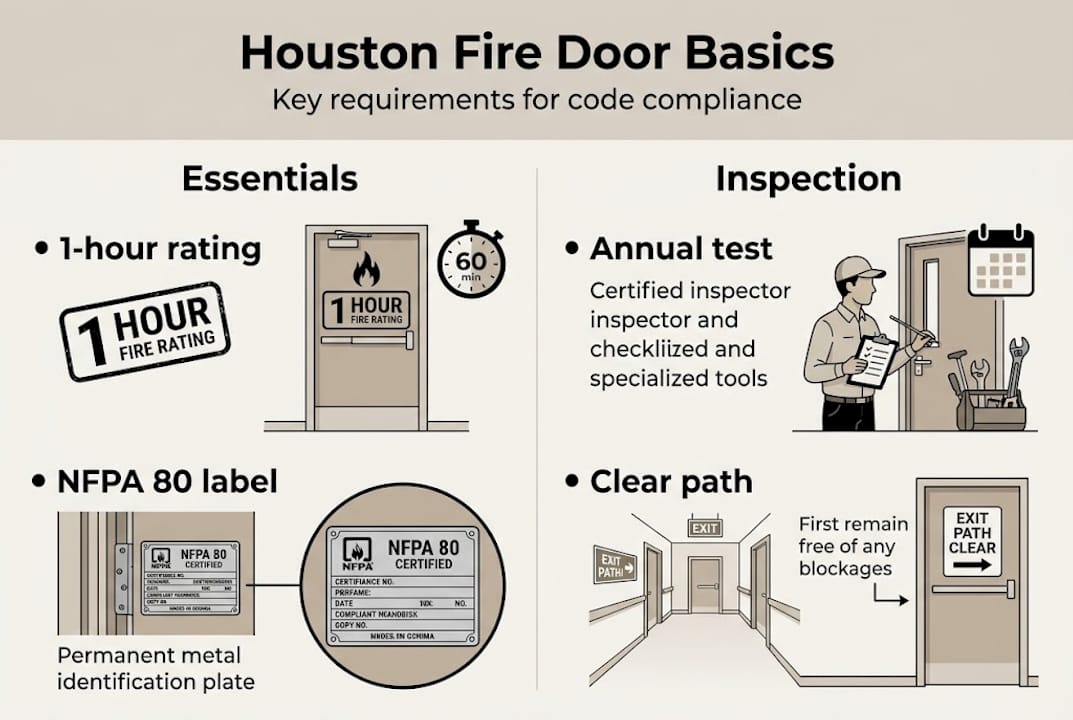
Here is a breakdown of the core requirements:
| Requirement | Standard | |
|---|---|---|
| Fire rating | Minimum 1-hour (higher for stairwells and high-hazard areas) | IFC / NFPA 80 |
| Hardware | Rated closers, latches, hinges, and seals | NFPA 80 |
| Signage | “Fire door, keep closed” or equivalent label | NFPA 80 |
| Inspection frequency | Annually, minimum | NFPA 80 |
| Testing documentation | Written records required on-site | IFC |
| Propping or blocking | Strictly prohibited unless magnetic hold-opens are code-compliant | IFC |
Inspectors typically check whether doors close and latch fully without manual assistance, whether intumescent seals (strips that expand in heat to block smoke) are intact, and whether all hardware is original rated components. They also review your inspection logs. Missing records alone can trigger a violation.
Common compliance pitfalls include:
- Doors propped open with wedges or furniture
- Non-rated replacement hardware installed by maintenance staff
- Missing or defaced certification labels on the door edge
- Gaps around the door frame that exceed NFPA 80 tolerances
- No written inspection records on file
Failures carry real consequences. Violations can result in fines, mandatory corrective orders, and in serious cases, partial or full occupancy suspension until deficiencies are corrected. For multi-tenant properties, that means business disruption for your tenants and potential liability.
Knowing what inspectors check during fire door testing requirements reviews gives you a clear advantage before any scheduled or surprise inspection.
Pro Tip: Keep a binder or digital folder with your most recent fire door inspection report at the property. Inspectors who see organized documentation often move through their review faster, and it demonstrates that compliance is part of your regular operations, not a last-minute scramble. Pair that with your compliance tips checklist for added confidence.
With regulatory basics in mind, let’s clarify what actually counts as a compliant fire door and how to recognize one.
Identifying compliant fire doors: Features and maintenance
The single most reliable way to identify a compliant fire door is the certification label, usually embedded or stamped into the door edge or top rail. This label shows the manufacturer, the fire rating, and the testing standard. If that label is painted over, sanded off, or missing entirely, the door fails compliance on the spot, regardless of how solid it looks.
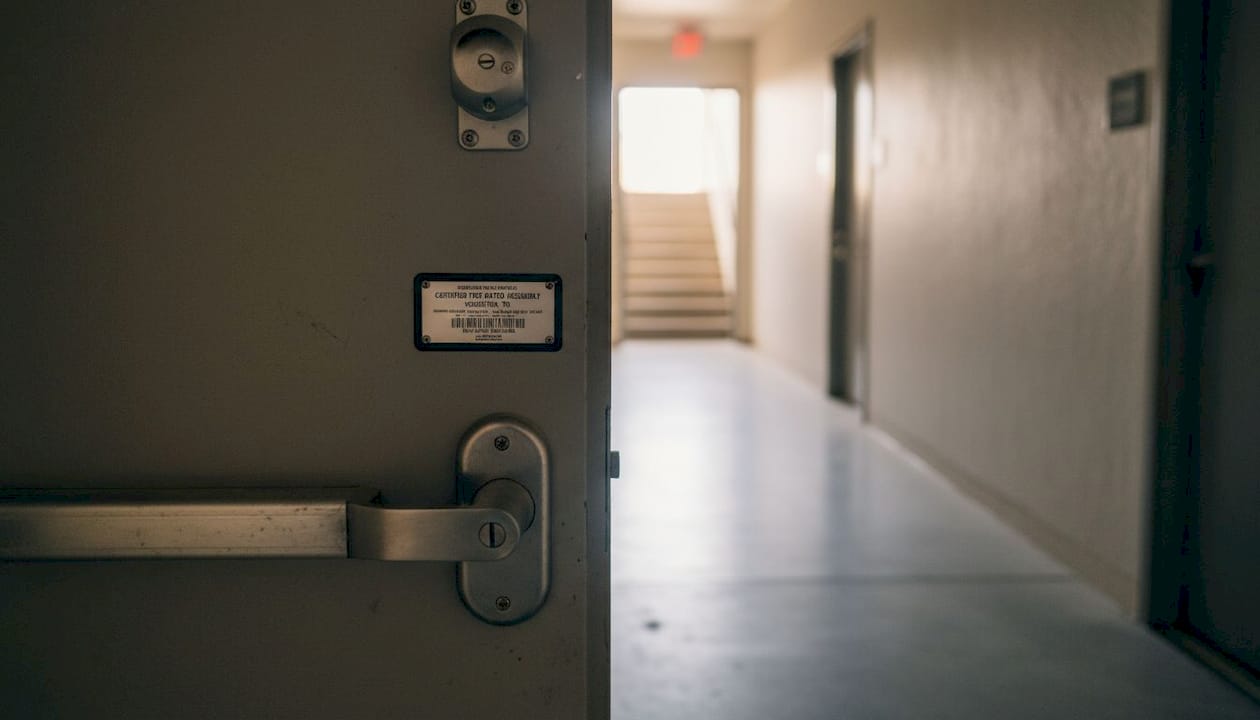
NFPA 80 details the hardware, signage, and maintenance standards adopted by Houston, and every one of those elements must be present and functional.
Compliant vs. non-compliant fire doors at a glance:
| Feature | Compliant | Non-Compliant |
|---|---|---|
| Certification label | Visible and legible on door edge | Missing, painted over, or defaced |
| Self-closing hardware | Rated closer installed and functional | Manual door, no closer, or broken closer |
| Intumescent seals | Intact around all edges | Cracked, missing, or replaced with standard weatherstripping |
| Latching | Fully latches without manual force | Does not latch, or hardware replaced with non-rated parts |
| Frame condition | No gaps exceeding 1/8 inch | Warped frame, visible daylight around edges |
| Signage | “Fire door, keep closed” posted | No signage |
Basic maintenance steps your team should perform regularly:
- Visually inspect the certification label on every fire door quarterly
- Test the self-closer by opening the door fully and releasing it, confirming it swings shut and latches
- Check intumescent seals for cracking, compression damage, or missing sections
- Verify the gap at the door bottom does not exceed 3/4 inch
- Confirm that no door is being propped open or has its closer disabled
- Document every check with date, door location, and findings
Linking these steps to your written maintenance schedule keeps you aligned with code obligations and gives you documentation to present during inspections. Use a fire prevention checklist to stay organized across your property.
A practical testing schedule built into your facility calendar prevents compliance gaps from forming between annual formal inspections.
Distinguishing and maintaining compliant fire doors is only part of the picture. Here is how they work with the larger building safety system.
Integrating fire doors with overall fire protection systems
Fire doors do not operate in isolation. They are one layer in a coordinated system that includes fire alarm panels, smoke detectors, and sprinkler networks. When these systems are properly integrated, each component reinforces the others. When they are not, gaps appear that can cost lives.
Here is a practical example: a smoke detector triggers the alarm panel, which simultaneously signals magnetic hold-open devices on fire corridor doors to release. Those doors swing shut automatically, sealing the corridor and slowing smoke migration while sprinklers activate in the affected zone. If the magnetic hold-opens are disconnected, or the alarm panel is not wired to release them, the doors stay open and the system fails at the first link in the chain.
Houston’s fire safety enforcement ties fire doors to building occupancy and system integration as part of coordinated code compliance. Inspectors increasingly look at whether fire door performance connects logically to alarm and suppression systems, not just whether each element passes its own standalone test.
Actions your team should take to ensure system interoperability:
- Confirm that all magnetic hold-open devices are wired to the building alarm panel
- Include fire door operation in every fire alarm test to verify release function
- Walk the evacuation routes as a team after any system service or upgrade
- Verify that sprinkler heads near fire door openings are not obstructed
- Store wiring schematics and integration documentation with your inspection records
- Notify your fire protection contractor before making any changes to alarm or sprinkler systems near fire door locations
Pro Tip: Schedule a joint walkthrough with your fire protection contractor and your facilities team at least once a year, separate from the formal annual inspection. This is where subtle integration failures, like a closer replaced without notifying the alarm integrator, get caught before they become code violations.
Reviewing fire protection best practices for Houston properties gives your team a stronger framework for these walkthroughs.
The hidden truth: What most property owners miss about fire doors
Here is something the standard compliance checklist will never tell you: passing an inspection does not mean your building is safe. It means your building met the minimum requirements on one specific day. That is a meaningful but limited achievement.
We see properties with fully documented, recently inspected fire doors that have a closer disabled the following week because a tenant found the door inconvenient. The door still has its label. It still has its seals. But it will stand open in a fire. Compliance on paper does not equal safety in practice.
The real gap is cultural, not technical. When your staff understands why a fire door must always close, they stop propping them open. When your tenants understand what those doors protect, they stop treating them like nuisances. That mindset shift is worth more than any single inspection.
Following government fire safety tips for property managers reinforces this culture between formal inspection cycles. The return on investment is not just avoiding fines. It is protecting the people inside your building and the asset you are responsible for.
Take the next step: Fire door compliance and protection solutions
You now have a clear picture of what fire doors do, what Houston codes require, and what genuine compliance looks like day to day. Putting that knowledge into action is where Reliable Fire Protection comes in.
We work with Houston property owners and facility managers on every aspect of fire code compliance, from fire door assessments to alarm systems and full suppression solutions. Explore our fire safety products and services to see how we support buildings like yours. Whether you need guidance on sprinkler system inspection scheduling or want to understand how fire alarm systems work alongside your fire doors, our team is ready to help you build a complete, integrated safety program.
Frequently asked questions
What is the minimum fire rating required for commercial fire doors in Houston?
Generally, commercial fire doors must have at least a 1-hour fire rating, though local code and occupancy type can require higher ratings. Fire door ratings reference NFPA 80 as adopted in Houston codes.
Who is responsible for fire door inspection and maintenance in Houston properties?
Property owners or their designated facility managers are responsible for regular fire door inspection and maintenance. Local codes require property managers to ensure compliance with NFPA 80 fire door maintenance standards.
How often must fire doors be inspected for compliance in Houston?
Fire doors must be inspected at least annually, or more frequently if specified by occupancy type or after any significant use event. NFPA 80 adopted by Houston dictates this annual minimum requirement.
Can a regular door be retrofitted to serve as a fire door?
No. Only doors specifically tested, rated, and labeled as fire doors with all required hardware and proper installation may satisfy fire code requirements. Houston enforces NFPA 80 requirements for properly rated and labeled assemblies, and no retrofit of a standard door qualifies.
Recommended
- Fire Safety Equipment Explained: Houston Compliance Impact
- Fire Safety Regulations Explained: Impact on Houston Property Managers
- Top fire prevention tips for Houston property owners
- Fire Safety Regulations 2025: Essential Changes for Houston Properties
- Fire Alarm System University Place TX
- Fire Alarm System Services in Bellaire, TX