
TL;DR:
- Kitchen fires involving oils require specialized wet chemical suppression systems to prevent reflash and contain damage. Regular maintenance, staff training, and proper system installation are essential for effective fire protection in commercial kitchens. Standard sprinklers are inadequate and can worsen grease fires, making tailored solutions like UL 300 systems vital for safety.
If you run a restaurant or work in a commercial kitchen, fire suppression for kitchens explained properly could be the difference between a contained incident and a total loss. Most operators assume a standard sprinkler system covers them. It does not. Kitchen fires behave differently from every other type of fire, and the wrong suppression system can make things dramatically worse. This article walks you through exactly how commercial kitchen fire suppression works, what types of systems exist, and what your team needs to do to stay protected.
Table of Contents
- Key takeaways
- Fire suppression for kitchens explained: why grease fires are different
- How kitchen suppression systems actually work
- Comparing types of kitchen fire suppression
- Practical fire safety for kitchen staff and owners
- What I have learned working with commercial kitchen systems
- How Reliable Fire Protection can help protect your kitchen
- FAQ
Key takeaways
| Point | Details |
|---|---|
| Grease fires need specialty systems | Standard sprinklers accelerate grease fires; only wet chemical systems meet code for commercial kitchens. |
| Saponification stops reflash | Wet chemical agents convert burning grease into foam, cooling oil and sealing it from oxygen within seconds. |
| Gas shutoff integration is critical | Suppression systems must automatically cut gas supply to prevent reignition during and after a fire. |
| Maintenance prevents failure | Poor upkeep and untrained staff are leading causes of fire spread, even when systems are installed. |
| Water mist reduces equipment damage | Water mist systems use up to 90% less water than traditional sprinklers, protecting expensive kitchen equipment. |
Fire suppression for kitchens explained: why grease fires are different
Not all fires are equal, and commercial kitchens prove it. The majority of fires in restaurant kitchens are Class K fires, which means they involve cooking oils and fats at extremely high temperatures. These are fundamentally different from the Class A fires (paper, wood) or Class B fires (flammable liquids) that most standard fire protection tools are built to handle.
Here is what makes kitchen fires so dangerous:
- Cooking oils reach auto-ignition temperatures between 600°F and 700°F without any open flame present
- The fuel source, rendered animal fats or vegetable oils, remains liquid and mobile, meaning fire spreads across surfaces rapidly
- When water contacts superheated grease, it instantly vaporizes and causes a violent steam explosion that sprays burning oil outward
- Grease accumulation in exhaust hoods and ductwork creates secondary ignition paths that standard systems cannot reach
The chemistry behind a grease fire matters here. Fire requires four elements to sustain itself: fuel, heat, oxygen, and a chemical chain reaction. Standard suppression approaches address one or two of these. Class K fires need all four disrupted simultaneously to prevent reflash, which is when a seemingly extinguished fire reignites because the oil is still hot enough to combust on its own.
Fire safety experts consistently emphasize that wet chemical systems are required over traditional dry chemical or sprinkler systems precisely because of this chemical complexity. Knowing your fire class is not optional knowledge for kitchen staff. It is foundational.
“Water on a grease fire is not a solution. It’s an accelerant. The physics of steam expansion turn a contained grease fire into a flaming eruption in under a second.”
How kitchen suppression systems actually work
Understanding the mechanics of these systems removes the mystery and helps you trust them, or identify when something is wrong. Modern automated kitchen fire systems follow a precise activation sequence every time.
Step 1: Detection. Advanced kitchen suppression systems use dual-sensor heat detection that analyzes both absolute temperature and the rate of temperature increase over time. This is important because it minimizes false alarms from normal cooking activity while still catching a real fire within seconds of ignition.
Step 2: Agent release. Once triggered, the system deploys a potassium-based wet chemical solution through nozzles positioned directly above cooking equipment and inside exhaust hoods. The solution hits burning grease and triggers saponification.
Step 3: Saponification. This is the chemical core of the whole system. Saponification converts burning grease into a soap-like foam that smothers the fire, physically seals the oil surface from oxygen, and cools the fuel below its auto-ignition point. Systems meeting NFPA 17A and UL 300 standards accomplish this within 2 to 5 seconds of agent contact.
Step 4: Gas shutoff. Simultaneously, the suppression system automatically cuts gas supply to all cooking equipment. Eliminating the fuel source during suppression is what prevents reignition from a pilot light or burner that is still active. This integration is non-negotiable in a properly designed kitchen fire safety system.
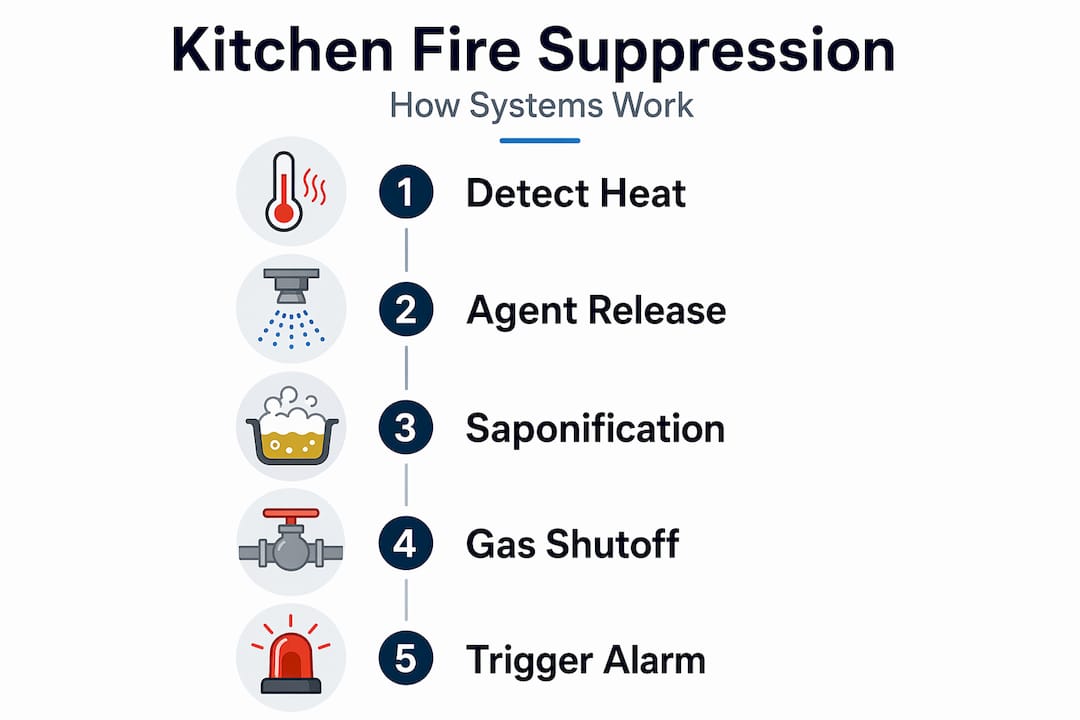
Step 5: Alarm and monitoring. The system triggers local alarms and, in setups with 24/7 monitoring, alerts the monitoring center simultaneously. Suppression systems discharge in seconds and include options for continuous monitoring to notify emergency services without relying on staff to make that call.
Pro Tip: After any system discharge, do not attempt to restart cooking equipment before a certified technician inspects and resets both the suppression system and the gas shutoff. Premature restart is a leading cause of secondary kitchen fires.
Comparing types of kitchen fire suppression
Not every commercial kitchen needs the same solution. Here is how the main fire suppression methods for kitchens compare:
| System type | How it works | Best for | Key advantage | Key limitation |
|---|---|---|---|---|
| Wet chemical (UL 300) | Potassium solution + saponification | All commercial kitchens with cooking equipment | Meets code, stops reflash, fast acting | Requires professional recharge after use |
| Water mist | Ultra-fine water droplets cool and displace oxygen | Sensitive equipment areas, hybrid kitchens | Up to 90% less water than sprinklers, minimal damage | Higher installation cost |
| Traditional sprinklers | High-volume water discharge | General building areas only | Widely available, low cost | Dangerous on grease fires, not code-compliant for kitchens |
| Clean agent (CO2/Inert gas) | Displaces oxygen | Enclosed equipment or server areas adjacent to kitchens | No residue, protects electronics | Not effective on open cooking surface fires |
The UL 300 standard exists specifically because dry chemical systems, which were once common in kitchens, proved inadequate for modern high-output cooking equipment. Standard sprinklers are not just ineffective for grease fires. They actively worsen them by spreading burning oil across the kitchen floor and into other surfaces.
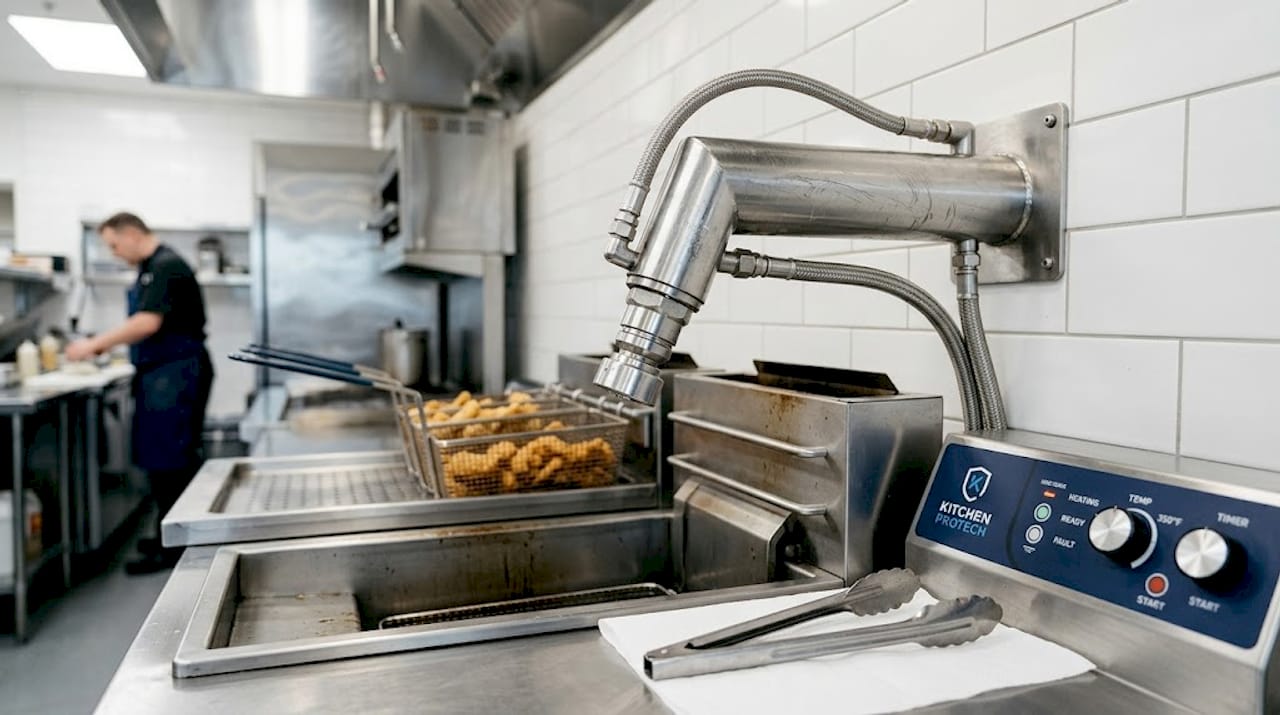
Water mist systems are worth a closer look if your kitchen uses expensive equipment. Water mist systems reduce equipment damage significantly compared to traditional sprinklers because the ultra-fine droplets absorb heat and displace oxygen without soaking every surface and piece of equipment in the room. For kitchens with high-cost ventilation systems or refrigeration units nearby, this is a real financial consideration.
Pro Tip: If you are upgrading or installing a new system, verify that nozzle placement covers 100% of your cooking surface area and the full interior of exhaust hoods. Partial coverage is a common installation error that leaves blind spots for fire to exploit.
Additional considerations for choosing your system type:
- Menu complexity matters: high-volume fry operations need higher agent output ratings
- Ventilation design affects nozzle placement and agent dispersal efficiency
- Local codes and insurance requirements may mandate specific system certifications beyond UL 300
- Kitchen layout changes require suppression system re-evaluation and possible nozzle repositioning
Practical fire safety for kitchen staff and owners
The best fire suppression system in the world can fail if the people around it are not prepared. Lack of maintenance and staff training are documented contributors to fire incidents in commercial kitchens, including cases where the system was present but failed to contain the fire due to poor upkeep.
Here is what kitchen fire prevention actually requires in practice:
- Monthly visual inspections: Check that nozzle caps are intact, agent canisters show proper pressure, and detection links are free of grease buildup. Grease-coated sensors are a primary reason systems fail to activate.
- Semi-annual professional inspection: A licensed technician should inspect all components, test the gas shutoff valve integration, and verify that the system still covers your current equipment layout. Equipment moves, systems do not update themselves.
- Hood and duct cleaning: Grease accumulation in exhaust ductwork is one of the most common paths for fire to spread beyond the suppression system’s coverage zone. Maintain a strict cleaning schedule based on your cooking volume.
- Staff training on manual pull stations: Every kitchen employee should know where the manual pull station is located and how to activate it without hesitation. Seconds matter in a grease fire.
- Evacuation protocols: Know the plan before you need it. Who calls 911? Who sweeps the dining room? These questions should have written answers posted in the kitchen.
Post-fire investigations consistently show that routine maintenance and trained staff responses are what separate contained incidents from restaurant-ending fires. Review your kitchen fire prevention steps with your team at least quarterly.
Pro Tip: Keep a written maintenance log for your suppression system on-site. Insurance carriers and fire marshals may request documentation of inspection history, especially after an incident.
What I have learned working with commercial kitchen systems
I will be direct with you: the most dangerous kitchens I have seen are not the ones without suppression systems. They are the ones where the system is installed but nobody on staff knows how it works or when it was last serviced.
There is a false sense of security that comes with having a system. Restaurant owners see the nozzles above the fryers and assume they are covered. What they often do not realize is that a grease-coated detection link will not activate at the right temperature, or that a suppression system designed for their original four-burner setup was never updated after they added a charbroiler last year.
Older kitchens face real challenges when it comes to retrofitting modern suppression systems. Building constraints, original ductwork design, and code compliance can turn what looks like a straightforward upgrade into a complex engineering project. I have seen operators skip this work because of cost, only to pay multiples of that cost after an incident.
My honest take is this: the suppression system is your last line of defense. Commercial kitchen fire prevention is a layered approach, and the system only activates when every other layer has already failed. Treat your fire system maintenance schedule with the same discipline you give your food safety protocols. Both protect lives.
— Reliable-fire-protection
How Reliable Fire Protection can help protect your kitchen
If this article raised questions about whether your current kitchen fire suppression system is up to the job, that is a question worth answering before an incident answers it for you.
Reliable Fire Protection serves Houston restaurants and commercial kitchens with certified installation, inspection, and maintenance of wet chemical suppression systems, fire alarm integration, and full compliance documentation. Whether you are opening a new location, upgrading aging equipment, or just overdue for an inspection, the team at Reliable Fire Protection provides solutions built for real kitchen environments, not generic commercial spaces. Explore kitchen suppression solutions for Houston businesses, or get a detailed breakdown of fire extinguisher options that complement your suppression system and keep your team ready for anything.
FAQ
What makes kitchen fires different from other fires?
Kitchen grease fires are Class K fires that burn at extremely high temperatures and reflash easily. Water-based systems spread burning oil rather than extinguish it, requiring specialized wet chemical suppression agents.
What is saponification and why does it matter for kitchens?
Saponification is the chemical reaction where wet chemical agents convert burning grease into a soap-like foam that smothers the fire, cools the oil, and seals it from oxygen to prevent reignition.
How often should a kitchen fire suppression system be inspected?
Most codes and manufacturers require a professional inspection every six months, along with monthly visual checks by kitchen staff to verify pressure, sensor condition, and nozzle integrity.
Can a standard sprinkler system protect a commercial kitchen?
No. Standard sprinklers discharge water that causes violent steam explosions on superheated grease. UL 300 standards specifically require wet chemical systems for commercial cooking equipment areas.
What should staff do immediately after a suppression system activates?
Evacuate the kitchen, do not restart any cooking equipment or gas lines, and wait for a certified technician to inspect and reset the system before resuming operations.
Recommended
- Fire Suppression Systems Workflow for Safe Properties
- Fire Suppression Agents: Protecting Houston Properties
- Fire extinguisher types for restaurants: expert guide 2026
- Fire Suppression System Setup Guide: Complete Installation Steps
- Fire Alarm System University Place TX
- Fire Alarm System Services in Bellaire, TX