
TL;DR:
- Customized fire protection strategies in hospitality address the unique risks of mixed-use, high-occupancy buildings, requiring tailored detection, suppression, and compartmentation systems. These innovations help prevent costly damage, ensure safety, and support operational continuity despite frequent renovations and complex environments. Proper ongoing management and regular inspections are essential for maintaining effective fire safety and safeguarding brand reputation.
Customized fire protection in hospitality is the targeted application of fire safety technologies and strategies specifically designed to meet the unique challenges of hotels, resorts, and similar venues. Generic, one-size-fits-all systems fail this industry because no other commercial sector combines sleeping quarters, commercial kitchens, event ballrooms, retail spaces, and continuous 24/7 occupancy under one roof. The stakes are high: a fire emergency in a hotel does not just threaten lives, it can permanently damage a brand and shut down operations for months. Understanding why hospitality needs customized fire protection starts with recognizing that the building itself is the hazard profile, and the protection strategy must match it precisely.
Why are fire risks in hospitality uniquely severe?
Hotels and resorts carry a fire risk profile that generic commercial systems are not built to handle. High occupancy density, transient guest populations unfamiliar with evacuation routes, and mixed-use spaces create a compounding set of hazards that demand a purpose-built response.
Non-residential building fires caused 1,025 injuries and 115 deaths in 2021 alone, according to the US Fire Administration. That figure represents the broader commercial sector, and hospitality properties sit at the high-risk end of that spectrum due to their complexity.
The specific risk factors that separate hospitality from standard commercial buildings include:
- Transient occupants who do not know the building layout and cannot self-evacuate reliably
- Commercial kitchens operating with open flames, grease, and high-heat equipment around the clock
- Laundry facilities with lint accumulation and dryer heat creating ignition risks
- Event and assembly spaces that shift from low to maximum occupancy within hours
- Continuous renovation cycles that temporarily compromise fire barriers and detection coverage
“Hospitality buildings are integrated ecosystems combining sleeping, assembly, and kitchen spaces, requiring customized protection strategies that generic systems fail to address.”
Beyond the physical risks, a fire event carries severe business consequences. Revenue loss during closure, insurance claims, and reputational damage can outlast the physical repairs by years. Fire risk management in hospitality is therefore both a life-safety obligation and a core business continuity strategy.
How does customization improve fire detection and alarm effectiveness in hotels?
A standard commercial fire alarm panel treats every zone identically. In a hotel, that approach creates two serious problems: false alarms that disrupt guests and erode trust in the system, and delayed or missed detection in zones with unusual environmental conditions like steam-heavy spa areas or cold-storage rooms.
Customized fire alarm systems for hotels use addressable panels that identify the exact device triggering an alert, not just a zone. This precision allows staff to verify and respond before a full evacuation is initiated, which matters enormously in a 300-room property at 2 a.m. Multi-sensor detectors that combine heat, smoke, and carbon monoxide readings reduce false activations in kitchens and laundry areas without sacrificing sensitivity elsewhere.
Staged evacuation strategies integrate fire alarms with elevators, smoke control systems, and mass notification to safely manage transient and vulnerable guests. In a defend-in-place protocol, guests on unaffected floors receive a shelter-in-place instruction while the affected floor evacuates. This approach prevents stairwell congestion and reduces panic-driven injuries.
Additional customization features that directly improve hotel alarm performance include:
- Low-frequency alarms (520 Hz) for guests with hearing impairments, now required under updated accessibility codes
- Voice evacuation messaging in multiple languages for international properties
- Coordinated elevator recall that automatically returns cars to the ground floor on alarm activation
- 3D-modeled concealed sprinkler heads that preserve interior design while maintaining full coverage
Pro Tip: Work with your fire protection engineer to map alarm zones against your property’s operational schedule. A kitchen zone during breakfast service needs different sensitivity thresholds than the same zone at midnight.
Reducing false alarms is not just a guest comfort issue. Properties with frequent false activations see staff begin to treat alarms as routine, which is the single most dangerous behavioral outcome in fire safety. Customization directly addresses this by calibrating detection to actual environmental conditions in each space.
What suppression solutions are essential for hotel kitchens and high-risk areas?
Commercial kitchens represent the highest single-point fire risk in any hotel. Grease accumulation on cooking surfaces, hoods, and ductwork creates a fuel source that standard water-based sprinklers cannot safely suppress. Water applied to a grease fire causes violent splatter and can spread flames rather than extinguish them.

Automatic kitchen suppression systems like ANSUL detect and suppress grease fires rapidly, minimizing damage and operational downtime. These systems use wet chemical agents that react with cooking oils to form a soapy foam layer, cutting off oxygen and cooling the fuel simultaneously. The suppression activates in seconds, well before a sprinkler head would reach its activation temperature.
For a hotel executive planning a suppression strategy, the priority sequence for high-risk areas looks like this:
- Commercial kitchen hoods and cooking surfaces with wet chemical ANSUL-type systems tied to automatic gas shutoff
- Laundry facilities with standard sprinkler coverage supplemented by lint management protocols
- Electrical and mechanical plant rooms with clean agent or CO2 suppression to protect equipment without water damage
- Spa and pool plant areas where chemical storage creates secondary ignition risks
The integration of suppression with shutoff controls is a detail that separates a well-designed system from a compliant-but-inadequate one. When a kitchen suppression system activates, it should simultaneously cut gas supply to all cooking equipment. Without that integration, re-ignition is a real risk even after the initial fire is knocked down.
Pro Tip: Schedule ANSUL system inspections every six months, not just annually. Kitchen environments accumulate grease in suppression nozzles faster than any other commercial setting, and a clogged nozzle will not activate correctly under fire conditions.
The advantages of suppression systems extend beyond life safety. A kitchen that recovers from a contained suppression event in two hours loses far less revenue than one that sustains structural fire damage requiring weeks of closure.
Why is fire compartmentation critical in hospitality properties?
Fire compartmentation is the practice of dividing a building into discrete fire-resistant zones using rated walls, floors, fire doors, and sealed penetrations. Its purpose is to contain fire and smoke to the area of origin long enough for evacuation and suppression to occur. In a hotel, effective compartmentation can mean the difference between a contained room fire and a floor-wide evacuation.
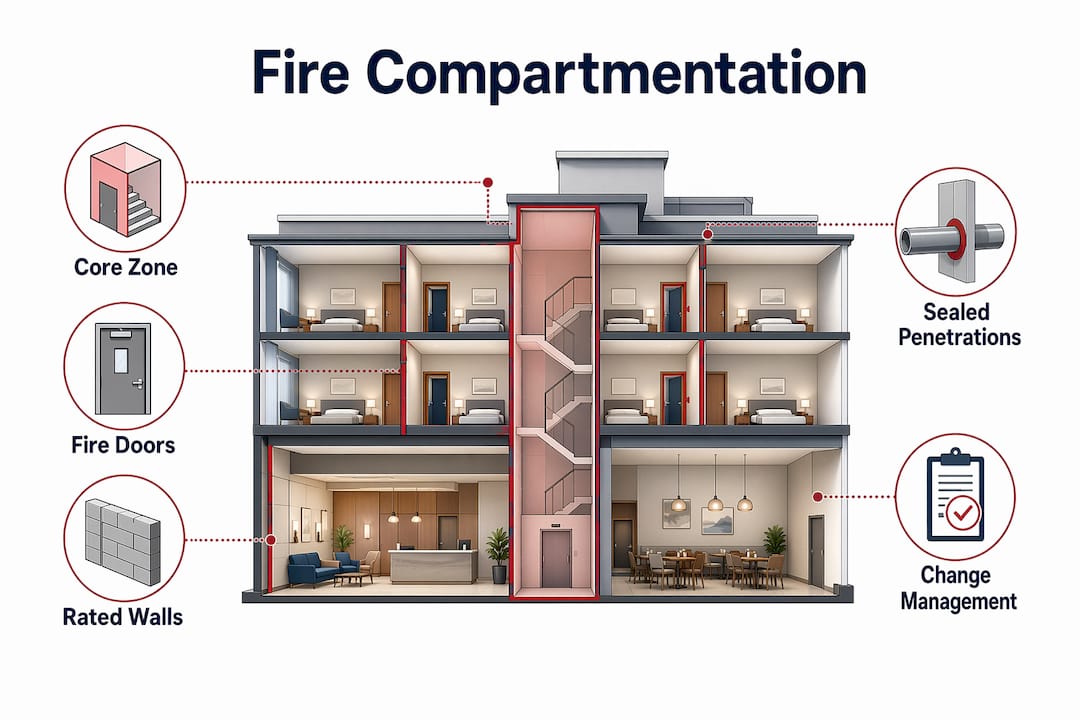
Passive fire protection including fire doors, compartmentation, and sealed penetrations is frequently compromised during renovations, creating hidden risks detectable only through specialized audits. This is the most underestimated risk in hotel fire safety. A contractor running new cabling through a fire-rated wall who fails to seal the penetration with intumescent material has created a gap that will not show up on any inspection unless someone specifically looks for it.
| Passive protection element | Common failure point |
|---|---|
| Fire doors | Propped open, damaged seals, or missing self-closers |
| Wall penetrations | Unsealed cable and pipe runs from renovation work |
| Floor/ceiling assemblies | Compromised by HVAC modifications |
| Smoke seals | Degraded gaskets on older door frames |
Maintaining compartmentation during active hotel operations requires a formal change management process. Every trade contractor working in the building must operate under a permit system that includes fire barrier restoration as a mandatory close-out step.
Maintaining fire system continuity during frequent renovations requires standardized, centralized management programs to prevent compromise on compartmentalization or code compliance. Passive and active systems work together. A sprinkler system buys time, but compartmentation determines how much time there is to use.
How to implement and manage customized fire protection long-term
Implementing a tailored fire protection strategy is not a single project. It is an ongoing operational commitment that requires structured planning, qualified partners, and regular verification.
- Conduct a property-specific risk assessment that maps every functional space, occupancy type, and operational schedule. A risk assessment for a 200-room full-service hotel will identify different priorities than one for a boutique property with a rooftop bar.
- Align your fire protection strategy with brand standards and local code requirements. Major hotel brands like Marriott and Hilton publish fire protection standards that exceed minimum code in many jurisdictions. Compliance with both is non-negotiable.
- Engage a licensed fire protection engineer at the design stage, not after construction documents are finalized. Fire alarm upgrades in hospitality must be treated as strategic long-term capital investments rather than reactive fixes.
- Plan phased upgrades that maintain system integrity during renovation. Never take a detection zone offline without a documented compensatory measure in place, such as increased patrols or temporary detection devices.
- Train staff quarterly, not annually. Front desk staff, housekeeping, and security personnel are the first responders in most hotel fire scenarios. Their ability to execute the emergency plan correctly determines outcomes before the fire department arrives.
Pro Tip: Build your fire protection maintenance schedule into your property management system as recurring work orders. Systems that rely on manual scheduling get deferred during busy periods. Automation removes that risk.
Fire alarm benefits in hospitality compound over time when systems are properly maintained and updated. A well-documented maintenance history also reduces insurance premiums and simplifies compliance audits.
Key takeaways
Customized fire protection outperforms generic systems in hospitality because the industry’s mixed-use spaces, transient occupants, and continuous operations create hazards that standard commercial solutions are not designed to address.
| Point | Details |
|---|---|
| Hospitality fire risks are compounded | Mixed-use spaces, transient guests, and 24/7 operations create layered hazards that generic systems miss. |
| Addressable alarms reduce false activations | Zone-specific detection calibrated to each space cuts false alarms and preserves staff response discipline. |
| Kitchen suppression is non-negotiable | ANSUL-type wet chemical systems are the only reliable solution for grease fire suppression in commercial kitchens. |
| Compartmentation degrades silently | Renovation work routinely compromises fire barriers; only proactive audits catch these hidden risks. |
| Upgrades are capital investments | Treating fire alarm and suppression upgrades as long-term investments protects guest trust and operational continuity. |
What I’ve learned from working on hospitality fire protection projects
The most consistent mistake I see in hotel fire protection is the assumption that passing a code inspection means the system is performing well. Code compliance sets a floor, not a ceiling. A system can be fully compliant and still be poorly suited to the actual operational patterns of the property.
The second mistake is treating fire protection as a facilities department issue rather than an executive one. When a general manager is not personally invested in the fire safety program, maintenance gets deferred, staff training gets skipped, and the system quietly degrades. The properties that handle fire emergencies well are the ones where leadership treats the fire protection program the same way they treat revenue management: with regular review, clear accountability, and real budget commitment.
Early collaboration between fire protection engineers and architects produces systems that are both effective and invisible. Concealed sprinkler heads coordinated through 3D modeling preserve interior design without compromising safety. That kind of integration only happens when fire protection is part of the design conversation from day one, not a retrofit problem solved after the ceiling tiles are in.
The payoff is real. Properties with well-designed, properly maintained customized systems recover from fire incidents faster, retain guest loyalty more effectively, and carry lower long-term insurance costs. That is not a theoretical benefit. It is a measurable return on a safety investment.
— Reliable-fire-protection
How Reliable-fire-protection can protect your property
Reliable fire protection designs and installs customized fire alarm systems built specifically for the demands of hotels, resorts, and hospitality venues across Houston and surrounding areas. From addressable alarm panels and kitchen suppression systems to sprinkler installation and passive fire protection audits, every solution is engineered to match your property’s specific risk profile and compliance requirements. Reliable-fire-protection’s certified technicians also provide ongoing inspection, maintenance, and upgrade planning to keep your systems performing at full capacity through renovations and operational changes. If you want to understand how your current fire alarm system works and where it may fall short, start with a free consultation from the Reliable-fire-protection team.
FAQ
What makes fire protection in hotels different from standard commercial buildings?
Hotels combine sleeping areas, commercial kitchens, assembly spaces, and continuous 24/7 occupancy in a single structure. This mixed-use profile requires customized detection, suppression, and evacuation strategies that standard commercial systems are not designed to provide.
Why do hotels need specialized kitchen fire suppression systems?
Water-based sprinklers cannot safely suppress grease fires because water causes violent splatter and can spread flames. Automatic wet chemical systems like ANSUL suppress grease fires in seconds by forming a foam layer that cuts off oxygen and cools the fuel simultaneously.
How often should hotel fire protection systems be inspected?
Fire alarm and sprinkler systems require annual inspection at minimum under NFPA standards, but kitchen suppression systems in active commercial kitchens should be inspected every six months due to grease accumulation in suppression nozzles.
What is fire compartmentation and why does it matter during renovations?
Fire compartmentation divides a building into fire-resistant zones using rated walls, fire doors, and sealed penetrations to contain fire and smoke. Renovation work routinely compromises these barriers through unsealed cable runs and damaged fire doors, creating hidden risks that require proactive audits to detect.
Are fire alarm upgrades worth the capital investment for hospitality properties?
Fire alarm upgrades in hospitality are long-term capital investments that protect guest trust, reduce insurance costs, and maintain operational continuity. Properties with well-maintained, customized systems recover from fire incidents faster and face fewer compliance liabilities than those running outdated generic equipment.