
TL;DR:
- Fire safety liability is the legal obligation to identify, manage, and document fire risks in controlled properties. Failure to comply can lead to severe fines, criminal charges, and civil claims, regardless of fire occurrence. Proper documentation, contractor accreditation, and proactive risk management are essential to mitigate these risks and ensure legal protection.
Fire safety liability is the legal obligation to prevent, manage, and document fire risks in any property you own, manage, or occupy. Business owners, property managers, and compliance officers who fail this duty face unlimited fines and custodial sentences for directors, along with civil claims that can permanently damage a company’s finances and reputation. Understanding fire safety liability is not optional. It is the foundation of every decision you make about fire systems, contractor selection, and documentation.
What is fire safety liability and who does it apply to?
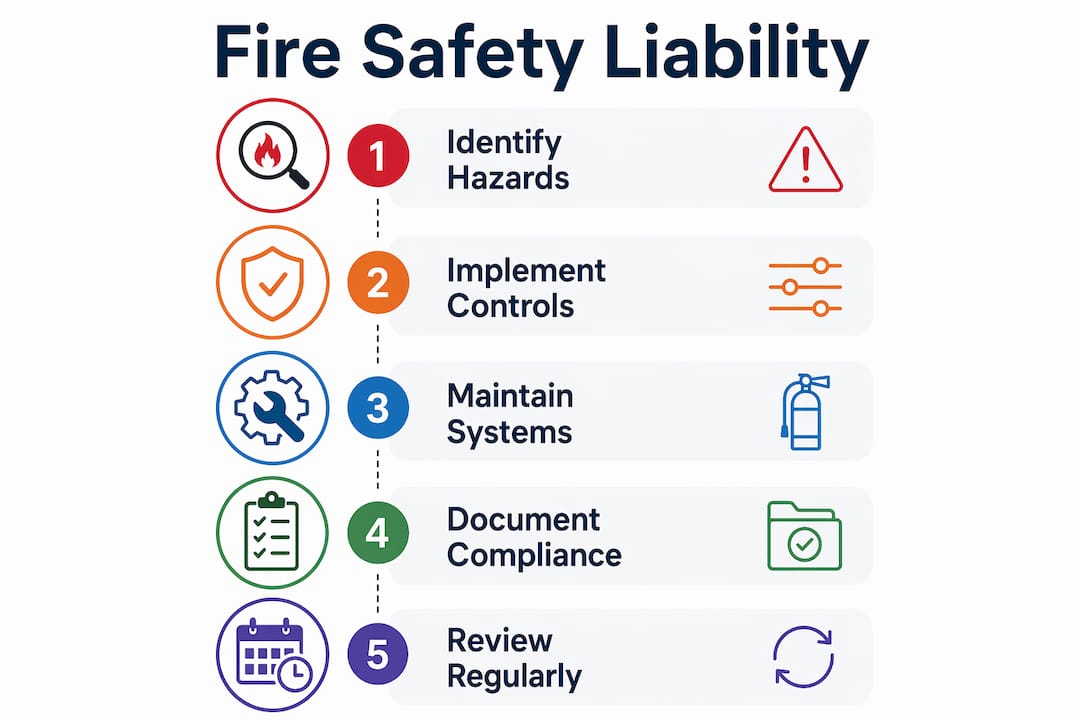
Fire safety liability is the legally enforceable responsibility to identify fire hazards, implement controls, maintain safety systems, and protect everyone who enters your property. This obligation applies to business owners, property managers, landlords, tenants, and contractors. The law does not distinguish between large corporations and small businesses. If you control a premises, you carry liability in fire safety.
The concept is closely tied to the formal legal term “duty of care,” which courts use to determine whether a party took reasonable steps to prevent foreseeable harm. When a fire causes injury or property damage, investigators examine whether the responsible party fulfilled that duty. Failing to do so triggers both criminal prosecution and civil claims.
Fire safety liability is not a single law. It draws from building codes, fire safety regulations, lease agreements, insurance contracts, and health and safety statutes. Each source creates a separate layer of obligation, and a breach of any one of them can expose you to legal action.
Who is responsible for fire safety in commercial and residential properties?
Responsibility for fire safety is assigned to a defined legal role called the “Responsible Person.” Under fire safety law, including the Building Safety Act 2022, the Responsible Person is typically the employer, the owner, or the person who has control of the premises. In multi-occupancy buildings, this role can be shared, but it cannot be eliminated.
The Responsible Person carries the following core duties:
- Conduct and regularly review a written fire risk assessment
- Implement and maintain fire detection, alarm, and suppression systems
- Train staff and communicate evacuation procedures
- Appoint competent persons to assist with compliance
- Coordinate with other duty holders in shared or multi-occupancy buildings
The Building Safety Act 2022 also introduces the role of the “Accountable Person” for higher-risk residential buildings, adding another layer of accountability above the Responsible Person. In practice, this means a parent company or building owner can be held liable even when day-to-day management is delegated to a property manager.
Contractors present a common misconception. Many property managers assume that hiring a certified fire safety contractor transfers their legal exposure. It does not. Liability cannot be delegated; the Responsible Person remains accountable for any failures, even when a third party performs the work. Selecting accredited professionals and maintaining post-handover documentation are what demonstrate due diligence in court.

Pro Tip: Keep a contractor engagement log that records the name, accreditation number, scope of work, and sign-off date for every fire safety contractor you hire. This single document has resolved liability disputes that would otherwise have cost property managers six figures.
Civil claims in fire safety frequently target multiple parties simultaneously, including property owners, contractors, tenants, and equipment manufacturers. A coordinated defense strategy among all responsible parties is not a luxury. It is a legal necessity.
What legal obligations create fire safety liability?
Fire safety legal obligations fall into four categories: assessment, installation, maintenance, and documentation. A failure in any category creates direct legal exposure.
- Fire risk assessments. Every business must conduct a written fire risk assessment and review it whenever significant changes occur. The Building Safety Act 2022 removed the five-employee threshold, making thorough recording mandatory for all businesses regardless of size. This means a sole trader running a small commercial unit carries the same documentation obligation as a national retailer.
- System installation and standards. Fire detection, alarm, and suppression systems must meet applicable codes such as NFPA 72 for fire alarms and NFPA 13 for sprinkler systems in the United States. Non-compliant installations create immediate liability exposure even before any incident occurs.
- Maintenance and inspection. Failure to maintain fire safety equipment increases civil liability risks and can lead to criminal charges in cases of willful negligence. Annual testing, monthly inspections, and prompt repairs are not best practices. They are legal requirements.
- Documentation and record-keeping. Authorities pursue prosecution for neglect even when no fire has occurred. Legal liability is triggered by preventable failures like ignoring risk assessments or postponing documented upgrades, not only by actual fire events.
Penalties for non-compliance are severe. Recent prosecutions have resulted in fines well into six figures, custodial sentences for directors, and corporate manslaughter charges in the most serious cases. Courts do not accept ignorance as a defense, and compliance standards override contract clauses that attempt to limit liability. Staying current with fire safety regulations in Houston and your local jurisdiction is the only reliable way to stay protected.
How does fire legal liability insurance protect against financial risk?
Fire legal liability insurance covers the financial cost of fire damage you cause to a property you rent or occupy through negligence. It is distinct from property insurance, which covers damage to property you own. Understanding this distinction is critical for any business operating in leased space.
Standard Commercial General Liability policies typically include a $100,000 limit for “damage to premises rented to you.” This means if your business accidentally starts a fire that damages your landlord’s building, your CGL policy covers up to $100,000 of that damage. That limit sounds substantial until you consider that a moderate commercial fire can easily exceed $500,000 in structural damage alone.
| Coverage type | What it covers | Common limit | Key exclusion |
|---|---|---|---|
| Fire legal liability (CGL) | Damage to rented premises from tenant negligence | $100,000 | Contents, water damage |
| Commercial property insurance | Damage to property you own | Varies | Tenant-caused fires |
| Umbrella liability | Excess coverage above CGL limits | $1M+ | Intentional acts |
| Endorsement coverage | Expanded premises damage limits | Negotiated | Lease-specific terms |
Basic fire legal liability coverage does not cover contents or water damage from firefighting efforts. It focuses solely on premises damage caused by negligence, and lease terms can further restrict what the policy will pay. A lease that assigns fire damage responsibility to the tenant regardless of fault can override standard CGL coverage entirely.
Pro Tip: Before signing any commercial lease, have your insurance broker review the fire damage liability clause. Leases that use “absolute liability” language for fire damage require a separate endorsement or a higher CGL limit. Missing this detail is one of the most expensive mistakes a business owner can make.
Common sources and scenarios of fire safety liability
Most fire safety liability claims trace back to a small set of recurring failures. Recognizing these patterns is the first step toward avoiding them.
- Deferred maintenance. Sprinkler heads that have not been tested, fire doors that no longer close properly, and extinguishers past their inspection date are the most common triggers for both regulatory action and civil claims. Regular fire system maintenance is the single most cost-effective liability control available.
- Faulty installation. A suppression system installed by an unaccredited contractor may fail during a fire and still expose the property manager to liability, even if the contractor is also sued. The Responsible Person’s duty to verify contractor credentials makes this a shared failure.
- Incomplete risk assessments. Conducting a risk assessment and then failing to act on its findings is legally equivalent to not conducting one at all. Courts treat documented but unaddressed hazards as evidence of willful neglect.
- Poor documentation. Missing inspection logs, unsigned contractor handover documents, and outdated emergency plans are the paper trail that loses liability cases. Authorities can and do prosecute based on documentation failures alone.
- Tenant-caused fires. Under most commercial leases, tenants carry fire safety responsibility for their occupied space. When a tenant’s negligence causes a fire, the property owner may still face liability if they failed to enforce lease compliance obligations or maintain common area systems.
- Unaccredited contractors. Using contractors without verifiable accreditation is a documented due diligence failure. It removes the legal defense that you took reasonable steps to comply.
Practical steps to reduce fire safety liability and ensure compliance
Reducing fire safety liability requires a structured approach, not a reactive one. The following steps reflect what courts and regulators look for when assessing whether a Responsible Person exercised genuine due diligence.
- Hire accredited contractors only. Verify credentials before any fire safety work begins. Request certificates of accreditation, proof of insurance, and references from comparable projects. Document everything in a contractor engagement log.
- Conduct and update fire risk assessments annually. A risk assessment completed three years ago and never reviewed is a liability, not a defense. Schedule annual reviews and trigger additional reviews after any significant change to the building, occupancy, or use.
- Implement annual system testing. Annual fire system testing is a legal requirement in most jurisdictions and the most direct way to demonstrate ongoing compliance. Keep signed test reports on file for a minimum of three years.
- Maintain rigorous documentation. Every inspection, repair, training session, and contractor visit should generate a dated, signed record. This audit trail is your primary legal defense in both criminal prosecution and civil claims.
- Train staff and build a fire safety culture. Fire safety is a culture of accountability, not a checklist. Staff who understand evacuation procedures, know how to use a fire extinguisher, and report hazards proactively reduce both incident frequency and liability exposure.
- Review lease terms for fire damage clauses. Understand exactly what your lease assigns to you before a fire occurs. Negotiate absolute liability clauses before signing, and confirm your insurance coverage matches the lease’s requirements.
Pro Tip: Set a calendar reminder 90 days before each lease renewal to review fire safety obligations alongside your insurance broker and fire safety contractor. Changes in occupancy or building use often trigger new compliance requirements that neither party flags automatically.
Key takeaways
Fire safety liability is a legal obligation that applies to every property controller, and documented compliance is the only reliable defense against prosecution or civil claims.
| Point | Details |
|---|---|
| Liability cannot be delegated | The Responsible Person remains legally accountable even when contractors perform fire safety work. |
| Documentation is a legal defense | Inspection logs, risk assessments, and contractor records are what courts examine first in any prosecution. |
| Insurance gaps are common | Standard CGL policies cap fire legal liability at $100,000, which rarely covers full commercial fire damage. |
| Liability starts before any fire | Ignored risk assessments and deferred maintenance trigger prosecution even without an incident. |
| Accredited contractors matter | Using unaccredited contractors removes the due diligence defense and exposes the property manager to shared liability. |
Why fire safety liability is misunderstood until it is too late
After working in fire protection for years, the pattern I see most often is this: property managers treat fire safety as a compliance event rather than an ongoing operational responsibility. They schedule the annual inspection, file the report, and consider the obligation met until next year. That mindset is exactly what prosecutors and plaintiff attorneys rely on.
The uncomfortable truth about fire safety liability is that the legal risk accumulates silently. A sprinkler head that has not been tested in 18 months does not announce itself. A risk assessment that was never updated after a building renovation sits quietly in a filing cabinet. Neither creates a visible problem until a fire occurs or an inspector arrives. By then, the liability is already established.
What I have found actually works is treating documentation as a daily operational habit rather than an annual event. The property managers who survive regulatory audits and civil claims without major financial damage are not the ones with the most sophisticated systems. They are the ones with the most complete paper trails. Courts do not reward good intentions. They reward evidence of consistent, documented action.
The other insight worth stating directly: the financial cost of proactive compliance is a fraction of the cost of a single liability claim. A thorough annual fire risk assessment from a certified assessor costs a few hundred to a few thousand dollars depending on building size. A six-figure fine, a civil settlement, or a corporate manslaughter charge costs everything. The math is not complicated.
— Reliable-fire-protection
Protect your property and reduce liability with the right fire systems
The most direct way to reduce fire safety liability is to install, maintain, and document fire protection systems that meet current regulatory standards. Reliable Fire Protection specializes in fire alarm systems, sprinkler installations, suppression systems, and fire extinguisher services for commercial and residential properties across Houston. Every installation and maintenance visit generates the signed documentation your compliance record requires. Understanding how fire alarm systems work is the first step toward choosing the right system for your building and your legal obligations. Learn how fire protection systems help businesses reduce liability and operating costs. Contact Reliable Fire Protection today for a free quote and a compliance review tailored to your property.
FAQ
What is fire safety liability in simple terms?
Fire safety liability is the legal responsibility to prevent fire hazards, maintain safety systems, and document compliance in any property you control. Failing this duty can result in fines, prosecution, and civil claims for damages.
Who is the Responsible Person for fire safety?
The Responsible Person is typically the employer, building owner, or person with control of the premises under fire safety law. In multi-occupancy buildings, this role can be shared but never eliminated, and it cannot be transferred to a contractor.
Does hiring a fire safety contractor remove my liability?
No. Hiring a contractor does not transfer legal accountability. The Responsible Person remains liable for any failures, which is why selecting accredited contractors and maintaining detailed engagement records is critical for a legal defense.
What does fire legal liability insurance cover?
Standard Commercial General Liability policies include up to $100,000 for damage to premises rented to the insured due to tenant negligence. This coverage does not extend to contents, water damage, or situations where lease terms assign absolute liability to the tenant.
Can I be prosecuted even if no fire has occurred?
Yes. Authorities pursue prosecution for neglect based on ignored risk assessments, deferred maintenance, and incomplete documentation, regardless of whether a fire has taken place. Legal liability is triggered by the failure itself, not only by its consequences.