
TL;DR:
- Fire system redundancy involves duplicating critical components, power supplies, and pathways to ensure continued operation during failures. NFPA 72 requires documented backup pathways and survivability levels, with emphasis on physical protection and integration of fire detection and sprinkler systems for layered safety. Proper maintenance, independent testing, and thorough documentation are essential to sustain reliable fire protection and meet safety standards.
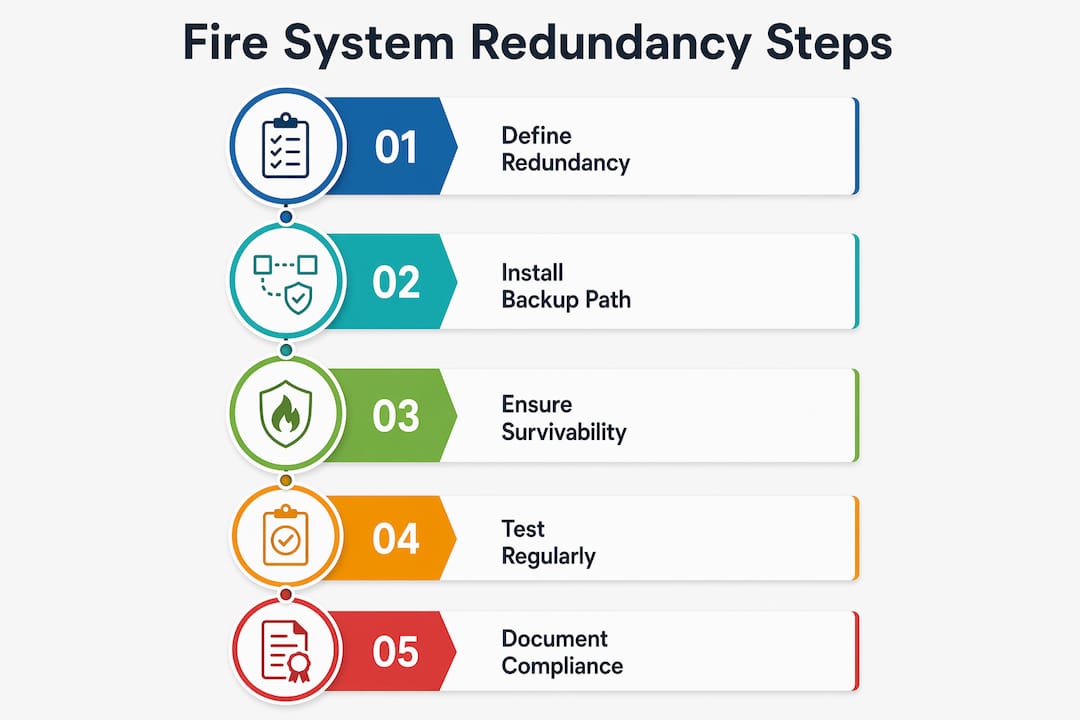
Fire system redundancy is defined as the deliberate duplication of critical components, power supplies, and communication pathways so a fire protection system keeps working even when one part fails. For facilities managers, safety officers, and property owners, this concept is not optional. NFPA 72, the National Fire Alarm and Signaling Code, requires documentation of redundant pathways and backup power as a core element of any compliant fire alarm system design. A system without redundancy is a system with a single point of failure, and in a fire, that failure can be fatal.
What is fire system redundancy and how does it work?
Fire system redundancy works by building backup capability into every critical layer of a fire protection system. Class A wiring is the clearest example. In a Class A circuit, wire feeds into a device loop from both ends. If a wire breaks or shorts anywhere in the loop, devices on both sides of the fault still communicate with the control panel. Class B wiring, by contrast, feeds from one end only. A single break silences every device downstream.
Redundancy extends well beyond wiring topology. The four main layers are:
- Backup power. Batteries and generators take over when utility power fails. Effective power redundancy means all circuits stay supervised during the outage, not just the panel itself.
- Dual communication pathways. Most modern systems report alarms over at least two paths, typically a primary landline or broadband connection and a cellular backup. If one path goes down, the other carries the signal.
- Supervised circuits. Every wire run in a supervised circuit is continuously monitored. A break or short triggers a trouble signal immediately, so technicians know about the fault before a fire occurs.
- Redundant control equipment. Networked systems use distributed amplifiers to localize processing. If one node fails, others continue operating independently.
Pro Tip: Do not assume backup batteries alone satisfy power redundancy requirements. True power redundancy keeps every device on the network supervised during an outage, not just the main panel.
How does NFPA 72 regulate pathway survivability?

NFPA 72 separates redundancy from survivability, and the distinction matters. Redundancy means having a backup path. Survivability means that path physically survives a fire long enough to keep the system running during the emergency. NFPA 72 defines pathway survivability in five levels, numbered 0 through 4.
| Survivability Level | Physical Protection Required |
|---|---|
| Level 0 | No special protection; standard wiring only |
| Level 1 | Listed cables in metal conduit or equivalent |
| Level 2 | 2-hour fire-rated cable or enclosures |
| Level 3 | 2-hour fire-rated cable plus automatic sprinkler protection of the pathway |
| Level 4 | Pathway separated into two geographically distinct routes |
The jump from Level 1 to Level 2 is where most facilities managers underestimate cost and complexity. 2-hour fire-rated cable is significantly more expensive than standard plenum cable, and it requires specific installation methods to maintain its rating. Level 3 adds the requirement that sprinklers protect the cable route itself, which means the sprinkler system and the fire alarm pathway become interdependent. Level 4 is typically reserved for the most critical emergency voice and alarm communication systems in high-rise buildings.
One of the most common compliance mistakes is assuming that a building with sprinklers automatically achieves a higher survivability level. Sprinkler presence alone does not satisfy survivability requirements. The pathway must be specifically protected and explicitly documented on the system drawings submitted for Authority Having Jurisdiction (AHJ) approval. Missing that documentation causes plan rejections and costly redesigns.
Pro Tip: Always note the survivability level for every pathway on your system drawings. AHJs look for this specifically, and omitting it is the fastest way to fail a plan review.
How do integrated fire protection systems use redundancy for layered safety?
Integration between fire alarms and sprinkler systems creates a second layer of redundancy that most facilities managers overlook. A smoke detector is the primary detection method. A sprinkler waterflow switch is the secondary one. Waterflow switches trigger alarms and emergency notifications when water moves through the sprinkler piping, which means the alarm activates even if a smoke detector fails to respond in time.
This integration produces several overlapping safety mechanisms:
- Dual activation paths. Smoke detection and water flow each independently trigger the alarm. Both must fail simultaneously for the system to miss a fire event.
- Tamper switch supervision. Valve tamper switches send a supervisory signal to the fire alarm panel whenever a sprinkler control valve is moved toward the closed position. This prevents someone from accidentally or intentionally shutting off sprinkler coverage without the panel registering the change.
- Coordinated notification. When a waterflow switch activates, the fire alarm panel can simultaneously trigger audible and visual notification devices, notify the monitoring center, and release magnetic door holders, all through a single integrated signal.
- Addressable device identification. Addressable alarm systems pinpoint exactly which waterflow switch or smoke detector initiated the alarm, giving first responders precise location data.
The practical result is a system where no single device failure can prevent occupant notification. That is the definition of effective redundant fire protection.
What are best practices for implementing and maintaining fire system redundancy?
Redundancy built correctly at installation is only as good as the maintenance program that follows. These four practices separate compliant, reliable systems from ones that look good on paper but fail in the field.
- Document every redundant pathway on system drawings. AHJ approval depends on explicit notation of survivability levels, cable types, and backup communication paths. Verbal agreements with inspectors do not substitute for documented plans.
- Test backup power under load. Disconnect primary power and confirm that all devices, including notification appliances and remote annunciators, remain supervised and functional for the full duration required by NFPA 72. A battery that powers the panel but drops notification circuits has not passed a real redundancy test.
- Verify dual communication paths independently. Test each communication path separately. A system that reports “both paths active” on a status screen may still have a secondary path that has not successfully transmitted to the monitoring center in months.
- Inspect tamper and waterflow switches at every service visit. These devices are the connective tissue between the sprinkler system and the fire alarm. A stuck tamper switch or a corroded waterflow switch defeats the integration that makes layered redundancy work.
Pro Tip: Assign a specific technician to review voltage drop calculations across survivable cable runs during each annual inspection. Voltage drop is the most frequently overlooked factor in networked fire alarm systems and a common cause of test failures.
Partnering with a contractor who understands both fire alarm and sprinkler integration is not a luxury. It is the only way to catch design conflicts before they become compliance failures. Understanding how fire alarm systems work as an integrated whole, not as separate components, is the foundation of every well-designed redundant system.
Key Takeaways
Fire system redundancy requires duplicated pathways, supervised circuits, rated backup power, and explicit documentation to function correctly under NFPA 72 and protect occupants during an actual fire event.
| Point | Details |
|---|---|
| Redundancy defined | Duplication of components, pathways, and power so the system operates through any single failure. |
| NFPA 72 survivability levels | Levels 0–4 set physical protection requirements; sprinklers alone do not satisfy survivability. |
| Class A wiring advantage | Feeds circuits from both ends so a single break does not disable downstream devices. |
| Integration creates layers | Smoke detectors and waterflow switches provide two independent alarm activation paths. |
| Documentation is non-negotiable | Survivability levels must appear on system drawings for AHJ approval; omissions cause plan rejections. |
Why redundancy is no longer a design option
Redundancy has moved from a design preference to a baseline requirement, and I have watched facilities managers learn that lesson the hard way. The most common mistake I see is treating power backup as a checkbox. A battery in the cabinet does not mean the system is redundant. Full circuit supervision during outages is what separates genuine redundancy from false confidence.
Networked fire alarm systems have made this more complex, not simpler. More devices, more pathways, and more integration points mean more places where a single failure can cascade. Design teams must apply the same rigor to fire alarm pathways that they apply to emergency power systems. That standard is now a code expectation, not a best practice suggestion.
The facilities managers who stay ahead of this are the ones who treat redundancy as a living system requirement, not a one-time installation decision. They schedule independent path testing, they review voltage drop calculations annually, and they ask their contractors to explain survivability levels in plain language. If a contractor cannot explain the difference between Level 1 and Level 2 survivability without hesitation, that is a signal worth paying attention to.
— Results
Reliable-fire-protection: your partner for compliant fire system design
Facilities managers and safety officers in the Houston area need a fire protection partner who understands redundancy at every level, from Class A wiring and survivability documentation to integrated sprinkler and alarm coordination.
Reliable fire protection designs, installs, inspects, and monitors fire alarm systems built to NFPA 72 standards, with full documentation of redundant pathways and backup power for AHJ approval. The team handles everything from initial system design through annual testing and emergency response, serving residential and commercial properties across Houston and surrounding neighborhoods. If your current system has not had its communication paths tested independently or its survivability levels verified on record, contact Reliable-fire-protection for a professional assessment and get ahead of your next inspection.
FAQ
What is fire system redundancy in simple terms?
Fire system redundancy means having backup components, wiring paths, and power supplies so the fire alarm system keeps working even when one part fails. It prevents a single fault from disabling the entire system.
What is the difference between redundancy and pathway survivability?
Redundancy means a backup path exists. Pathway survivability, as defined by NFPA 72 Levels 0–4, means that backup path physically withstands fire conditions long enough to remain operational during an emergency.
Does having sprinklers mean my fire alarm pathways are survivable?
No. Sprinkler presence alone does not satisfy NFPA 72 pathway survivability requirements. Pathways must be specifically protected with rated cable or enclosures and documented on system drawings submitted for AHJ approval.
How often should backup communication paths be tested?
Each communication path should be tested independently at every inspection, not just confirmed as “active” on a status screen. NFPA 72 inspection and testing requirements set the minimum frequency, typically annually for most systems.
What is Class A wiring and why does it matter for redundancy?
Class A wiring feeds a device circuit from both ends of the loop. If a wire breaks or shorts, devices on both sides of the fault continue communicating with the panel, which is the core principle of wired fire system redundancy.