
Fire suppression agents extinguish fires by removing or interrupting one or more elements of the fire tetrahedron: heat, fuel, oxygen, and the chemical chain reaction. For facility managers protecting data centers, archives, or control rooms, the choice of agent determines whether equipment survives a fire event intact. NFPA 2001 governs clean agent fire extinguishing systems in the United States, setting the design, testing, and safety standards that every compliant suppression system must meet.
What suppression agents actually do in fire protection
The role of suppression agents goes well beyond simply “putting out fires.” Each agent targets a specific weakness in the fire tetrahedron, and matching the right agent to the right hazard is what separates a reliable system from one that fails when it matters most.
- Heat removal: Halocarbon agents like FM-200 and Novec 1230 absorb heat rapidly, dropping flame temperatures below the ignition threshold.
- Oxygen reduction: Inert gas agents such as IG-541 (Inergen) and IG-55 displace oxygen to a level that cannot sustain combustion, reduced to a concentration low enough to extinguish the fire.
- Chemical chain interruption: Certain halocarbons interfere directly with the free-radical reactions that keep a flame alive, stopping combustion at the molecular level.
- Residue-free discharge: Clean agents leave no residue after discharge, protecting electronics, documents, and irreplaceable assets from secondary damage.
- Agent types covered by NFPA 2001: These include halocarbon agents, inert gas blends, and carbon dioxide (CO2), each with distinct mechanisms and application profiles.
The importance of suppression agents in sensitive environments cannot be overstated. Water-based systems extinguish fires but destroy servers, archival records, and precision instruments in the process. Clean gaseous agents do neither.
How suppression agents work to extinguish a fire
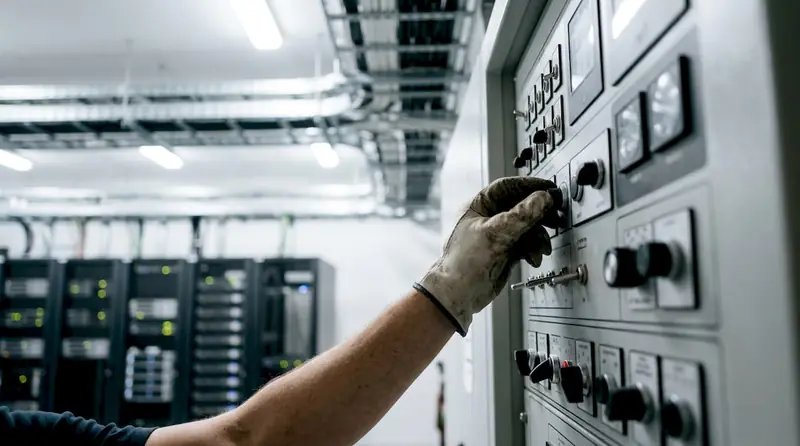
Every fire needs four things simultaneously: heat, fuel, oxygen, and a self-sustaining chemical chain reaction. Remove any one of them and combustion stops. Suppression agents act on this principle, but the mechanism varies by agent class.

Halocarbon agents work primarily through heat absorption and chemical flame inhibition. When FM-200 or Novec 1230 discharges into a protected space, the liquid agent vaporizes instantly, pulling thermal energy from the flame faster than combustion can replace it. Simultaneously, the breakdown products of these compounds interfere with the chain-carrying radicals (O, H, and OH) that sustain the fire. Inert gas agents take a different path: IG-541 floods the room with a blend of nitrogen, argon, and CO2, diluting oxygen concentration until the fire simply cannot continue. CO2 works similarly through oxygen displacement, though at concentrations lethal to humans.
Incorrect agent matching creates real risk. Deploying a CO2 system in an occupied server room, for instance, can extinguish the fire and the personnel simultaneously. Proper agent selection is a design decision, not an afterthought.
- Total flooding systems fill an entire enclosed space with agent to achieve a uniform suppression concentration.
- Local application systems direct agent onto a specific hazard without enclosing the space, used for open-area equipment risks.
- Discharge speed matters: NFPA 2001 requires clean agent systems to reach design concentration within 10 seconds of discharge, stopping fire spread before damage escalates.
Pro Tip: If your facility uses mechanical hard drives, coordinate with your IT team before specifying an agent. Rapid gaseous discharge generates high-amplitude sound waves that can corrupt data on spinning disks. Acoustic silencing panels or pre-discharge shutdown sequences protect against this specific risk.
Types of suppression agents used in critical environments
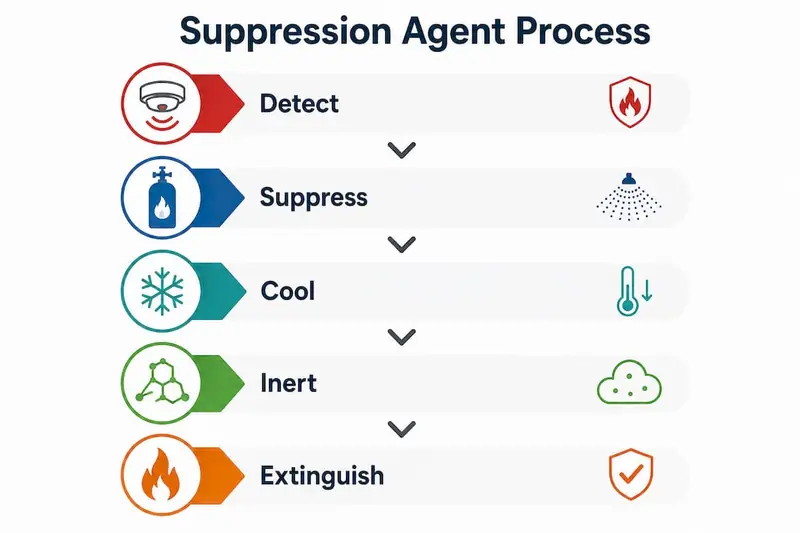
Three primary categories cover the vast majority of suppression agents in firefighting applications for sensitive facilities.
Halocarbon agents store as compressed liquids, making them practical for space-constrained equipment rooms. FM-200 (HFC-227ea) and Novec 1230 (FK-5-1-12) both achieve suppression at relatively low concentrations, minimizing the pressure load on the protected enclosure. FM-200 and Novec 1230 carry low toxicity ratings and minimal environmental impact compared to earlier halon-based agents, which were phased out under the Montreal Protocol.
Inert gas agents require larger cylinder banks because they store as compressed gases rather than liquids. IG-541 (an inert gas blend of nitrogen, argon, and carbon dioxide) and IG-55 (a blend of argon and nitrogen) reduce oxygen to suppression levels while remaining breathable at design concentration. Inert gas systems carry zero ozone depletion potential and zero global warming potential, making them the preferred choice where environmental compliance is a priority.
Carbon dioxide is highly effective and inexpensive but is restricted to unoccupied spaces due to its asphyxiation hazard at suppression concentrations.
| Agent type | Primary mechanism | Storage form | Occupied spaces | Environmental impact |
|---|---|---|---|---|
| FM-200 | Heat absorption, chain inhibition | Compressed liquid | Yes | Low GWP |
| Novec 1230 | Heat absorption, chain inhibition | Compressed liquid | Yes | Very low GWP |
| IG-541 (Inergen) | Oxygen reduction | Compressed gas | Yes (at design conc.) | Zero GWP/ODP |
| IG-55 | Oxygen reduction | Compressed gas | Yes (at design conc.) | Zero GWP/ODP |
| CO2 | Oxygen displacement | Compressed gas/liquid | No | Low GWP, no ODP |
- Halocarbon agents suit facilities with limited floor space for cylinder storage.
- Inert gas agents suit facilities with strict environmental reporting requirements.
- CO2 suits unoccupied electrical vaults, industrial equipment enclosures, and marine applications.
Why clean agent systems protect sensitive environments so well
Clean agent fire suppression systems prevent damage by flood-filling a protected space with gaseous agent that leaves zero residue after discharge. That single characteristic changes the recovery calculus entirely for a data center or museum.
Water activates sprinklers indiscriminately, soaking servers, storage arrays, and irreplaceable documents. A clean agent discharge, by contrast, dissipates without leaving corrosive or conductive residue. Tier III data centers use dedicated fire zones with independent detection and agent supplies precisely because a single suppression event cannot be allowed to cascade across the entire facility.
- Data centers: Independent suppression zones protect individual server rooms without triggering adjacent areas.
- Archives and museums: Residue-free discharge preserves paper records, textiles, and artifacts that water or dry chemical agents would destroy.
- Control rooms and telecom facilities: Fast suppression prevents fire from spreading to adjacent infrastructure during the critical seconds before manual intervention.
- Medical imaging suites: Sensitive equipment tolerates gaseous agents; it does not tolerate water or powder.
Pro Tip: For facilities with mixed occupancy, consider zoning your suppression system so that clean agent coverage applies only to the equipment-dense areas. Pairing clean agent zones with addressable fire alarms gives you pinpoint detection that triggers the right agent in the right zone.
Best practices for keeping your suppression system compliant and effective
NFPA 2001 compliance is not a one-time design achievement. It requires ongoing verification that the system will actually perform when a fire occurs.
Room integrity testing is the most commonly neglected requirement; similar to how radon mitigation requires careful installation and maintenance to ensure home safety, proper sealing of the protected space is critical for fire suppression effectiveness as discussed by Hunt Home Inspection, LLC. A system can be perfectly designed and still fail because a new cable penetration, a replaced ceiling tile, or a worn door seal bleeds agent concentration below the suppression threshold. Room integrity testing using blower door equipment per ASTM E2174 verifies that the enclosure retains agent long enough to extinguish the fire. The Fire Suppression Systems Association is explicit that suppression agents function as one component of a broader strategy that includes early detection, room integrity, trained personnel, and documented incident response plans.
- Annual functional testing: Verify that the system achieves design concentration within the 10-second discharge window required by NFPA 2001.
- Pre-discharge warnings: NFPA 2001 requires audible and visible pre-discharge alarms and abort switches to protect occupants before agent release.
- Seal and penetration audits: Inspect all cable trays, conduit penetrations, and door seals annually; any new construction in the protected space triggers a re-test.
- Trained personnel: Maintenance staff must understand abort procedures and lockout/tagout protocols before working inside a suppression zone.
- Integrated detection: Suppression systems without fast, reliable detection are reactive rather than preventive. Early smoke detection cuts the time between ignition and agent release.
Pro Tip: Schedule room integrity testing immediately after any renovation or tenant improvement work inside a suppression zone. Construction crews rarely seal penetrations to fire-suppression standards, and a single unsealed conduit can render an otherwise compliant system ineffective.
Environmental impact and regulatory considerations
The regulatory environment for suppression agents has shifted considerably since halon was banned under the Montreal Protocol. The U.S. Environmental Protection Agency’s Significant New Alternatives Policy (SNAP) program evaluates and approves substitute agents, and not every agent on the market carries SNAP approval for every application. Facility managers must verify that their specified agent is SNAP-listed for their specific use case before procurement.
Halocarbon agents carry global warming potentials that vary by compound. Novec 1230 has a very low global warming potential, making it one of the environmentally favorable halocarbon options currently available. FM-200 carries a higher global warming potential but remains SNAP-approved and widely used. Inert gas agents carry zero global warming potential and zero ozone depletion potential, which simplifies environmental reporting for facilities subject to sustainability mandates. CO2 is a greenhouse gas but is used in quantities too small in most suppression applications to trigger reporting thresholds.
How to choose the right agent for your facility and assets
Agent selection starts with three questions: What is the fire hazard class? Is the space occupied during normal operations? And what are the physical constraints on cylinder storage?
Class C fires involving energized electrical equipment are the dominant concern in data centers and control rooms. Both halocarbon and inert gas agents handle Class C fires effectively without conducting electricity or leaving residue. For facilities with strict environmental reporting requirements, inert gas agents eliminate global warming potential concerns entirely. For facilities with limited mechanical room space, halocarbon agents stored as compressed liquids require far less volume than inert gas cylinder banks.
Asset value and recovery time objectives also drive the decision. A financial trading floor with sub-second recovery requirements needs the fastest possible suppression and zero residue. A manufacturing facility with robust equipment may tolerate a broader range of agent options. Reliable-fire-protection recommends a site-specific suppression design that accounts for room geometry, occupancy schedules, asset sensitivity, and local AHJ (Authority Having Jurisdiction) requirements before any agent is specified.
Limitations and risks you need to account for
No suppression agent is without trade-offs. CO2 is lethal at suppression concentrations and is restricted to unoccupied spaces under NFPA guidelines. Inert gas systems require large cylinder banks that may not fit in existing mechanical rooms without structural modifications. Halocarbon agents, while effective, carry global warming potentials that some jurisdictions are beginning to regulate more aggressively.
Rapid discharge of any gaseous agent creates a pressure transient inside the protected enclosure. If the room is not designed to vent that pressure, structural damage to walls, doors, or raised floor panels can result. Pressure relief venting is a required design element under NFPA 2001, but it is sometimes omitted in retrofit installations. Additionally, some halocarbon agents produce decomposition byproducts when they contact very high-temperature flames, generating hydrogen fluoride gas that is corrosive and toxic. Proper detection speed minimizes this risk by triggering discharge before temperatures reach decomposition thresholds.
Maintenance and inspection protocols that keep systems ready
A suppression system that has not been inspected is a system of unknown reliability. NFPA 2001 mandates annual inspection and testing, but the specific tasks go beyond a visual check.
Cylinder weight or pressure verification confirms that agent inventory has not been depleted by slow leakage. Nozzle inspections check for blockages or corrosion that would disrupt discharge patterns. Control panel diagnostics verify that detection inputs, abort switches, and discharge outputs all communicate correctly. For inert gas systems, cylinder pressure must be checked against temperature-corrected baseline values because pressure varies with ambient temperature.
Beyond the annual cycle, any event that triggers a partial or full discharge requires immediate system recharge and a post-event integrity test before the space is returned to service. Reliable-fire-protection provides suppression system inspection services that cover all NFPA 2001 annual requirements, including room integrity testing and functional discharge verification, for Houston-area facilities.
Protect your facility with the right suppression strategy

A suppression system is only as reliable as its design, its agent selection, and its maintenance record. Reliable-fire-protection works with facility managers across Houston to specify, install, and maintain clean agent suppression systems that meet NFPA 2001 requirements and protect the assets that matter most. Whether you are designing a new data center suppression zone or auditing an existing system, our team brings the technical depth and local expertise to get it right. Learn how fire alarm systems work alongside suppression systems to create a complete, integrated fire protection program. Contact Reliable-fire-protection for a free consultation.
Key Takeaways
Clean agent suppression systems protect sensitive environments by extinguishing fires without leaving residue, but their effectiveness depends on correct agent selection, room integrity, and annual NFPA 2001 compliance testing.
| Point | Details |
|---|---|
| Agent mechanism determines suitability | Halocarbons absorb heat and interrupt chain reactions; inert gases reduce oxygen; CO2 displaces oxygen but is restricted to unoccupied spaces. |
| NFPA 2001 sets the performance standard | Systems must reach design concentration within 10 seconds of discharge, verified through mandatory annual functional testing. |
| Room integrity is the most overlooked requirement | Unsealed penetrations bleed agent concentration below suppression threshold, making integrity testing per ASTM E2174 a prerequisite for compliance. |
| Environmental regulations affect agent choice | The EPA SNAP program governs approved substitutes; Novec 1230 carries a global warming potential of 1, while inert gas agents carry zero global warming potential. |
| Suppression agents work best within a full program | The Fire Suppression Systems Association stresses that agents must be paired with early detection, trained personnel, and documented incident response plans. |