
The most common causes of commercial fires are cooking incidents, electrical malfunctions, heating and powered-equipment failures, careless or unintentional actions, and intentional fires (arson). Every one of them is preventable with focused building controls, scheduled inspections, and active detection and suppression systems.
According to USFA national estimates, cooking alone accounts for roughly 29.7% of nonresidential building fires. The USFA’s nonresidential building report puts the annual average at approximately 108,500 reported nonresidential fires for the 2017–2019 period, with electrical malfunctions and unintentional actions driving many of the larger, more destructive events. The pattern across all property types is consistent: fires that spread beyond the room of origin cause the overwhelming share of dollar losses.
The three prevention priorities that cut across every cause:
- Housekeeping and separation: Keep combustibles away from heat sources; clear storage areas and electrical rooms regularly.
- Inspection and maintenance: Follow NFPA 25 for sprinkler systems and NFPA 72 for fire alarm testing; schedule electrical thermal imaging annually.
- Detection and suppression readiness: Never disable alarms or sprinklers without an approved impairment plan and compensating controls in place.
Key Takeaways
Cooking, electrical faults, and impaired suppression systems are the three highest-impact risk factors in commercial fires — and all three respond directly to scheduled maintenance and active detection.
| Point | Details |
|---|---|
| Cooking leads all causes | Cooking accounts for roughly 29.7% of nonresidential fires; hood cleaning and suppression maintenance are the primary controls. |
| Electrical faults drive large losses | Electrical malfunctions cause roughly 7% of incidents but are a leading factor in large, nonconfined fires; annual thermal imaging catches problems early. |
| Suppression impairment is a critical failure mode | Swiss Re’s large-loss analysis found suppression systems frequently impaired at the time of major events; follow NFPA 25 and never leave a zone isolated without a documented impairment plan. |
| Inspection cadence is the backbone | Weekly visual checks, quarterly alarm tests, and annual full-system inspections to NFPA 25 and NFPA 72 are the minimum schedule for any commercial property. |
| Reliable-fire-protection covers the full cycle | Reliable-fire-protection provides alarm, sprinkler, suppression, and extinguisher services for Houston commercial properties, including inspections, repairs, and 24/7 emergency response. |
Table of Contents
- What are the most common causes of commercial fires?
- How do commercial fires actually start and spread?
- Building-level prevention controls every owner should have in place
- How fire risks differ across property types
- Your inspection and maintenance schedule
- Why sprinklers and alarms change the outcome
- Steps to limit damage and speed recovery after a fire
- What the field actually looks like
- Reliable-fire-protection can help you close these gaps
- Sources
What are the most common causes of commercial fires?
The five causes below account for the vast majority of nonresidential fire incidents in the United States. Understanding where each one typically starts inside a building is the fastest way to prioritize your prevention resources.
| Cause | Estimated Share of Nonresidential Fires | Typical Area of Origin |
|---|---|---|
| Cooking equipment | roughly one-third | Commercial kitchens, break rooms |
| Other unintentional/careless actions | ~11% | Storage areas, loading docks, general work areas |
| Intentional (arson) | ~10% | Exterior, storage, vehicle areas |
| Electrical malfunctions | ~7% | Electrical rooms, distribution panels, machinery |
| Heating equipment | ~6–7% | Mechanical rooms, rooftop units, portable heaters |
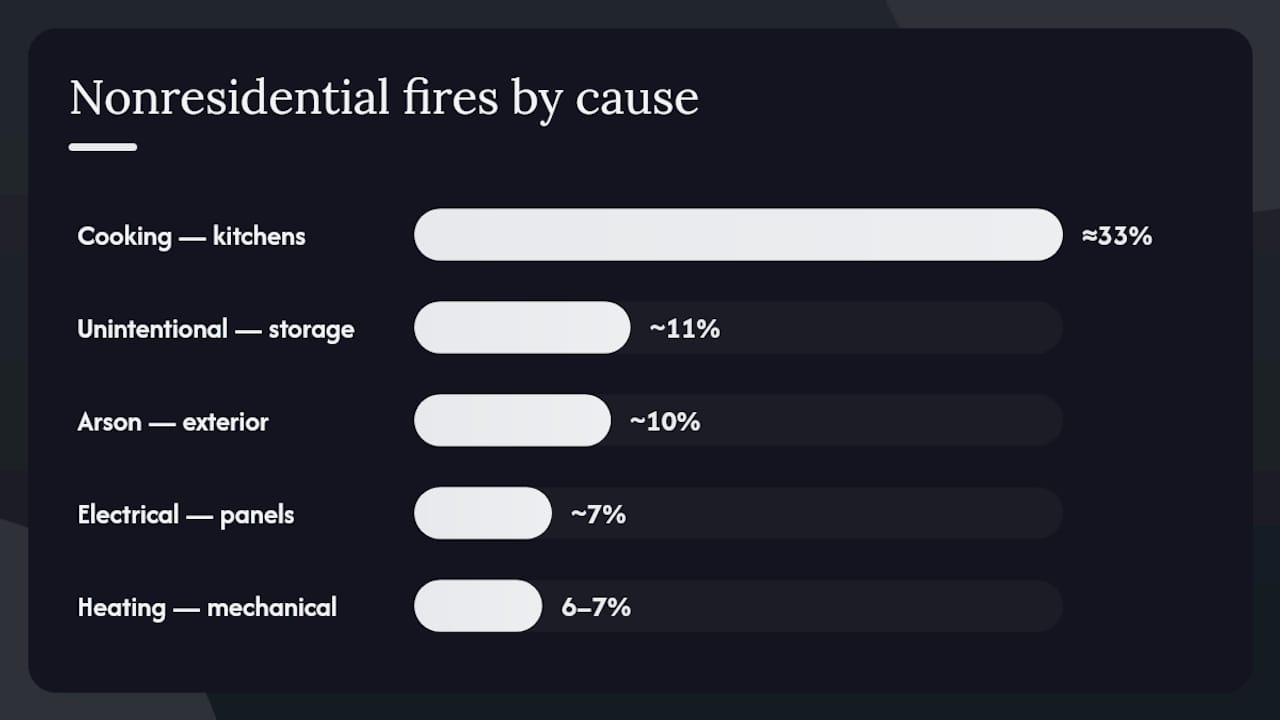
Source: USFA nonresidential building fires (2017–2019) and leading causes through 2023.
Cooking equipment is the single leading cause by incident count. Most cooking fires are small and confined, but the sheer volume means even a modest ignition rate produces thousands of incidents annually. Grease accumulation in hoods and ducts is the primary escalation path from a small flare-up to a structural fire.
Electrical malfunctions rank lower in incident count but punch well above their weight in property damage. Arcing faults, overloaded circuits, and deteriorated insulation can smolder for hours before open flame appears. The USFA nonresidential report identifies powered equipment and electrical arcing as leading heat sources in nonconfined fires — the ones that spread and cause serious losses.
Heating and powered-equipment failures cluster in mechanical rooms and rooftop units. Portable electric heaters placed near combustible storage are a recurring culprit in office and retail settings.
Unintentional or careless actions cover a wide range: discarded smoking materials, improper disposal of flammable liquids, and combustibles left too close to heat sources. The USFA causes page shows this category has trended upward through 2023, alongside intentionally set fires.
Intentional fires (arson) are the second-largest cause of fire deaths in nonresidential buildings. They tend to originate in exterior areas, dumpsters, vehicle storage, and unlocked storage rooms — locations with low foot traffic and delayed detection.
How do commercial fires actually start and spread?
Knowing a cause by name is one thing. Understanding the ignition pathway is what lets you interrupt it.
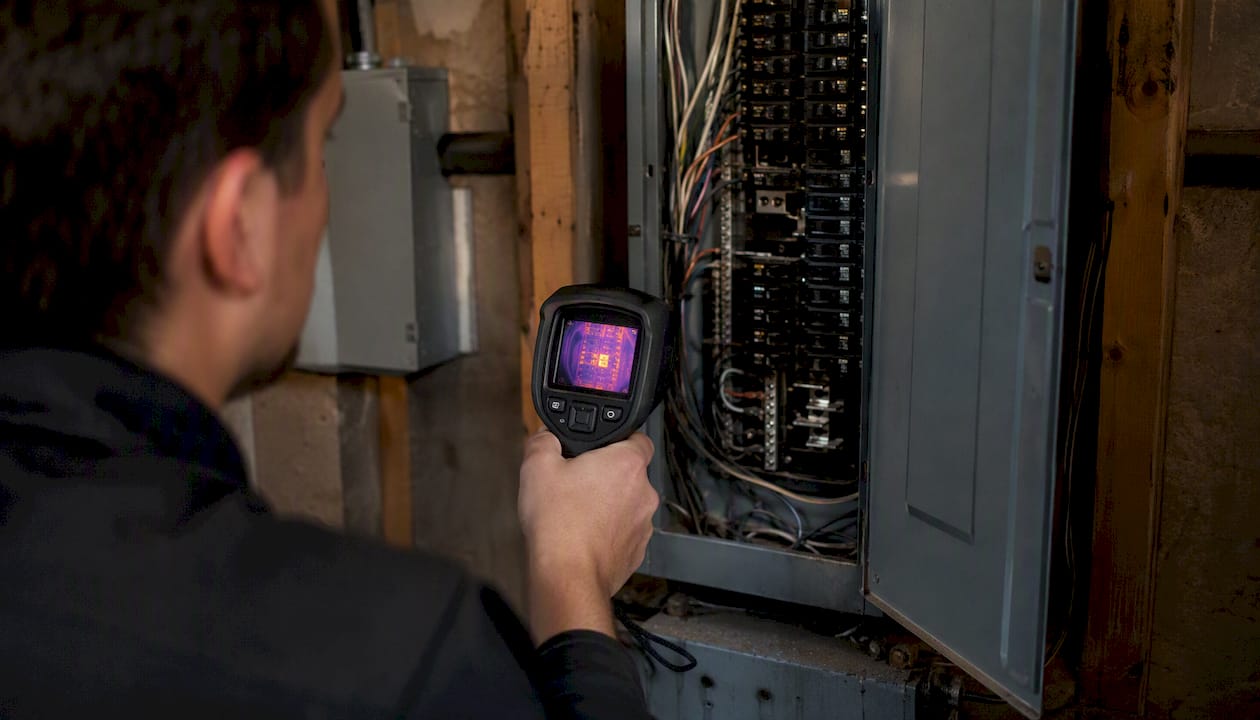
Electrical arcing is the most insidious pathway. A worn insulation jacket on a wire inside a wall cavity arcs against a metal stud, ignites nearby cellulose insulation, and smolders for hours before breaking into open flame. By the time a smoke detector activates, the fire may already be inside the wall. This is why thermal imaging during annual electrical inspections catches problems that visual checks miss entirely.
Grease ignition follows a predictable sequence: grease accumulates in the hood plenum and duct, a flare-up from the cooking surface contacts the grease layer, and the duct becomes a chimney carrying fire to the roof. A suppression system over the appliance stops this at step two — but only if the system is charged and the nozzles are unobstructed.
Hot work sparks (grinding, welding, cutting) travel up to 35 feet and can land on combustibles that smolder for 30 minutes or more before igniting. Open vertical shafts, cable trays, and gaps in fire-rated assemblies let fire travel between floors rapidly once it gets past the room of origin.
The main contributing factors that turn a small ignition into a large loss:
- Poor housekeeping: combustible packaging, pallets, and waste accumulation near heat sources
- Lack of physical separation between ignition sources and flammable or combustible materials
- Impaired or isolated suppression systems that fail to activate at the critical moment
- Deferred maintenance on electrical equipment, motors, and HVAC units
- Hot work performed without a permit, fire watch, or post-work inspection
- Disabled or silenced alarm zones during renovation or tenant fit-out
ILO fire safety guidance specifically recommends active physical separation of ignition sources from flammable materials and rigorous scheduled maintenance for machinery — not just minimum code compliance.
Pro Tip: Schedule annual infrared thermal imaging of your electrical panels, switchgear, and high-load circuits. A hot spot on a breaker or connection point shows up clearly on a thermal camera weeks before it causes arcing or a fire. The cost of a scan is a fraction of what a single electrical fire costs in downtime alone.
Building-level prevention controls every owner should have in place
Prevention at the facility scale comes down to four programs. Each one addresses a different ignition pathway.
Housekeeping and storage controls
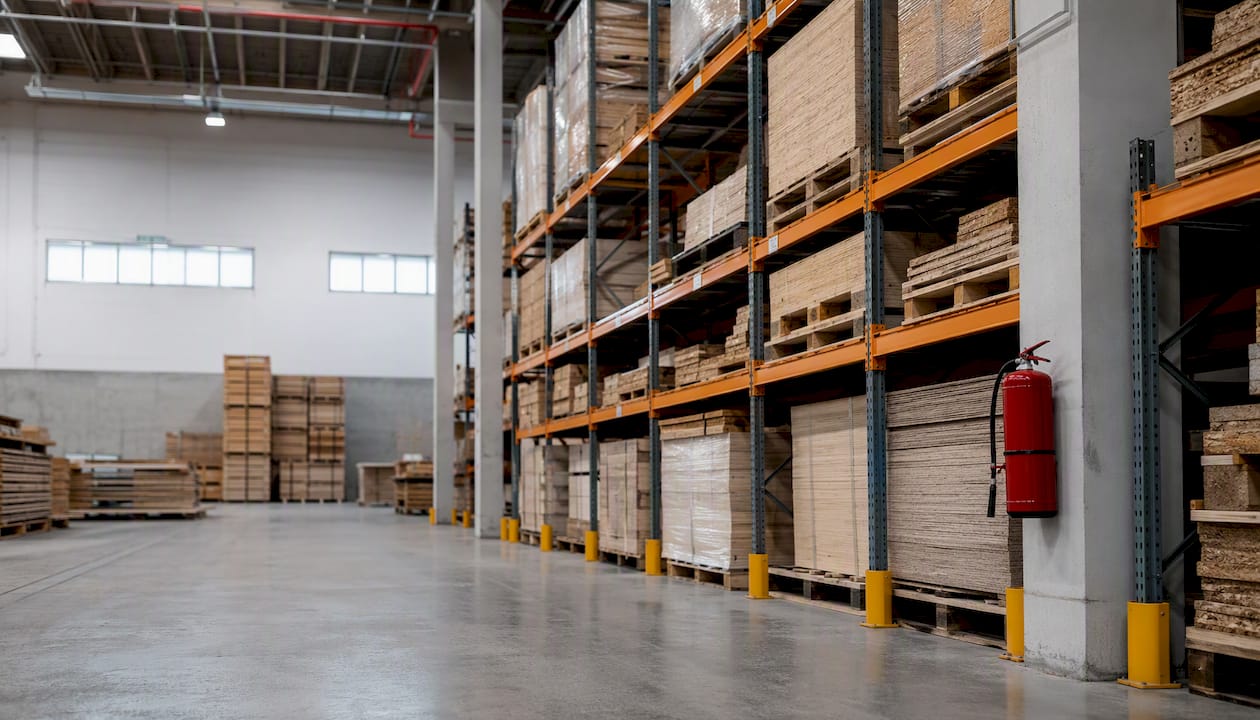
Combustible loading is the single most controllable fire risk factor in most commercial buildings. Set and enforce minimum clearance distances between stored materials and heat-producing equipment. In warehoused or high-rack storage, maintain clear flue spaces (typically 6 inches between rack rows and 18 inches below sprinkler heads) so suppression systems can reach a fire before it spreads laterally. Hazardous materials — flammable liquids, aerosols, oxidizers — belong in rated storage cabinets or dedicated rooms with appropriate ventilation and signage.
Trash and recycling accumulation near electrical rooms or loading docks is a common arson accelerant. Rodent activity in wall cavities can damage wiring insulation and create ignition points; commercial rodent prevention is worth coordinating with your pest control contractor as part of a broader building hygiene program.
Electrical safety program
Label every circuit in every panel. Implement a load management policy that prohibits daisy-chained power strips and limits portable heater use to approved locations. Apply lockout/tagout procedures before any maintenance on electrical equipment. Schedule a licensed electrician for a full panel inspection at least annually, and add thermal imaging for any panel or switchgear that runs at high load.
Hot work management
Every welding, cutting, or grinding task inside your building needs a written hot work permit, a cleared 35-foot radius of combustibles, a charged extinguisher on site, and a 30-minute fire watch after work ends. Contractor controls should require proof of insurance and a site-specific safety briefing before any hot work begins.
Detection, suppression, and staff readiness
Never disable a sprinkler zone or silence an alarm panel without a documented impairment plan, a notified authority having jurisdiction (AHJ), and compensating controls (fire watch, additional extinguishers, restricted operations) in place. Test and document. Train every employee on evacuation routes and extinguisher use — workplace fire hazard avoidance starts with people who know what to do before the alarm sounds.
Pro Tip: Post a laminated “system impairment checklist” at every fire alarm panel and sprinkler riser. When a contractor or maintenance tech disables a zone, they fill it out, sign it, and notify the designated safety contact. This one habit prevents the most common cause of suppression failure: a zone that was shut off for a plumbing repair and never turned back on.
How fire risks differ across property types
Fire risk factors in workplaces vary significantly by occupancy. The controls that matter most in a restaurant kitchen are largely irrelevant in a warehouse, and vice versa.
Restaurants and eating establishments
Grease control is the defining risk. Hood filters need cleaning on a schedule tied to cooking volume (weekly for high-volume fryers, monthly for moderate use). The suppression system over cooking appliances must be inspected every six months per NFPA 96 requirements. Keep a restaurant-rated fire extinguisher accessible at every cooking station.
Mini-checklist: hood filter cleaning log, suppression system semi-annual inspection, grease duct inspection annually (or more frequently for high-volume operations), cooking appliance clearances verified monthly.
Offices and retail spaces
Electrical hazards dominate here. Extension cords used as permanent wiring, overloaded power strips, and space heaters near paper storage are the recurring culprits. Storage rooms and back-of-house areas accumulate combustibles faster than anyone tracks. An office fire hazards checklist gives safety managers a structured starting point.
Mini-checklist: no extension cords as permanent wiring, power strip load limits enforced, storage room clearances checked monthly, electrical panel inspection annually.
Warehouses and storage facilities
High fire loads and wide-open floor plans mean a fire can grow fast. Sprinkler design must match the commodity class and storage height — a system designed for Class I commodities will not adequately protect a rack of aerosols. Maintain 18-inch clearance below sprinkler heads at all times. Separate ignition sources (battery chargers, forklifts, electrical panels) from high-rack storage areas. Industrial fire safety practices for facility managers go deeper on rack storage and suppression design.
Mini-checklist: sprinkler head clearance verified weekly, forklift charging stations separated from storage, commodity class reviewed when inventory changes.
Manufacturing facilities
NFPA research on industrial and manufacturing properties identifies mechanical failure and electrical distribution equipment as leading ignition factors. Add combustible dust to that list for woodworking, metalworking, and food processing operations. Dust collection systems need regular cleaning; a dust layer as thin as 1/32 inch across a large surface area is a deflagration hazard. Hot work permits are non-negotiable.
Mini-checklist: dust collection system cleaned per manufacturer schedule, hot work permits required for all cutting/welding, mechanical equipment PM schedule current, electrical distribution inspected annually.
Vehicle storage and parking structures
Arson and vehicle fires are the primary risks. Limit combustible storage in these areas, install adequate lighting and camera coverage to deter intentional ignition, and verify that suppression systems cover the full footprint including ramps and corners.
Your inspection and maintenance schedule
A documented schedule is the difference between a system that works when you need it and one that fails silently. The table below maps frequency to the key inspection items, with the governing NFPA standards noted.
When any suppression or alarm system is impaired, the required steps are: tag the impaired component, notify the AHJ, implement a fire watch or other compensating control, and restore the system as quickly as possible. Document every step. A sprinkler system inspection guide can help you build this cadence into your facility’s standard operating procedures.
Pro Tip: Use a digital maintenance log (a simple shared spreadsheet works) that timestamps every inspection and flags overdue items. Insurance adjusters and fire marshals ask for this documentation after an incident. Having it ready also makes your annual renewal conversation with your insurer much shorter.
Why sprinklers and alarms change the outcome
The gap between a contained fire and a total loss often comes down to one question: were the detection and suppression systems working?
A Swiss Re analysis of more than 500 large-loss fire events found that electrical faults accounted for roughly 25% of large-loss ignitions, incendiarism (intentional fires) about 23%, hot work approximately 16%, and gas issues around 16%. Critically, suppression systems were frequently found impaired or isolated at the time of these large-loss events. A sprinkler system that exists but is shut off delivers exactly the same protection as no system at all.
The math on detection is equally direct. Early alarm activation gives occupants time to evacuate and gives suppression systems time to activate before a fire grows beyond the room of origin. The role of addressable alarms in commercial settings is particularly significant: they identify the exact device and zone that triggered, cutting response time and reducing false-alarm-driven complacency.
Common causes of system impairment in the field:
- Zones isolated during tenant renovation and never restored
- Sprinkler control valves closed for a plumbing repair and left closed
- Alarm panels placed in “test” mode and forgotten
- Suppression nozzles over cooking equipment obstructed by new equipment installed after the last inspection
Pro Tip: Ask your fire protection contractor to enable remote supervisory signaling on your sprinkler control valves and tamper switches. This sends an alert to a monitoring center the moment a valve is moved to the closed position — catching accidental or unauthorized impairment before it becomes a liability.
Steps to limit damage and speed recovery after a fire
When a fire occurs, the decisions made in the first hour determine how much of the loss is recoverable.
During the event:
- Prioritize life safety above all else. Activate the alarm, initiate evacuation, and call 911 before attempting any suppression.
- Shut down equipment in the affected area if it is safe to do so without re-entering a smoke-filled space.
- Isolate utilities (gas, electrical) only if you are trained and the shutoff is accessible from a safe location.
Immediately after the fire department clears the scene:
- Secure the building perimeter. Unauthorized entry after a fire creates liability and destroys evidence.
- Photograph and document everything before any cleanup begins. Capture the area of origin, damaged equipment, suppression system status, and any open doors or windows.
- Contact your property insurer within 24 hours. Most policies require prompt notification.
- Call your fire protection service provider to assess system damage and begin the reactivation process. Operating a building with an impaired alarm or sprinkler system after a fire event is both a code violation and a serious liability.
- Begin controlled drying and mitigation within 24–48 hours to prevent secondary water and mold damage from suppression discharge.
Pro Tip: Do not restore a suppression or alarm system yourself after a fire. A certified fire protection contractor must inspect the system, replace any activated components, recharge suppression agents, and provide a written certification before the system is back in service. Your insurer and the AHJ will both ask for that documentation.
What the field actually looks like
The fire causes that show up most often in the field are rarely mysterious. Grease-caked hoods that haven’t been cleaned in 18 months. Sprinkler zones that were isolated during a renovation six months ago and never turned back on. Electrical panels with breakers that run hot enough to blister the paint inside the door.
The fix for most of these is not expensive. It’s documentation and follow-through. The clients who avoid large losses are the ones who treat their inspection schedule as a non-negotiable operating cost, not a line item to defer when cash flow tightens. They also keep certificates. When a contractor services a suppression system or cleans a hood, they get a signed certificate with the date, the technician’s name, and the scope of work. That paper trail is what separates a manageable insurance claim from a disputed one.
Vendor selection matters too. Ask any fire protection contractor for proof of licensing, current certificates of insurance, and references from similar property types. A contractor who can’t produce those in five minutes is not the right contractor for a compliance-critical system.
Reliable-fire-protection can help you close these gaps
The prevention checklists above are only as good as the systems behind them. If your sprinkler coverage hasn’t been inspected to NFPA 25 standards, your alarm system hasn’t been tested to NFPA 72, or you’re not sure whether your kitchen suppression system is still properly charged, those are gaps that need a certified contractor, not a spreadsheet.
Reliable-fire-protection serves commercial properties across Houston and nearby neighborhoods, providing alarm system installation and inspection, sprinkler installation and maintenance, kitchen suppression service, fire extinguisher programs, and 24/7 emergency response. The team handles the full compliance cycle: installation, testing, documentation, and repair. If you want a clear picture of where your property stands before the next inspection, request a free site assessment and get a written scope of what needs attention.
Sources
The figures and recommendations in this article draw on the following primary sources. Each is publicly available and worth bookmarking for your own compliance reference.
- USFA statistics
- Large fire losses: Unlocking the sources of ignition | Swiss Re
- Fire in Industrial or Manufacturing Properties | NFPA Research
- Fire safety — ILO