

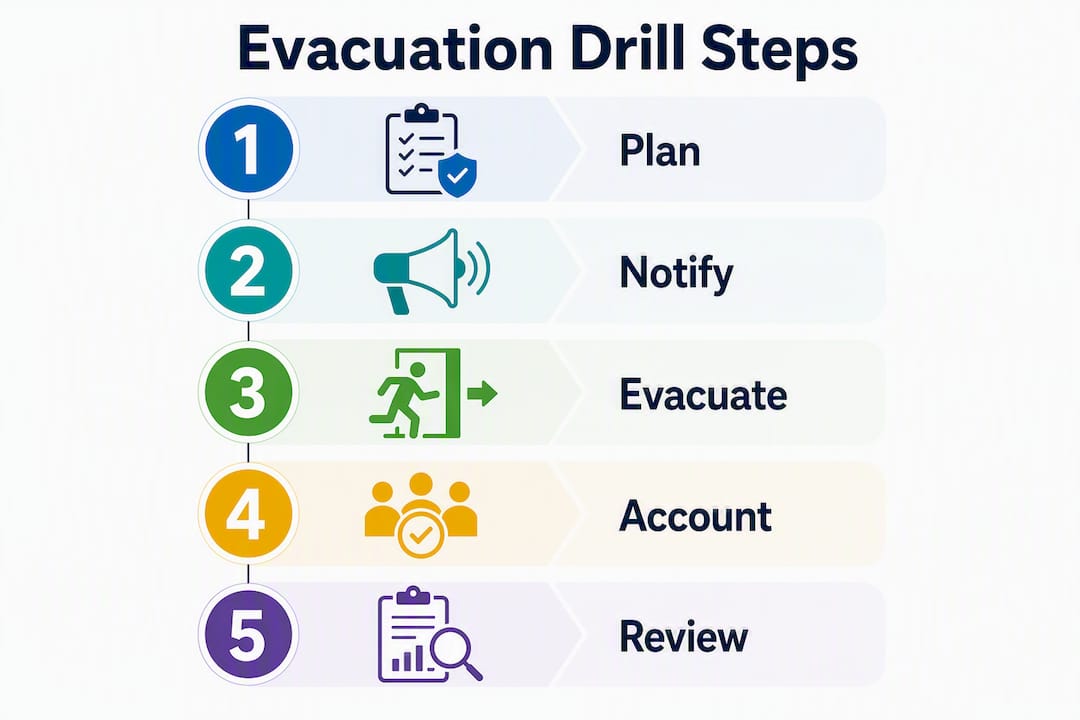
An effective evacuation drill process moves every occupant to a designated assembly point, verifies full accountability, and produces documented corrective actions before the next drill cycle.
Every drill that earns its compliance value covers these non-negotiables:
- Alarm activation using the actual building alarm system, not a verbal announcement
- Safe egress along posted routes, with stairs only (no elevators)
- Assembly point located at least 50 feet from the building and clear of fire lanes
- Supervised headcount that accounts for employees, visitors, contractors, and anyone requiring assisted evacuation
- After-action review with root-cause findings, named corrective owners, and closeout deadlines
For compliance evidence, your drill program needs three written anchors: a current Emergency Action Plan (EAP) referencing 29 CFR 1910.38, a drill cadence aligned with NFPA 101 for your occupancy type, and drill records retained according to regulatory requirements.
Table of Contents
- What scope and objectives should your drill cover?
- How to plan and document the drill before it runs
- Who does what: roles, responsibilities, and backups
- Step-by-step: how to run the drill on the day
- Notification templates and scripts for before, during, and after
- How do you account for everyone during a drill?
- After-action review: how to measure and improve drill performance
- How often should you run drills, and what do regulations require?
- What templates do you need, and how should you manage them?
- Key Takeaways
- The drills that actually improve safety look nothing like the ones most facilities run
- Reliable-fire-protection supports your drill program from alarm to after-action report
- Useful sources and standards
What scope and objectives should your drill cover?
Before scheduling anything, decide what kind of drill your facility actually needs. A full-building evacuation is the default for most commercial occupancies, but alternatives exist depending on site needs. Partial drills test a single floor or zone. Defend-in-place exercises are standard in healthcare settings where moving patients creates more risk than sheltering them. Tabletop exercises work well for testing coordinator decision-making without moving a single person.
The decision turns on four factors: occupancy group, vulnerable populations, shift coverage, and whether hazardous processes are running. A hospital with ICU patients runs defend-in-place. A school runs monthly full evacuations. A chemical plant with a PSM-covered process needs a drill design that accounts for safe shutdown procedures before anyone leaves.
Set measurable success criteria before the drill date, and write them into the EAP. Useful targets include minimizing alarm-to-last-occupant time, timely headcounts, and full assistance to occupants with Personal Emergency Evacuation Plans (PEEPs). Vague objectives produce vague after-action reports. Specific targets give you something to measure against the next time.

How to plan and document the drill before it runs
Good drills are built on paper before they happen on the floor. The documentation you produce in advance is what an OSHA inspector or AHJ will ask for first.
- Produce the written artifacts. Your file should contain: the EAP with drill procedures, a drill SOP, a role matrix with backup assignments, PEEP rosters, and a drill schedule. The OSHA EAP standard requires the plan to be in writing, kept on-site, and available to employees. Employers with 10 or fewer employees may communicate it orally, but written documentation is always the safer practice.
- Map evacuation routes and post floor plans. Every floor needs a current, version-dated floor plan showing primary and secondary routes, stairwell locations, and the designated assembly point. Post plans prominently near exits. When routes change due to construction or renovation, update and repost immediately. Fire escape route planning is not a one-time task; treat floor plans as living documents with a version date in the footer.
- Confirm assembly point placement. The assembly area must be at least 50 feet from the building, clear of fire lanes, and large enough to hold the full occupant load. Parking lots that double as fire apparatus staging areas are not acceptable assembly zones.
- Complete the pre-drill permissions checklist. Before the drill date, confirm: alarm test authorization from your monitoring company, fire department notification if your jurisdiction requires it, AHJ notification for large-scale or unannounced drills, observer assignments (one observer per roughly 25 occupants is a practical ratio), and first-aid or medical coverage on standby.
- Set up your recordkeeping log. Every drill record must capture: date and time, alarm-to-last-occupant time, headcount completion time, total participants, identified problems, and corrective actions with owners and deadlines. Keep these records for at least three years — OSHA inspectors routinely request drill logs during fire-related investigations.
- Verify exit hardware is functional. Confirm that all exit doors open freely, panic bars operate correctly, and stairwell doors close behind evacuees. A panic bar inspection before the drill catches hardware failures that could create real bottlenecks during an actual emergency.
Who does what: roles, responsibilities, and backups
A drill without assigned roles is a crowd moving toward a door. The role matrix below defines who is responsible for what, and every position needs a named backup.
Drill Coordinator / Emergency Coordinator
- Owns the overall drill plan, schedule, and documentation
- Briefs observers and wardens before the drill starts
- Authorizes alarm activation and controls re-entry
Floor / Zone Wardens
- Assigned to specific floors or zones; wear identifying vests or armbands
- Direct occupants to the nearest safe exit
- Confirm their zone is clear before leaving
- Receive warden training that covers sweep technique, PEEP escort procedures, and roll-call reconciliation
Sweepers
- Trained to check bathrooms, storage rooms, break rooms, and remote offices
- Sweepers must actively check concealed spaces rather than relying on passive headcounts at the door
- Report any occupant found in a hidden area to the warden and log it
Assembly Point Lead
- Stationed at the assembly area before the alarm sounds
- Manages supervisor roll calls, visitor sign-in reconciliation, and contractor liaison
- Escalates missing-person reports to the drill coordinator
Critical Operations Staff
- Named individuals assigned to specific equipment or processes that require safe shutdown before evacuation
- OSHA guidance requires these employees to be clearly identified, trained on their shutdown procedures, and given explicit abandonment conditions — the exact point at which they must stop and evacuate regardless of process status
- Their backup must be equally trained
Observers / Evaluators
- Positioned throughout the building and at the assembly point
- Collect time-stamped notes, not subjective impressions
- Do not intervene during the drill unless a real safety hazard emerges
Communications Lead
- Manages PA announcements, coordinates with the monitoring company, and relays status updates to the drill coordinator
Every role needs a named primary and a named backup. If the floor warden is absent the day of the drill, the backup steps in automatically — no coordinator decision required.
Step-by-step: how to run the drill on the day
This sequence runs from pre-brief to re-entry. Follow it in order.
- Pre-brief observers and wardens (T-minus 30 minutes). Confirm assignments, distribute observer checklists, verify communications channels, and confirm medical responders are on standby. Walk the primary and secondary routes one final time.
- Conduct pre-checks. Verify alarm zones are armed and the monitoring company is notified. Confirm all exits are unobstructed. Check that PEEP escorts are in position near their assigned occupants.
- Activate the alarm. Use the actual building alarm system. OSHA has cited employers who rely on silent drills because silent exercises fail to test alarm audibility, strobe coverage, and employee recognition of the signal. If the live alarm cannot be used safely, document the reason and use a PA announcement as a secondary method — but plan to test the full alarm system separately.
- Evacuate. Occupants stop work immediately, close doors behind them (slows fire spread), and move to the nearest posted exit. No personal item collection. No elevators. Wardens direct traffic and sweepers begin their zone checks simultaneously.
- Execute PEEP assistance. Designated escorts assist mobility-impaired occupants using pre-planned routes. If a stairwell evacuation chair is needed, the escort uses it per their training. Any occupant who cannot be moved immediately is placed in an area of refuge and their location is reported to the assembly point lead.
- Assemble and account for everyone. Supervisors take roll call against their department roster. The assembly point lead reconciles visitor sign-in logs and contractor check-in sheets. Any name unaccounted for triggers the missing-person protocol immediately — do not wait.
- Escalate missing persons. The sweeper for the relevant zone conducts an immediate secondary sweep. The drill coordinator is notified and relays the last-known location to the incident commander. In a real event, this information goes directly to the fire department.
- Capture data. Observers record the time the last occupant cleared the building, headcount completion time, any PEEP complications, and any exit or route problems. Photographs of congestion points are useful for the after-action report.
- Authorize re-entry. Only the drill coordinator (or, in a real emergency, the fire department incident commander) authorizes re-entry. No one re-enters until the all-clear is given and the building is confirmed safe.
- Conduct the immediate observer debrief. Within 15 minutes of re-entry, observers share their time-stamped notes with the drill coordinator. This is the raw material for the formal after-action review.
Pro Tip: Vary your drill scenarios by occasionally blocking a primary exit or running an unannounced drill on a second shift. Always conduct a formal risk assessment before adding simulated complications — the goal is to improve preparedness, not create real hazards.

Notification templates and scripts for before, during, and after
Consistent communication keeps a drill from causing panic and protects you legally if a participant is injured during the exercise.
Pre-drill notice (send 3–5 days before):
- Date, time, and expected duration of the drill
- Scope (full building, partial floor, specific zones)
- Reason for the drill (annual compliance requirement, new staff onboarding, post-renovation route update)
- Special instructions for visitors and contractors on that date
- PEEP arrangements and who to contact with accessibility questions
- Contact name and number for questions
Live PA announcement (announced drill):
Live PA announcement (unannounced drill):
Using identical language for announced and unannounced drills is intentional. Employees should respond the same way regardless of whether they know it is a drill.
All-clear message:
Only the drill coordinator or incident commander delivers the all-clear. Never delegate this to a warden.
Roll-call sheet fields:
- Employee name and department
- Time noted present at assembly point
- PEEP flag (yes/no)
- Visitor or contractor (yes/no)
- Notes (late arrival, assisted evacuation, refused to evacuate)
For accessibility, confirm that visual alarm strobes cover all occupied areas, that hearing-impaired occupants have vibrating pager alerts or personal notification devices, and that non-English-speaking occupants receive the pre-drill notice in their primary language.
How do you account for everyone during a drill?
The headcount method you choose depends on your facility size, shift structure, and available technology. Each approach has real trade-offs.
| Method | How it works | Strengths | Limitations |
|---|---|---|---|
| Supervisor roll call | Supervisors check names against printed department rosters at the assembly point | Simple, no technology required, works in power outages | Slow for large facilities; rosters must be current |
| Visitor/contractor log reconciliation | Assembly point lead compares sign-in log against names at assembly | Captures non-employees | Depends on accurate sign-in at entry |
| Card-swipe / access control log | Security pulls last-swipe data to identify who was in the building at alarm time | Fast, automated, audit trail | Does not capture tailgaters; requires IT coordination |
| Dedicated mustering app | Employees check in via smartphone at the assembly point | Real-time dashboard, flags missing names instantly | Requires device and connectivity; needs staff training |
For most mid-size facilities, a hybrid works best: supervisors run paper roll calls while a security or safety officer cross-references the access control log. The two lists reconcile within two minutes of assembly.
Visitors and contractors are the most common accountability gap. Require all visitors to sign in with their host’s name and department. Contractors should designate a liaison who holds their crew’s roster and reports to the assembly point lead. Brief contractors on the evacuation procedure at sign-in, not the morning of the drill.
Missing-person escalation flow:
- Assembly point lead flags the name as unaccounted for and notifies the drill coordinator immediately.
- The sweeper for the relevant zone conducts a secondary sweep and reports back within two minutes.
- If still unaccounted for, the drill coordinator escalates to the incident commander and provides the last-known location.
- In a real emergency, this information goes to the fire department on arrival.
After-action review: how to measure and improve drill performance
OSHA guidance is clear that the after-action evaluation is where drill value is actually realized. Running the drill is the easy part. The debrief is where safety improvements happen.
A meaningful debrief goes beyond “it went fine.” It identifies root causes, assigns corrective owners, and sets deadlines. Schedule the formal debrief within 48 hours of the drill while observations are fresh.
Metrics to capture and track across drills:
- Alarm-to-last-occupant time (target: under four minutes for most occupancies)
- Headcount completion time from assembly
- Percent of PEEPs assisted successfully without incident
- Percent of corrective actions closed from the previous drill cycle
- Number of occupants who used elevators or re-entered without authorization
After-action report structure:
- Incident summary: date, time, drill type, total participants, weather/conditions
- Timeline: alarm activation, last occupant out, headcount complete, all-clear
- Observer notes: congestion points, communication failures, PEEP complications, warden performance
- Photographic evidence of bottlenecks or route problems
- Prioritized corrective actions with named owners and closeout dates
Pro Tip: Track KPIs across multiple drill cycles — average evacuation time, slowest-quartile time, and percent of corrective actions closed — to demonstrate progressive program improvement to auditors and leadership.
After the debrief, update the EAP if route changes, role assignments, or PEEP rosters need revision. Update the training schedule if warden performance gaps were identified. File the completed after-action report in the same folder as the drill log, and confirm the retention clock: minimum three years.
How often should you run drills, and what do regulations require?
Drill frequency is set by occupancy type, and local AHJs can always mandate stricter schedules than the model codes. The table below reflects NFPA 101 and IFC guidance by occupancy.
| Occupancy type | Minimum drill frequency | Notes |
|---|---|---|
| — | Monthly during school year | Some states require additional drills in first week of school |
| Healthcare | Quarterly per shift | Defend-in-place protocols; patient movement restrictions apply |
| Business / office | Annually | AHJ may require more; high-rise buildings often require twice annually |
| Assembly / places of public gathering | Annually or per AHJ | Frequency increases with occupant load |
| Residential / hotels | Annually per shift | Staff drills; guest notification procedures required |
| PSM / HAZMAT sites | Per process safety plan | Shutdown procedures must be integrated into drill design |
Regulatory anchors to know:
NFPA 101 sets drill frequency by occupancy chapter. OSHA 29 CFR 1910.38 requires a written EAP and periodic drills but defers to NFPA and AHJ for specific frequency. The International Fire Code (IFC) Section 405 mirrors NFPA 101 in most jurisdictions. Healthcare facilities also answer to CMS Conditions of Participation and The Joint Commission, both of which require documented drills with after-action reports.
Construction and renovation change the equation. Blocked exits, temporary routes, and reduced egress capacity may require additional drills or partial exercises to verify the temporary configuration works.
Accessibility and ADA considerations deserve their own planning step. PEEPs must be current, escorts must be trained, and areas of refuge must be identified and marked. Healthcare defend-in-place strategies differ fundamentally from full evacuations: the goal is horizontal relocation to a smoke compartment, not building exit. Train staff on both protocols and document which applies to which zone.
Unannounced drills are allowed and recommended for realism. In healthcare and other high-vulnerability settings, pre-coordinate unannounced drills with clinical leadership to avoid patient harm. Always conduct a formal risk assessment before running a surprise drill.
What templates do you need, and how should you manage them?
A complete drill program runs on seven core documents. Build them once, version them consistently, and store them where every warden can find them in 30 seconds.
Template index:
- Pre-drill notice — sent to all occupants 3–5 days before; includes scope, time, PEEP arrangements, and visitor instructions
- Observer checklist — time-stamped fields for each observation point; one per observer
- Warden sweep sheet — zone map with checkboxes for each hidden space; warden signs and timestamps when zone is clear
- Roll-call sheet — employee name, department, time noted, PEEP flag, visitor/contractor flag
- After-action report — incident summary, timeline, observer notes, photos, corrective actions
- Corrective-action tracker — running log of findings, owners, due dates, and closeout dates
- PEEP roster — name, floor, mobility aid type, designated escort, area of refuge location
File versioning and storage:
Name every file with this convention: [DocumentType]_[BuildingCode]_[YYYYMMDD]_v[X]. Example: AfterActionReport_HQ-Main_20260415_v1. Store the master copy on a shared drive with edit rights limited to the drill coordinator and safety manager. Keep a printed copy in the fire safety binder at the main security desk and at each floor warden station.
Distribute templates to wardens and contractors at the annual training session. Include a one-page “where to find forms” reference card in each warden kit. When templates are updated, notify all holders and collect outdated versions.
Key Takeaways
A well-run evacuation drill process requires written documentation, trained role-players, a live alarm activation, full accountability at the assembly point, and a structured after-action review that closes corrective actions before the next drill.
| Point | Details |
|---|---|
| Use the actual alarm | Silent drills fail to test audibility and strobe coverage; OSHA has cited employers for this practice. |
| Assembly point placement | Position the assembly area at least 50 feet from the building and clear of fire lanes. |
| Retain drill records | Keep all drill logs, after-action reports, and corrective-action trackers as required by applicable regulations. |
| Frequency by occupancy | Schools drill regularly during the school year; healthcare drills occur multiple times per year per shift; most business occupancies drill at least annually. |
| Reliable-fire-protection support | Reliable-fire-protection provides alarm testing, drill planning support, and post-drill documentation for Houston-area facilities. |
The drills that actually improve safety look nothing like the ones most facilities run
Most workplace drills follow the same script: announce it a week ahead, pull the alarm at 10 AM on a Tuesday, watch everyone walk to the parking lot, take attendance, and call it done. The paperwork gets filed. Nothing changes. And when a real emergency happens, the gaps that drill should have found are still there.
The single biggest failure mode is treating the drill as a compliance event rather than a training event. The difference shows up in the after-action report. A compliance-focused drill produces a log entry: date, time, participants, no issues noted. A training-focused drill produces a corrective-action list: Exit B door was propped open and unmonitored. Three employees used the elevator. The second-floor warden did not check the server room. The PEEP escort for the third floor did not know where the evacuation chair was stored.
The second failure mode is the announced Tuesday-morning drill. Real fires do not happen at 10 AM when everyone is at their desk and the building is fully staffed. Running an unannounced drill on a Friday afternoon, or during a shift change, or when half the wardens are at a conference, tells you what your program actually looks like under realistic conditions. That information is worth far more than a clean drill log.
Third: the role of the alarm system itself is underestimated. Facilities that test their alarm annually for inspection purposes but never activate it during a drill are missing the point. Occupants need to recognize the signal, trust it, and respond immediately. That recognition is built through repetition with the real alarm, not a verbal announcement.
The fix for all three is the same: design drills to find problems, not to avoid them. Assign observers with checklists. Set measurable targets. Run the debrief within 48 hours. Close every corrective action before the next drill. That cycle, repeated consistently, is what actually builds a prepared workforce.
Reliable-fire-protection supports your drill program from alarm to after-action report
Running a compliant, well-documented drill takes more than a checklist. The alarm system has to work, the documentation has to hold up to an OSHA review, and someone has to know what to do when the headcount does not reconcile.

Reliable-fire-protection provides Houston-area facilities with the hands-on support that turns a drill from a paperwork exercise into a genuine safety test. Services include fire alarm system testing and inspection, pre-drill alarm authorization coordination, observer staffing, post-drill documentation review, and PEEP equipment guidance. For facilities planning multi-zone drills, addressable alarm systems allow zone-by-zone activation and real-time status monitoring during the exercise.
Reliable-fire-protection does not replace the employer’s legal responsibility for conducting drills and maintaining the EAP. What the company provides is the technical infrastructure and documentation support that makes your program defensible and effective.
Contact Reliable-fire-protection for a free consultation and quote. Reach the team directly at reliable-fire-protection.com to schedule alarm testing, request observer support, or get help building your drill documentation package.
Useful sources and standards
The following primary sources and standards are the authoritative references for U.S. workplace evacuation drill compliance. Consult your local AHJ or fire marshal for jurisdiction-specific requirements that may exceed these baselines.
- OSHA 29 CFR 1910.38 — Emergency Action Plans: The federal standard requiring written EAPs, drill procedures, and employee training. Start here for baseline compliance.
- OSHA Publication 3088 — How to Plan for Workplace Emergencies and Evacuations: Practical guidance on EAP elements, evacuation route assignments, and employee responsibilities.
- OSHA Evacuation Plans and Procedures eTool: Interactive tool covering EAP development, employer responsibilities, and post-drill evaluation guidance.
- OSHA Employer Responsibilities — Evacuation Elements: Specific checklist of employer obligations including warden training, posted floor plans, and periodic drills.
- NFPA 101 — Life Safety Code: Sets drill frequency by occupancy type. Consult the chapter specific to your occupancy (educational, healthcare, business, assembly, residential). Available through NFPA at nfpa.org.
- IFC Section 405 — Emergency Evacuation Drills: International Fire Code provisions on drill frequency and documentation, adopted by most U.S. jurisdictions.
- CMS Conditions of Participation / The Joint Commission: Healthcare-specific drill and documentation requirements, including defend-in-place protocols and quarterly drill cadence.
- Fire Drill Frequency by Occupancy — EvacPlan Generator: Practical reference summarizing NFPA 101 and IFC frequency requirements by occupancy type.
- Reliable-fire-protection — Fire Drill Role in Emergency Preparedness: Templates and guidance for Houston-area facility managers.
For jurisdictional clarifications, contact your local fire marshal or AHJ directly. They can confirm whether your occupancy requires additional drills, specific notification procedures, or AHJ observation of drills. Their requirements override model code minimums.