NFPA standards are consensus-based technical documents that become enforceable law only when a government body adopts them by reference. Once adopted, the Authority Having Jurisdiction (AHJ) enforces them with the same force as any local statute. That distinction matters for every facility owner, property manager, and safety officer in the United States.
Here is what that means in practice:
- Adoption by reference: A state legislature, city council, or federal agency incorporates an NFPA standard into law by citing it. Your building must comply with the specific edition your jurisdiction adopted, which may not be the current one.
- AHJ enforcement: Fire marshals and building officials can issue citations, halt construction, or deny an occupancy permit when installed systems do not meet the adopted edition.
- Insurance and legal exposure: Insurers use NFPA standards to set underwriting expectations. Courts use them to define the standard of care in negligence cases, even when a jurisdiction has not yet adopted the latest edition.
Your immediate action: confirm which edition of NFPA 13, NFPA 70, and NFPA 101 your local AHJ enforces, then map your systems against those requirements.
Key Takeaways
NFPA standards become enforceable law through adoption by reference, and once adopted, the AHJ can deny occupancy for non-compliance regardless of when the system was installed.
| Point | Details |
|---|---|
| Adoption makes standards law | NFPA standards are voluntary until a government body adopts them; the enforced edition varies by jurisdiction. |
| AHJ holds enforcement power | Fire marshals can issue citations, stop construction, or deny occupancy permits for systems that do not meet the adopted edition. |
| Legal risk extends beyond adoption | Courts use NFPA standards to define standard of care in negligence cases, even when a standard has not been locally adopted. |
| Track revision cycles proactively | NFPA standards update every 3–5 years; monitoring the Public Input stage gives facility managers an 18–24 month planning window for retrofits. |
| Reliable-fire-protection | Provides inspections, installation, and testing documentation aligned to locally adopted NFPA editions for Houston-area properties. |
Table of Contents
- What is the NFPA and why does its history matter?
- How do codes and standards actually differ?
- How are NFPA standards developed and revised?
- How do NFPA standards become enforceable law in the U.S.?
- Key NFPA standards every facility team should recognize
- What does NFPA compliance mean for liability and insurance?
- A practical checklist for implementing NFPA standards
- What practitioners get wrong about NFPA standards
- Reliable-fire-protection handles the compliance work for you
- Where to read NFPA standards and track updates
- Sources
What is the NFPA and why does its history matter?
The National Fire Protection Association is a private, self-funded nonprofit founded in 1896. Its original mission was straightforward: standardize sprinkler installation after a string of catastrophic fires exposed the chaos of incompatible equipment. That founding problem, how to get competing manufacturers and insurers to agree on a single technical baseline, shaped everything NFPA became.
Today NFPA publishes more than 300 codes and standards covering fire, electrical, life safety, and related hazards. The documents are written by Technical Committees composed of volunteers from industry, government, insurance, and the public. A Standards Council oversees the process and appoints committee members. No single interest group controls the outcome, which is the point.
That origin story also explains why NFPA’s authority is persuasive even before a jurisdiction adopts a standard. The organization’s credibility comes from the breadth and balance of its committee membership, not from a government mandate.
How do codes and standards actually differ?
The terms get used interchangeably, but the distinction carries real compliance weight.
A model code tells you when a requirement applies: which occupancies need sprinklers, which buildings require a fire alarm, what egress width a corridor must have. The International Building Code (IBC) and the International Fire Code (IFC), both published by the ICC, are model codes. So is NFPA 101, the Life Safety Code.
A standard tells you how to implement a requirement: the pipe sizes, head spacing, and water-supply calculations for a sprinkler system. NFPA 13 is a standard. NFPA 70, the National Electrical Code (NEC), is a standard.
In practice, a jurisdiction’s model code will reference a standard. The IBC, for example, often points to NFPA 13 for sprinkler design. That reference is what makes the standard legally binding in that jurisdiction. Some states use the ICC suite for building and energy requirements while relying on NFPA model codes for fire-specific rules. Others adopt NFPA 101 as their primary life-safety code. The mix varies by state and sometimes by county.
| Document | Type | Primary subject | Common adopting body |
|---|---|---|---|
| NFPA 101 | Model code | Life safety, egress | State fire marshal offices |
| NFPA 13 | Standard | Sprinkler system design | Referenced by IBC and local codes |
| NFPA 70 (NEC) | Standard | Electrical installations | State electrical boards |
| NFPA 72 | Standard | Fire alarm and signaling | Referenced by IBC and local codes |
| IBC / IFC | Model code | Building and fire | Local building departments |
How are NFPA standards developed and revised?
The NFPA standards development process runs on a roughly 3–5 year revision cycle and is open to anyone who wants to participate. Here is the sequence:
- Public Input stage: Anyone, including you, can submit a proposed change to an existing standard or a new requirement. Submissions are public record.
- Committee draft: The relevant Technical Committee reviews all inputs, accepts or rejects them with documented reasoning, and produces a first draft.
- Public Comment stage: The draft is published. Another round of comments is accepted and reviewed.
- Technical Meeting: Stakeholders can appeal committee decisions at the NFPA annual technical meeting.
- Standards Council review: The Standards Council handles final appeals and issues the standard. A new edition becomes effective 20 days after issuance.
The cycle matters because a jurisdiction may adopt a new edition months or years after NFPA publishes it. Your AHJ might still enforce the 2019 edition of a standard while the 2022 edition is already available.
Pro Tip: Subscribe to NFPA’s free “Standards in Development” alerts for any standard that governs your building systems. When a standard enters the Public Input stage, you have roughly 18–24 months before a new edition is issued. That window is your planning horizon for budgeting retrofits.
How do NFPA standards become enforceable law in the U.S.?
A standard published by NFPA is voluntary until a government body acts. Adoption by reference is the mechanism: a legislature or agency writes a rule that says, in effect, “the requirements of NFPA 13, 2022 edition, are hereby adopted as law in this jurisdiction.” From that point, the standard carries the force of statute.
The pathway looks like this:
- State and local adoption: Most adoption happens at the state or municipal level through building codes, fire codes, or administrative rules. Editions vary. Texas, for example, adopts specific NFPA editions through the State Fire Marshal’s Office, and local municipalities may add amendments on top.
- Federal incorporation: OSHA incorporates certain NFPA standards by reference into its regulations. When OSHA and a local fire code both apply, follow the most protective requirement. OSHA can also cite employers under the General Duty Clause using an NFPA standard as evidence of a recognized hazard-mitigation method, even when the standard has not been formally adopted locally.
- AHJ enforcement powers: Once adopted, the AHJ (typically the local fire marshal or building official) can inspect, issue citations, stop construction, and refuse occupancy permits. That refusal is legally binding until the deficiency is corrected.
- Legal liability beyond adoption: Courts and investigators routinely cite NFPA standards to define the standard of care in negligence cases. A building owner who ignored an NFPA requirement that was not yet locally adopted can still face civil liability if a court finds the standard reflects reasonable industry practice.
Pro Tip: Before any renovation or new installation, call your local fire marshal’s office and ask two questions: which edition of the relevant NFPA standard is currently enforced, and are there local amendments? Get the answer in writing. That single step prevents the most common and expensive compliance surprises.
Key NFPA standards every facility team should recognize
These five documents cover the systems most commonly inspected, cited, and litigated in U.S. commercial and residential buildings. Each is widely adopted across jurisdictions and industries:
- NFPA 13 covers the design and installation of automatic sprinkler systems. Applies to virtually every commercial, industrial, healthcare, and multifamily residential building. Referenced by the IBC and most state fire codes.
- NFPA 70 (National Electrical Code) governs electrical wiring, equipment, and installations. Adopted in some form by all 50 states; enforced by state electrical boards and local building departments. Electrical fires remain one of the leading causes of structure fires in the U.S.
- NFPA 101 (Life Safety Code) addresses means of egress, occupancy classifications, and life-safety features. Widely used in healthcare (CMS requires it for Medicare/Medicaid-certified facilities), education, and assembly occupancies.
- NFPA 72 (National Fire Alarm and Signaling Code) sets requirements for fire alarm system design, installation, testing, and maintenance. Applies to commercial buildings, high-rises, and any occupancy requiring a monitored alarm system.
- NFPA 25 covers inspection, testing, and maintenance of water-based fire protection systems, including sprinklers, standpipes, and fire pumps. Defines the frequency and documentation requirements for ongoing compliance after installation.
What does NFPA compliance mean for liability and insurance?
Non-compliance with adopted NFPA standards is not just a code violation. It creates layered financial and legal exposure that facility owners often underestimate until something goes wrong.
Insurance: Underwriters treat NFPA standards as the baseline for acceptable risk. A property with systems that do not meet the adopted edition may face coverage exclusions, higher premiums, or outright denial of a claim after a fire loss. Insurers typically expect documentation of annual inspections, testing records, and any corrective actions taken.
Legal liability: As noted in the USFA/FEMA analysis, investigators and plaintiff attorneys use NFPA standards to establish what a reasonable building owner should have done. A gap between your installed system and the applicable standard becomes evidence of negligence. This applies even when the standard was not yet adopted by your jurisdiction, because courts look at industry practice, not just local law.
Common compliance challenges facility managers face:
- Edition mismatches: Your jurisdiction may enforce a 2016 edition while your contractor quoted work to the 2022 edition. Always confirm the enforced edition before design begins.
- Access costs: NFPA standards are copyrighted documents sold by the organization. Purchasing every applicable standard is a real budget line. NFPA does offer free read-only online access to many documents, but that access is limited.
- Multi-layer compliance: When OSHA, state fire code, and local amendments all apply, the most protective requirement governs. Tracking three regulatory layers simultaneously is where most compliance gaps appear.
- Retrofit costs: When a jurisdiction adopts a new edition, existing buildings may face upgrade requirements. Systems installed to a prior edition are sometimes grandfathered, but alterations or change-of-occupancy can trigger full compliance with the current edition.
Documentation insurers and inspectors typically expect: current inspection reports, testing logs with dates and technician credentials, corrective-action records, and the specific NFPA standard number and edition the work was performed to.
For a practical starting point, the fire compliance checklist for commercial properties covers the documentation and inspection tasks most commonly required by AHJs.
A practical checklist for implementing NFPA standards
Moving from awareness to actual compliance takes a structured approach. Here is a prioritized sequence:
- Identify your adopted editions. Contact your local fire marshal and building department. Record the NFPA standard number, edition year, and any local amendments for every system in your building.
- Map standards to building systems. Match each system (sprinklers, alarms, electrical, egress) to its governing standard. A building with a sprinkler system, a fire alarm, and commercial electrical needs NFPA 13, NFPA 72, and NFPA 70 at minimum.
- Schedule inspections and testing. NFPA 25 sets inspection frequencies for water-based systems; NFPA 72 sets testing intervals for alarm systems. Put these on a recurring calendar with assigned responsibility.
- Maintain records. Keep inspection reports, test results, and corrective-action documentation on file. Many AHJs require records going back several years.
- Engage the right people. Your compliance team should include a facility manager, a direct AHJ contact, a certified fire-protection contractor, your insurance representative, and legal counsel for any change-of-occupancy or major renovation.
- Budget for edition changes. When a standard you rely on enters the NFPA revision cycle, begin estimating retrofit costs. A new edition adopted by your jurisdiction two years from now is a known planning variable today.
For a deeper walkthrough of the owner’s side of this process, the guide on how to meet fire code compliance covers the AHJ relationship and documentation in detail.
What practitioners get wrong about NFPA standards
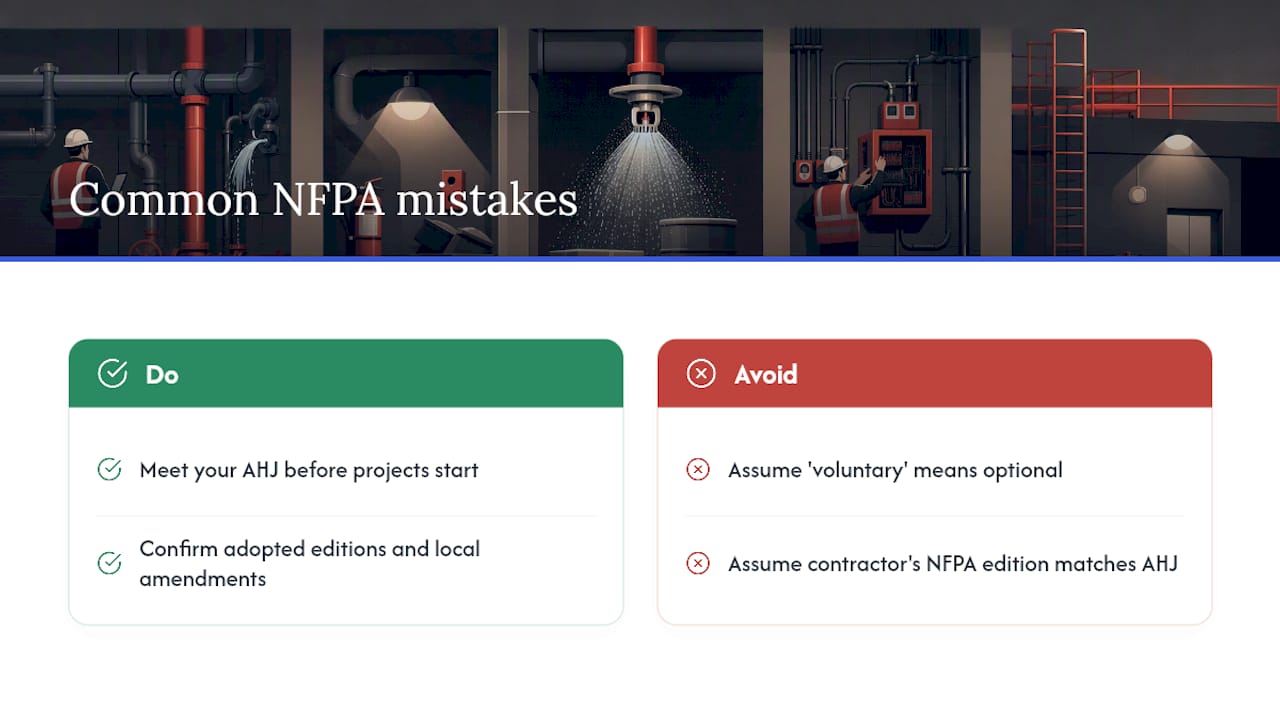
The most persistent misconception is treating “voluntary standard” as a synonym for “optional.” It is not. A standard that has not been adopted by your jurisdiction can still be used against you in court, and OSHA can cite you under the General Duty Clause using an unadopted NFPA standard as evidence that a recognized hazard-mitigation method existed and you ignored it.
The second mistake is assuming the edition your contractor knows is the edition your AHJ enforces. A facility in Texas had a sprinkler retrofit quoted and designed to the current NFPA 13 edition. The local jurisdiction had adopted an earlier edition with different head-spacing requirements. The discrepancy was caught at final inspection, requiring partial redesign and a four-week delay before occupancy was approved. The cost was not the redesign itself but the lost revenue during the delay.
Build a direct relationship with your AHJ before a project starts, not after a failed inspection. Most fire marshals will meet with facility managers informally to confirm applicable editions and flag known local amendments. That conversation costs nothing and routinely prevents the kind of rework described above.
Reliable-fire-protection handles the compliance work for you
Knowing which NFPA standards apply is one thing. Having systems designed, installed, and documented to the correct edition is another. Reliable-fire-protection is a Houston-based fire protection company that handles the full compliance cycle: inspections, system design, installation, retrofits, and the testing documentation your insurer and AHJ will ask for.
Where most property owners get stuck is the gap between knowing a standard applies and having a certified contractor who knows the local adopted edition and the AHJ’s specific expectations. Reliable-fire-protection works directly with Houston-area AHJs and covers fire alarm systems, sprinkler systems, suppression systems, fire extinguishers, and backflow preventers under one roof. If your building needs fire alarm system services or a sprinkler inspection aligned to NFPA 25, contact Reliable-fire-protection for a free quote and get the documentation your next inspection requires.
Where to read NFPA standards and track updates
Accessing the actual text of NFPA standards requires some navigation. Here are the most reliable sources:
- NFPA Codes and Standards main page: Lists all active documents with free read-only access to many of them. Purchasing a standard gives you a downloadable, searchable PDF.
- NFPA Standards Development Process page: Shows which standards are currently in revision and at what stage. Subscribe to email alerts here.
- Congressional Research Service report R47665: A nonpartisan federal analysis of how model codes and standards, including NFPA and ICC documents, are used by federal agencies and jurisdictions. Useful for understanding the federal layer of compliance.
- USFA/FEMA analysis on NFPA enforceability: Documents how courts and investigators treat NFPA standards as evidence of standard of care. Worth reading before any litigation or insurance dispute.
- Your local fire marshal’s office: The only authoritative source for which edition is currently enforced in your jurisdiction and what local amendments apply. No website replaces this call.
One practical note on access: NFPA relies on document sales for operating revenue, which means the standards you are legally required to follow are not always free to read. The free online viewer covers most documents but restricts printing and copying. For any standard central to your building’s systems, purchasing the current edition is worth the cost.
Sources
- How NFPA Standards Are Made, Enforced, and Accessed – LegalClarity
- NFPA and OSHA: Roles, Overlap, and Compliance Rules – LegalClarity
- Recommendation or Regulation: Analysis of the Enforceability of the National Fire Protection Association Standards on the Merced Fire Department – USFA (FEMA)
- Standards development process | NFPA
- Codes and standards | NFPA
- R47665 – Congressional Research Service product
- NFPA Standards Key Codes Updates and Global Fire Safety Impact – Fire & Safety Journal Americas