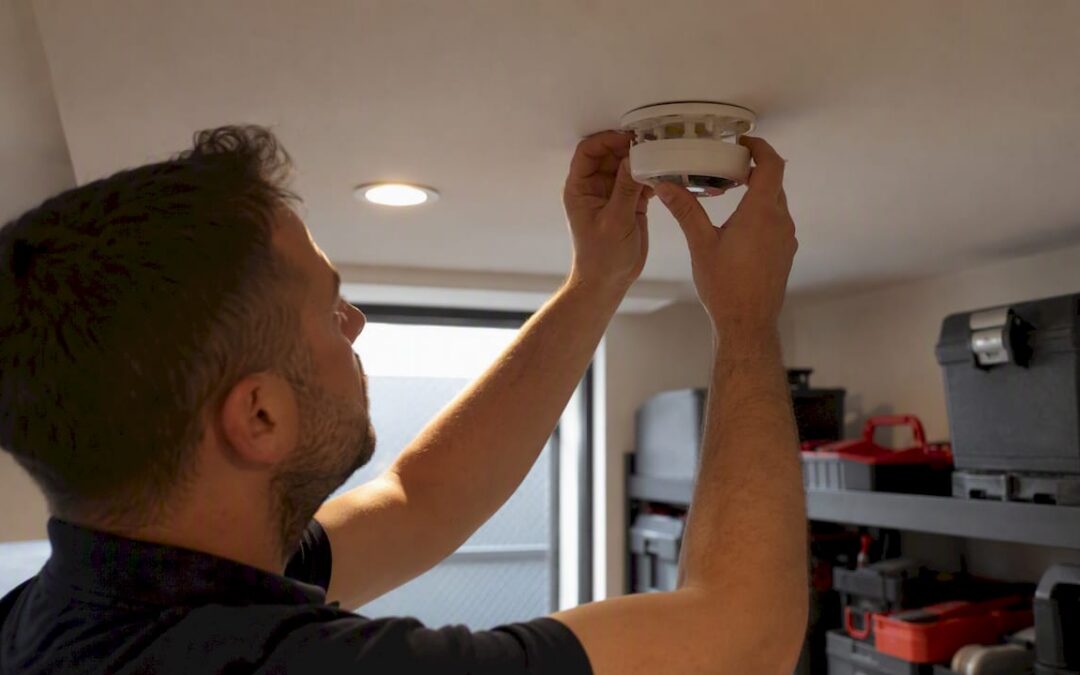
Certified fire-protection technicians are the credentialed specialists who perform system layout, shop drawings, inspection, testing, maintenance (ITM), installation support, and emergency repairs on life-safety systems. Under NFPA 72 and the guidance of the Authority Having Jurisdiction (AHJ), professional credentialing — primarily NICET certification — is the primary evidence of competency the AHJ looks for. Before any technician touches your system, request three things: their NICET wallet card or certificate number, confirmation of factory training on your specific installed equipment, and copies of any shop drawings or PE review letters the project requires.
Before work begins, verify:
- NICET certification level and discipline (Fire Alarm Systems or Inspection and Testing of Fire Alarm Systems)
- NFPA CFAITMS credential for ITM-focused roles
- Factory/manufacturer training certificates for the specific equipment installed
- Shop drawings stamped or reviewed by a licensed Professional Engineer (P.E.) where the project scope requires it
- Acceptance test protocols and criteria in writing
Key Takeaways
Certified fire-protection technicians reduce owner liability, speed AHJ acceptance, and keep life-safety systems code-compliant when their credentials, factory training, and deliverables are properly verified and documented.
| Point | Details |
|---|---|
| Verify NICET level before hiring | Request the certificate number and confirm it at nicet.org; require Level III/IV for layout and shop drawings. |
| Require factory training certificates | NICET credentials alone do not guarantee competency on proprietary equipment; factory training fills that gap. |
| Demand a full deliverables package | Contracts must specify shop drawings, PE review letter (where required), acceptance test reports, and as-built drawings. |
| Engage a P.E. for design-affecting work | Any modification to the original permitted design or occupancy change requires engineer review to protect owner liability. |
| Reliable-fire-protection delivers documented compliance | Every project includes NICET credentials, factory training records, PE coordination when required, and signed test reports. |
Table of Contents
- What does a certified fire-protection technician actually do?
- How does a licensed P.E. differ from a NICET-certified technician?
- Which certifications should you actually require?
- How to verify credentials before hiring or accepting work
- What your contracts and close-out deliverables must include
- How certified technicians reduce your compliance and liability exposure
- When can a technician work without P.E. review?
- Why Reliable-fire-protection prioritizes certified technicians
- Reliable-fire-protection: request a quote with credentials built in
- Sources
What does a certified fire-protection technician actually do?
The role of certified technicians spans the full project and maintenance lifecycle, but the specific tasks depend on certification level and system type.
Routine and project tasks:
- System layout and shop drawings: Translating the engineer’s design intent into field-ready drawings. NICET certification at an advanced level is the recognized threshold for this work.
- Equipment selection and material submittals: Confirming that specified devices meet design and code requirements.
- Installation support: Supervising or performing device placement, wiring, and panel programming.
- Acceptance testing: Running the full test sequence against NFPA 72 criteria and documenting results.
- Inspection, testing, and maintenance (ITM): Periodic functional tests, sensitivity checks, and preventive maintenance. NICET’s Inspection and Testing of Fire Alarm Systems credential is specifically built for this work and widely accepted by AHJs.
- Troubleshooting and emergency repair: Diagnosing faults, replacing failed components, and restoring system function.
Routine visual checks — verifying that pull stations are unobstructed, extinguishers are in place, and sprinkler heads are undamaged — can be handled by trained facility staff. Functional testing, sensitivity calibration, and annual comprehensive inspections require NICET-certified contractors with calibrated equipment and documented credential capture on completion.
| System Type | Key Technician Tasks | Minimum NICET Level Typical |
|---|---|---|
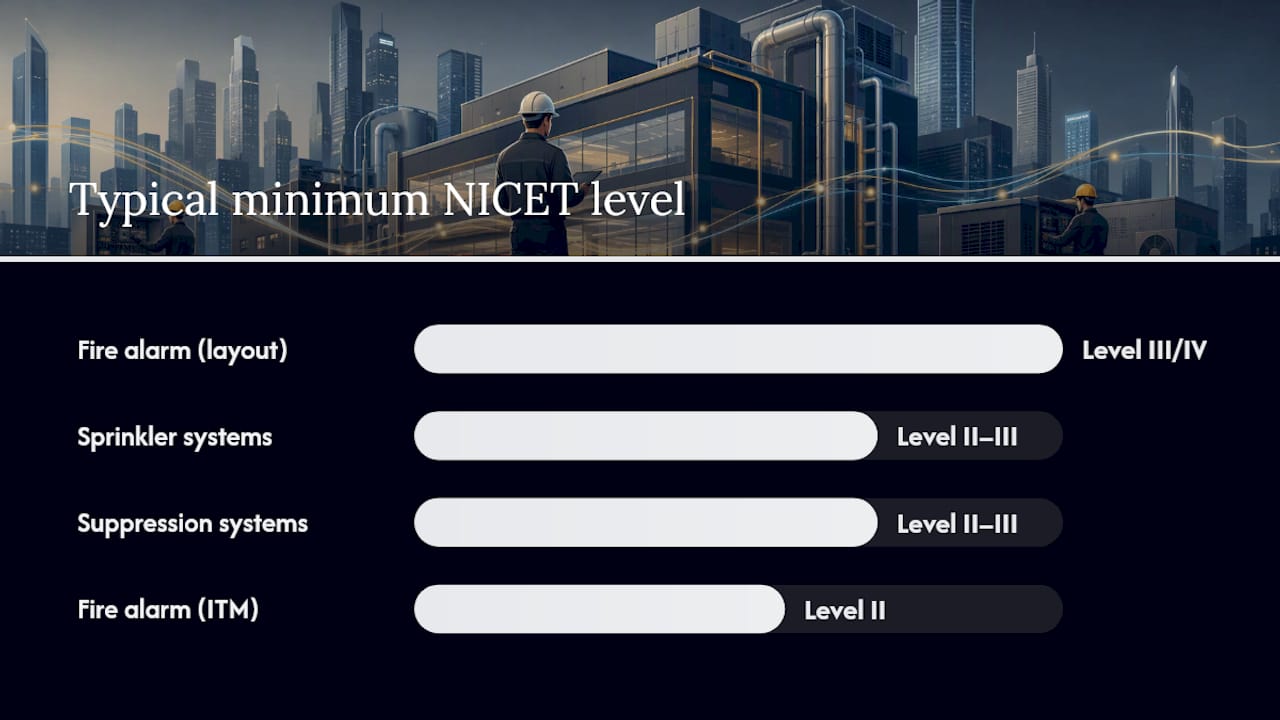
| Fire alarm systems | Layout, shop drawings, installation, acceptance testing, ITM | Level II (ITM); Level III/IV (layout/drawings) |
| Water-based sprinkler systems | Hydraulic calculations support, installation, flow tests, ITM | Level II–III |
| Suppression systems | Design support, installation, agent discharge tests, ITM | Level II–III |
| Portable extinguishers | Annual inspection, hydrostatic testing, recharging | Manufacturer/state certification |
How does a licensed P.E. differ from a NICET-certified technician?
The boundary is clear and legally significant. A licensed Professional Engineer holds responsibility for the original design: the performance objectives, the code-compliance basis, and the sealed documents submitted for permit. A NICET-certified technician implements that design — preparing shop drawings, selecting equipment, supporting installation, and performing testing — all under the engineer’s direction and subject to the engineer’s review.
The SFPE/NSPE/NICET joint position states this directly: Level III/IV technicians are qualified to perform system layout and prepare shop drawings based on the engineer’s design, while the engineer remains responsible for the original design and review. Technicians must not assume the role of the engineer.
Tasks that stay with the P.E.:
- Preparing and sealing the original design documents
- Establishing performance criteria and code-compliance basis
- Reviewing and approving technician-prepared shop drawings
- Signing off on design modifications that affect system performance
Tasks technicians may perform (with PE review where required):
- Preparing shop drawings and material submittals
- Performing system layout consistent with the engineer’s design
- Conducting acceptance tests and documenting results
- Performing all ITM activities
Shop drawings prepared by a technician do not always require a P.E. stamp, but the engineer must review and approve them for compliance with the original design. That review may appear as a letter or a stamp, depending on jurisdiction and project scope.
Pro Tip: On any project that touches the original permitted design — even a partial renovation — ask the contractor whether a P.E. review letter is required in your jurisdiction before work starts. Getting that answer after the fact costs far more than asking upfront.
Which certifications should you actually require?
NFPA 72 guidance and AHJ practice treat professional credentialing as the primary evidence of competency. For facility managers, three credential categories matter most.

| Credential | Who It’s For | What It Qualifies | Recertification |
|---|---|---|---|
| NICET Fire Alarm Systems (Levels II–IV) | Installation and design-support technicians | Layout, shop drawings, installation, acceptance testing (Level III/IV for layout) | Every 3 years via continuing professional development (CPD) |
| NICET Inspection and Testing of Fire Alarm Systems | ITM-focused technicians | Periodic inspection, testing, and maintenance | Every 3 years via CPD |
| NFPA CFAITMS | ITM specialists applying NFPA 72 | Validates NFPA 72 application for inspection, testing, and maintenance | Professional development points every 3 years |
NICET advanced certification levels require an exam, documented work history, and a personal recommendation — not just a test pass. That rigor is why local, state, and federal jurisdictions commonly require or accept NICET certification for fire protection work.
Factory training sits alongside these credentials, not below them. A technician certified by NICET but untrained on your specific panel brand may still misconfigure sensitivity settings or miss proprietary diagnostic codes. Require factory training certificates for the exact equipment installed, not just general brand familiarity.
How to verify credentials before hiring or accepting work
A credential that exists on paper but cannot be confirmed is no credential at all. Use this sequence before any contractor starts work.
Immediate verification steps:
- Request the technician’s NICET wallet card or certificate number and verify it directly at nicet.org.
- Confirm CFAITMS status through NFPA’s certification verification portal if the scope includes ITM.
- Ask for factory training certificates — manufacturer name, course title, completion date, and technician name must all appear.
- Confirm the contractor’s state license (where required) and any local AHJ registration.
Documents to require before work starts:
- Shop drawings (stamped or with PE review letter where required)
- Material submittals with cut sheets for all specified devices
- Acceptance test protocols and pass/fail criteria
- Maintenance plan covering ITM frequency and scope
Questions to ask during bidding:
- “What NICET level and discipline does the lead technician hold?”
- “Who prepared the shop drawings, and has a P.E. reviewed them?”
- “What factory training does your team hold for this panel and detection equipment?”
- “What does your acceptance test report include, and who signs it?”
Pro Tip: Create a single credentialing file for each project: scanned NICET cards, factory training certificates, PE review letters, and signed test reports. AHJ inspectors and insurance auditors will ask for exactly this package, and having it organized saves hours.
What your contracts and close-out deliverables must include
A contract that references “qualified technicians” without specifying credentials is unenforceable when something goes wrong. Tie every requirement to a named standard or credential.
Non-negotiable contract clauses:
- Scope tied explicitly to the approved design documents and permit drawings
- Required NICET level and discipline for the lead technician (state it by name)
- Factory training requirement for all installed equipment brands
- Acceptance test procedures referencing NFPA 72 criteria
- PE review/approval letter or stamp requirement (state when it applies)
- Record retention period for all deliverables (minimum five years is common practice)
Close-out deliverables checklist:
- As-built drawings reflecting actual field conditions
- Signed acceptance test report with pass/fail results for every device
- Material submittals and cut sheets for installed equipment
- Technician credentialing records (NICET cards, factory training certificates)
- Maintenance plan with ITM schedule and scope
- Warranty documentation for equipment and labor
- Training records if staff received system-operation training
A fire alarm installation guide for Houston property managers outlines the typical deliverable sequence from submittal through final acceptance — useful as a reference when drafting scope language.
How certified technicians reduce your compliance and liability exposure
AHJs do not simply accept a contractor’s word. Under NFPA 72, professional credentialing is the primary evidence of competency the AHJ evaluates. A technician who cannot produce a current NICET card or equivalent credential creates an immediate inspection problem — and potentially a failed acceptance test that delays occupancy.
The compliance and liability benefits of certified technician responsibilities stack up quickly:
- AHJ acceptance: Credentialed technicians reduce plan-review friction and speed permit approval. Many jurisdictions require NICET certification explicitly.
- Insurance alignment: Documented credentials and signed test reports give insurers evidence that the system was installed and maintained to code — relevant when a claim is filed.
- Owner liability reduction: When a certified technician performs and documents work correctly, liability for system failure shifts toward the contractor, not the owner. Understand the full scope of fire safety liability before signing any service contract.
- Code compliance continuity: NICET and CFAITMS recertification requirements mean the technician’s knowledge stays current with code cycles — a passive benefit owners rarely consider until a code change creates a compliance gap.
When can a technician work without P.E. review?
Some jurisdictions permit technician-only layouts for pre-engineered systems, small projects, or minor modifications where the original design is not affected. This is a state and local determination, not a universal rule.
Common exceptions where technician-only work may be permitted:
- Pre-engineered systems with manufacturer-provided design templates
- Minor device relocations within an existing, permitted layout
- Replacement-in-kind maintenance that does not alter system performance
Risk factors that should always trigger P.E. involvement:
- Any modification to the original permitted design
- Occupancy changes that affect hazard classification or coverage requirements
- Performance-based design elements (non-prescriptive approaches)
- Life-safety-critical systems in high-occupancy or high-hazard facilities
- Projects where the AHJ specifically requests engineer involvement
The absence of a P.E. does not reduce the owner’s exposure — it often increases it. If a system fails and no engineer reviewed the design or shop drawings, the owner bears a larger share of the liability. Confirm your local AHJ’s specific requirements before accepting a proposal that omits P.E. coordination.
Why Reliable-fire-protection prioritizes certified technicians
Certification is not a checkbox at Reliable-fire-protection. Every technician on a project carries current NICET credentials and factory training on the specific equipment being installed or serviced. When a project scope requires P.E. coordination — a major renovation, a performance-based design, or an AHJ that specifically requires engineer review — Reliable-fire-protection coordinates that engagement so facility managers do not have to track it separately.
What managers receive on every project: documented NICET credentials, factory training certificates, shop drawings with appropriate PE review, signed acceptance test reports, and a maintenance plan. The deliverables package is built to satisfy AHJ inspections and insurance audits without follow-up requests.
Reliable-fire-protection: request a quote with credentials built in
Reliable-fire-protection covers the full scope Houston facility managers need: NICET-certified installation and ITM, factory-trained technicians for fire alarms, sprinklers, suppression systems, extinguishers, and advanced detection, plus PE coordination when the project requires it.
When you request a quote, specify: NICET level required for the lead technician, factory training on your installed equipment brands, shop drawings with PE review option, acceptance testing per NFPA 72, and a close-out deliverables package. Every one of those items is standard at Reliable-fire-protection, not an add-on.
Start with the fire alarm system services page for alarm-specific work, or visit the products and services catalog for a full overview. Request your free quote today and specify your credentialing requirements upfront.
Sources
- Fire Alarm Systems – NICET
- Inspection and Testing of Fire Alarm Systems – NICET
- CFAITMS program overview (NFPA)
Always confirm your local AHJ’s specific credentialing requirements and request manufacturer factory training documentation for any equipment-specific work before signing a service contract.