
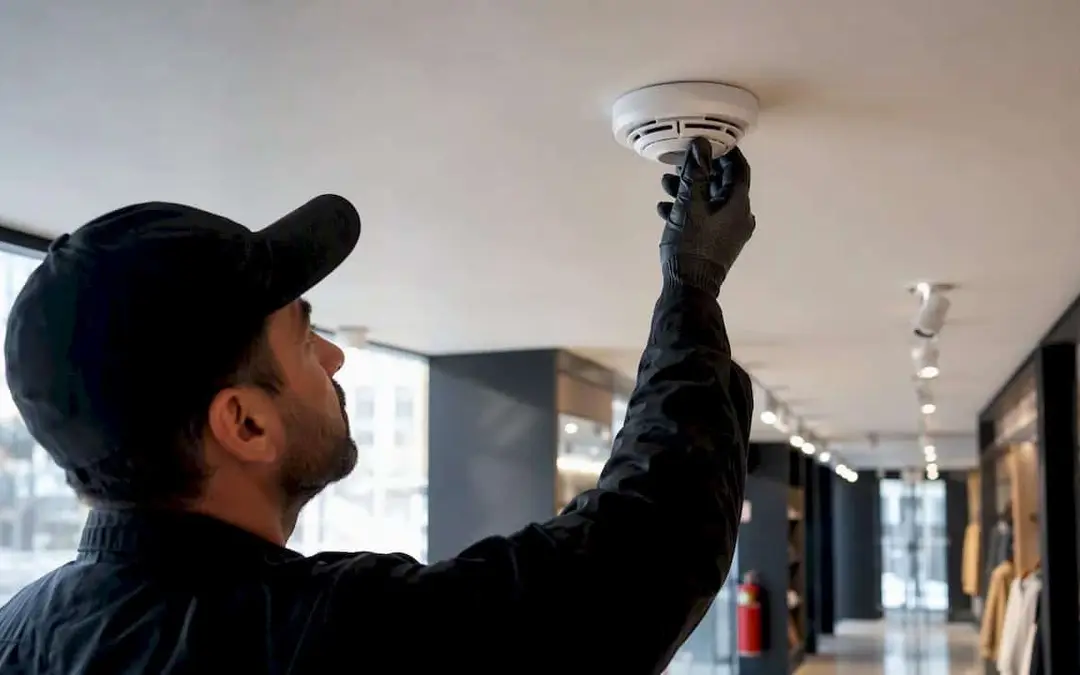
Early detection of fires is the single most effective life-safety measure available to building owners, facility managers, and homeowners. NFPA data shows that roughly 3 out of 5 home fire deaths occur in homes with no working smoke alarms or alarms that failed to operate. Three actions matter most right now:
- Confirm coverage and interconnection. Every sleeping room, the area outside each sleeping area, and every level of your building needs a working alarm. Interconnected alarms mean that when one sounds, all sound.
- Test every device today. Press the test button on each unit. A device that does not respond needs immediate replacement.
- Schedule a professional inspection. Functional testing alone does not confirm a detector is operating within its listed sensitivity range. An inspection and testing and maintenance (ITM) visit, governed by NFPA 72, closes that gap.
The sections below tie each action to the standards behind it: NFPA 72 for system design and ITM, UL 217 and UL 268 for device listings, and NIST research on detector response limits.
Key Takeaways
Working smoke alarms, properly placed and professionally maintained, reduce fire death rates by roughly 60% compared with homes and buildings where alarms are absent or fail to operate.
| Point | Details |
|---|---|
| Working alarms cut death rates | NFPA data shows roughly a 60% lower death rate per 1,000 fires in homes with working alarms versus those without. |
| Under 2 minutes to evacuate | USFA guidance states you may have less than 2 minutes after an alarm sounds, making early detection and interconnection non-negotiable. |
| Device type and placement drive performance | Ionization, photoelectric, heat, and aspirating detectors each suit different spaces; NFPA 72 and NIST findings govern spacing and selection. |
| ITM must include sensitivity verification | Functional tests alone miss detectors operating outside their listed sensitivity range; NFPA 72 ITM schedules require periodic verification. |
| Reliable-fire-protection covers the full scope | Houston-based inspection, installation, advanced detection design, and 24/7 emergency response with code-compliant ITM for residential and commercial properties. |
Table of Contents
- Why early detection matters: the evidence behind the numbers
- How detectors sense fire and where they fall short
- What placement rules and codes require you to follow
- How to keep detectors working: testing, ITM, and recordkeeping
- Commercial risk strategy: monitoring, closed-hours alerting, and suppression integration
- When do you need aspirating, beam, or multisensor detection?
- Your detection action plan: this week, this month, this year
- Technical note: how detector response modeling works and its limits
- Reliable-fire-protection’s perspective on getting detection right
- Reliable-fire-protection: fire detection services for Houston properties
- Sources
Why early detection matters: the evidence behind the numbers
The numbers are stark. NFPA research covering 2018–2022 found that working smoke alarms reduce the death rate per 1,000 reported home structure fires by a significant margin compared with homes that lack working alarms. That gap is not a design flaw or a statistical quirk. It reflects what happens when detection fails: occupants do not know a fire has started until conditions are already dangerous.
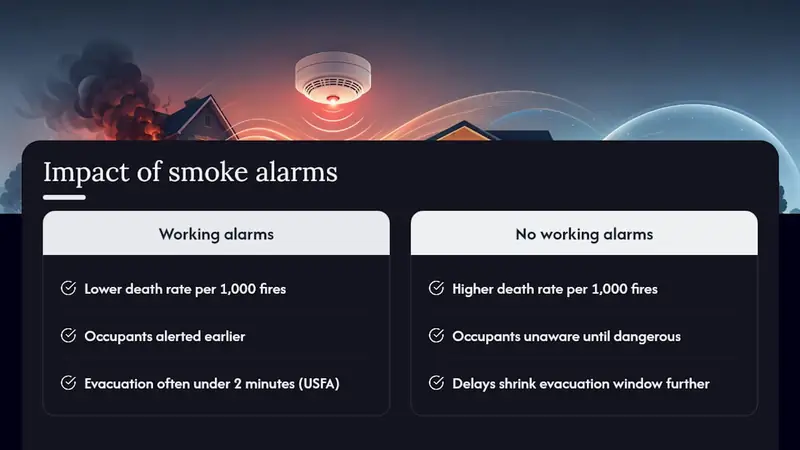
The USFA frames the urgency plainly: once a smoke alarm sounds, you may have less than a few minutes to get everyone outside. Two minutes sounds like enough time. In a building with long corridors, mobility-limited occupants, or sleeping residents behind closed doors, it often is not. Every second of detection delay shrinks that window further.
For commercial properties, the stakes extend beyond occupant safety. A fire that starts after closing hours and goes undetected for even a few minutes can destroy inventory, equipment, and records that no insurance policy fully replaces. Early detection paired with monitored alarm systems gives emergency services the lead time to limit that damage.
How detectors sense fire and where they fall short
No single detector type catches every fire equally well. Understanding the differences helps you choose the right device for each space rather than defaulting to whatever was cheapest at the supply house.
Common detector types:
- Ionization smoke detectors respond faster to fast-flaming fires with small combustion particles.
- Photoelectric smoke detectors detect larger smoke particles from slow, smoldering fires more reliably and are generally less prone to nuisance alarms near kitchens.
- Heat detectors (fixed-temperature and rate-of-rise) activate at a set temperature or a rapid temperature climb; they do not detect smoke at all, making them suitable for dusty or steamy environments where smoke detectors would false-alarm constantly.
- Multisensor detectors combine two or more sensing technologies to reduce false alarms while maintaining sensitivity.
- Aspirating smoke detection (ASD) systems actively draw air samples through a pipe network to a central detector, providing very early warning in spaces like data centers or clean rooms.
- Beam detectors project an infrared beam across large open spaces and trigger when smoke obscures it, covering areas where spot detectors would require impractical numbers of units.
What affects how fast any detector responds? NIST research shows that smoke detector alarm conditions depend on particle size and optical scattering properties, making smoke detector response more complex and less deterministic than thermal detector response. Ceiling height and airflow compound this. In a high-bay warehouse, smoke may stratify well below the ceiling before rising enough to reach a spot detector. NFPA research confirms that detector spacing must often be reduced as ceiling height increases to maintain reliable detection times.
Pro Tip: In mixed-use buildings with both office areas and kitchen or mechanical spaces, specify photoelectric detectors in sleeping and living areas and heat detectors in high-humidity or cooking zones. Combining them on an interconnected system gives you the benefits of both without the nuisance-alarm problem that drives occupants to disable devices.
What placement rules and codes require you to follow
NFPA placement guidance is specific, not aspirational. Alarms belong inside every sleeping room, outside each separate sleeping area, and on every level of a residence, including the basement. Interconnection is the standard that turns individual alarms into a system: when the detector in the basement activates, every alarm in the building sounds simultaneously.
“Install smoke alarms inside every sleeping room, outside each separate sleeping area, and on every level of the home, including the basement. Interconnect all smoke alarms throughout the home so that when one sounds, they all sound.”
— NFPA Smoke Alarm Safety Tips
For commercial and multi-family properties, NFPA 72 is the governing standard for system design, device placement, wiring, monitoring, and ITM. Device listings matter too: UL 217 covers standalone smoke alarms, while UL 268 applies to smoke detectors used within fire alarm systems. Specifying a UL 217-listed device in a system that requires UL 268 compliance is a code deficiency, not a minor paperwork issue.
The International Building Code (IBC) and International Fire Code (IFC) add occupancy-specific requirements. Sleeping areas in hotels, dormitories, and healthcare facilities may require 520-Hz low-frequency audible signals to wake occupants who do not respond to standard 3,100-Hz tones. High-rise buildings typically require emergency voice/alarm communication systems with paging zones.
Your local Authority Having Jurisdiction (AHJ) interprets and enforces all of this. When code language is ambiguous for your occupancy type, the AHJ’s written interpretation is what matters in an inspection. Get it in writing before you finalize a design. For Houston-specific placement guidance, the smoke alarm placement tips resource covers common pitfalls in local building types.
How to keep detectors working: testing, ITM, and recordkeeping
A detector that passes a functional test may still be operating outside its listed sensitivity range. ITM best practices, including sensitivity verification, are documented by organizations like BFAAM and referenced in NFPA 72: devices can trigger during a push-button test yet respond too slowly or too quickly to actual smoke conditions. Sensitivity verification catches that gap.
| Task | Frequency | Who performs it |
|---|---|---|
| Functional test (push-button) | Monthly | Occupant or facility staff |
| Battery replacement (non-sealed units) | Annually or per manufacturer | Facility staff |
| Full-device functional test with documentation | Quarterly (commercial) | Facility staff or contractor |
| Sensitivity verification | Per NFPA 72 schedule (typically at 1 year, then every 2 years) | Licensed fire alarm contractor |
| Professional ITM inspection | Annually (minimum) | Licensed fire alarm contractor |
| Device replacement | Per manufacturer or at 10 years (smoke alarms) | Licensed contractor |
Recordkeeping is not optional for commercial properties. NFPA 72 requires written records of all inspections, tests, and maintenance. Those records protect you during AHJ inspections, insurance audits, and, in the worst case, post-incident investigations. A gap in the log is treated as a gap in the program.
For a structured maintenance approach, the fire alarm maintenance tips for property managers resource covers task frequency and documentation in detail. Older buildings undergoing renovation also face detection gaps during construction phases; renovation safety considerations are worth reviewing before any retrofit project begins.
Commercial risk strategy: monitoring, closed-hours alerting, and suppression integration
Fire alarms in business occupancies serve two distinct time windows: occupant evacuation when the building is open and remote alerting to emergency services when it is closed. A system that handles only one of those functions is half a risk-control measure.
“Fire alarm systems in business occupancies provide early detection for occupant evacuation during open hours and can alert emergency services during closed hours, reducing property and inventory loss.”
— Minnesota Department of Public Safety
Monitoring integration is the mechanism that makes closed-hours protection work. A central station receives the alarm signal, verifies it, and dispatches the fire department, often before any employee is aware a fire has started. For facilities with high-value inventory, server rooms, or irreplaceable records, that response-time advantage translates directly into reduced loss.
Linking detection to suppression systems adds another layer. When an addressable alarm system identifies the exact initiating device, suppression can be targeted to the affected zone rather than activating building-wide. That precision matters in occupied spaces and in facilities where water damage from an untargeted suppression response would be as costly as the fire itself.
Facility managers should add three items to every risk register: confirmed monitoring contract with 24/7 central station coverage, documented suppression-to-detection integration testing, and a notification appliance audit confirming that audible and visible devices meet code requirements for every occupancy zone.
When do you need aspirating, beam, or multisensor detection?
Standard spot detectors are the right tool for most spaces. They are not the right tool for all spaces.
High-ceiling warehouses, distribution centers, and manufacturing floors present a stratification problem: smoke rises, cools, and spreads horizontally before it reaches ceiling-mounted spot detectors. Field guidance from practitioners warns against relying on duct detectors as substitutes for open-area detection in these environments and recommends matching detector type to the space’s airflow patterns and combustible loading.
IT rooms and data centers need very early warning before smoke concentrations reach levels that would trigger a standard detector, because by that point equipment damage has already begun. Aspirating systems sample air continuously and can detect smoke at concentrations far below the threshold of a conventional spot detector.
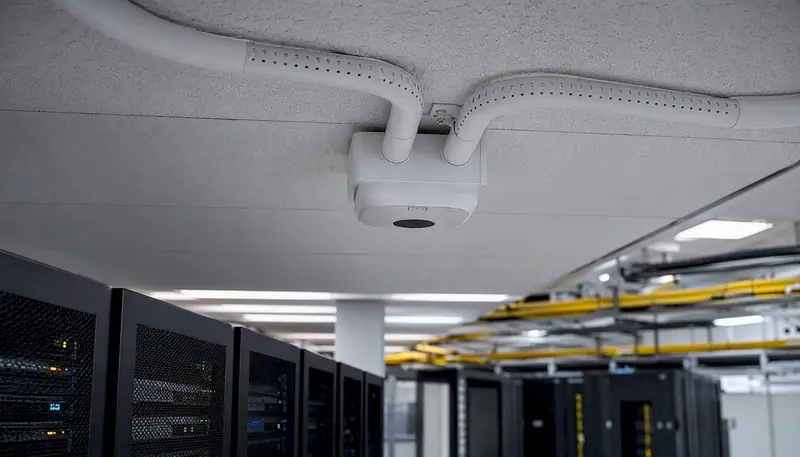
Museum and gallery spaces, cold-storage facilities, and spaces with unusual fuel loads (foam, plastics, flammable liquids) all have fire signatures that may not match the assumptions built into standard detector spacing tables.
Pro Tip: When evaluating an advanced detection proposal, ask the contractor for the system’s sensitivity reporting capability and its false-alarm mitigation strategy. A system that generates frequent nuisance alarms will be disabled by frustrated occupants, which defeats the entire purpose. Verified sensitivity data and a documented commissioning test are non-negotiable deliverables.
For a detailed breakdown of aspirating, beam, and multisensor options, the advanced detection systems guide covers selection criteria and application examples.
Your detection action plan: this week, this month, this year
This week
- Walk every floor and confirm a working alarm is present inside each sleeping room, outside sleeping areas, and on every level.
- Press the test button on every device. Replace any unit that does not respond.
- Verify that alarms are interconnected: activating one should trigger all others.
- Confirm your monitoring company’s current contact information and test the signal transmission.
This month
- Run a full functional test of every device and document the results in your maintenance log.
- Replace batteries in any non-sealed units, even if they appear to be working.
- Check that no detector is within 10 feet of a cooking appliance or in a location subject to steam or exhaust that would cause nuisance alarms.
- Review your commercial fire alarm checklist against your current system documentation.
This year
- Schedule a professional ITM inspection with a licensed fire alarm contractor. Confirm the scope includes sensitivity verification for smoke detectors where NFPA 72 requires it.
- For any space with ceilings above 15 feet, request an engineering review of detector spacing.
- Ask your contractor two questions: “Are all devices currently within their listed sensitivity range?” and “Are there any zones where coverage does not meet NFPA 72 requirements?” A contractor who cannot answer both questions clearly is a red flag.
- If your building has undergone renovation, confirm that detection coverage was restored in any area where devices were temporarily removed or disabled during construction.
Technical note: how detector response modeling works and its limits
Professionals estimating how quickly a detector will respond to a given fire use analytical models, the most established of which is DETACT-T2. NIST and NBS research describes these methods: DETACT-T2 and related NFPA 72E table-based approaches estimate heat detector activation times under t-squared fire growth assumptions, accounting for ceiling height, detector RTI, and activation temperature. The models are reliable for unobstructed flat ceilings with predictable fire growth.
Smoke detector response modeling is less precise. Particle size, optical properties of the smoke, and airflow all affect when a photoelectric or ionization detector reaches its alarm threshold. No single model captures all of those variables with the same confidence that thermal models achieve for heat detectors.
When does this matter practically? Any space where ceiling height, unusual geometry, high airflow, or critical occupancy makes the difference between a model-predicted response time and an actual response time consequential. Data centers, high-bay storage, atria, and facilities with life-safety-critical operations all warrant engineering analysis rather than default spacing tables. Engaging a fire protection engineer for those spaces is not a luxury; it is the only way to confirm that the detection system will perform as intended.
Reliable-fire-protection’s perspective on getting detection right
The gap between a code-compliant system on paper and a system that actually performs under fire conditions is where most detection failures live. A building can pass an AHJ inspection and still have detectors operating outside their sensitivity range, coverage gaps in renovated areas, or monitoring contracts that have lapsed. Houston’s building stock makes this worse: high-ceiling mixed-use buildings, older warehouses converted to office or retail use, and hospitality properties with complex occupancy patterns all present detection challenges that standard residential-grade thinking does not address.
What Reliable-fire-protection consistently finds in the field is that owners and managers who schedule annual professional ITM, not just functional tests, catch these problems before they become incidents. Sensitivity verification, zone-by-zone coverage audits, and suppression-to-detection integration checks are the three items most often missing from a maintenance program that otherwise looks complete on paper.
It applies to every occupancy type. The question for any building owner is not whether early detection matters. It is whether the system installed in their building will actually deliver it when it counts.
Reliable-fire-protection: fire detection services for Houston properties
Reliable-fire-protection brings code-knowledgeable fire alarm installation, ITM inspection, advanced detection design, and 24/7 emergency response to residential and commercial properties across Houston and surrounding neighborhoods. The difference from a generalist contractor is specificity: every inspection includes sensitivity verification where NFPA 72 requires it, every installation is designed against the occupancy’s actual code requirements, and every monitoring integration is tested before the job is closed out.
Services include fire alarm system installation and replacement, smoke and heat detector ITM, aspirating and beam detection design for high-ceiling and critical spaces, suppression system integration, and monitoring setup. Certifications and 24/7 emergency response mean that when something goes wrong outside business hours, a qualified technician responds, not an answering service.
The next step is a free site assessment. A technician reviews your current coverage, identifies any sensitivity or placement gaps, and gives you a written scope before any work begins. Request your assessment or explore how fire alarm systems work to understand what a properly designed system looks like for your property type.
Sources
Use these references to go deeper on code language, modeling methods, and operational guidance:
- Smoke alarms safety tips – NFPA
- Smoke alarms in US home fires — NFPA research summary
- Smoke alarms – U.S. Fire Administration (USFA)
- Fire alarms for businesses | Minnesota Department of Public Safety
- Evaluating thermal fire detection systems — NIST/NBSIR