
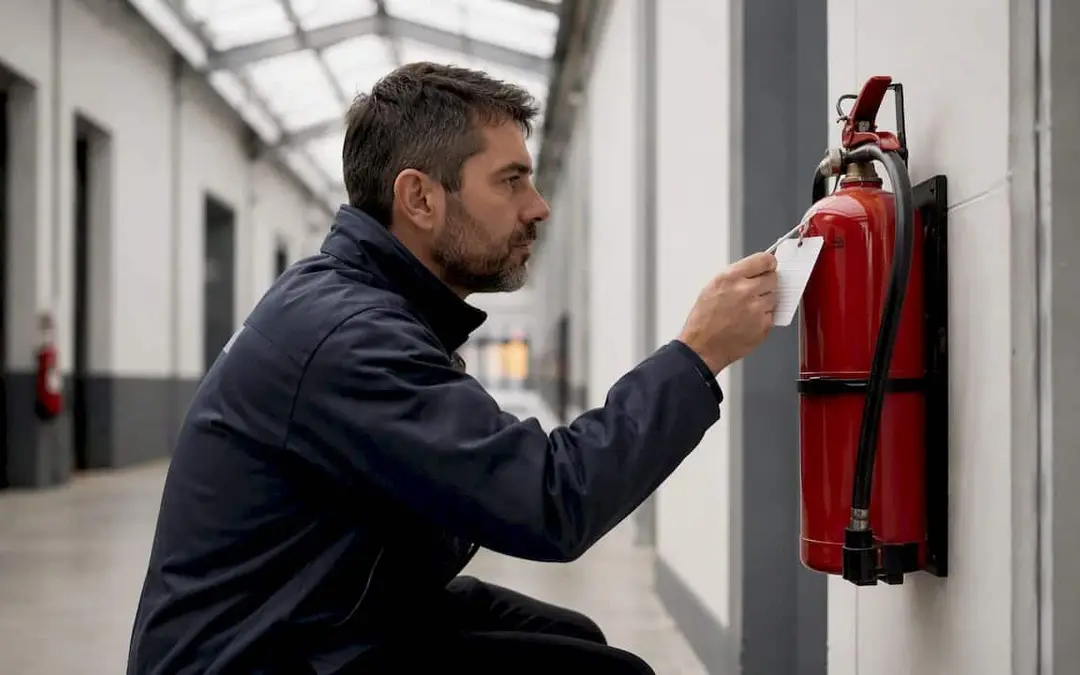
Under 29 CFR 1910.157, employers who provide portable fire extinguishers for employee use must select, place, inspect, maintain, test, train employees on, and document every unit. That obligation covers general industry. Construction sites fall under 29 CFR 1926.150, which carries its own distribution rules. One important caveat: if your written fire safety policy requires immediate, total evacuation on alarm and you have a compliant Emergency Action Plan (EAP) and Fire Prevention Plan (FPP), you may qualify for an exemption from most of 1910.157’s distribution requirements. Most workplaces do not qualify, and the rest of this guide explains exactly what you need to do if yours is one of them.
Key Takeaways
OSHA’s portable fire extinguisher rules require employers to select, place, inspect, maintain, test, train on, and document every unit when employees are expected to use them, with monthly visual checks and annual certified maintenance as the non-negotiable baseline.
| Point | Details |
|---|---|
| Monthly inspections are mandatory | Reducing to quarterly is not acceptable; OSHA’s 2006 interpretation letter confirms monthly is the regulatory floor. |
| Travel distances are hard limits | 75 ft for Class A hazards, 50 ft for Class B, measured along the walking path, not a straight line. |
| Hydrostatic testing has fixed intervals | Dry chemical stored-pressure units require internal examination every 6 years and hydrostatic testing every 12 years. |
| Training records must exist | Initial and annual training for designated users; a dated log with attendee signatures is required documentation. |
| Reliable-fire-protection | Provides certified inspection, maintenance, hydrostatic testing, and training for Houston commercial facilities. |
Table of Contents
- What OSHA fire extinguisher requirements actually cover
- How to select the right extinguisher for each hazard
- Where extinguishers must be placed and how far apart
- Inspection, maintenance, and hydrostatic testing schedules
- Training requirements and your emergency action plan
- Special hazards and when portable extinguishers are not enough
- Your practical OSHA compliance checklist
- What we see in the field: the compliance mistakes that keep showing up
- Reliable-fire-protection handles the compliance work for you
- Sources
What OSHA fire extinguisher requirements actually cover
The standard applies to any workplace where portable extinguishers are provided and employees are expected or permitted to use them. That covers the vast majority of commercial, industrial, and institutional facilities in the U.S.
Who is covered:
- General industry employers under 29 CFR 1910.157(a)
- Construction contractors under 29 CFR 1926.150
- State-plan states (about half of U.S. states run their own OSHA programs) must adopt standards at least as protective as federal OSHA; verify your state’s specific rules if you operate in California, Michigan, or another state-plan state
Common exemptions and narrowing conditions:
- Employers with a written evacuation-only policy, a compliant EAP under 29 CFR 1910.38, and a compliant FPP under 29 CFR 1910.39 may be exempt from distribution, training, and maintenance requirements under 1910.157(b)
- Extinguishers provided solely for use by a trained fire brigade (not general employees) narrow the training obligation
- Local fire codes and insurance policies often require extinguishers regardless of the OSHA exemption; the exemption does not override those requirements
Pro Tip: An evacuation-only policy eliminates OSHA’s extinguisher training and maintenance burden, but check your lease, local fire code, and property insurer before removing units. Many commercial leases and municipal codes require extinguishers independently of OSHA.
The OSHA evacuation eTool is a practical starting point for confirming which requirements apply to your specific workplace configuration.
How to select the right extinguisher for each hazard
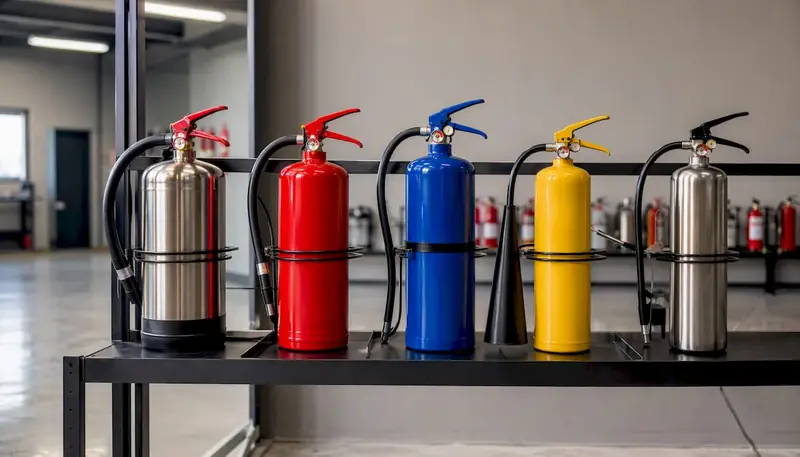
Fire class determines which extinguisher you need. Putting the wrong agent on the wrong fire makes things worse, not better.
Fire classes at a glance:
- Class A: Ordinary combustibles (wood, paper, cloth, plastics). Most office and warehouse spaces.
- Class B: Flammable and combustible liquids and gases (gasoline, paint, solvents). Garages, paint booths, fuel storage areas.
- Class C: Energized electrical equipment. Server rooms, electrical panels, manufacturing lines.
- Class D: Combustible metals (magnesium, titanium, sodium). Machining and metalworking operations.
- Class K: Cooking oils and fats. Commercial kitchens and foodservice operations.
Extinguisher ratings tell you the size of fire the unit can handle. A 2A rating means the unit is equivalent to roughly 2.5 gallons of water on a Class A fire. A 10B rating means it can cover 10 square feet of a Class B fire. A 2A:10B:C label means the unit handles all three classes at those respective capacities.
| Rating | Class covered | Typical application |
|---|---|---|
| 2A:10B:C | A, B, C | General office, retail, light manufacturing |
| 4A:60B:C | A, B, C | Warehouses, auto shops, larger floor areas |
| 10B:C | B, C | Flammable-liquid storage, fuel areas |
| Class K (wet chemical) | K | Commercial kitchens |
| Class D (dry powder) | D | Metal machining, grinding operations |
OSHA explicitly prohibits carbon tetrachloride and chlorobromomethane extinguishing agents in occupied workplaces. If you have older units with either agent, remove them from service immediately. For a deeper look at agent types and unit configurations, the types of fire extinguishers guide breaks down each option in plain language.
Where extinguishers must be placed and how far apart
Travel distance is the most commonly cited placement violation. OSHA measures distance along the normal walking path, not a straight line across the floor.
Travel-distance limits:
- Class A hazards: 75 feet or less to any extinguisher
- Class B hazards: 50 feet or less to any extinguisher
- Class D hazards: The extinguisher must be within the immediate work area where combustible metal operations occur, close enough to the hazard to ensure quick access
- Class K: Within a short and safe distance of the cooking appliance, according to NFPA 10 guidance that OSHA defers to
Under 29 CFR 1926.150, construction sites require 2A-rated extinguishers distributed to adequately cover the protected building area, with travel distances limited to a reasonable maximum as specified in the regulation.
Mounting and visibility rules:
- Extinguishers weighing 40 lbs or less: mount so the handle is no higher than 5 feet above the floor
- Extinguishers weighing more than 40 lbs: mount so the handle is no higher than 3.5 feet above the floor
- Minimum 4-inch clearance from the floor for all units
- Mount on brackets, in cabinets, or on shelving designed for the purpose; never set units directly on the floor where they can be knocked over or hidden
- Place units along normal paths of travel and near exits where possible
- Use signage or overhead markers where units are not immediately visible; obstruction by equipment, shelving, or stored materials is a citable violation
Pro Tip: Walk your facility with a tape measure and a floor plan once a year. Furniture moves, storage grows, and a unit that was compliant in January can be blocked or over-distance by June.
Inspection, maintenance, and hydrostatic testing schedules
This is where most facilities fall short. The monthly visual inspection requirement is not optional, and OSHA’s 2006 interpretation letter makes clear that reducing inspections to quarterly is not acceptable without a formal variance. Monthly is the floor.
Monthly visual inspection
Each month, a designated employee checks every unit for:
- Correct location and unobstructed access
- Pressure gauge in the operable range (green zone)
- Safety pin and tamper seal intact
- No visible damage, corrosion, or leakage
- Legible labels and operating instructions
- Full weight (for non-gauge units, a weight check or heft test)
- Nozzle or horn free of blockage
Initial the tag or log with the date. That record is your first line of defense in an OSHA inspection.
Annual maintenance
A qualified technician must perform a thorough examination of each unit every 12 months. This goes beyond the visual check: the technician verifies mechanical parts, extinguishing agent, and expelling means are all in operating condition. Per 1910.157’s maintenance requirements, the date of annual maintenance must be recorded on a tag attached to the extinguisher and retained for one year (or for the life of the shell for hydrostatic test records). Stored-pressure extinguishers generally do not require internal examination at the annual maintenance interval.
Hydrostatic testing and internal examinations
OSHA’s Table L-1 specifies testing intervals by extinguisher type. Key intervals:
| Extinguisher type | Internal examination | Hydrostatic test |
|---|---|---|
| Dry chemical, stored pressure | Every 6 years | Every 12 years |
| CO2 | Not required at annual | Every 5 years |
| Wet chemical (Class K) | Every 6 years | Every 5 years |
| Pressurized water | Every 5 years | Every 5 years |
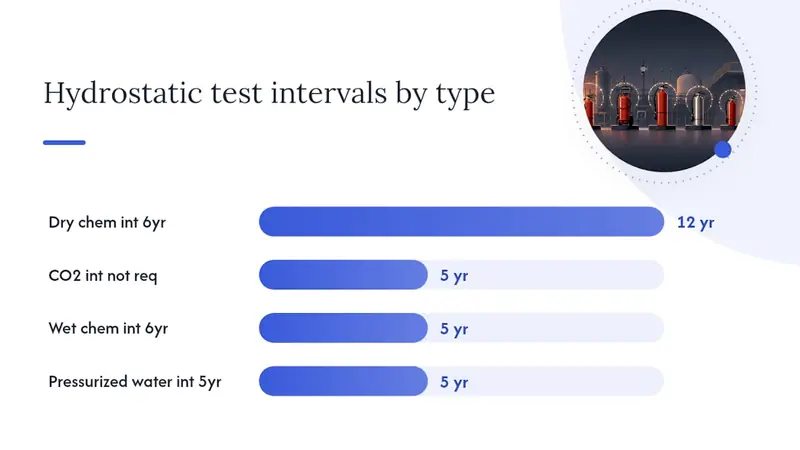
Hydrostatic test records must include the test date, the technician’s signature, and the extinguisher’s serial number or identifier. Those records stay with the unit until it is retested or removed from service.
OSHA defers to NFPA 10 as the recognized industry standard for inspection and maintenance procedures. Following NFPA 10’s checklists satisfies OSHA’s procedural expectations, and most certified technicians use NFPA 10 as their working reference. For a step-by-step maintenance workflow, the Houston fire extinguisher maintenance guide covers recordkeeping templates and scheduling cadence.
Recordkeeping summary:
- Monthly inspection: initials and date on tag or log; no formal retention period specified, but keep at minimum until the next inspection
- Annual maintenance: tag on unit; retain records for one year
- Hydrostatic test certification: retain until next test or unit retirement
- All records must be available to the OSHA Assistant Secretary upon request
Training requirements and your emergency action plan
OSHA requires that employees designated to use extinguishers receive initial training before they are expected to fight a fire and at least annual refresher training thereafter. Employees who work in areas where extinguishers are present but are not designated to use them must receive a general educational program covering the location of units, the hazards of incipient-stage fire, and when to evacuate instead of attempting suppression.
What training must cover for designated users:
- General principles of fire extinguisher operation
- The hazards of fighting incipient-stage fires (smoke inhalation, flashover risk, blocked egress)
- How to select the correct agent for the fire class present
- Hands-on operation: PASS technique (Pull, Aim, Squeeze, Sweep)
- When to stop fighting and evacuate
Documentation to record for each training session:
- Date of training
- Names and signatures of attendees
- Name and credentials of the instructor
- Topics and methods covered (classroom, hands-on, video)
- Equipment used for demonstration
Your EAP and FPP directly shape training scope. If your policy designates a specific fire response team rather than all employees, only that team needs hands-on training. If your policy is evacuation-only, you may eliminate the hands-on requirement entirely, though the general educational program for all employees still applies when extinguishers are present.
Training and documentation gaps are among the most common findings in OSHA fire-safety inspections. A missing training log is just as citable as a missing extinguisher.
Special hazards and when portable extinguishers are not enough
Some situations require more than a standard ABC unit on a wall bracket.
Class D combustible metals:
Class D extinguishers are required in any work area where combustible metal machining, grinding, or processing generates metal powders or shavings at least once every two weeks. The extinguisher must be in the immediate work area, not down the hall. No standard travel-distance number applies; proximity to the specific operation is the requirement. The agent must match the specific metal: a dry powder rated for magnesium will not work on sodium. Confirm the agent-to-metal match before purchasing.
Fixed systems as alternatives:
A fixed suppression system (sprinkler, CO2, or clean-agent system) can substitute for portable Class A extinguisher coverage in some configurations. OSHA allows standpipe and hose systems to satisfy Class A distribution requirements when the system is properly maintained and accessible. If you manage a facility with a fire sprinkler system, confirm with your AHJ (Authority Having Jurisdiction) whether it satisfies the portable extinguisher distribution requirement for Class A hazards.
When extinguishers are removed from service:
Any unit pulled for hydrostatic testing, repair, or inspection must be replaced with a spare of equivalent rating during the service period. A fire watch may be required depending on the hazard level and local code. Document the removal, the replacement unit placed, and the return date.
Pro Tip: The decision rule for employees is simple: if the fire is larger than a wastebasket, or if you are not between the fire and the exit, evacuate. Portable extinguishers are for incipient-stage fires only. Electrical hazards, like those described in electrical safety guidance, can escalate quickly and are often better handled by evacuation than suppression.
Your practical OSHA compliance checklist
Use this as your working audit tool. Walk through it at least once a year and after any facility change.
Selection and placement
- Identify every fire class present in each area of the facility
- Confirm extinguisher ratings match the hazard classes in each zone
- Verify travel distances: 75 ft for Class A, 50 ft for Class B, immediate area for Class D
- Check mounting heights: handle at or below 5 ft (units ≤40 lbs) or 3.5 ft (units >40 lbs)
- Confirm 4-inch minimum floor clearance for all units
- Verify no unit is blocked by equipment, shelving, or stored materials
- Confirm signage or overhead markers are in place where units are not immediately visible
Monthly visual inspection log
Each entry should capture:
- Date of inspection
- Extinguisher ID or serial number
- Location (room, zone, or asset tag)
- Inspector initials
- Pass/fail for each checklist item
- Corrective action taken and date resolved
Pro Tip: Attach a QR code sticker to each extinguisher that links to its digital inspection record. Technicians scan and log on a phone; no paper tag to lose, and the record is timestamped automatically. Several CMMS platforms support this workflow out of the box.
Annual maintenance and hydrostatic testing schedule
- Schedule annual maintenance with a certified technician at least 30 days before the anniversary date
- Maintain a master log of every unit’s last annual maintenance date, last hydrostatic test date, and next due date
- Keep spare units on hand for rotation during service periods
- Assign a single person (internal safety manager or contracted vendor) as the accountable owner for the schedule
Training schedule
- Conduct initial training for all new designated users before they are assigned fire response duties
- Schedule annual refresher training; tie it to a fixed calendar date (e.g., first week of October) so it does not drift
- File training records in a dedicated binder or digital folder, organized by year
For a ready-to-use fire extinguisher compliance checklist with printable templates, Reliable-fire-protection has a seven-step checklist built for Houston-area commercial properties that maps directly to 1910.157’s requirements.
What we see in the field: the compliance mistakes that keep showing up
The most common OSHA fire extinguisher citations are not exotic. They are the same four problems, facility after facility.
Missing or incomplete monthly tags top the list. The regulation is clear, the task takes two minutes per unit, and yet tags are routinely blank, undated, or missing entirely. The fix is simple: assign a named person, put it on a recurring calendar reminder, and audit the tags yourself once a quarter.
Improper mounting heights come up constantly in warehouses and manufacturing facilities where units get relocated during equipment moves. A unit that ends up on a shelf at six feet, or sitting on the floor behind a pallet, fails on two counts simultaneously.
Undocumented hydrostatic tests are a slower-moving problem. A unit that has never been tested or whose test records were lost is a liability in an inspection and a physical risk in a fire. The 12-year interval for dry chemical stored-pressure units sounds distant until you realize many facilities have units that have been on the wall since the building opened.
Training gaps are the easiest to overlook because they are invisible until an inspector asks for records. A verbal briefing during onboarding does not satisfy the requirement. A dated log with attendee signatures does.
These are not difficult problems to fix. They are scheduling and documentation problems, not technical ones. A professional audit identifies every gap in a single site visit and produces a remediation plan with specific due dates. That is exactly the kind of structured review Reliable-fire-protection performs for commercial clients across Houston.
Reliable-fire-protection handles the compliance work for you
Staying current with OSHA fire extinguisher requirements means monthly inspections, annual maintenance by a certified technician, hydrostatic testing on schedule, and training records that hold up to an audit. That is a lot of moving parts for a safety manager already managing a full facility.
Reliable-fire-protection provides certified annual maintenance, hydrostatic testing, monthly inspection workflows, and hands-on employee training for commercial and industrial clients throughout Houston. On a first visit, the team conducts a full site audit, documents every unit’s location, rating, and service history, and delivers a recommended maintenance and testing schedule with clear due dates. Every service visit produces documentation formatted to meet OSHA’s recordkeeping requirements.
For equipment selection, placement audits, or a complete fire extinguisher inspection and maintenance program, contact Reliable-fire-protection for a free quote. If your facility also needs sprinkler system compliance support, the team covers sprinkler inspection and maintenance under the same service umbrella.
Sources
The following primary sources were used throughout this guide. Verify current regulation text directly with OSHA before making compliance decisions, as standards are subject to revision.
- Inspecting and maintaining fire extinguishers. | Occupational Safety and Health Administration
- 1910.157 – Portable fire extinguishers.
This article is general information, not a substitute for advice from a qualified lawyer. Consult a qualified legal professional about your own circumstances before acting on anything here.