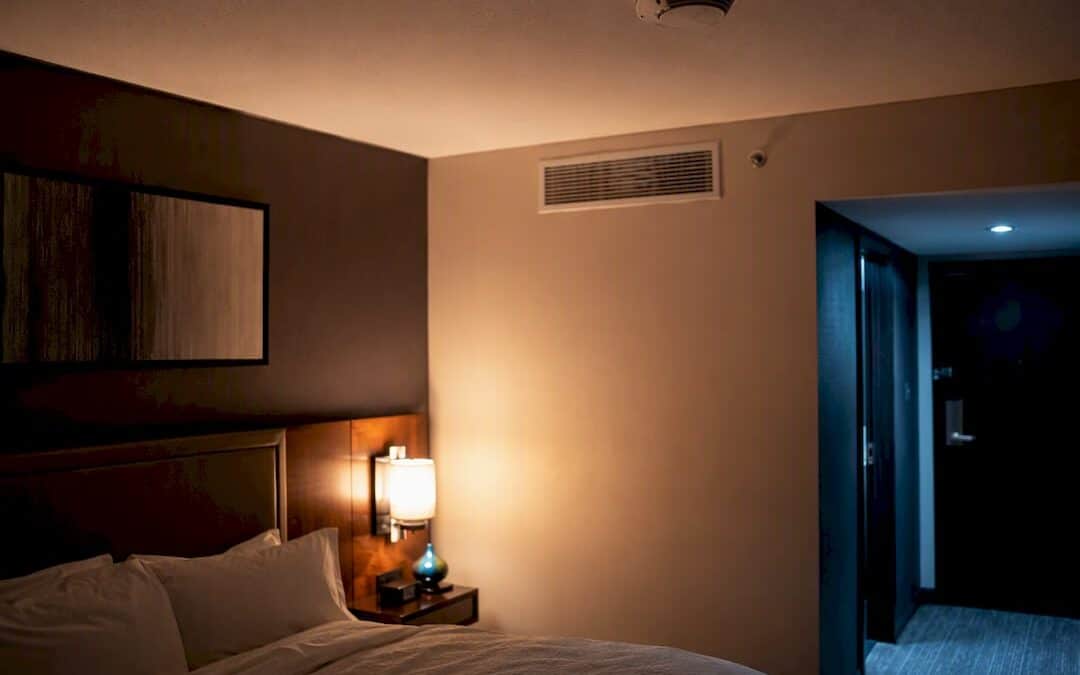
Hotels in the United States must meet the smoke detection and notification requirements set by the adopted model codes, primarily NFPA 72 and NFPA 101, plus whatever amendments your state or city has layered on top. Coverage generally extends to guest rooms, corridors, stairwells, and elevator lobbies. Sleeping areas typically need 520 Hz low-frequency notification and ADA-compliant visual alarms. None of it is optional, and the Authority Having Jurisdiction decides how it applies to your property.
TL;DR:
- Most hotels must install addressable, system-connected smoke detectors in guest rooms and corridors unless the building layout provides a specific exemption.
- Detection at stair enclosures and elevator lobbies is generally required for early warning and smoke control, especially in mid-rise and high-rise buildings.
- Using 520 Hz low-frequency alarms in sleeping areas significantly improves wake-up rates for hearing-impaired or otherwise at-risk guests.
- Compliance hinges on accurate device inventories, scheduled testing, and detailed records, with digital logs reducing citation risks.
- Local amendments and state regulations often add requirements beyond national codes, making jurisdiction-specific review essential.
Table of Contents
- Hotel Smoke Detector Requirements: The Codes That Actually Govern Your Property
- Where Smoke Detectors Are Actually Required in a Hotel
- Device Types and Notification Rules You Can’t Skip
- Testing, Sensitivity Checks, and the Records Inspectors Will Ask For
- State and Local Variation: Why Your Address Changes the Rules
- A Compliance Checklist You Can Actually Run This Month
- The Gap Between Code Compliance and Actual Safety
- How Reliable-fire-protection Handles Hotel Smoke Detector Compliance
- Sources
Hotel Smoke Detector Requirements: The Codes That Actually Govern Your Property
Two NFPA standards do most of the heavy lifting. NFPA 72, the National Fire Alarm and Signaling Code, governs how alarm systems detect, signal, and get tested. NFPA 101, the Life Safety Code, decides where detection has to exist in the first place and how it ties into egress planning for sleeping occupants. Think of NFPA 101 as the map of what needs coverage, and NFPA 72 as the rulebook for how that coverage has to perform once installed.
The International Building Code (IBC) and International Fire Code (IFC) sit alongside these standards, and most states adopt one edition or another with local amendments attached. That’s the piece a lot of operators miss: nothing here is automatically national law. A model code only becomes enforceable once a state or municipality adopts it, often with tweaks. Federal law adds one more layer. 15 U.S.C. § 2225 requires hard-wired, single-station smoke detectors in places of public accommodation, installed per NFPA 74 or its successor standard, which is now incorporated into NFPA 72.
Practically, that means your compliance obligation is a stack, not a single document:
- NFPA 101 for where detection and egress protections are required
- NFPA 72 for how detection, signaling, and testing must perform
- IBC/IFC as adopted locally, often with amendments
- Federal statute for baseline public-accommodation detector requirements
- Your state fire marshal or local AHJ for the final, binding interpretation
If you operate in more than one state, do not assume the rules transfer. Adoption dates and amendment language vary enough that a property compliant in Texas can fall short of a different state’s amended code on day one.
Where Smoke Detectors Are Actually Required in a Hotel
Placement rules aren’t uniform across a hotel property. Different zones carry different requirements, and getting this wrong is one of the more common ways operators fail an inspection.
- Guest rooms. New construction under Group R-1 occupancy generally requires system smoke detectors wired into the building’s fire alarm panel rather than standalone battery units. Industry guidance on hotel occupancy makes clear that modern builds specify addressable, system-type detectors with in-room sounder bases, giving you both local notification and supervised signaling back to the panel.
- Corridors. Interior corridors serving sleeping rooms need automatic smoke detection unless an exception applies, most commonly a motel-style layout with direct exterior egress from each room. Code commentary on Group R-1 requirements spells out this exception clearly, and it’s worth checking against your building’s actual egress design before you assume you qualify for it.
- Stair enclosures. Detection at stairwell landings supports both early warning and smoke control, particularly in mid-rise and high-rise properties where stairs double as the primary evacuation route.
- Elevator lobbies. These typically require detection tied to elevator recall functions, since smoke in a lobby has to trigger the cab to bypass that floor automatically.
- Laundry and mechanical rooms. These spaces often call for heat detection instead of smoke detection, since dust, steam, and combustion byproducts trigger nuisance alarms on smoke-sensing devices. A smoke versus heat detector comparison is worth reviewing before you spec these areas.
Spacing and ceiling clearance follow the layout tables in NFPA 72, and those tables account for ceiling height, HVAC airflow, and beam or joist obstructions. Don’t eyeball spacing based on a neighboring property’s layout. Pull the actual table for your ceiling configuration.
Device Types and Notification Rules You Can’t Skip
Choosing the right device isn’t just about passing inspection. It’s about whether a sleeping guest actually wakes up when it matters. Standard smoke alarms emit a high-frequency tone that a lot of sleepers, especially those with hearing loss, don’t register as urgency. NFPA and the NFPA’s own guidance on low-frequency signaling point to 520 Hz square-wave tones as significantly more effective at rousing sleeping occupants, which is why code increasingly requires them in sleeping areas.
A few distinctions matter when you’re specifying equipment:
- System smoke detectors connect to a central fire alarm panel, support supervision (the panel knows if a device is offline), and generally include emergency power backup through the panel itself.
- Single- or multiple-station alarms operate independently, often on battery or standalone AC power, and lack supervision, which is why most new hotel construction has moved away from relying on them alone.
- ADA notification appliances need visual strobes rated for the room’s candela requirement and, where applicable, tactile devices like bed shakers for accessible sleeping rooms.
Pro Tip: If you’re weighing a retrofit budget, prioritize 520 Hz devices in every sleeping room before you upgrade anything cosmetic. Liability exposure concentrates almost entirely around notification failures during sleeping hours, not daytime false alarms.
Properties considering a system upgrade should look at addressable fire alarm system architecture as the baseline for new hotel construction and major renovations alike.
Testing, Sensitivity Checks, and the Records Inspectors Will Ask For
NFPA 72 sets specific testing intervals, and missing one of them is the single most common reason hotels get cited during inspection. Quarterly testing covers supervisory signals. Semi-annual testing applies to smoke detectors in elevator lobbies specifically. Annual testing covers the full system. Sensitivity testing runs on its own schedule to confirm detectors haven’t drifted out of their calibrated range from dust or age.
Documentation matters as much as the testing itself. Every test record needs to show:
- The device’s address or physical location
- The test result, pass or fail, with any corrective action noted
- The identity of the technician who performed the test
- The date, retained on file for the AHJ’s next inspection cycle
According to inspection compliance data from the hospitality sector, documentation gaps, not equipment failures, drive most citation activity. Properties get flagged for overdue sensitivity tests or missing on-site records far more often than for a detector that physically failed. That’s a fixable problem with the right process, not an equipment budget line.
The pattern worth noticing: operators that move to digital maintenance logs report meaningfully fewer citations than those still relying on paper binders in a back office, largely because a digital system flags an overdue test before an inspector does. Our fire alarm maintenance guidance covers how to set that calendar up correctly the first time.
State and Local Variation: Why Your Address Changes the Rules
Model codes are a starting point, not a finish line. Every state, and often every municipality within it, adopts a specific code edition and layers its own amendments on top. The AHJ, whether that’s a local fire marshal or a state-level fire safety office, has final say on how those amendments apply to your specific building.
Oregon offers a useful example of how far state amendments can go beyond the baseline model code. Oregon Revised Statute 479.255 requires hotels to provide at least one smoke alarm designed for guests who are hard of hearing, plus one door-knock device for every several dozen rooms, and to post conspicuous notice that these accommodations exist. Nothing in the base model codes spells that out in that level of detail. It’s a state legislature deciding public accommodation law needs to go further.
Before you assume your property is covered, take these steps:
- Check your state fire marshal’s published code adoption bulletin for the current edition in effect
- Search your city or county’s local code amendment library, which is often a separate document from the state code
- Request a plan review directly from your AHJ before a renovation or system upgrade, rather than after
A Compliance Checklist You Can Actually Run This Month
Turning code language into daily operations is where most of the actual work happens. Here’s a sequence that gets a property from “probably fine” to “provably compliant.”
- Inventory every device, room by room. Log device type, power source, and network address if it’s part of an addressable system. A commercial property compliance checklist gives you a template to start from.
- Build a testing calendar tied to NFPA 72 intervals. Quarterly, semi-annual, and annual tests each need their own trigger date, with sensitivity testing scheduled separately.
- Assign retention rules for every test record. Decide now how long records stay on file and where, so nothing gets lost between staff turnover.
- Lock in a vendor contract for scheduled inspections. A standing service agreement removes the risk of a missed interval sitting on someone’s to-do list.
- Train front-desk staff on annunciation procedures. Whoever’s at the desk when a panel signals an alarm needs to know exactly what that signal means and what to do next.
- Label and log accessible rooms. Rooms with ADA visual or tactile devices need clear records showing which units have them installed.
Pro Tip: Assign one staff member as the system’s point of contact with your service vendor. Split accountability across shifts is how quarterly tests quietly slip to five months without anyone noticing.
The Gap Between Code Compliance and Actual Safety
Most hotel operators treat fire code as a checklist to clear once a year. That’s backwards, and it’s the single biggest gap we see across properties of every size. A system can pass every NFPA 72 test on paper and still fail the guest who needed it at 2 AM, because the device in the room was a standalone battery alarm with a high-frequency tone nobody heard over a running air conditioner.
The properties that avoid trouble aren’t necessarily the ones with the newest equipment. They’re the ones with clean, current records and a system that’s supervised rather than assumed to be working. Missing test documentation, unsupervised in-room alarms, and skipped sensitivity checks account for the overwhelming majority of citation activity we see, not equipment that’s genuinely failed. An addressable system upgrade paired with a digital maintenance log closes most of that gap in one move, because the system tells you when something’s wrong before an inspector does.
The fix isn’t complicated. It’s disciplined. Scheduled service agreements, digital logs instead of paper binders, and a device inventory someone actually owns.
— Results
How Reliable-fire-protection Handles Hotel Smoke Detector Compliance
Getting every guest room, corridor, and elevator lobby to code doesn’t have to mean piecing it together yourself. Reliable-fire-protection runs compliance surveys specifically for hospitality properties, mapping your current device inventory against NFPA 72 and NFPA 101 requirements before a citation ever shows up.
Our team handles fire alarm installation for hotel-specific system architecture, ongoing NFPA 72 testing with full documentation, and maintenance contracts that keep your sensitivity testing schedule on track without a staff member having to chase it down. We also install ADA-compliant visual and tactile notification devices for accessible rooms, and can walk you through how fire alarm systems actually function so your management team understands what you’re maintaining, not just paying for. For properties considering integrated safe and room-security upgrades alongside detection work, partners like American Security’s in-room safes round out a full guest-room safety package.
If your last inspection turned up a gap, or you’re not sure your current records would survive one, request a free compliance quote and we’ll schedule a walkthrough.
Sources
- Fire Alarm 411: Retail Spaces & Hotels and Condos | Security Info Watch
- Hotel Fire Safety Inspection Checklist: NFPA Compliance for Every Property | Oxmaint
- 15 U.S.C. § 2225 | Fire prevention and control guidelines for…
- Oregon Revised Statute 479.255 – Smoke alarm or smoke detector required in certain structures
- Group R-1 hotel and motel automatic smoke detection system | UpCodes