If your building’s occupancy or size requires a fire alarm system under the adopted building or fire code, that system almost always has to be monitored off-site too. IBC Section 907.6.6 sets the trigger, and NFPA 72 spells out how that monitoring has to work. Local adoption can shift the details, so the first call always goes to your Authority Having Jurisdiction, or AHJ.
TL;DR:
- Most buildings with occupancy or size triggers must have off-site monitored fire alarm systems, especially for high-rise, institutional, educational, or storage facilities.
- NFPA 72 requires alarm signals to reach the fire department within one to two minutes and mandates distinct responses for alarm, supervisory, and trouble signals.
- The most common compliance issue is improper monitoring handoff, which can be avoided by scheduling live signal tests during pre-inspections.
- Monitoring pathways should be supervised IP, cellular, or licensed radio, with dual-path systems preferred to ensure continuous coverage.
- Regular ITM (inspection, testing, maintenance) schedules include monthly receiver tests, quarterly device verification, and annual full system inspections, all documented thoroughly.
Table of Contents
- When Is Fire Alarm Monitoring Required Under Code?
- What Does NFPA 72 Require for Monitored Systems?
- Which Type of Supervising Station Fits Your Building?
- What Communication Pathways Does NFPA 72 Allow?
- What Are the Power and Backup Requirements?
- What Are the ITM Schedules for Monitored Systems?
- How Do You Confirm Compliance With Your AHJ?
- Reliable-fire-protection’s Take on Monitoring Compliance
- Ready for a Monitoring Compliance Review?
- Sources
When Is Fire Alarm Monitoring Required Under Code?
Two questions decide this, in order. First: does your local jurisdiction’s adopted edition of the International Building Code or International Fire Code require a fire alarm system for your occupancy classification at all? Second, only after that: what does NFPA 72 demand for monitoring that system? Property managers frequently start at the second question and skip the first, which leads to either over-building a system nobody required or missing a trigger entirely.
IBC Chapter 9 ties the alarm requirement to occupancy type and occupant load, and those thresholds are where most buildings get pulled into monitoring obligations. Common triggers include assembly occupancies that reach a threshold occupant load, such as banquet halls, theaters, and large restaurants.
- High-rise buildings, regardless of occupancy type, because vertical evacuation changes the risk calculus entirely.
- Institutional occupancies, including hospitals, nursing homes, and correctional facilities.
- Educational occupancies above certain size thresholds, and most hotels, motels, and dormitories.
- Storage and industrial occupancies that are regularly occupied, even if lightly staffed.
One- and two-family homes typically fall outside these rules and rely on standalone smoke alarms instead of a monitored system. Some jurisdictions also allow a constantly attended, on-site location to receive alarm signals in place of an off-premises supervising station, but that’s the exception, not the default, and it needs explicit AHJ sign-off.
What Does NFPA 72 Require for Monitored Systems?
Once a fire alarm system is required, NFPA 72’s Chapter 26 and related chapters govern how monitoring actually functions. The code separates signals into three categories, and each one triggers a different response:
- Alarm signals indicate an active fire condition and demand immediate notification to the fire department.
- Supervisory signals flag a problem with a suppression or detection component, like a closed sprinkler valve, that needs attention but isn’t an active fire.
- Trouble signals report system faults, wiring issues, or low battery conditions that threaten reliability but aren’t emergencies.
NFPA 72 governs retransmission methods of signals to supervising stations, such as by zone, individual point, or event, influencing the information detail available to responders. The code requires prompt transmission to the fire department communications center with specified maximum timeframes, typically within a minute or two. A supervising station generally cannot let a premise contact the fire department directly except under narrow, AHJ-approved arrangements, according to ESA’s monitoring guidance. That retransmission step is the entire point of monitoring: it’s the difference between an alarm that rings in an empty office and one that reaches a dispatcher.
Which Type of Supervising Station Fits Your Building?
Not every building needs the same monitoring setup, and NFPA 72 recognizes three distinct models.
- Central station: A third-party facility, typically listed to UL 827, that monitors signals from many buildings simultaneously and handles reporting and recordkeeping. This is the default for the vast majority of commercial and residential properties.
- Proprietary supervising station: Owned and operated by the property itself, common on large campuses, industrial complexes, or hospital systems where a dedicated staff already monitors other building systems around the clock.
- Remote supervising station: Often used for municipal or specific jurisdictional acceptance requirements, where signals route to a station operated by or for the local government.
For most owners, central station service is both the simplest and most defensible choice to an AHJ or insurer. Look for UL 827 listing, 24-hour staffing, redundant power at the station itself, and documented recordkeeping practices. Those four items are what an inspector or underwriter will ask about first, and a station that can’t produce them quickly is a station worth reconsidering.
What Communication Pathways Does NFPA 72 Allow?
Fire alarm monitoring used to run almost exclusively over a digital alarm communicator transmitter, or DACT, riding a dedicated telephone line, often called an MFVN, or municipal fire alarm voice network line. That copper infrastructure is disappearing fast, and standard VoIP service often fails to meet the supervision and reliability characteristics NFPA 72 expects from an MFVN connection, a gap ESA has flagged as a growing compliance blind spot.
Modern accepted pathways include:
- Supervised IP connections over a dedicated or monitored internet circuit.
- Cellular transmitters, now common as either a primary or backup path.
- Licensed radio networks, used in areas with unreliable wired or cellular service.
NFPA 72 requires supervision of whatever pathway you use, meaning the system has to detect and report a lost connection within a defined test interval. Best practice, and increasingly what AHJs expect, is a dual-path design combining two independent technologies, such as IP plus cellular, so one failure doesn’t take monitoring offline entirely.
Pro Tip: If your building still runs a copper-line DACT, ask your monitoring provider whether that line is scheduled for disconnection. Phone carriers are retiring copper service in many areas, and waiting until it fails leaves you scrambling for an emergency retrofit.
What Are the Power and Backup Requirements?
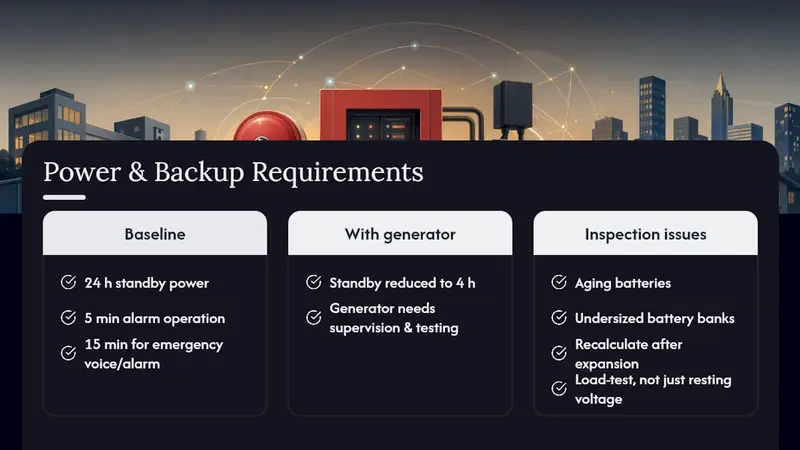
A monitored fire alarm system has to keep working when the building’s normal power doesn’t. NFPA 72 sets the baseline: 24 hours of standby power plus 5 minutes of alarm operation for most systems, extending to 15 minutes of alarm operation for emergency voice/alarm communication systems. A backup generator can reduce that standby figure to 4 hours, provided the generator meets its own supervision and testing requirements.
Inspection failures here are almost always the same two culprits: aging batteries that no longer hold a full charge, and undersized battery banks installed for a smaller system that got expanded later without a power recalculation. Ask your service provider to confirm battery age, verify the recharge cycle completes within the code-required window, and load-test the bank rather than just checking voltage at rest.
What Are the ITM Schedules for Monitored Systems?
NFPA 72’s inspection, testing, and maintenance requirements, laid out largely in Chapter 14, run on overlapping calendars, and missing one is a common reason systems fail acceptance or annual reinspection.
- Monthly: Supervised receiver equipment at the supervising station gets tested to confirm it’s receiving and logging signals correctly.
- Quarterly: Transmitter equipment on monitored systems, along with select device functions, gets verified for proper operation.
- Annually: Full system inspection, detector sensitivity testing, and complete functional testing of every initiating and notification device.
- Ongoing: Off-premises transmission paths get periodic verification aligned with the pathway’s supervision interval.
Every test needs a paper or digital record: date, technician, results, and any corrective action taken. AHJs and insurers both expect these records on demand, and a gap in the file is often treated the same as a missed test, whether or not the work actually happened.
How Do You Confirm Compliance With Your AHJ?
Working through this in order saves time and rework.
- Confirm which edition of the IBC/IFC and NFPA 72 your jurisdiction has adopted, since requirements shift between code cycles.
- Classify your occupancy and calculate occupant load to see if a §907 trigger applies.
- If triggered, confirm which monitoring pathway and supervising station model your AHJ accepts locally.
- Schedule acceptance testing, including a live test of the supervising station’s response.
- Assemble ITM records, device documentation, and power calculations before your final inspection.
Call your local fire marshal’s office or building department early, not the week before your inspection, and ask specifically what documentation they want at final acceptance. Pro Tip: The most common acceptance-test failure isn’t the alarm system itself, it’s the monitoring handoff. Run a live test signal to the supervising station during your pre-inspection walkthrough, not just a bench test of the panel. A step-by-step checklist can help you track each item before the inspector arrives.
Reliable-fire-protection’s Take on Monitoring Compliance
Most compliance headaches we see trace back to skipping that first question: does the code even require an alarm here, before anyone worries about NFPA 72’s technical details. Reliable-fire-protection works through code review, installation, acceptance-test coordination, and ongoing ITM contracts for Houston-area properties, and that order matters more than most owners expect. We coordinate directly with supervising stations and walk clients through UL 827 listing questions, local occupancy classification, and recordkeeping setup before an AHJ ever shows up. The AHJ’s decision is always final. Our job is making sure you walk into that inspection with nothing left to guess about.
— Results
Ready for a Monitoring Compliance Review?
Running through that checklist above is useful, but it’s also exactly the work Reliable-fire-protection does for Houston property owners every week, minus the guesswork of doing it solo. We review your occupancy classification, coordinate supervising-station setup, and handle ongoing ITM contracts to help ensure your records are ready before an inspector ever asks for them.
If you’re not sure whether your building’s system even meets how a compliant fire alarm system is supposed to work, that’s the right place to start. Property managers in the Energy Corridor and surrounding neighborhoods can also see local installation and monitoring service details specific to their area. Reach out for a free site review and quote, and get a straight answer on where your building stands before your next inspection date lands on the calendar.
Sources
Verify these directly: IBC §907.6.6, NFPA 72, and your local AHJ’s adopted edition.
- 2021 International Building Code – Section 907.6.6 (IBC excerpt)
- Are you monitoring life safety systems? Maybe you should — ESA
- Fire Alarm Monitoring Requirements Under NFPA 72 — LegalClarity