TL;DR:
- Many building managers mistakenly believe a green light indicates complete fire alarm supervision. Proper supervision continuously monitors all wiring and connected devices, detecting faults before system failure occurs. Effective, comprehensive supervision includes integrated systems like sprinkler valves and ERCES, ensuring full life safety system operability and code compliance.
Most safety professionals assume a fire alarm system is “supervised” simply because the panel shows a green light. That assumption is one of the most common compliance blind spots in the industry. Fire alarm circuit supervision explained properly goes well beyond a healthy-looking panel: it means every wire, device, and connected subsystem is under continuous electrical monitoring so that any fault gets detected before it silently disables your protection. This guide covers the core principles, wiring class comparisons, integrated system requirements, and practical testing protocols you need to keep your building protected and code-compliant.
Table of Contents
- Key takeaways
- Fire alarm circuit supervision explained: core principles
- Class A vs. Class B: choosing the right wiring path
- Supervision requirements for integrated systems
- Practical implementation and testing protocols
- What I’ve learned about supervision that most guides miss
- Get expert fire alarm supervision support in Houston
- FAQ
Key takeaways
| Point | Details |
|---|---|
| Supervision is continuous monitoring | Circuit supervision detects opens, shorts, and ground faults in real time, not just during testing. |
| Class A vs. Class B matters | Class A wiring offers redundant paths for fault tolerance; Class B loses continuity on a single break. |
| Integrated systems need supervision too | ERCES, valve tamper switches, and flow switches all require dedicated supervisory signal coverage. |
| Signal classification prevents confusion | Supervisory, trouble, and alarm signals are legally distinct; misclassifying them creates compliance failures. |
| Documentation is now code-required | NFPA 72 requires survivability level, wiring method, and redundancy to be shown explicitly on system drawings. |
Fire alarm circuit supervision explained: core principles
The term “circuit supervision” gets used loosely, and that looseness creates real problems during AHJ inspections. At its core, circuit supervision is the continuous electrical monitoring of wiring and connected devices to detect any fault that would impair the system’s ability to transmit an alarm. It is not periodic testing. It is not a manual walkthrough. It is an always-on process built directly into the fire alarm control panel (FACP).
Three types of faults drive most supervision failures:
- Open circuits: A wire break that severs communication between the panel and a device
- Short circuits: Conductors touching and collapsing the voltage, masking device responses
- Ground faults: Current leaking to building structure, which can create unpredictable circuit behavior
The devices that make supervision possible fall into two main categories. Supervisory switches (such as valve tamper switches or duct detector supervisory inputs) report the physical status of a monitored component. Resistors, specifically End-of-Line Devices (EOLDs), provide a known electrical signature at the end of a circuit so the panel can detect the difference between a normal loop, an open, and a short.
Initiating Device Circuits (IDCs) connect pull stations, smoke detectors, and heat detectors back to the panel. Signaling Line Circuits (SLCs) carry digital communications in addressable systems, where each device has a unique address. Both circuit types require electrical supervision of all components including control units, signal devices, and water flow detection devices to meet national code standards.
Without EOLDs in Class B circuits, an open wire looks identical to a normal idle state until someone actually triggers the device. Without EOLDs, open circuits go undetected until device failure occurs, which is exactly the kind of invisible gap that ends careers and endangers lives.
Pro Tip: When you review a system for the first time, pull the panel event log and filter for ground fault and trouble events over the last 90 days. A clean log does not mean the system is healthy. A system that never reports trouble events may have supervision turned off or improperly configured.
Class A vs. Class B: choosing the right wiring path
This is where most building managers get tripped up, and the confusion is understandable because the naming convention sounds simpler than it is.
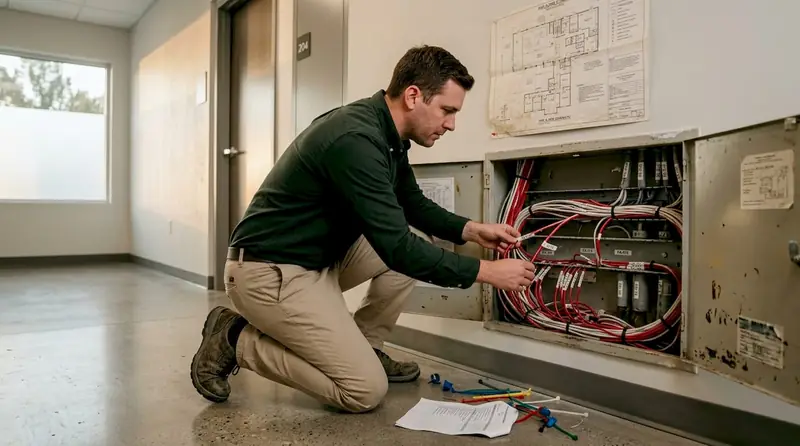
How the two classes behave under a fault
Class A wiring runs a loop from the FACP out to the field devices and back to the panel on a separate return path. Imagine a letter “C” shape. If a single wire break occurs anywhere along that loop, the panel reroutes communication through the return path and the devices stay online. Class B, by contrast, is a single path that terminates at an EOLD. One break and everything beyond that break goes silent.
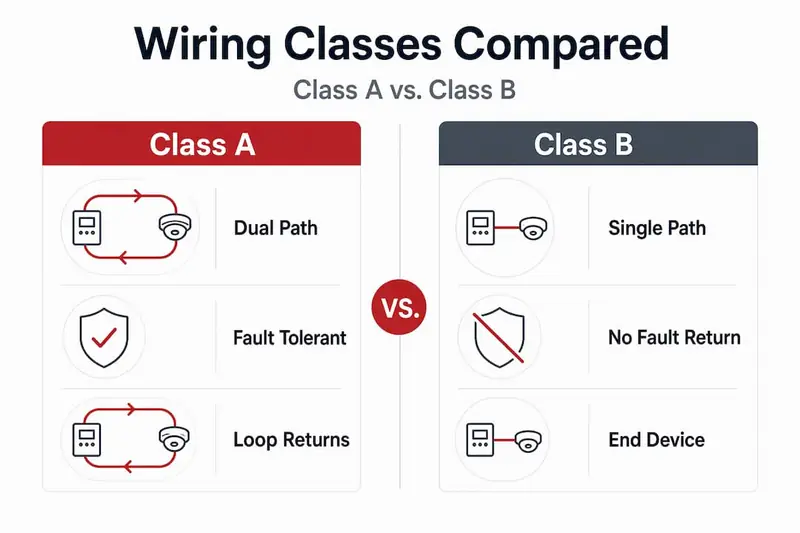
| Feature | Class A | Class B |
|---|---|---|
| Wiring configuration | Outgoing and return paths to panel | Single path, EOLD at endpoint |
| Fault tolerance | Continues operating after single break | Loses devices beyond break point |
| Installation cost | Higher (more wire, more conduit) | Lower |
| Typical application | High-rise, hospitals, critical facilities | Low-risk, single-story buildings |
| NFPA 72 survivability | Supports higher survivability levels | Limited to lower survivability levels |
Survivability levels and 2026 code requirements
NFPA 72 introduced pathway class designations with specific survivability levels that go beyond the old Class A/B binary. Modern fire alarm designs now use Circuit Integrity (CI) cabling or distributed amplifiers to maintain operation even when portions of the building structure are compromised by fire. A Class A loop using standard wire still fails if fire burns through both the outgoing and return paths in the same chase.
Survivability requirements are increasingly code-driven, and since NFPA 72 requires explicit documentation of survivability level, wiring method, fire-rated routing, and redundancy on system drawings, you cannot afford to leave this to installer discretion.
Here is a practical sequence for choosing the right class:
- Identify the building occupancy type and height. High-rise and healthcare occupancies almost always require Class A or CI cabling by the Authority Having Jurisdiction (AHJ).
- Review the AHJ’s local amendments to NFPA 72. Many jurisdictions add requirements beyond the base code.
- Assess the risk profile. Mission-critical spaces, data centers, and buildings with non-ambulatory occupants warrant higher survivability regardless of minimum code.
- Confirm your system drawings explicitly label survivability levels before submitting for permit. Missing documentation is a leading cause of failed inspections.
Pro Tip: Do not assume that upgrading from Class B to Class A on the same cable run satisfies survivability requirements. If both the outgoing and return conductors share the same conduit or cable tray, a single fire event can destroy both paths simultaneously. Physical separation of pathways is what makes Class A actually resilient.
Supervision requirements for integrated systems
Here is the insight that separates professionals who truly understand circuit supervision in fire alarms from those who only know the basics: the fire alarm panel is not just monitoring its own wiring. It serves as the central supervisory platform for every connected life safety system in the building.
Sprinkler and water-based system monitoring
Supervisory monitoring of water-based protection systems includes:
- Valve tamper switches: Detect when a control valve is closed, which would disable sprinkler coverage
- Water flow switches: Confirm water movement in the system, indicating either a sprinkler activation or a pipe break
- Pre-action system solenoid valves: Require supervision of both the solenoid position and the dry pilot line pressure
- Water pressure and level switches: Monitor tank levels and pump house conditions
These devices generate supervisory signals, not alarm signals. That distinction matters enormously. Supervisory signals indicate impairments to auxiliary systems without indicating a fire condition, and misclassifying them as alarms or troubles can trigger wrong responses from occupants and emergency responders. It can also result in non-compliance during an inspection.
ERCES and amplifier supervision
Buildings that require an Emergency Responder Communication Enhancement System (ERCES) add another layer of supervisory complexity. Fire alarm systems must integrate and supervise ERCES by monitoring power loss, battery status, amplifier health, and tampering, and they must report any impairment as a supervisory signal. A green panel status does not tell you whether your ERCES amplifiers are functional. Reliable-fire-protection has seen buildings pass routine fire alarm inspections while their ERCES systems were silently degraded because the supervision configuration was incomplete.
The hard truth spelled out clearly: a healthy fire alarm panel does not guarantee full life safety system operability. You need to verify that supervision extends to every connected subsystem. Euralarm guidance also makes clear that non-fire supervisory signals must never mask or delay emergency evacuation tones. The annunciation hierarchy must be correctly programmed to preserve that priority.
For a deeper look at how these systems connect and communicate, the fire alarm integration overview at Reliable Fire Protection explains the Houston-specific integration requirements in detail.
Practical implementation and testing protocols
Understanding the principles is half the work. Getting the implementation right in the field is where compliance gets won or lost.
Installation best practices
Cable routing and physical protection are not afterthoughts. Conductors for circuits requiring higher survivability levels must be routed in fire-rated assemblies or separated from one another to prevent a single fire event from disabling redundant paths. Use the correct wire gauge specified by the FACP manufacturer. Undersized conductors create voltage drop that can generate nuisance trouble signals, and oversized conductors can affect the sensitivity of EOLD resistance readings.
Testing your circuits systematically
Follow this sequence when verifying circuit supervision integrity:
- Continuity test each circuit with the panel in test mode to confirm end-to-end connectivity before powering devices.
- Short circuit test by temporarily bridging conductors at the most remote device location to confirm the panel correctly identifies and annunciates the fault.
- Open circuit test by disconnecting the EOLD to verify the panel reports an open trouble condition within the required response time.
- Polarity check all polarized devices, particularly notification appliances and addressable modules, to prevent reversed-polarity faults that pass continuity tests but fail during alarm activation.
- Supervisory device functional test by manually actuating each tamper switch, flow switch, and supervisory input to confirm correct signal classification at the panel.
Document every test result against the fire alarm system checklist and retain records for AHJ review. NFPA 72 requires that all documentation, including survivability level designations, be current and available on-site.
Pro Tip: When coordinating with your AHJ before an inspection, ask specifically whether they require witnessed testing of supervisory devices in addition to alarm devices. Many jurisdictions expect a full supervisory signal demonstration, and arriving unprepared for that adds time and cost to your inspection cycle.
For step-by-step setup guidance that parallels these testing protocols, the fire detection setup guide from Reliable Fire Protection is a practical companion resource.
What I’ve learned about supervision that most guides miss
I’ve reviewed a lot of fire alarm systems in my time working with safety professionals across Houston, and the same pattern appears repeatedly. Building managers invest in good equipment and competent installers, then assume the supervision problem is solved. It is not solved. It is started.
The integration gaps are where things fall apart. A fire alarm panel can be perfectly configured for its own circuits and still be blind to a failed ERCES amplifier, a closed sprinkler control valve, or a tamper switch that was wired to the wrong input type. I’ve seen “compliant” systems that were compliant only on paper because supervisory signals were programmed as trouble signals or simply not connected.
My contrarian take: the industry’s obsession with newer, networked addressable systems has created a false sense of security. Sophisticated technology does not automatically mean better supervision. A networked system with poor integration documentation and undertrained maintenance staff produces worse outcomes than a well-documented conventional system with a trained facilities team. The sophistication of the equipment matters less than the depth of understanding behind it.
Ongoing training is not optional. NFPA 72 changes with each edition, and the 2025 cycle brought documentation requirements that many professionals are still catching up to. Work with fire alarm specialists who can walk you through how fire alarm systems work from the circuit level up, not just technicians who can swap devices.
— Reliable Fire Protection
Get expert fire alarm supervision support in Houston
If this article raised questions about your own building’s circuit supervision configuration, that reaction is exactly right.
Reliable Fire Protection works with building managers and safety professionals across Houston to evaluate, install, and maintain fire alarm systems that meet current NFPA 72 standards, including full circuit supervision for integrated life safety systems. Whether you are facing an upcoming AHJ inspection, upgrading an aging panel, or adding ERCES integration to an existing system, the team at Reliable Fire Protection provides the certified expertise and local knowledge to get it done correctly. Visit the fire alarm systems page to learn more about their offerings, or contact them directly for a no-obligation assessment of your current supervision setup.
FAQ
What is circuit supervision in a fire alarm system?
Circuit supervision is the continuous electrical monitoring of all wiring and connected devices in a fire alarm system to detect faults like opens, shorts, and ground faults before they disable protection. It operates constantly, not just during scheduled testing.
What is the difference between Class A and Class B fire alarm wiring?
Class A wiring runs a redundant return path to the panel, maintaining device connectivity after a single wire break. Class B uses a single path terminated at an End-of-Line Device and loses all devices beyond any break point.
Why do supervisory signals need to be classified separately from alarm signals?
Supervisory signals indicate impairments to auxiliary systems, such as a closed valve or low battery, without indicating an active fire condition. Misclassifying them as alarms triggers wrong occupant responses and can result in code non-compliance during AHJ inspections.
Does a green status on the fire alarm panel mean full system supervision?
No. A healthy panel status only confirms the panel’s own circuit integrity. Systems integrated with ERCES, sprinkler valves, and amplifiers require separate supervisory monitoring, and those subsystems can be degraded while the main panel shows normal status.
How often should fire alarm supervisory devices be tested?
NFPA 72 requires functional testing of supervisory devices, including valve tamper switches and flow switches, at least annually. Many AHJs and occupancy types require more frequent testing, so always verify local code amendments and AHJ preferences before setting your testing schedule.
Recommended
- Fire Alarm Annunciators Explained: What You Need to Know
- How Do Fire Alarm Systems Work? – Reliable Fire Protection
- Fire Alarm Installation Guide for Houston Property Managers
- Master fire alarm panel explained: Houston property guide
- Fire Alarm System University Place TX
- Fire Alarm System Services in Bellaire, TX