
TL;DR:
- Fire code compliance ensures buildings meet safety standards set by local authorities. Property owners must maintain fire alarm, sprinkler, extinguisher, egress, and emergency lighting systems, with proper documentation for inspections. Routine self-audits and immediate correction of violations are essential for long-term compliance.
Fire code compliance is the process of meeting all fire safety standards and regulations required by your local authority to protect occupants and property from fire risks. For property owners and facility managers, understanding how to meet fire code compliance is not optional. It determines whether your building stays open, your occupants stay safe, and your liability stays manageable. This guide covers which codes apply to your property, what physical systems you must maintain, how to document everything, and how to pass inspections without surprises.
How to meet fire code compliance: start with the right codes
The first step in fire code compliance is confirming which regulations actually apply to your building. Not every property follows the same rules. Your building’s occupancy classification, its use type, and your local jurisdiction all determine which version of the fire code governs you.
The National Fire Protection Association publishes NFPA 1 (Fire Code) and NFPA 101 (Life Safety Code) as the national baseline. Most states and municipalities adopt these with local amendments. Those amendments can significantly change egress requirements, alarm thresholds, and sprinkler standards. Local AHJs may impose amendments that alter egress, alarms, and sprinkler standards in ways the base code does not require. That means a warehouse in Houston may face different rules than an identical building in Dallas.
Your Authority Having Jurisdiction (AHJ) is the local fire marshal or building department official who enforces the code. Contact your AHJ directly to confirm which edition of the fire code your jurisdiction has adopted and whether any local amendments apply.
Key questions to answer before you do anything else:
- What is your building’s occupancy classification (assembly, business, industrial, residential)?
- Has your jurisdiction adopted local amendments to NFPA 1 or NFPA 101?
- Does your building have any mixed-use areas that trigger multiple classifications?
- Are there recent construction or renovation permits that changed your compliance baseline?
Pro Tip: Ask your AHJ for a written confirmation of which code edition applies to your property. This protects you if enforcement interpretations change.
What fire protection systems must you maintain?
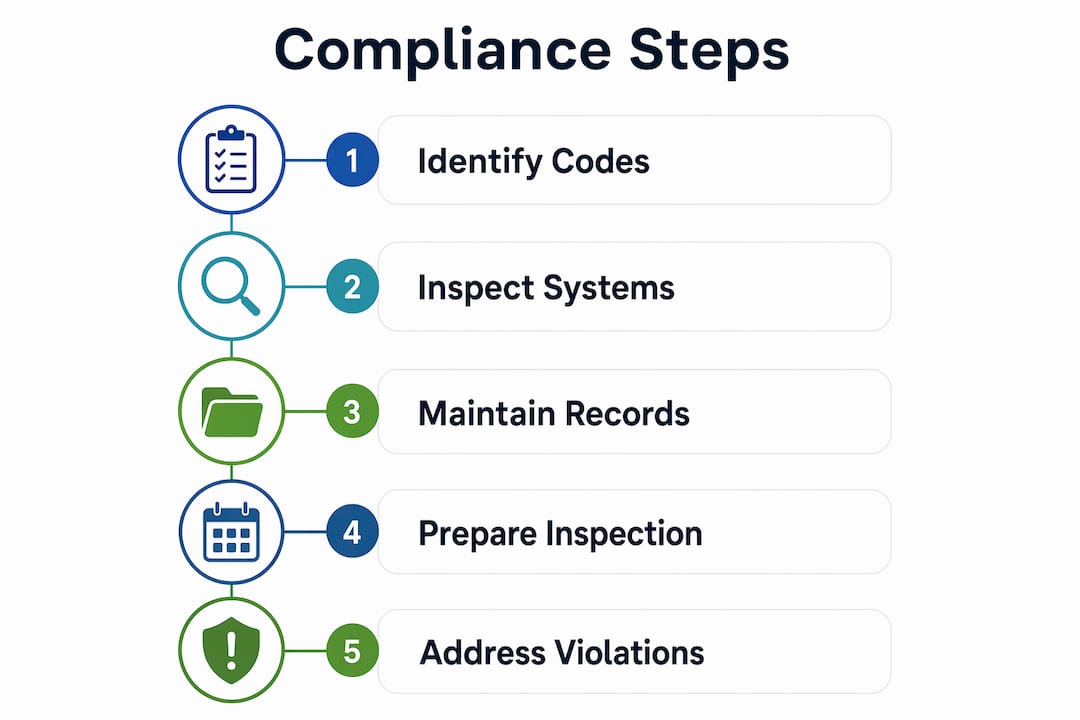
A routine fire inspection examines egress routes, fire protection systems, exit signage, emergency lighting, extinguisher status, and housekeeping. Inspectors verify no blocked exits, properly working doors, and posted occupancy limits. Each system has its own maintenance schedule and documentation requirement.

Fire alarm and detection systems
Fire alarm systems require annual testing by a licensed contractor, with quarterly testing for certain components like pull stations and smoke detectors in high-risk occupancies. Every test must be logged with the date, technician name, and results. Gaps in your fire alarm system checklist are among the most common reasons properties fail inspections.
Sprinkler systems
Sprinkler systems fall under NFPA 25, which mandates quarterly, annual, and five-year inspections depending on the component. Sprinkler heads must have 18 inches of clearance below them at all times. Storage that encroaches on that clearance is a violation that inspectors flag immediately. Keep a copy of your most recent NFPA 25 inspection report on site.
Fire extinguishers
Extinguishers must be mounted in visible, accessible locations and inspected monthly by building staff and annually by a licensed technician. The inspection tag must be current and attached. Knowing the right extinguisher types for your occupancy matters too. A Class K extinguisher is required in commercial kitchens, while a Class ABC unit covers most office and warehouse environments.
Means of egress and emergency lighting
Exit routes must be clear, lit, and marked at all times. Emergency lighting must pass a 90-minute battery test and exit signs must be illuminated and visible at all times. Test your emergency lighting monthly using the manual test button and log the results. Burned-out exit signs are a fast path to a violation notice.
| System | Inspection frequency | Key standard |
|---|---|---|
| Fire alarm | Annual (some quarterly) | NFPA 72 |
| Sprinkler system | Quarterly to five-year | NFPA 25 |
| Fire extinguishers | Monthly (staff) + annual (licensed) | NFPA 10 |
| Emergency lighting | Monthly test + annual | NFPA 101 |
| Egress routes | Ongoing + pre-inspection | NFPA 101 |
Pro Tip: Walk your egress routes at the start of every month. Blocked exits are the single most cited violation across commercial property types.
How do you organize fire safety documentation for inspections?
Documentation is where most property owners lose points during inspections. You can have a perfectly maintained building and still fail if you cannot produce records on demand. Fire protection system documentation like sprinkler and fire alarm test records must be kept for typically at least 5 years, though local rules may require longer. That includes NFPA 25 and NFPA 72 logs, hot work permits, and fire drill records.
The records you need to maintain include:
- Fire alarm test reports (dated, signed by the technician)
- Sprinkler inspection reports (quarterly and annual)
- Fire extinguisher inspection tags and annual service records
- Hot work permits for any welding or cutting on the premises
- Fire drill records showing date, time, number of occupants, and any issues noted
- Corrective action logs documenting how and when violations were fixed
A 47-point checklist used monthly or quarterly gives you a structured self-audit framework. Each completed checklist should be dated and initialed by the person who conducted the walkthrough. Commercial properties should maintain at least 12 months of dated, initialed self-audit checklists to prove a proactive compliance program. That 12-month log is the strongest single proof of a proactive compliance program you can show an AHJ.
| Document type | Minimum retention | Who creates it |
|---|---|---|
| Fire alarm test reports | 5 years | Licensed contractor |
| Sprinkler inspection reports | 5 years | Licensed contractor |
| Fire drill records | 5 years | Facility manager |
| Self-audit checklists | 12 months minimum | Facility manager |
| Hot work permits | Duration of project + 5 years | Contractor or facility manager |
Store records both digitally and in a physical binder on site. Inspectors expect to see records immediately. Searching through email during an inspection signals disorganization. A dedicated fire safety documentation guide can help you build a records system that holds up under scrutiny.
How do you prepare for a fire inspection and handle violations?
Preparation separates properties that pass on the first visit from those that cycle through re-inspections. Pre-inspection prep includes walking exits to confirm no obstructions, verifying all system inspection tags are current, and printing fire safety plans. Follow this sequence before any scheduled inspection:
- Walk every exit route. Remove any storage, equipment, or furniture blocking corridors, stairwells, or exit doors.
- Check all inspection tags. Confirm fire extinguisher, sprinkler, and alarm system tags are current and legible.
- Test emergency lighting. Press the manual test button on each unit and confirm the 90-minute battery holds.
- Gather your documentation binder. Pull the last 12 months of self-audit checklists, contractor reports, and drill records.
- Assign a knowledgeable staff member. This person accompanies the inspector, answers questions, and takes notes on every observation.
- Request a written report. After the inspection, get the written findings and correction deadlines in writing before the inspector leaves.
When a compliance item fails, document it, implement compensatory measures like a fire watch, and then contact a licensed professional for repairs. That order matters. A fire watch demonstrates that you prioritized occupant safety immediately rather than waiting for a contractor appointment. Document the fix with photos, receipts, and a corrective action note in your records binder.
For complex violations involving structural egress changes or suppression system redesigns, involve a code consultant or licensed fire protection contractor before you attempt any repairs. Guessing on code-driven repairs often creates new violations.
Pro Tip: After every inspection, schedule a debrief with your facilities team. Review what the inspector flagged, even items that did not result in violations. Patterns in observations predict future citations.
Key Takeaways
Consistent documentation and routine self-audits are the most reliable path to passing fire inspections and maintaining long-term fire code compliance.
| Point | Details |
|---|---|
| Identify applicable codes first | Confirm your occupancy classification and contact your AHJ before applying any fire code standard. |
| Maintain all five core systems | Fire alarms, sprinklers, extinguishers, egress routes, and emergency lighting each require scheduled inspections and logs. |
| Keep records for at least 5 years | Retain all contractor reports, drill records, and hot work permits; local rules may require longer retention. |
| Run monthly self-audits | A 47-point checklist completed monthly and initialed proves a proactive compliance program to any AHJ. |
| Act immediately on failures | Implement a fire watch, document the failure, then hire a licensed contractor before the correction deadline. |
What I have learned about fire code compliance after years in the field
Most property owners treat fire code compliance as a once-a-year event tied to the inspection calendar. That mindset is the root cause of most violations I see. Inspectors use binary pass or fail observations. They do not grade on effort. What distinguishes a compliant facility manager is not a perfect building. It is documented, dated evidence that problems were found and fixed before the inspector arrived.
Routine self-audits with documented fixes demonstrate a proactive compliance program more convincingly than a perfect one-time inspection. I have seen properties with minor system issues pass inspections because their records showed a pattern of finding and correcting problems. I have seen pristine buildings fail because they had no documentation at all.
The other mistake I see constantly is assuming the national NFPA standard is the whole story. Compliance is never one-size-fits-all. Local amendments and AHJ expectations can change standards drastically. A facility manager who knows their AHJ personally, who calls before a project starts rather than after a violation lands, operates at a different level than one who reads the code in isolation.
Balance matters too. Fire safety cannot grind operations to a halt, but cutting corners on sprinkler clearance or skipping a drill because the calendar is full creates compounding risk. Build compliance into your monthly operations rhythm. Treat the self-audit checklist the same way you treat a utility bill. It is not optional, and ignoring it costs more than doing it.
— Reliable-fire-protection
How Reliable-fire-protection can help you stay compliant
Reliable-fire-protection is a Houston-based fire safety company serving commercial and residential properties across the Houston area. Their team installs, inspects, and maintains fire alarm systems built to meet NFPA 72 standards, and their sprinkler services follow the full sprinkler compliance workflow required under NFPA 25. Whether you need a first-time system installation, a contractor report for your documentation binder, or a pre-inspection walkthrough, Reliable-fire-protection provides the certified expertise and local knowledge to keep your property compliant. Contact them for a free quote and get your fire protection systems on a documented maintenance schedule before your next inspection.
FAQ
What does fire code compliance mean for a property owner?
Fire code compliance means your building meets all fire safety regulations required by your local authority, including maintained alarm systems, clear egress routes, current inspection records, and trained staff. Non-compliance can result in fines, forced closure, or increased liability.
How often do fire inspections happen for commercial properties?
Inspection frequency varies by jurisdiction and occupancy type. Most commercial properties face annual inspections, though high-risk occupancies like restaurants and assembly spaces may be inspected more frequently by the local fire marshal.
What records do you need to show during a fire inspection?
You need fire alarm test reports, sprinkler inspection reports, fire extinguisher service records, fire drill logs, and any corrective action documentation. Records should cover at least the past 5 years, and self-audit checklists should cover the past 12 months.
What happens if your building fails a fire inspection?
Document the failure immediately, implement compensatory measures like a fire watch if a system is offline, and contact a licensed fire protection contractor for repairs before the correction deadline. Provide the inspector with written proof of corrective actions taken.
How do local amendments affect fire code requirements?
Local amendments can change egress distances, alarm sensitivity thresholds, sprinkler requirements, and occupancy limits beyond what the base NFPA code requires. Always confirm which code edition and amendments apply with your local AHJ before planning any compliance work.