
Regular fire safety training reduces fire incidents by up to 50%, yet many Houston property managers mistakenly believe only large commercial buildings require it. This comprehensive guide cuts through the confusion, explaining exactly what fire safety training entails, which Houston properties legally require it, and how to implement cost-effective programs that protect your tenants, assets, and compliance status. You’ll discover practical training methods, clear regulatory requirements, and actionable steps to build a robust fire safety culture.
Table of Contents
- Introduction To Fire Safety Training
- Regulatory And Legal Compliance For Fire Safety Training In Houston And Texas
- Core Components And Methods Of Effective Fire Safety Training
- Common Misconceptions About Fire Safety Training
- Comparison Of Fire Safety Training Delivery Options
- How To Implement And Evaluate A Fire Safety Training Program
- Benefits Of Fire Safety Training For Risk Reduction And Liability Management
- Enhance Your Fire Safety With Expert Systems And Support
- Frequently Asked Questions
Key takeaways
| Point | Details |
|---|---|
| Fire safety training equips property managers with essential prevention and response skills | Structured education and drills prepare staff to prevent fires and respond effectively during emergencies. |
| Houston and Texas laws mandate specific training requirements for compliance | Property owners must meet Texas OSHA and Houston Fire Code standards to avoid penalties. |
| Effective training combines prevention education, evacuation drills, and hands-on extinguisher use | Blended approaches mixing online instruction with practical exercises deliver the best skill retention. |
| Misconceptions can undermine preparedness and legal compliance | Beliefs that small properties don’t need training or one-time sessions suffice create dangerous gaps. |
| Implementing recurring training with evaluation maximizes safety and minimizes liability | Annual sessions with regular drills and documentation protect lives, reduce claims, and demonstrate due diligence. |
Introduction to fire safety training
Fire safety training is structured education and practical drills designed to prepare property managers, staff, and tenants for fire prevention and emergency response. This training goes beyond basic awareness, equipping participants with hands-on skills like using fire extinguishers, executing evacuation plans, and recognizing fire hazards before they escalate. For Houston property owners and managers, where regular fire safety training reduces fire incidents by up to 50%, implementing effective programs isn’t just smart management but a critical investment in tenant safety and asset protection.
Without proper training, Houston property managers face significant challenges. Untrained staff may panic during emergencies, fail to identify growing fire risks, or misuse safety equipment when seconds matter most. Tenants in buildings lacking clear evacuation procedures suffer higher injury rates during fire events. Properties without documented training programs also face steep insurance premiums, legal liability exposure, and potential violations of fire safety regulations enforced by local authorities.
Key audiences who benefit from comprehensive fire safety training include:
- Property managers overseeing day-to-day operations and emergency preparedness
- Maintenance staff responsible for inspecting and maintaining fire protection equipment
- Leasing agents who interact with tenants and must communicate safety procedures
- Tenants themselves, particularly in multi-family residential and commercial properties
- Building owners seeking to reduce liability and demonstrate regulatory compliance
An effective training framework rests on four critical pillars. Prevention focuses on identifying and eliminating fire hazards through regular inspections and proper storage practices. Detection teaches proper use and maintenance of fire alarm systems and smoke detectors. Response covers evacuation protocols, extinguisher use, and emergency communication procedures. Recovery addresses post-incident procedures, documentation, and system restoration.
Pro Tip: Regularly update your training to reflect new risks and regulations. This keeps your property and occupants safer while ensuring you meet evolving fire safety testing requirements as Houston codes change.
Regulatory and legal compliance for fire safety training in Houston and Texas
Texas property managers operate under a complex web of fire safety regulations that directly impact training requirements. Texas OSHA mandates specific fire safety training for various workplaces, including property management offices and commercial buildings, requiring employers to provide education on fire hazards, emergency action plans, and proper equipment use. These state-level requirements form the baseline, but Houston’s local ordinances often exceed these minimum standards, particularly for high-occupancy buildings.
The Houston Fire Code establishes property-specific training mandates based on occupancy classification and building characteristics. High-rise commercial properties must conduct quarterly evacuation drills and maintain detailed training logs. Multi-family residential buildings with more than 16 units require annual fire safety instruction for all residents and semi-annual drills. Hotels, healthcare facilities, and educational institutions face even stricter requirements, including monthly fire watch procedures and specialized training for staff handling fire protection systems.
Houston Fire Code Section 401 requires property owners to maintain written records of all fire safety training activities, including participant names, dates, topics covered, and instructor credentials, for a minimum of three years.
Failing to comply with these training regulations carries serious consequences. Monetary penalties for first-time violations typically range from $500 to $2,500 per incident, escalating quickly for repeat offenses. More significantly, inadequate training creates liability exposure. Property owners found negligent in fire safety preparation face civil lawsuits from injured tenants, with settlements often reaching six or seven figures. Insurance carriers may deny claims or cancel policies entirely when documented training gaps contributed to fire damage or injuries.
Compliance delivers tangible benefits beyond avoiding penalties. Properties with documented training programs qualify for insurance premium reductions averaging 10 to 20 percent annually. Well-trained staff respond more effectively during emergencies, reducing property damage and protecting lives. Systematic training also demonstrates due diligence in legal proceedings, often serving as a strong defense against negligence claims.
Essential compliance steps every Houston property manager must take include:
- Conduct annual risk assessments to identify property-specific fire hazards and training needs
- Develop written fire safety plans documenting evacuation routes, assembly points, and emergency contacts
- Schedule mandatory training sessions meeting minimum frequency requirements for your property type
- Maintain detailed training records with signatures, dates, and curriculum documentation
- Coordinate with local fire marshals for periodic inspections and fire safety testing
- Update training materials whenever regulations change or new fire protection systems are installed
Core components and methods of effective fire safety training
Comprehensive fire safety training covers multiple interconnected topics that prepare property staff and tenants for real-world scenarios. Fire prevention education teaches participants to identify common hazards like blocked exits, overloaded electrical circuits, improper storage of flammable materials, and malfunctioning heating equipment. Evacuation procedures training establishes clear protocols for alerting occupants, directing them to exits, accounting for everyone at assembly points, and communicating with emergency responders.
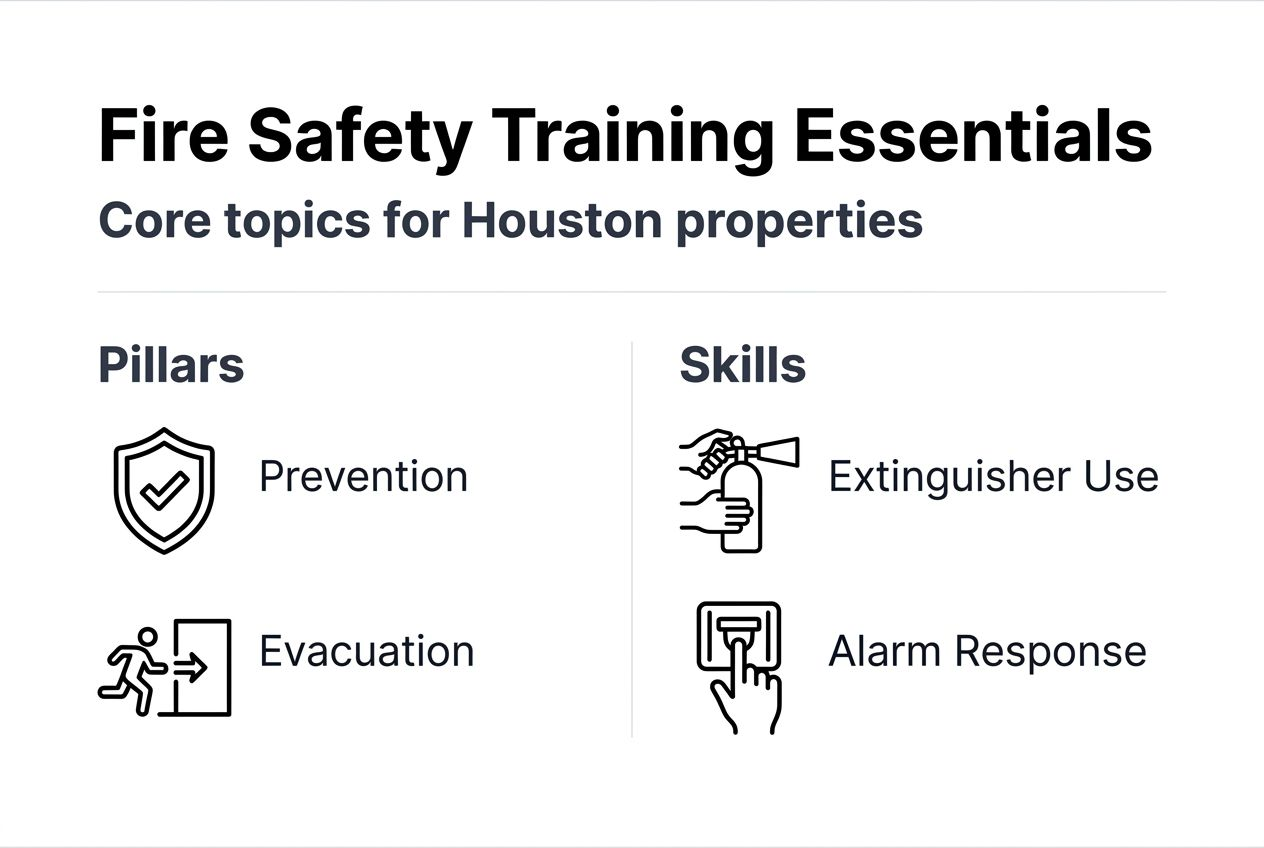
Hands-on fire extinguisher training remains the most valuable practical component. Participants learn the PASS method (Pull, Aim, Squeeze, Sweep) using actual extinguishers on controlled fires, building muscle memory and confidence for real emergencies. Alarm response training ensures everyone knows how to recognize different alarm signals, when to evacuate versus shelter in place, and how to manually activate alarm systems when automatic detection fails.
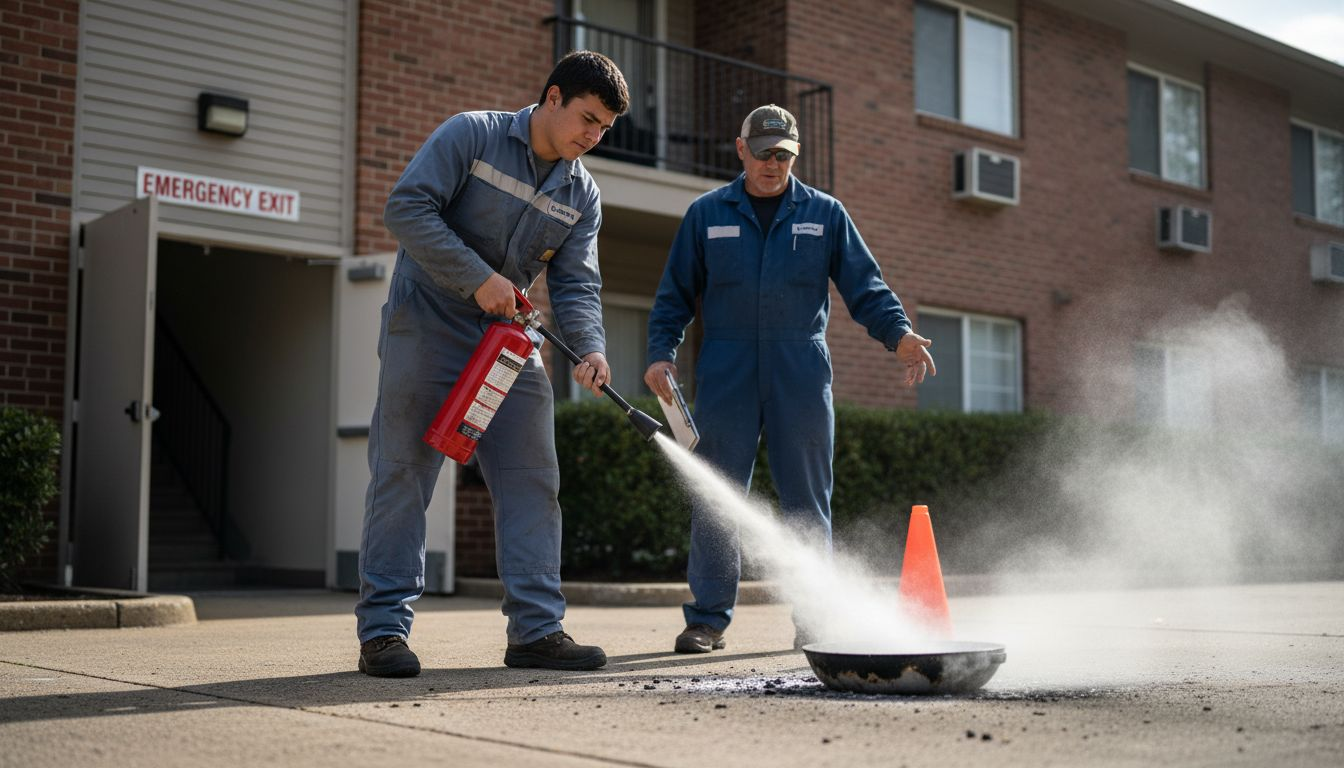
Property managers can choose from three primary training delivery methods, each offering distinct advantages. In-person instruction provides face-to-face interaction with certified trainers, hands-on practice with actual equipment, and immediate feedback on technique. Online courses offer scheduling flexibility, lower costs per participant, and convenient accessibility for geographically dispersed staff. Blended training combines online theoretical instruction with in-person practical sessions, delivering comprehensive coverage while managing costs.
| Delivery Method | Pros | Cons | Best For |
|---|---|---|---|
| In-person | Hands-on practice, immediate feedback, team building, highest retention | Higher cost, scheduling challenges, requires dedicated space | Large properties, high-risk facilities, staff requiring certification |
| Online | Cost-effective, flexible timing, consistent content delivery, easy updates | No hands-on practice, requires self-discipline, limited interaction | Budget-conscious properties, geographically dispersed staff, theory-only components |
| Blended | Balances cost and effectiveness, combines theory with practice, flexible yet thorough | Requires coordination of multiple sessions, moderate cost | Most Houston properties seeking comprehensive cost-effective training |
Research shows blended training combining online instruction and hands-on practice yields the best results in skill retention and confidence. Participants who complete online modules before attending practical sessions demonstrate 40 percent better technique mastery than those receiving only classroom instruction.
For small apartment complexes with limited budgets, online training supplemented by annual hands-on drills provides adequate coverage. Commercial properties benefit most from quarterly blended sessions combining e-learning with practical exercises. High-rise buildings and industrial facilities should invest in comprehensive in-person programs with specialized training for fire wardens and emergency response teams.
Pro Tip: Incorporate hands-on fire extinguisher drills for real-world preparedness. Online alone isn’t enough because reading about the PASS method doesn’t prepare your hands and mind for the weight, noise, and pressure of actually fighting a fire. Budget for at least one annual practical session where staff discharge real extinguishers under supervision.
Common misconceptions about fire safety training
Several persistent myths prevent Houston property owners from implementing effective fire safety programs. The most dangerous misconception claims only large commercial buildings require formal training, leading small property owners to skip systematic preparation entirely. Statistics prove otherwise: over 60% of small property fires could be prevented with proper training, as smaller buildings often lack redundant safety systems and suffer disproportionate damage when staff can’t respond quickly.
Another widespread belief holds that online courses alone satisfy training requirements and prepare staff adequately. While digital instruction conveniently delivers theoretical knowledge, it cannot replicate the physical experience of operating a fire extinguisher under pressure or navigating smoke-filled hallways during evacuation drills. Compliance regulations often explicitly require hands-on components that online-only programs cannot fulfill.
Many property managers assume one-time training provides permanent preparedness, scheduling initial sessions for new hires but never refreshing that knowledge. Human memory degrades significantly over time, particularly for skills rarely practiced. Studies show fire response proficiency drops by over 70 percent within six months without reinforcement, rendering one-time training nearly useless when emergencies strike years later.
Cost concerns fuel the misconception that comprehensive training programs are financially prohibitive for smaller properties. While premium in-person courses do carry higher upfront costs, blended programs and group training sessions reduce per-person expenses dramatically. More importantly, training costs pale compared to potential fire damage, legal liability, and insurance premium increases resulting from inadequate preparation.
Common misconceptions clarified:
- Small properties need training just as much as large buildings, often more so due to limited safety redundancy
- Online courses provide valuable theory but must be supplemented with practical hands-on drills for true competency
- Annual refresher training is essential because skills and knowledge degrade without regular practice and updates
- Blended and group training options make comprehensive programs affordable for properties of all sizes
- Tenants benefit significantly from training, not just staff, reducing panic and improving evacuation success rates
- Documentation requirements exist for good reason, protecting property owners legally and demonstrating due diligence
Recognizing these myths allows Houston property managers to make informed decisions prioritizing genuine safety over convenient shortcuts. Effective training requires commitment, but the protection it provides for lives and assets justifies that investment many times over.
Comparison of fire safety training delivery options
Choosing the right training format requires evaluating multiple factors beyond simple cost comparison. The following table provides detailed analysis across key decision criteria:
| Criteria | In-Person Training | Online Training | Blended Training |
|---|---|---|---|
| Effectiveness for skill retention | Excellent (85%+ retention after 6 months) | Moderate (45-60% retention) | Very Good (70-80% retention) |
| Cost per participant | $150-$400 | $30-$80 | $100-$200 |
| Accessibility for staff | Requires scheduling coordination | Available 24/7 from any location | Flexible with some coordination needed |
| Hands-on practice opportunities | Extensive with real equipment | None or very limited simulation | Focused practical sessions |
| Compliance documentation | Comprehensive with instructor certification | Automated certificates and tracking | Complete with both components |
| Best property types | Large commercial, high-risk facilities | Small residential, budget-limited properties | Most commercial and multi-family properties |
Practical considerations significantly influence format selection. Budget constraints naturally favor online options, but property managers must weigh upfront savings against reduced effectiveness and potential compliance gaps. Staff availability presents another challenge since coordinating multiple employees for simultaneous in-person sessions disrupts normal operations. Larger properties with dedicated training spaces find in-person logistics easier than smaller buildings requiring off-site venues.
Property size and risk profile should drive format decisions. High-rise buildings, hotels, and industrial facilities with elevated fire risks justify the premium cost of comprehensive in-person training. Their larger budgets and full-time staff make scheduling coordination manageable. Small apartment complexes and office buildings with limited budgets achieve adequate preparation through blended approaches, reserving in-person components for critical hands-on skills while covering theory online.
Recommendations for common Houston property scenarios:
- Apartment complexes under 50 units: Annual online training plus one hands-on drill meeting testing requirements
- Office buildings 5-20 floors: Quarterly blended training with semi-annual evacuation drills
- Hotels and hospitals: Monthly in-person sessions for all shifts with specialized emergency response team training
- Retail and restaurant properties: Blended quarterly training emphasizing kitchen fire prevention and suppression systems
- Mixed-use developments: Customized blended programs addressing residential, commercial, and common area specific needs
Blended training emerges as the preferred approach for most Houston properties because it balances cost-effectiveness with comprehensive skill development. Participants complete online modules covering fire science, prevention strategies, and regulatory requirements at their convenience. Follow-up in-person sessions then focus exclusively on high-value practical exercises like extinguisher use, evacuation coordination, and emergency communication. This format maximizes training efficiency while ensuring compliance with hands-on requirements.
Cost-benefit analysis should account for long-term value, not just immediate expenses. Properties investing $200 per employee annually in quality blended training typically recover that investment through reduced insurance premiums within the first year. The liability protection, regulatory compliance, and genuine safety improvements provide additional value impossible to quantify until an emergency tests your preparedness.
How to implement and evaluate a fire safety training program
Building an effective fire safety training program requires systematic planning and ongoing refinement. Follow these sequential steps to establish comprehensive preparation:
- Conduct a detailed property risk assessment identifying specific fire hazards, vulnerable areas, occupancy patterns, and existing safety equipment
- Review applicable Houston Fire Code requirements, Texas OSHA mandates, and insurance policy training obligations for your property classification
- Develop a written training curriculum addressing identified risks, regulatory requirements, and property-specific emergency procedures
- Select appropriate delivery methods balancing budget constraints, staff availability, and hands-on practice needs
- Establish a recurring training schedule with initial sessions for new hires, annual refreshers for all staff, and quarterly drills
- Arrange qualified instructors holding current fire safety certifications from recognized organizations
- Prepare necessary training materials including written manuals, equipment for hands-on practice, and documentation forms
- Conduct initial training sessions ensuring all participants understand content and demonstrate practical skills
- Implement systematic evaluation procedures measuring learning outcomes and identifying improvement opportunities
- Maintain detailed records documenting all training activities, participant attendance, and skill assessments for compliance purposes
Evaluation methods ensure your program delivers genuine preparedness rather than just checking compliance boxes. Regular fire drills test whether staff and tenants can execute evacuation procedures under time pressure, revealing bottlenecks and confusion points requiring additional training. Written tests or practical demonstrations verify participants retained critical knowledge and skills. Anonymous feedback surveys identify unclear instruction, inadequate practice opportunities, or outdated content needing revision.
Compliance audits by internal staff or external consultants provide objective assessment of your program’s adequacy:
- Review training records for completeness, proper documentation, and regulatory compliance
- Observe live training sessions evaluating instructor quality and participant engagement
- Inspect fire protection equipment ensuring proper maintenance and accessibility for trained staff
- Interview employees testing their knowledge retention and confidence in emergency response
- Benchmark your program against industry best practices and competitor properties
Pro Tip: Engage third-party experts for testing and updating your program annually. External fire safety professionals bring fresh perspectives, identify blind spots internal staff might overlook, and provide credible documentation that insurance carriers and regulators value during compliance reviews.
Align training timing with operational realities for maximum effectiveness. New staff onboarding should always include fire safety orientation within the first week of employment, establishing safety as a core priority from day one. Annual refresher sessions work best during slower business periods when staff absences cause minimal disruption. Schedule major evacuation drills during moderate weather months avoiding Houston’s oppressive summer heat and severe storm seasons when outdoor assembly becomes problematic.
Documentation practices directly impact legal protection and insurance claims. Every training session requires written records capturing participant names and signatures, date and duration, topics covered, instructor credentials, and skill assessment results. Store these records securely for the minimum three years required by Houston Fire Code, though five to seven years provides better liability protection. Digital documentation systems with cloud backup prevent record loss while simplifying compliance reporting.
Benefits of fire safety training for risk reduction and liability management
Comprehensive fire safety training delivers measurable advantages that justify the time and resources invested. Property owners implementing systematic training programs experience:
- Dramatic reduction in fire incidents through early hazard identification and proper equipment maintenance
- Improved occupant safety with faster evacuations, fewer injuries, and more effective emergency response
- Insurance premium discounts averaging 10 to 20 percent annually for properties with documented training programs
- Reduced legal liability exposure by demonstrating reasonable care and regulatory compliance in prevention efforts
- Lower property damage costs when trained staff quickly contain small fires before they escalate
- Enhanced tenant satisfaction and retention in buildings where safety is visibly prioritized
- Competitive advantage in attracting quality tenants who value well-managed, safety-conscious properties
Training directly supports claims of due diligence in risk management, a critical legal standard in negligence cases. When fire incidents result in injuries or property damage, courts examine whether owners took reasonable precautions preventing foreseeable harm. Documented training records, regular drills, and systematic equipment maintenance provide compelling evidence of responsible property management. Without this documentation, even property owners who acted carefully struggle to prove their diligence, facing substantial liability.
The financial return on training investment extends beyond insurance discounts and liability protection. Properties with strong safety records attract higher-quality tenants willing to pay premium rents for peace of mind. Reduced fire damage translates directly to lower repair costs and shorter vacancy periods following incidents. Employee retention improves when staff feel confident and prepared rather than anxious about fire risks they don’t understand.
Investing in comprehensive fire safety training transforms compliance from a burden into a strategic advantage. Properties prioritizing genuine preparedness over minimum requirements consistently outperform competitors in tenant satisfaction, insurance costs, and long-term asset value preservation.
The benefits compound over time as training builds organizational culture around safety awareness. Properties maintaining programs for multiple years develop staff who instinctively identify hazards, follow proper procedures, and communicate safety priorities to tenants. This cultural foundation provides resilience that no single piece of equipment or isolated training session can match.
Enhance your fire safety with expert systems and support
While trained personnel form the foundation of fire safety, professional protection systems provide critical backup when human response alone proves insufficient. Properly designed fire alarm systems detect threats early, automatically alerting occupants and emergency responders before small fires become catastrophic. Modern suppression systems can extinguish fires in seconds, protecting property even when buildings are unoccupied.
Reliable Fire Protection specializes in comprehensive solutions tailored for Houston properties of all sizes. Our certified technicians assess your specific risks, recommend appropriate fire safety equipment meeting local code requirements, and provide professional installation ensuring optimal performance. We maintain ongoing relationships with property managers, conducting regular inspections and testing that complement your training programs.
Our product and service portfolio includes:
- Advanced fire alarm systems with monitoring and automatic emergency notification
- Commercial sprinkler installations and residential sprinkler retrofits
- Portable fire extinguishers and cabinets with training on proper selection and use
- Kitchen suppression systems for restaurants and commercial cooking facilities
- Smoke and heat detection equipment customized for your property layout
- Regular testing and maintenance programs ensuring continuous compliance
Understanding how fire alarm systems work empowers property managers to make informed decisions about protection investments. Similarly, knowing the differences in types of fire extinguishers ensures your staff can quickly select the right equipment for specific fire classes. Contact our team today for a free consultation assessing your property’s needs and developing a comprehensive protection strategy combining trained personnel with professional-grade safety systems.
Frequently asked questions
What types of properties in Houston require fire safety training?
Fire safety training is legally required for most commercial buildings, multi-family residential properties with more than 16 units, hotels, healthcare facilities, and educational institutions according to Houston Fire Code and Texas OSHA regulations. Even small properties not explicitly mandated benefit significantly from tailored training programs, as they often lack redundant safety systems and suffer disproportionate damage when staff cannot respond effectively to fire emergencies.
How often should fire safety training be conducted for Houston properties?
Training frequency should be at least annual for all staff and tenants, with refresher sessions and evacuation drills scheduled quarterly or semi-annually depending on property type and occupancy classification. High-risk facilities like hospitals and high-rise buildings require more frequent sessions. Additional training sessions are essential for new hires within their first week and whenever property modifications, occupancy changes, or code updates affect emergency procedures.
Can fire safety training be completed fully online for Houston property managers?
Online training offers valuable accessibility and cost savings for delivering theoretical knowledge about fire prevention and emergency procedures, but it cannot satisfy hands-on practice requirements mandated by Houston regulations. Effective programs supplement online instruction with in-person practical sessions where participants operate fire extinguishers, navigate evacuation routes, and practice emergency communication. Blended approaches combining both formats deliver optimal results for skill retention and regulatory compliance.
What are common penalties for non-compliance with fire safety training laws in Texas?
Penalties for inadequate fire safety training include monetary fines ranging from $500 to $2,500 per violation for initial offenses, escalating significantly for repeat violations. Property owners also face increased legal liability exposure, higher insurance premiums, potential policy cancellations, and in severe cases, temporary closure orders or occupancy restrictions until compliance is demonstrated. Maintaining consistent training documentation and practices effectively mitigates these substantial risks.
How do I document fire safety training to satisfy Houston compliance requirements?
Proper documentation requires written records for every training session capturing participant names with signatures, session date and duration, specific topics covered, instructor name and credentials, and any skill assessment results. Houston Fire Code mandates retaining these records for a minimum of three years, though five to seven years provides stronger legal protection. Digital record systems with secure cloud backup prevent document loss while simplifying compliance reporting during inspections or insurance audits.